
Quick Take
- BitMart will end trading on Aug. 26 and cease operations on Jan. 31, 2027.
- Users and projects report withdrawal delays as tracked wallets show limited recent outflows.
- Manual compliance reviews could extend processing times, with no maximum timeline disclosed.


With ETH drained from its wallets, BitMart faces a wave of stuck user withdrawals after abruptly announcing its closure
BitMart said it will wind down its trading platform after nine years, abruptly reversing an expansion push that continued into the summer.
The exchange stopped accepting new registrations, deposits and orders at 01:30 UTC on July 26. Spot, futures and other trading services will end at 01:00 UTC on Aug. 26, before the platform formally ceases operations on Jan. 31, 2027.
The decision followed a series of service cuts that initially appeared to be routine product changes. Earlier in the week, BitMart discontinued its Spot Margin service and suspended its Automated Market Making Bot, saying the changes were intended to improve the security, convenience and reliability of its trading platform.
The shutdown is particularly striking because BitMart had continued signaling growth only weeks earlier.
In June, the exchange secured an Australian Financial Services License, while its asset-management business reported that assets under management increased by about 256% period-over-period in the first half of the year.
BitMart attributed the closure to an assessment of its operating conditions, market environment and future strategic direction, without identifying a specific financial, regulatory or operational event behind the decision.
Withdrawal concerns intensify as users rush to exit
BitMart’s shutdown is now colliding with a more immediate problem: some customers and projects say they are struggling to withdraw funds from the exchange.
The concerns are sharpened by on-chain movements that began before BitMart announced its closure.
On-chain analysis platform Nansen said much of the ETH and stablecoin balance held in wallets it tracks for the exchange was transferred out in recent days, leaving those Ethereum wallets with relatively little readily usable liquidity and reserves increasingly dominated by less-liquid tokens.
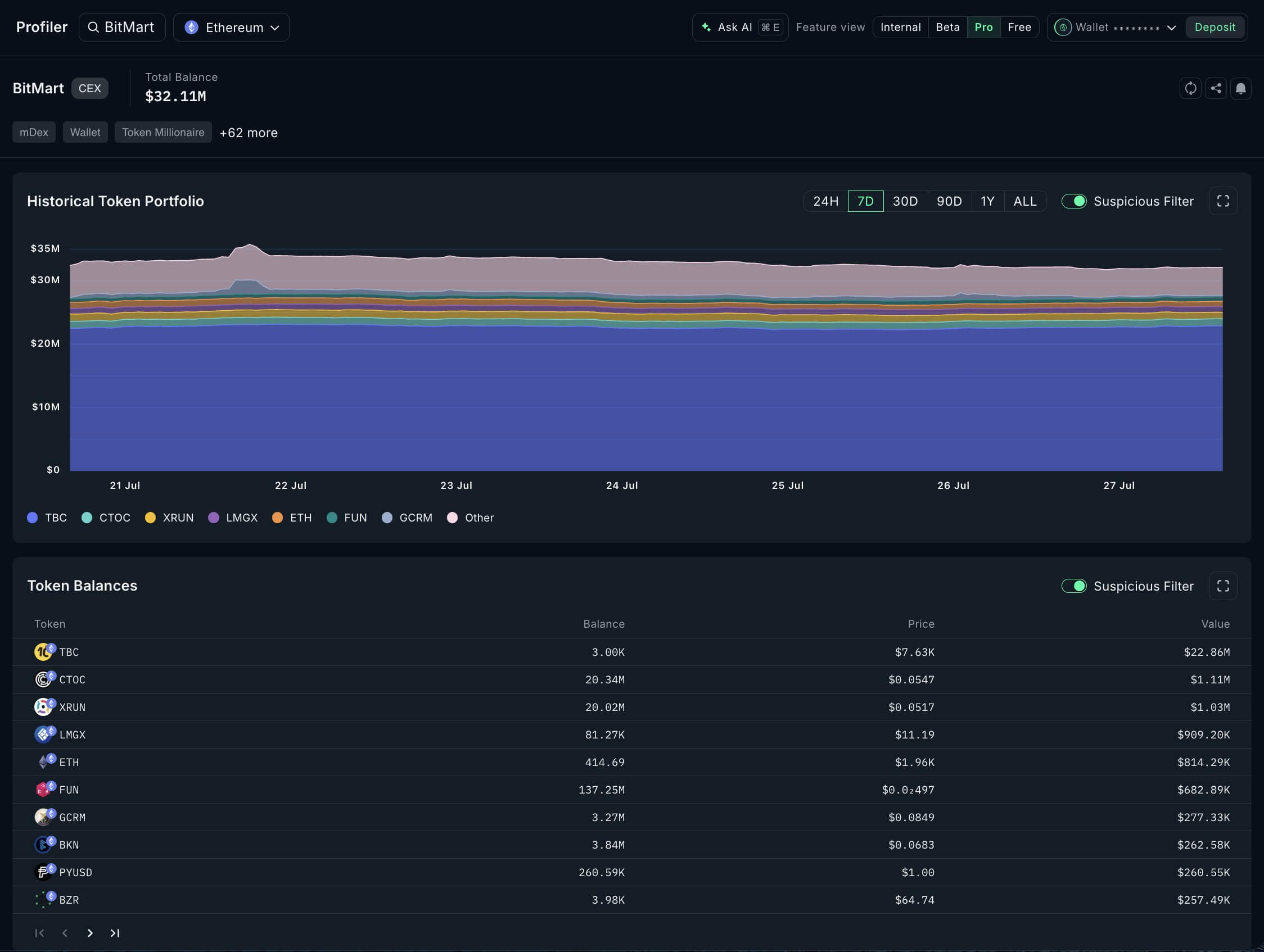
While the transfers do not establish that BitMart lacks sufficient assets to honor customer withdrawals, the shift has drawn attention because BitMart is now urging customers to remove their assets as the exchange winds down.
So far, relatively little appears to be leaving through identified wallets.
Blockchain analysis platform Lookonchain said only 58 wallets withdrew about $805,000 over a 24-hour period following the shutdown announcement. It also reported an eight-hour stretch in which BitMart processed no withdrawals.
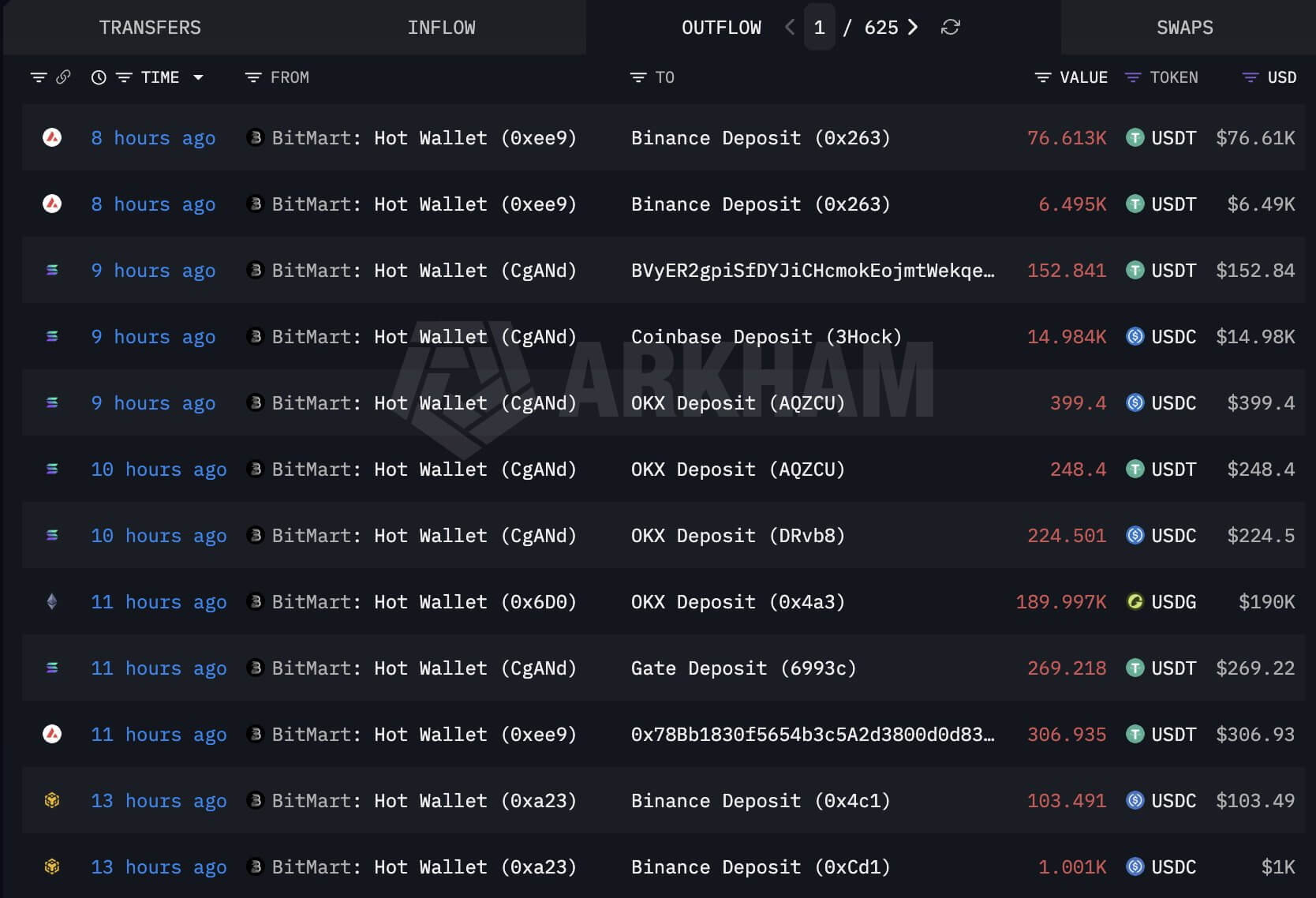
Onchain Lens reported a similar pattern, saying BitMart processed no Bitcoin, stablecoin or altcoin withdrawals above $25,000 over a 24-hour period. It said its tracking showed no large withdrawals from retail users, market makers or listed projects during that window.
The concerns have also moved beyond individual customers as some projects are complaining about their inability to withdraw funds.
Paxi Network called on BitMart to immediately release funds it said belong to its users and market makers, arguing that delays were already causing financial damage.
“These funds do not belong to BitMart,” Paxi said, demanding a clear timeline for the return of outstanding balances.
Paxi did not disclose how much it says remains on the exchange, how many users are affected, or how long the withdrawal requests have been pending. BitMart has not publicly responded to the claims.
These complaints have revived questions BitMart was confronting before the shutdown.
In May, the exchange acknowledged allegations that some users were unable to withdraw funds after account restrictions were imposed.
BitMart said the restrictions primarily involved 239 linked accounts that its risk-control system identified as part of an organized effort to exploit trading subsidies, while legitimate users remained unaffected and operations were running normally.
The exchange also addressed concerns about its reserves at the time, saying it was preparing a proof-of-reserves disclosure and would publish it after addressing security and risk-control considerations.
That earlier dispute gives the latest withdrawal complaints a different context. BitMart was already defending access to customer funds months before deciding to close, while the Nansen data suggests the composition of its tracked wallets was shifting even before users were told to exit.
BitMart to manually review withdrawals
The exchange has not said it faces a liquidity shortage. However, the firm's wind-down procedures offer a possible explanation for the delays users are experiencing.
According to BitMart:
“We strongly recommend that all users complete identity verification and close all trading positions before 01:00 (UTC) on August 26, 2026, and submit withdrawal requests before 05:00 (UTC) on August 26, 2026.”
The firm stated that certain withdrawals may undergo additional reviews covering KYC information, login devices, IP addresses, destination wallets, and blockchain transaction risks.
BitMart said it may also examine customers’ source of funds and trading history, conduct sanctions and Travel Rule checks, and request proof of address, source of funds or ownership of the receiving wallet.
The company warned that high withdrawal volumes, additional documentation, blockchain congestion and compliance reviews could lengthen processing times. It also stressed that submitting a withdrawal request does not mean the assets have been sent to the blockchain.
Such controls are common tools for managing fraud, sanctions exposure and account security. Their use during a shutdown, however, leaves customers dependent on BitMart completing potentially lengthy reviews while the platform is being dismantled.
The exchange has not provided a maximum period for processing an approved withdrawal.
Could BitMart’s withdrawal problems trigger another confidence crisis?
BitMart’s withdrawal troubles are landing at a particularly sensitive moment for centralized exchanges in this bear market, with another long-running venue preparing to disappear days before BitMart announced its own closure.
BitMEX said last week that it will shut its exchange on Sept. 23 following a strategic review, ending more than 11 years of operations. The derivatives venue has said customer assets are safe and urged users to close positions and withdraw funds before the deadline.
While the two closures are unrelated, their proximity is reviving scrutiny of the risks customers take when leaving assets on centralized platforms, particularly as BitMart users report withdrawal problems.
That sensitivity is rooted in 2022, when withdrawal freezes repeatedly became the first visible sign of deeper financial distress.
Celsius suspended withdrawals in June before filing for bankruptcy the following month. Voyager Digital froze customer transactions in July and entered bankruptcy days later. FTX stopped processing withdrawals in November as customers rushed to remove assets ahead of its collapse, while the resulting contagion later engulfed BlockFi and Genesis.
Chicago Federal Reserve researchers estimated that FTX customers withdrew $7.81 billion, equivalent to roughly 37% of customer funds, during the run preceding its bankruptcy. Voyager experienced an even larger proportional run, losing almost 39% of customer funds.
Those failures turned access to withdrawals into a basic test of confidence in centralized exchanges. JPMorgan analysts described the FTX fallout at the time as a broader confidence crisis, while institutional investors became increasingly focused on counterparty exposure and the ability of trading venues to meet customer claims during periods of stress.
The industry responded by embracing proof-of-reserves disclosures intended to show that customer assets remained backed and available. BitMart itself said in May that it was preparing such a disclosure after facing questions about withdrawals and asset transparency.
BitMart has not said it faces a liquidity shortfall, and the available on-chain evidence does not establish one. BitMEX has also not reported comparable withdrawal stress.
But after the failures of 2022, confidence can deteriorate quickly once customers begin questioning whether funds can be retrieved on demand.
BitMart’s ability to process withdrawals smoothly will now shape whether its shutdown remains a contained exchange exit or adds to broader market unease around centralized crypto platforms.
Mentioned in this article




Editorial credits