
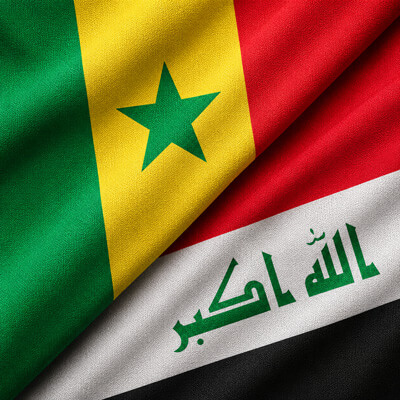
Senegal vs. Iraq
Ended Jun 26, 2026, 19:00 UTC
Market resolution
Polymarket reports Senegal as the winning outcome for the Senegal vs. Iraq prediction market with a final probability of 100%. The market closed on Jun 26, 2026, 19:00 UTC. Final reported trading volume was $5.88M.
Final probabilities, volume, and open interest are sourced from Polymarket and were last synced at Jun 26, 2026 10:52 pm.
Senegal’s Favorite Status Leaves Draw Risk Doing the Work
The price structure leans on a clear hierarchy between the teams, while the draw sits high enough to acknowledge football’s single-game friction. The deeper question is how much of Senegal’s premium rests on durable quality assumptions versus late information still due before kickoff.

The market is assigning Senegal the role of clear favorite, with the draw carrying the main burden of resistance and Iraq priced as a narrow upset path. That structure matters because this is a one-off FIFA World Cup fixture scheduled for June 26, so any perceived gap between the teams has only one match to express itself.
The price is anchored in a hierarchy that still needs match-day proof
Senegal’s 75.5% price implies a strong prior that the match starts from an uneven baseline. Since the supplied context does not include rankings, squads, recent form, or tactical data, the strongest supported reading is inferential: the market is treating Senegal as the side with the broader route to victory. Iraq’s 8.5% price implies a more conditional path, likely requiring a favorable game state, a Senegal error, an early scoring event, or some other match-specific break.
The draw at 16.5% prevents the market from turning Senegal’s advantage into a near-binary call. That matters in football because a favorite can control territory, tempo, or shot volume while the scoreboard stays level. In a three-outcome structure, the draw absorbs many scenarios where Senegal’s perceived superiority shows up without producing separation.
| Outcome | Current price | Market-implied role |
|---|---|---|
| Senegal | 75.5% | Default winner if the perceived team gap translates cleanly |
| Draw | 16.5% | Main protection against low-scoring friction or cautious game states |
| Iraq | 8.5% | Upset path requiring a tighter chain of events |
The draw price is doing more work than Iraq’s win price
The gap between the draw and Iraq prices is the most revealing part of the market. A draw requires Iraq to prevent Senegal from converting superiority into a winning margin; an Iraq win requires prevention plus a decisive scoring edge. That asymmetry explains why the draw sits at roughly twice Iraq’s price even while Senegal dominates the board.
This matters because late information that weakens Senegal’s attacking reliability could flow first into the draw outcome. A hypothetical absence for a key Senegal attacker, a conservative lineup, or match incentives that reward caution would naturally strengthen the case for an even result before creating a full Iraq-win narrative. The market’s shape suggests the draw is the pressure valve for doubts about Senegal’s conversion rate.
Deep liquidity can make consensus look firmer than participation proves
The market lists $1.05 million in liquidity, alongside $49.03K in volume and $30.59K in open interest. That combination matters because visible liquidity can stabilize quoted prices, while the smaller volume and open interest show a more limited amount of completed positioning so far. The price may therefore be anchored by available depth and broad priors, with room for sharper movement if fresh match information arrives.
Because the close date is June 26 at 7:00 PM UTC, late catalysts have a compressed window to affect the three outcomes. A market with large displayed liquidity may absorb routine orders, but official lineup news, disciplinary information, fixture-status updates, or a sudden shift in external football expectations could still force a reassessment of how much of Senegal’s price rests on confirmed match conditions.
Official match information carries more force than broad reputation
The settlement source is FIFA’s World Cup page, which makes official match reporting the relevant anchor for resolution. That matters editorially because broad team reputation can set the opening hierarchy, while FIFA-linked match facts determine the event that settles the market. The closer the market gets to kickoff, the more narrow and concrete the evidence becomes.
Several hypothetical catalysts would matter because they change the assumptions embedded in the current split:
- Official starting lineups that confirm or weaken Senegal’s expected attacking strength.
- Late injury, suspension, or disciplinary news affecting either side.
- Weather, pitch, or venue conditions that could reduce scoring efficiency.
- Pre-match signals that Iraq will prioritize defensive structure and tempo control.
- A material rise in volume that confirms the current hierarchy or redistributes probability toward the draw.
The main counter-signal is a favorite trapped in a narrow game
The central failure mode for Senegal’s price is a match that stays low-event for too long. In that scenario, the favorite still carries the burden of creating separation, while the underdog can gain market relevance through time decay, set pieces, goalkeeper variance, or a single transition chance. The draw price already reflects that possibility, which is why it deserves attention as the primary counterweight.
The strongest counterargument to the Senegal-heavy structure is that a single World Cup match can compress perceived quality gaps into a few decisive moments. If official information before kickoff points to rotation, fitness concerns, or a tactical setup built around containment, the market’s story could shift from Senegal dominance toward game-state management. If the opposite occurs, with confirmed strength and no disruptive signals, the existing hierarchy has a clearer route to survive into settlement.
Sources
Market details
- Resolution criteria
- This event is for the upcoming FIFA World Cup game, scheduled for Friday, June 26, 2026 between Senegal and Iraq.
- Platform
-


- Category
- Sports › World Cup
- Close date
- June 26, 2026, 7:00 PM UTC
- Settlement source
- fifa.com
- Market rules summary
- Multi-outcome Polymarket event. Each listed option is represented by its Yes price on the underlying market. View full rules
Frequently asked questions
What was the final result of the Senegal vs. Iraq prediction market?
Polymarket reports Senegal as the winning outcome for the Senegal vs. Iraq prediction market with a final probability of 100%. The final market snapshot includes $5.88M volume and $2.56M open interest. CryptoSlate last synced the final market data at Jun 26, 2026, 21:52 UTC.
How does the Senegal vs. Iraq prediction market resolve?
This event is for the upcoming FIFA World Cup game, scheduled for Friday, June 26, 2026 between Senegal and Iraq. Multi-outcome Polymarket event. Each listed option is represented by its Yes price on the underlying market. The settlement source listed for this market is fifa.com.
Related World Cup markets
 Spain vs. Argentina
 France vs. England
 England vs. Argentina