Plague declared public health emergency date?
Current Odds
Odds Summary
December 31 leads at 2% reported probability on Polymarket.
Polymarket · Last synced
Market Analysis
Plague emergency odds hinge on WHO escalation, despite endemic cases
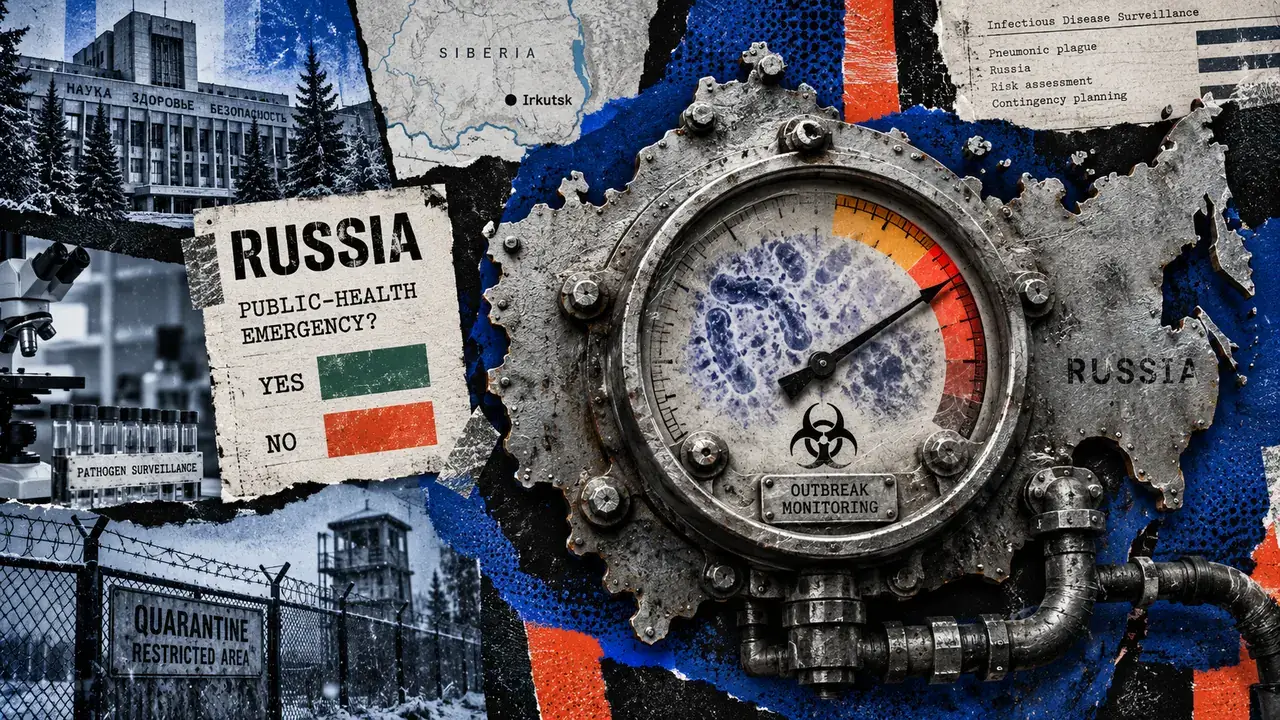
WHO’s emergency process has no active plague committee, while reported cases remain concentrated in two countries. The decisive question is whether a new outbreak creates enough international concern to move beyond routine reporting, with pneumonic transmission providing the clearest potential trigger.

The plague market’s low probabilities imply that an outbreak would need to change WHO’s assessment of international risk before either deadline. Plague already circulates in several countries, but WHO lists no active plague emergency committee. The hierarchy between November 30 and December 31 therefore fits a waiting-for-escalation thesis: the additional month allows more time for a qualifying outbreak and an official response.
WHO declaration rules set a higher threshold than plague detection
The resolution criteria require an official WHO declaration of a Public Health Emergency of International Concern covering plague, Yersinia pestis, pneumonic plague, or any plague outbreak. A confirmed case, national emergency declaration, or WHO outbreak notice would leave that condition unmet. This distinction explains why evidence of a dangerous disease can coexist with a low declaration probability.
WHO’s reporting framework already anticipates plague events. Its Weekly Epidemiological Record says pneumonic plague must always be considered under the International Health Regulations’ Annex 2 decision instrument. That creates a route for assessment and reporting, but reporting does not guarantee a PHEIC. The market-implied assumption is that most reports will remain within established outbreak-response channels.
The market URL refers to Russia, yet the supplied resolution criteria impose no geographic restriction. An eligible WHO declaration covering an outbreak elsewhere could satisfy the rule. Analysis centered exclusively on a hypothetical Russian outbreak would consequently miss evidence from the countries carrying most reported cases.
Plague cases in Madagascar and Congo shape the baseline
WHO’s review of 2019–2025 reports records confirmed human plague cases in six countries across two WHO regions. The Democratic Republic of the Congo and Madagascar accounted for 97.7% of those confirmed cases. WHO’s plague fact sheet also identifies those countries as the locations reporting most human cases during that period.
That concentration supports a narrower explanation for the low odds: recurring plague activity has largely remained geographically concentrated. It does not establish that future outbreaks will stay contained. The inference behind the current price is that another outbreak in a familiar endemic setting is less likely to prompt an international emergency declaration unless its transmission pattern, scale, or reach changes materially.
A hypothetical outbreak spreading from an endemic focus into a densely populated setting, or producing linked cases across borders, would weaken that inference. Conversely, reports showing cases confined to established local foci would support continuity with the historical pattern. Geography matters because it helps distinguish recurrence from an event with wider consequences.
Pneumonic plague supplies the strongest escalation scenario
WHO says pneumonic plague can spread through respiratory particles, can be especially contagious, and can progress rapidly. Its fact sheet describes untreated pneumonic and septicaemic plague as invariably fatal. Those characteristics give a confirmed pneumonic cluster more relevance to the declaration question than an undifferentiated report of “plague.”
The causal link would run through evidence of transmission. A hypothetical cluster with documented person-to-person spread, expanding exposure networks, or linked infections in another country would strengthen the case for international assessment. A report identifying isolated cases without evidence of continued transmission would provide less support for that scenario.
The strongest counterargument to the low probabilities is that historical concentration offers limited protection against a new respiratory-transmission event. Because pneumonic plague can progress quickly, an outbreak could compress the time available for assessment. The supplied evidence establishes that possibility; it does not establish that such a cluster currently exists.
No active plague committee leaves an institutional gap
WHO’s current emergency-committee roster includes poliovirus and Ebola Bundibugyo virus disease, but no plague committee. That absence supports the view that the market lacks an ongoing plague-specific emergency process to anchor an imminent declaration. It cannot establish the absence of outbreaks or prevent WHO from beginning a fresh assessment.
A WHO announcement convening a plague emergency committee would therefore be a concrete catalyst, connecting disease reports to the institution named in the resolution rule. Committee conclusions supporting continued monitoring without a declaration would weaken the near-term escalation thesis, even if the underlying outbreak remained medically serious.
November and December deadlines depend on the same trigger
December 31’s 9% probability exceeds November 30’s 4.2%, consistent with extra time for the same declaration pathway. Both fell over the supplied 24-hour period, but $8.85K in volume and $5.24K in liquidity cannot establish why. No linked announcement supports attributing those moves to improved disease conditions. The next decisive evidence would be a documented transmission change or a formal WHO plague assessment before the relevant deadline.
Sources
What Could Move the Odds?
Market-Implied Thesis
The 1.5% November and 2% December pricing implies WHO is unlikely to declare a plague-related PHEIC before year-end.
The small increase between cutoffs suggests the market sees limited incremental declaration risk through December, rather than a rapidly developing international emergency.
What Could Reprice It
A WHO International Health Regulations Emergency Committee process on plague would be the clearest repricing catalyst before resolution.
WHO says an Emergency Committee advises the Director-General on whether an event constitutes a PHEIC; a meeting, recommendation, or decision would directly address settlement.
Where the Market May Be Weak
The signal rests on a relatively limited pool of committed capital, which may not fully absorb or anticipate fast-moving outbreak information.
The market’s listed liquidity and open interest are modest for a low-probability global-health event, while its multi-timeframe structure can split attention across related cutoffs.
Counter-Signal
A pneumonic-plague cluster could overturn the benign baseline because WHO says this form spreads person-to-person and can cause severe epidemics.
WHO describes plague as endemic and concentrated in a few countries, but also notes annual outbreaks vary and cases may occur where reporting is absent.
Market Details
- Resolution criteria
- This market will resolve to "Yes" if the World Health Organization officially declares a Public Health Emergency of International Concern covering plague, Yersinia pestis, pneumonic plague, or any plague outbreak between market creation and the specified date, 11:59 PM ET. Otherwise, this market will resolve to "No".
- Platform
-


- Category
- Climate & Science › Nature
- Scheduled deadline
- January 1, 2027, 4:59 AM UTC
- Market rules summary
- Multi-timeframe Polymarket event. Each listed timeframe is represented by its Yes price on the underlying binary market. View full rules
Frequently Asked Questions
What are the current Plague declared public health emergency date odds?
Polymarket reports Plague declared public health emergency date odds with December 31 at 2% and November 30 at 1.5%. These probabilities are market-implied and can change as liquidity and trading activity update. The latest market snapshot includes $21.74K volume, $11.81K liquidity, and $8.93K open interest. CryptoSlate last synced this market data at Oct 27, 2026, 04:02 UTC.
What could move the Plague declared public health emergency date prediction market odds?
The 1.5% November and 2% December pricing implies WHO is unlikely to declare a plague-related PHEIC before year-end. The small increase between cutoffs suggests the market sees limited incremental declaration risk through December, rather than a rapidly developing international emergency. Catalysts to watch include WHO PHEIC declaration process, IHR committee advice or Director-General decision, and New outbreak reporting.
How does the Plague declared public health emergency date prediction market resolve?
This market will resolve to "Yes" if the World Health Organization officially declares a Public Health Emergency of International Concern covering plague, Yersinia pestis, pneumonic plague, or any plague outbreak between market creation and the specified date, 11:59 PM ET. Otherwise, this market will resolve to "No". Multi-timeframe Polymarket event. Each listed timeframe is represented by its Yes price on the underlying binary market.