

RBA interest rate decision: November 2026
Current Odds
Odds Summary
No change leads at 81.5% reported probability on Polymarket.
Polymarket · Last synced
Market Analysis
RBA November 2026 decision pits September tightening against rising unemployment
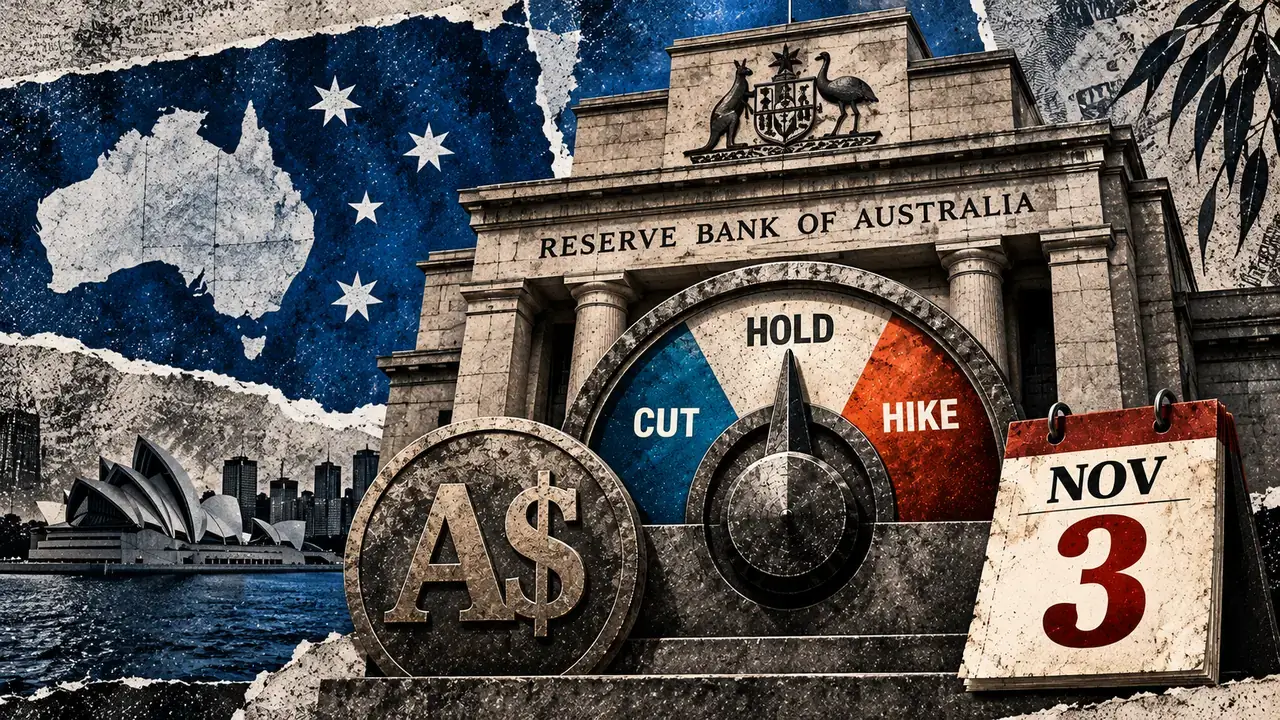
September’s rate increase creates a high hurdle for a November reversal, while rising unemployment gives the RBA a reason to pause. The decisive question is whether late-October inflation data justify another increase before the effects of the previous move become clearer.

The RBA’s November decision turns on whether September’s rate increase needs reinforcement or time to work. Above-target inflation supports continued restraint, while rising unemployment makes another increase harder to justify without fresh evidence. That tension supports a hold-versus-hike interpretation, with a cut requiring a sharper change in the evidence. This is a policy inference: the supplied market record contains no outcome prices, so it cannot establish an observed probability ranking.
September’s RBA rate increase raises the hurdle for a reversal
According to the supplied September meeting record, the RBA raised its cash rate target by 25 basis points to 4.60% on September 29 and said inflation remained too high. That decision supplies the strongest evidence about the board’s recent assessment: it judged the inflation problem serious enough to tighten policy despite the economic costs of higher rates.
The causal implication runs in two directions. Continued inflation pressure could justify another increase. Equally, September’s tightening gives the board grounds to leave rates unchanged while assessing its effects. A November hold would therefore be compatible with continuing concern about inflation. Interpreting a pause as the beginning of an easing cycle would require additional evidence that the board’s inflation assessment had changed.
August inflation keeps another November hike plausible
The ABS reported annual headline inflation of 4.0% in August and trimmed mean inflation of 3.6%. The supplied research identifies inflation as above the RBA’s target band. Both measures give the board a reason to maintain restrictive policy; the trimmed mean reading also weakens an explanation that relies entirely on unusually large price movements.
The hidden assumption behind a further-hike scenario is persistence. An elevated annual reading establishes the level of inflation, but does not by itself establish that inflation is accelerating. A November increase becomes easier to explain if the next release shows renewed pressure. A clearer easing trend would instead support allowing September’s increase more time to affect activity and prices.
A competing explanation is that September’s move already addressed the inflation risk sufficiently. The available record cannot settle that question because it supplies neither the board’s detailed forecast path nor evidence about the subsequent effects of the increase. Any claim that another hike is necessary would go beyond these facts.
Rising unemployment strengthens the case for an RBA pause
The August labour release put unemployment at 4.6%, an increase from the previous month. That creates a counter-signal to the inflation evidence. If weaker labour demand continues, another rate increase could add pressure to an economy already cooling, giving the board a reason to wait for clearer evidence of inflation persistence.
The pause thesis assumes the unemployment increase reflects sustained loosening. One release cannot establish that trend. A hypothetical September report showing another rise in unemployment alongside weaker employment would strengthen it. A reversal in unemployment or firmer employment would weaken the argument that labour conditions are deteriorating enough to constrain further tightening.
A cut requires a more demanding explanation. The board had just raised rates because inflation remained too high. Labour weakness alone may support holding; a reversal would become more coherent if it coincided with convincing inflation relief or a materially worse economic outlook.
October data can change the November policy balance
The ABS schedules the September labour report for October 15 and September CPI for October 28 at 11:30 am AEDT. Their sequence matters: inflation arrives after the labour update and only days before the board meets.
Conditional scenarios give those releases meaning. Cooling employment and easing inflation would strengthen the pause case. Firmer employment and renewed inflation pressure would support another increase. Weak labour data paired with persistent inflation would leave the board facing the sharpest trade-off, limiting how much either release alone could explain.
November 3 forecasts will test the meaning of a hold
The RBA calendar sets the meeting for November 2–3, with the decision at 2:30 pm on November 3 and the quarterly Statement on Monetary Policy released alongside it. Those forecasts can distinguish a pause to assess September’s tightening from a broader reassessment of the inflation outlook. Before that decision, the October 28 CPI release will test whether rising unemployment gives the board sufficient reason to wait.
Sources
Market Details
- Resolution criteria
- This market will resolve according to the change in basis points in the cash rate target resulting from the November 2026 meeting of the Reserve Bank of Australia (RBA) Monetary Policy Board, relative to the level it was prior to this meeting.
- Platform
-


- Category
- Economy › Economic Policy
- Scheduled deadline
- November 4, 2026, 4:59 AM UTC
- Settlement source
- rba.gov.au
- Market rules summary
- Multi-outcome Polymarket event. Each listed option is represented by its Yes price on the underlying market. View full rules
Frequently Asked Questions
What are the current RBA interest rate decision: November 2026 odds?
Polymarket reports RBA interest rate decision: November 2026 odds with No change at 81.5%, 25 bps increase at 18.3%, 25 bps decrease at 0.3%, and 50+ bps increase at 0.3%. These probabilities are market-implied and can change as liquidity and trading activity update. The latest market snapshot includes $114.05K volume, $31.12K liquidity, and $21.85K open interest. CryptoSlate last synced this market data at Oct 14, 2026, 04:32 UTC.
How does the RBA interest rate decision: November 2026 prediction market resolve?
This market will resolve according to the change in basis points in the cash rate target resulting from the November 2026 meeting of the Reserve Bank of Australia (RBA) Monetary Policy Board, relative to the level it was prior to this meeting. Multi-outcome Polymarket event. Each listed option is represented by its Yes price on the underlying market. The settlement source listed for this market is Rba.
Related Economic Policy Markets
 Bank of England interest rate decision: November 2026
  Bank of Japan interest rate decision: October 2026
  Bank of Canada interest rate decision: October 2026