
Overview
Introduction
Prediction market insider trading is not a single legal category. An informational edge is not automatically prohibited merely because other traders lack it. Risk rises when information was obtained through deception or used in breach of a pre-existing duty. A prohibited tip can extend that concern to its recipient. Separate rules can apply when a trader can influence the outcome, makes false statements, or manipulates the market.
No universal test can decide whether a particular trade is lawful. The result changes with the instrument, jurisdiction, source of information, applicable duty, conduct and exact platform rule. The discussion below focuses on the U.S. framework and current official record. It does not provide legal advice.
Key takeaways
- What it is. Prediction-market insider trading can involve information acquired through fraud, used in breach of a duty, passed through a prohibited tip, or restricted by a venue rule.
- Why it matters. The analysis can turn on who controlled the information, how it was obtained, what the recipient knew, and whether the trader could affect the outcome.
- Main risk or limitation. Platform access or registration does not establish that information was lawfully acquired or that a contemplated use or trade is permitted.
Is Insider Trading Illegal in Prediction Markets?
It can be, but the label alone does not answer the question. Rule 180.1 prohibits intentional or reckless fraud, deception and manipulation in connection with covered commodity interests. It applies only when the conduct connects to a covered instrument: a swap, a commodity sale in interstate commerce or a futures contract the rule covers. Those instruments sit inside the CFTC commodity-market remit. The CFTC said in its 2011 adopting release that the rule does not create a general parity-of-information requirement. Silence is not automatically deceptive when no pre-existing duty requires disclosure.
The same release says trading on material nonpublic information may violate Rule 180.1 when it breaches a duty established by law, rule, agreement, understanding or another source. Information acquired through fraud or deception can also support liability.
A designated contract market (DCM) or platform can impose contractual restrictions broader than the federal rule requires. Instrument classification, location, eligibility and access belong to a separate check of US prediction-market legality .
Information Advantage Is Not One Legal Category
Questions about prediction market insider trading often collapse different information sources into one bucket. A private model built from public data is not the same as a confidential result taken from an employer. A lawful observation is not the same as a stolen document. The Rule 180.1 adopting release leaves room for lawfully obtained informational advantages, but that is not a blanket safe harbor.
The analysis separates the information source from the trader's duty, control, conduct and venue rules. In academic usage, informed trading describes activity in a prediction market based on superior analysis or information, but that label does not decide whether the information was lawfully obtained or used.
| Information category | Typical source | Main question | Also verify |
|---|---|---|---|
| Public research | Public filings, weather data or disclosed polling | Were the inputs public and obtained without deception or unauthorized access? | Data rights, platform rules and conduct |
| Lawfully obtained private research | A privately commissioned model or poll | Was it owned and used without violating a duty? | Contracts, confidentiality and venue restrictions |
| Duty-breached information | Employment, NDA, agency or entrusted relationship | Did use or tipping breach a pre-existing duty? | Knowledge, intent and instrument connection |
| Fraudulently acquired information | Theft, impersonation, deception or unauthorized access | Was the information obtained through wrongful conduct? | Other civil, criminal and platform rules |
Materiality, nonpublic status and a duty's scope are fact-specific. Employment policies, confidentiality agreements, professional standards and government rules can matter independently of federal commodity law.
When Nonpublic Information Becomes Misappropriation
Misappropriation analysis begins with the information's source, not with whether a trade won. It assesses whether the information was material and nonpublic, whether the trader owed a pre-existing duty to its source, and whether the trade or tip breached that duty. The relevant mental state and necessary instrument connection under the Commodity Exchange Act also matter.
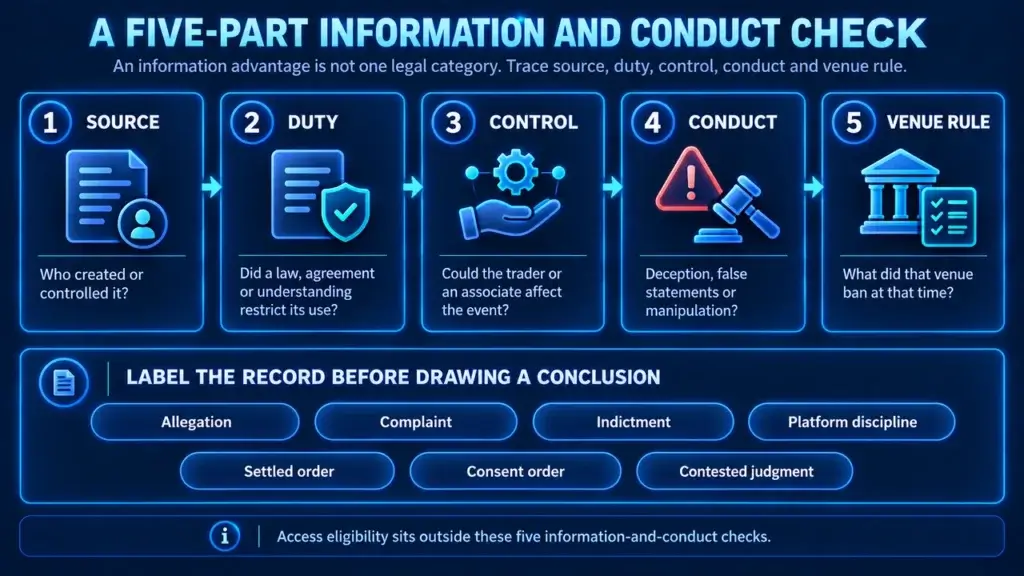
The five checks stay separate. Source asks who created or controlled the information and how it was obtained. Duty asks whether a law, agreement or understanding restricted its use. Control asks whether the trader or an associate could affect the event. Conduct asks about deception, false statements or manipulation. Venue rule asks what the trading venue prohibited under the rulebook version in force at the time of the trade. Access eligibility sits outside these five information-and-conduct checks.
The director of the CFTC Division of Enforcement described the division's formulation in a March 31, 2026 speech. The speech discussed possession of material nonpublic information (MNPI), a breach of a duty of trust and confidence to the source, scienter (the required state of mind, such as intent or recklessness), and the necessary instrument connection. That is an Enforcement Division position, not a contested court judgment resolving the 2026 cases about event contracts, the CFTC's term for contracts that pay on the outcomes of specified events.
Nonpublic government information has additional statutory rules. CEA section 4c(a)(3) and (4) addresses specified federal personnel who use positional nonpublic information for personal gain in covered trading or intentionally disclose it to assist another's covered trade. The text also reaches knowing use by a recipient and wrongful acquisition of specified government information. The provision does not reach every government employee, fact or product. Its defined actors and instrument connection limit its scope.
Classification can affect the instrument connection. Background on how futures contracts work covers one of the instrument types the rule reaches.
Lawful Research, Stolen Information and Tips Compared
Each scenario below identifies facts that require verification. None supplies a conclusion about a particular trade. The table covers source, duty, control and venue rule. It leaves out the conduct check, which turns on the trader's own actions rather than on the information or the event. A source that appears harmless can still involve a contract, duty or platform restriction, while a tip adds questions about the source's duty and what the recipient knew.
| Scenario | Information source | Possible duty | Outcome control | Separate venue rule | Stop and verify |
|---|---|---|---|---|---|
| Public-data model | Public records analyzed privately | Usually no source duty, subject to facts | Usually none | Research and data rules | Inputs, licenses and market terms |
| Commissioned private poll | Contract-owned research | Polling or client agreement | Usually none | Nonpublic-information policy | Ownership and permitted use |
| Employer result | Confidential work data | Employment, NDA or policy | May exist | Venue insider rules, plus source-agency rules if the employer publishes settlement data | Duty, authorization and compliance review |
| Tip from a friend | Information passed by another person | The source may owe a duty | Depends on the event | A venue rule for tip recipients may reach beyond the federal duty test | Source, duty and recipient knowledge |
| Stolen document | Theft or deceptive access | Wrongful acquisition plus possible duty | Depends on the event | Fraud and integrity rules | Do not trade pending qualified review |
| Event participant | Personal plans or operational control | Contractual or professional obligations may apply | Direct or indirect influence | Participant restrictions | Influence, disclosure and exact rule |
The misappropriation theory described above does not by itself determine how an event contract is treated. Classification of the instrument, the authority that applies to it and the venue's own rule text still control.
Trading When You Can Influence the Outcome
A trader may possess little secret information and still be able to change the event. A candidate can change the outcome of their own race, and with it any market resolving on that race, by withdrawing, conceding or timing an announcement. An employee of the body that publishes settlement data can affect the timing or content of a release. Settlement can also turn on the performance, call or words of an event participant, official or speaker.
In a February 25, 2026 advisory, the CFTC Division of Enforcement said one candidate's trading on their own candidacy potentially violated Rule 180.1 through a manipulative scheme or through a pattern of conduct that operated as a fraud. The advisory states that Kalshi, not the CFTC, imposed the penalty and five-year suspension. The advisory was not a CFTC order adjudicating the trader's liability.
Manipulation and False Statements Are Separate Risks
Information misuse focuses on acquisition, duty and use. Manipulation focuses on conduct intended to distort a price, event, data source or settlement process. False or misleading public statements can create a different theory from trading on confidential information.
| Risk category | What it concerns | Examples at category level |
|---|---|---|
| Information misuse | Source, duty, knowledge and use | Misappropriation or a prohibited tip |
| Outcome or settlement influence | Control over the event or source data | Interference with an event, announcement or resolution input |
| Deceptive market conduct | Orders, trades or statements that mislead | False statements, wash trading between accounts under common control, fictitious trades or spoofing |
An order-book bid or ask the trader does not intend to have executed can misrepresent price interest or depth, a practice known as spoofing. A failed or unprofitable attempt may still violate applicable rules. Tactics for moving a market or concealing conduct are outside scope.
What DCM and Platform Rules Add
Commodity Exchange Act section 5(d), codified at 7 U.S.C. § 7(d) requires a DCM to comply with the statutory core principles. Core Principle 4 requires the capacity and responsibility to prevent manipulation, price distortion and settlement disruption. Core Principle 12 requires rules that protect markets and participants from abusive practices and promote fair and equitable trading. CFTC Staff Letter 26-08 recommends surveillance and contract-design practices for event contracts, but the letter expressly reflects nonbinding Division of Market Oversight staff views. It does not create or amend a rule.
The current Kalshi rulebook v1.29, dated August 17 and checked September 1, 2026, includes Rule 5.17(y) restrictions involving MNPI and source-agency personnel, meaning people working for the body that publishes settlement data. Rule 5.17(z) restricts people with direct or indirect influence over an outcome. Those provisions are venue-specific, so the Kalshi entity and rule context must be matched to the version applying at the relevant time.
Polymarket International's integrity policy, checked September 1, 2026, prohibits trading on duty-breached confidential information, tipping that information, trading in markets whose outcome one influences, and manipulative conduct. The separate Polymarket US policy, checked the same day, contains comparable information-source and outcome-influence restrictions and points users to its own rulebook. These are entity-scoped platform rules. They are not universal law, and comparable wording does not make the entities or regulatory regimes interchangeable.
Operator descriptions of screening, surveillance or enforcement effectiveness remain operator claims unless independently verified. Venue discipline can establish a rule violation under that venue's process without becoming a CFTC adjudication or court judgment.
Why Offshore and Onchain Markets Are Not a Safe Harbor
Execution architecture does not decide lawfulness. The relevant legal entity appears in the operator's current terms, such as Polymarket's terms of service. A user's location, product classification, information source, duty and conduct remain separate questions even when trades settle onchain.
Foreign incorporation does not erase a trader's own duties or change how the information was acquired and used.
Public transaction history can support monitoring, but it does not by itself establish who controls an address, reveal an offchain agreement or prove intent. Smart contracts execute programmed rules, while blockchain oracles supply outcomes to the settlement process. Neither technical function creates a legal exemption.
A guide to decentralized prediction markets maps the wallet, interface, collateral, contract and resolution layers. None of those layers, alone, determines whether information was misappropriated or an outcome was manipulated.
What the 2026 Cases Establish — and What They Do Not
The official record checked September 1, 2026 includes platform discipline, unresolved complaints, an indictment, settled CFTC orders, and a consent order outside the event-contract context. Those statuses are not interchangeable.
| Matter | Official record | Status checked | Information or conduct type | What is established | What is not established |
|---|---|---|---|---|---|
| Kalshi candidate | Division of Enforcement advisory | Platform discipline public Feb. 25, with the official record rechecked Sept. 1, 2026 | Self-influenced outcome | The advisory states that Kalshi imposed a penalty and five-year suspension. The CFTC Division of Enforcement said the conduct potentially violated Rule 180.1. | No CFTC merits order or court judgment against the trader |
| Kalshi YouTube editor | Kalshi disciplinary notice | Platform discipline effective Feb. 25, with the official record rechecked Sept. 1, 2026 | Employment information | Kalshi found Rule 5.17(y) and cooperation violations and imposed exchange sanctions | Not a CFTC adjudication or judicial holding |
| Gannon Ken Van Dyke | CFTC complaint release and DOJ indictment release | Complaint and indictment filed Apr. 23. Official agency pages checked Sept. 1, 2026 identify no merits disposition | Government information and alleged misappropriation | The agencies filed civil allegations and a criminal indictment | No CFTC merits order or criminal conviction |
| Michele Spagnuolo | CFTC complaint and DOJ complaint release | Civil and criminal complaints filed May 27. Official agency pages checked Sept. 1, 2026 identify no disposition | Employer data and alleged misappropriation | The complaints allege use of confidential Google data | No CFTC merits order or criminal conviction |
| George Santos | CFTC settled order release | Settled administrative order July 31, checked Sept. 1, 2026 | Self-influenced outcome and misleading statements | The CFTC filed and settled charges. The order finds the specified trading and statements, orders disgorgement and a civil penalty, and imposes a three-year trading ban | Not a contested court precedent or a pure MNPI case |
| Gabriel Perez | CFTC settled order release | Settled administrative order Aug. 28, checked Sept. 1, 2026 | Government employment and unreleased speech information | The CFTC filed and settled charges. The order finds a duty breach and imposes sanctions | Not a contested judicial holding defining every element |
| Matthew Clark | Court-entered consent order | Consent order entered Jan. 29 and checked Sept. 1, 2026 | Commodity misappropriation background | The consent order addresses confidential natural-gas order information under Rule 180.1 | Not a prediction-market case or trial on the merits |
The Van Dyke indictment and Spagnuolo criminal complaint state allegations. Both defendants are presumed innocent unless and until proven guilty. A complaint is not a finding, an indictment is not a conviction and a settlement is not a contested precedent.
Checks to Make Before You Trade
These checks identify reasons to stop and obtain current compliance or legal review.
- Identify the exact venue, legal entity, product and current rulebook.
- Check whether the information is public. If not, identify who created or owns it and how it was obtained.
- Look for an NDA, employment policy, confidentiality agreement, professional rule, government obligation or other duty.
- If a tip is involved, determine what duty the source may owe and what the recipient knew or had reason to know.
- Ask whether the trader or an associate can affect the event, wording, timing, source data, resolution or settlement.
- Stop if the contemplated conduct includes a false statement, deceptive order, coordinated distortion or interference with the event.
- Verify the instrument's classification and the authority that applies. Do not infer either from a brand or payout format.
- Preserve the applicable market terms, rulebook version and relevant records. Do not delete, alter or conceal information.
- Ask the relevant employer, compliance function, venue or qualified lawyer when a source, duty or rule is uncertain.
The checklist cannot determine legality or replace legal and compliance advice based on the specific facts.
How to Report Suspected Misconduct
Use the relevant venue's current integrity or complaint channel when appropriate. The CFTC also maintains a customer complaint form and a separate Whistleblower Office. Those resources have different purposes and eligibility rules.
A general explainer cannot tell someone whether to accuse a named person, waive rights, contact law enforcement or take action in a particular matter. Review the official instructions and seek qualified advice where needed.
Compare Prediction-Market Platforms
A comparison of prediction market platforms should distinguish the legal entity, access conditions, current rulebook and complaint channel before relying on a familiar product name.
Use the Polymarket entity risk review to check the operator and rulebook governing an account. No comparison can name a universally compliant or “safest” venue for every user and trade.
Frequently Asked Questions
Is all nonpublic information illegal to trade on?
No universal rule makes every nonpublic fact illegal to use. Lawfully obtained private research differs from information stolen, acquired through deception or used in breach of a pre-existing duty. Government-information provisions, employment terms, professional obligations, instrument classification and a platform’s rules can add restrictions.
Can a candidate trade on their own election?
That trade raises outcome-influence, disclosure, manipulation and platform-rule questions. Kalshi Rule 5.17(z) reaches people with direct or indirect influence over an outcome regardless of whether the federal duty test applies. That venue-specific restriction does not determine a candidate’s or contract’s status under other rules or laws.
Can an employee trade a market about their company?
The answer can turn on the information used, its source, an employment or confidentiality duty, the product and the venue rule. Public research is different from confidential company data. The pending 2026 Spagnuolo complaint alleges use of confidential employer data. A complaint may resolve without any finding of liability, and its allegations are not findings. Employer compliance and qualified legal review may be necessary.
Can you insider trade on Polymarket?
“Polymarket” can refer to separate U.S. and international services, each with its own integrity policy. Both policies restrict trading on duty-breached confidential information and trading in markets whose outcome one influences. The international policy also names tipping and manipulative conduct. The U.S. policy points users to its own rulebook. The precise entity, terms, location, instrument and applicable law still matter.
Can prediction markets be manipulated?
Yes, like other markets they can face false statements, deceptive orders, wash trades, outcome influence and settlement interference. Whether particular conduct violates Rule 180.1, another law or a venue rule depends on the elements and evidence. DCM surveillance duties and platform controls can reduce risk, but cannot guarantee prevention or recovery.
Does onchain transparency prevent insider trading?
No. A public ledger can expose transactions and addresses, which may support monitoring. A ledger entry shows an address and an amount, not the person behind the address, an offchain agreement or the trader’s intent. Jurisdiction, product classification and applicable venue rules still depend on facts outside the chain.