

Overview
Introduction
A decentralized prediction market is an event-contract system that uses blockchain infrastructure for some combination of custody, trading, resolution as well as settlement. A participant connects a wallet, supplies collateral plus buys an outcome token or contract. Smart contracts record positions and distribute value after the market resolves.
Decentralized does not mean that every layer is trustless or permissionless. A front end can restrict access. A stablecoin issuer controls collateral policy. An oracle proposes the result, governance can hear disputes and administrators may retain upgrade powers. The useful question is which layer is decentralized, who can change it as well as what happens when that dependency fails.
Key takeaways
- What it is. A decentralized prediction market represents event positions and settlement through smart contracts and crypto infrastructure.
- Why it matters. Onchain positions can support transparent balances, programmable settlement and cross-platform integrations.
- Main risk or limitation. Oracles, collateral, front ends, governance, contracts, networks and liquidity create distinct dependencies and failure modes.
How the Onchain Stack Works
The label describes an architecture instead of one product design.
| Layer | Function | Main dependency |
|---|---|---|
| Wallet | Signs orders and transactions | Key security and wallet software |
| Collateral | Funds positions and settlement | Token value, issuer, bridge and redemption |
| Market contract | Defines outcome tokens and payout | Code, permissions and upgrade controls |
| Trading engine | Matches orders or updates pool prices | Relayer, sequencer, market maker or AMM formula |
| Oracle | Proposes the real-world outcome | Data source, proposer incentives and timing |
| Dispute system | Challenges an incorrect proposal | Bond size, voters, governance and appeal path |
| Front end and off-ramp | Provides discovery and cash access | Domain, hosting, compliance, banking and exchange access |
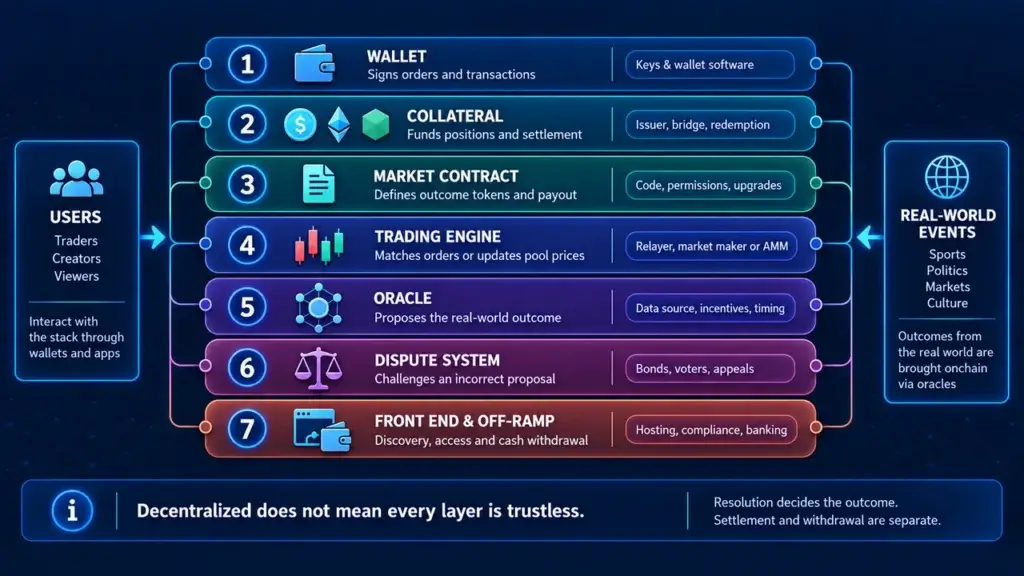
A chain may preserve the final position while an offchain order relay manages quotes. A market can settle through contracts but depend on a centralized interface for discovery. The shared event-contract lifecycle covers the steps also used by centralized products.
CryptoSlate's crypto-native prediction platforms keep provider discovery separate. Polymarket's current implementation describes one product, not a universal model for decentralization.
Wallets, Collateral and Outcome Tokens
A self-custody wallet manages the keys a user employs to sign trades and token-approval transactions. It reduces dependence on a platform login, but key loss, malicious approvals, phishing plus compromised software become the user's direct risk.
Collateral supplies the winning outcome value through the selected digital asset. A market can use a stablecoin, native token, bridged asset or platform-specific balance. Before treating a one-dollar payout as one dollar of cash, check the collateral's redemption path and network. Depegging, issuer action, bridge failure and withdrawal costs can change its practical value.
Many binary systems create a complete set, one Yes token and one No token, for each unit of collateral. After resolution, the winning token redeems for that unit and the losing token has no redemption value. Before resolution, the contract may allow a complete Yes and No set to merge back into collateral.
Token visibility onchain does not prove that the market question is sound. The rule must still identify outcomes, cutoff, source as well as edge cases.
Order Books and Automated Market Makers
Markets may price and match trades with an order book, an automated market maker or a combination of the two.
An order book matches compatible bids and offers under the platform's stated priority rules, often using price and time priority. Orders may be signed offchain and settled onchain to reduce transaction costs. That design depends on an offchain service to relay signed orders. The settlement contract checks each order's signature and terms before allowing a fill.
An automated market maker quotes from a formula and pool. Trades move the reserve balance and price. Larger trades create more price impact when the pool is small. The formula-based pool mechanics explain the general system.
Calling this hybrid execution path wholly onchain hides a material dependency.
The cost test includes spread, price impact, trading fee, gas, bridge cost, token conversion plus withdrawal. Turn quotes into probabilities from executable prices instead of a decorative display.
Oracles, Resolution and Disputes
Smart contracts cannot observe most real-world events directly. An oracle process supplies the outcome.
A clear market states:
- The exact question and eligible outcomes.
- The primary resolution source.
- The resolution method and earliest time an outcome can become final.
- Any proposer bond and challenge period, if the design uses them.
- Who can dispute or appeal and at what cost, if applicable.
- Any escalation or voting process, if applicable.
- Treatment of ties, cancellation, missing data and delayed events.
- The final resolution authority and the contract that executes settlement.
Consider a market asking whether an asset closes above a threshold at a named time. After the cutoff, a proposer submits Yes and posts a bond. If no one challenges during the dispute window, the answer becomes final and settlement opens. A challenger can force another adjudication step. The final system can reward the correct party and penalize a false proposal.
Economic incentives reduce casual false reports, but they do not eliminate ambiguous wording or coordinated governance. A bond that is large for an ordinary user may be small compared with the value of a disputed market. Voters can also interpret edge cases differently.
Resolution is not the same as settlement. The market's oracle or designated resolver, together with any dispute process, determines the final outcome. The contract then makes winning tokens redeemable. A wallet transaction or relayer may still be needed to claim collateral.
What Decentralization Can Improve
Transparent positions can let users verify token balances and settlement transactions. Open contracts can support integrations, analytics or alternative front ends. Programmable collateral can reduce manual reconciliation once a result is final.
Open participation can make it easier to create niche markets. It can also let external market makers quote through common interfaces. Composability may allow outcome tokens to move into other applications, although that creates additional liquidation and protocol dependencies.
These are potential benefits, not universal facts. A closed market-creation process, proprietary front end, admin key or centralized oracle can keep important control concentrated.
Risks in Decentralized Prediction Markets
Smart-Contract Risk
A code defect can misprice, freeze or transfer collateral. Audits reduce uncertainty but do not prove a contract is safe. Upgradeable contracts add governance and key risk.
Oracle and Governance Risk
The outcome process can fail through ambiguous rules, bad data, insufficient dispute incentives, voter concentration or delayed finality.
Collateral and Bridge Risk
The settlement token can lose value or become difficult to redeem. Bridged collateral adds a separate contract and custodian path.
Front-End and Access Risk
A contract can remain published while the main interface blocks a jurisdiction or becomes unavailable. Direct contract interaction is technically demanding and does not override legal restrictions.
Network and Execution Risk
Network congestion, downtime in services that order transactions, fee spikes and failures in wallet-to-network connections can prevent an entry or exit. Offchain order relays can also fail even when custody remains onchain.
Liquidity Risk
Transparent balances do not create buyers. Weak liquidity for onchain exits can produce large price impact and difficult execution.
Centralized vs. Decentralized Prediction Markets
| Dimension | Centralized structure | Decentralized structure |
|---|---|---|
| Account | Platform login and identity controls | Wallet and possible interface controls |
| Custody | Exchange, broker or custodian account | Smart contract and wallet, often with token issuer dependencies |
| Trading | Platform-operated order book or dealer system | Onchain AMM, signed order book or hybrid |
| Resolution | Platform applies its rulebook | Oracle, designated resolver or proposal-and-dispute process, depending on design |
| Settlement | Internal ledger and clearing process | Smart-contract payout or redemption, depending on design |
| Recovery | Support and formal complaint path | Governance, admin process or no practical recovery |
Neither column is automatically safer. A regulated centralized platform may provide formal surveillance and complaint channels. A transparent contract may give clearer custody evidence. Each product must be evaluated layer by layer against its actual design.
US users should apply the five-part eligibility test. Technical availability from a wallet does not establish permission to trade.
A Worked Onchain Lifecycle
Assume a binary market uses a stablecoin and a signed order book.
- A user acquires $100 of collateral and moves it to the supported network.
- The user signs a token-approval transaction authorizing the exchange contract to spend up to a chosen amount of collateral.
- The user buys 100 Yes tokens at an average of $0.44 each and pays $1 in trading and network costs.
- The position costs $44. After the $1 trading and network cost, $55 of the original collateral remains unspent.
- After the event, an oracle proposes Yes under the named source.
- No valid challenge appears during the dispute window.
- Yes tokens become redeemable for $1 each.
- The wallet claims $100 of collateral and pays another network cost.
- The user records token acquisition, fees, position settlement and collateral disposition.
The example produces $56 in gross contract profit before related costs. To calculate net profit, subtract every trading, network, bridge, conversion and withdrawal cost from the $56 gross contract profit. For recordkeeping, log collateral purchases, transfers and conversions separately from the outcome-token trade and redemption. Applicable requirements depend on the user's jurisdiction and circumstances, as covered in onchain contract tax records.
Cross-platform price gaps can also reflect different oracle rules. Traders must compare outcome-resolution rules before combining positions.
A Decentralization Checklist
- Identify the chain, contract addresses, upgrade controls and administrators.
- Name the collateral, issuer, bridge and redemption path.
- Determine whether matching is onchain, relayed or operated by a service.
- Read the oracle source, bond, challenge window, voters and final authority.
- Inspect spread, depth, pool size, gas and exit route.
- Check wallet approval and key-security practices.
- Confirm location, sanctions and interface eligibility.
- Save rule and transaction records.
Broader risk controls for crypto trading can provide context, but they do not replace product-specific contract review.
Open-source code and visible transactions improve inspectability only when a reader can connect them to the live product. Check contract addresses through more than one trusted source and confirm the network before signing. Wallet custody tradeoffs affect control of collateral, while transferable digital-asset basics explain the settlement asset. Neither source proves that a particular market contract or oracle is safe.
Onchain market data needs interpretation before it can support an execution decision. Onchain volume can include incentives, repeated routing or activity that does not create usable exit depth. Inspect current orders or pool price impact for the intended size. A transparent transaction history is evidence of activity, not a promise of future liquidity.
Contract upgrades deserve their own review. Identify whether an administrator can pause trading, replace logic, recover funds or change the oracle. A time lock and public governance vote can make changes visible without removing control. If the market uses an upgradeable proxy, record both the proxy address users interact with and the current implementation address containing its logic. Monitor official upgrade notices until settlement.
Permissionless market creation shifts more rule-writing risk to the participant. A creator can choose an obscure source or omit a critical edge case. Liquidity incentives do not repair unclear wording. Reject the question before considering its price when the resolution path cannot produce one defensible outcome.
Frequently Asked Questions
Are decentralized prediction markets trustless?
No. They redistribute trust across code, collateral, oracles, governance, networks, interfaces plus wallets. Some layers may be verifiable while others remain controlled.
How does an oracle know who won?
Oracle designs differ. The oracle or designated resolver applies the market’s named source and rules. In proposal-based designs, a submitted outcome may be challenged before resolution becomes final.
Can a user trade without KYC?
Interfaces, jurisdictions, sanctions rules, collateral providers as well as off-ramps can impose checks.
What happens if the oracle is wrong?
The market’s dispute rules determine what happens. In a proposal-and-dispute design, users may have to challenge the outcome within a fixed window and post a bond. After finalization, reversal can be difficult or governed by exceptional admin powers.
Do decentralized prediction markets have fees?
They can charge trading fees and also expose spread, price impact, gas, bridge, conversion plus withdrawal costs. A zero platform-fee claim does not mean zero total cost.