

Solflare brings native SOL staking, Jupiter swaps and Solana NFTs into one wallet. Optional Shield signing works on mobile, but the screenless card leaves transaction review on your phone.
Solflare vs Phantom: Which Solana Wallet Fits You?
Solflare lets you open native SOL stakes from your phone. Phantom adds Bitcoin and Ethereum accounts alongside Solana. The better choice depends on what you hold, how you stake and where you want transactions signed.
Phantom combines multichain transfers, swaps and SOL staking. Local phrase accounts sign on your device, new Google/Apple accounts use remote signing, and compatible Ledger accounts sign on hardware.
Affiliate Disclosure
Some links in this comparison are affiliate links. CryptoSlate may earn a commission if you sign up through these links. Our ratings remain editorially independent.
Overview
Both wallets cover everyday Solana transfers, tokens and app connections. The main trade-off is Solflare’s mobile native staking and web-wallet access against Phantom’s additional networks.
Solflare Phantom
Core Wallet
Solana software wallet with optional hardware
Multichain software wallet with optional hardware and login-based accounts
Local Key Control
Recovery-phrase accounts sign on the user's device
Recovery-phrase accounts sign locally, optional KMS accounts sign remotely
Recovery Options
Recovery phrase or account-specific private key for software accounts
Recovery phrase, plus Google or Apple recovery for accounts created that way
Signing Warnings
Transaction inspection and phishing warnings
Transaction previews, swap simulation, and suspicious-activity warnings
Opening Native SOL Stakes On Mobile
Available with validator selection
New native stakes need the extension, existing stakes can be managed on mobile
Native BTC And ETH Accounts
Not supported
Bitcoin and Ethereum supported alongside Solana
Computer Access Without An Extension
Web wallet
Standard wallet platform list specifies extension and mobile
Hardware Connections
Ledger, Keystone Essential/Pro, and optional Shield, with platform limits
Ledger, including Nano X, Stax, and Flex on mobile Bluetooth
Download Cost
Free, services and optional hardware cost extra
Free, services and optional hardware cost extra
Phantom wins overview
Comparison scope: Solflare and Phantom software wallets, with optional hardware treated separately. Documentation reviewed through September 11, 2026, including earlier dated sources. This assessment does not include hands-on app use, firmware tests or funded transactions. Advertised prices are in USD and were not checked at regional checkout.
Screenshots
Solflare screenshots
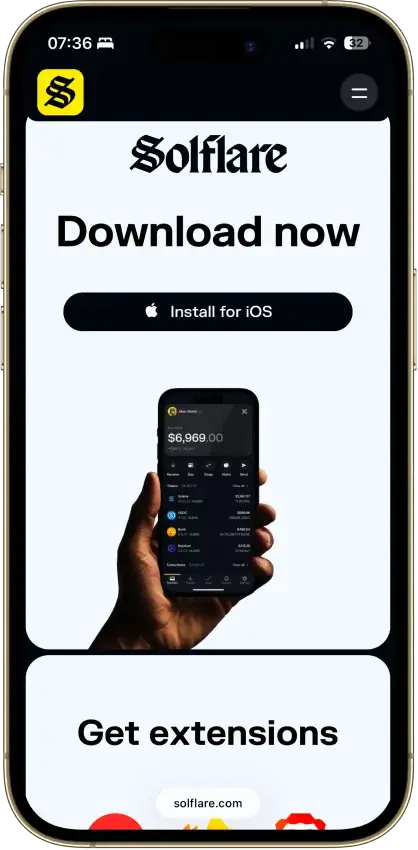
Screenshot 1 of 4
Phantom screenshots
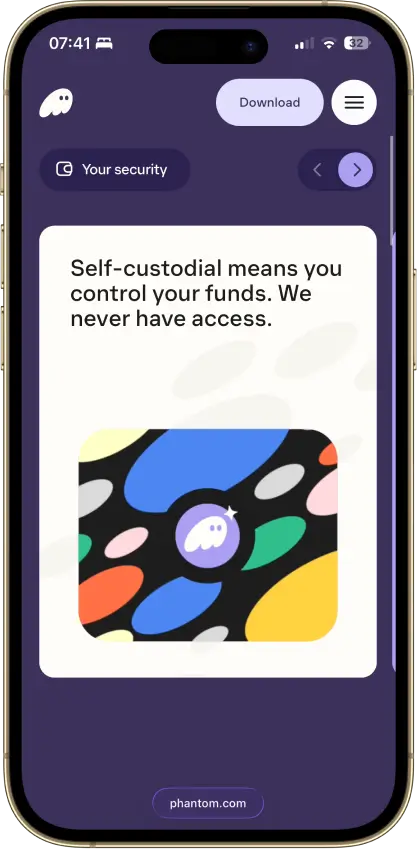
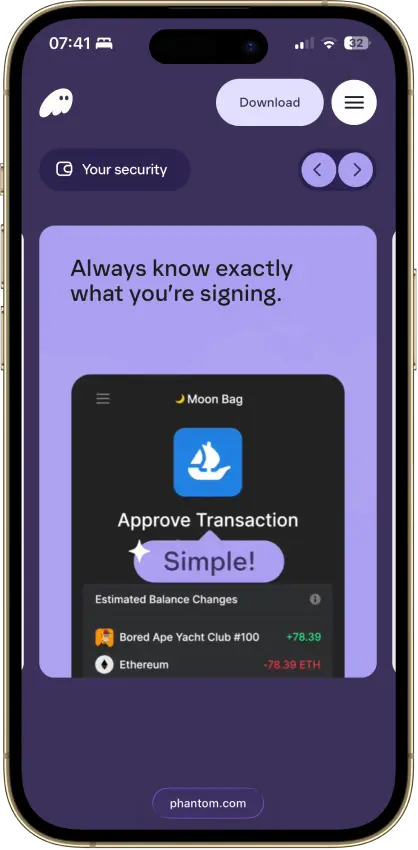
Screenshot 1 of 4
Winners By Category
Solflare wins for opening native SOL stakes on a phone and using a web wallet without an extension. Phantom wins for native network breadth. Those specific advantages do not establish a security winner.
Solflare Phantom
Solana users can choose local recovery-phrase accounts or supported hardware connections in either wallet. Phantom's optional KMS accounts add remote signing dependence.
Local recovery-phrase accounts, Ledger, Keystone and optional Shield hardware
Local recovery-phrase accounts, Ledger hardware, optional KMS accounts sign remotely
Both offer pre-approval warnings and hardware connections. Their disclosed audits and incidents provide no sound basis for ranking overall safety.
Guards transaction inspection and phishing warnings, 2023 Snap-only audit, screenless Shield card
Previews, swap simulation and suspicious-activity warnings, 2021 and 2024 audits, remediated 2022 Demonic flaw
Either restores compatible Solana phrase accounts. Phantom adds login recovery for users willing to depend on Google or Apple and its signing service.
Recovery phrase or per-account private key, Shield phrase shown once at setup
Recovery phrase, or Google or Apple login recovery through KMS
Holders of native BTC or ETH alongside SOL can manage those networks in Phantom. Solflare's native accounts remain Solana-only.
Solana only, with SOL, SPL tokens and Solana NFTs
Solana, Ethereum, Base, Polygon, Robinhood Chain, Bitcoin and HyperEVM, Sui retiring September 24, 2026
Solana users working without an installed extension can use Solflare's web wallet, including its specified Keystone QR connection. Phantom supports several Ledger models on mobile.
Web wallet, extension, iOS and Android, Keystone QR through the web wallet
Chrome extension and mobile apps, Nano X, Stax and Flex over mobile Bluetooth
Phone users can open a native validator stake in Solflare. Phantom requires its extension for creation, but mobile manages existing stakes and offers PSOL. The published fees alone do not settle swap costs.
Jupiter swaps with 0.5% default slippage, native stakes opened on mobile, Instant Unstake 0.5% to 3%
0.85% on selected same-network pairs, LI.FI bridges, native stakes need the extension, PSOL takes 4% of rewards
Phantom supplies address-association and analytics opt-outs, but published policies alone do not measure either wallet's total data exposure.
Policy covers wallet, IP, device and usage data, Onramper fiat partners
Address-association and analytics opt-outs, KYC for US Cash bank and card features
Solflare retired its Solana MetaMask Snap and Phantom has browser and network retirements. Neither provides a comparable guaranteed support horizon.
Solana MetaMask Snap closed May 11, 2026
Firefox updates stopped, Monad cutoff August 26 and Sui retirement September 24, 2026
The overall verdict uses our separate review ratings. Category results identify the task each wallet handles better, rather than adding up wins across unrelated features.
Custody And Key Control
Solana users can choose local recovery-phrase accounts or supported hardware connections in either wallet. Phantom's optional KMS accounts add remote signing dependence.
Solflare Phantom
Local Phrase Accounts
Signing keys stay on the phone or computer
Signing keys stay on the phone or computer
Optional Remote Signing
Core software accounts sign locally
New Google/Apple accounts use remote KMS signing
Solflare and Phantom both let Solana users retain local phrase control or connect supported signing hardware. Phantom's optional KMS setup changes the service dependency, so this tie compares the local and hardware choices, not every account type as equivalent.
Solflare's Solana wallet software uses local signing for software accounts. Phantom offers that arrangement too, so choosing Solflare does not uniquely give a user control of a recovery phrase.
Local And Remote Signing
With a conventional phrase account, the phone or computer holds the signing keys.
New Phantom wallets created with Google or Apple use its Key Management System, or KMS. Signing takes place inside a remote secure enclave. A separate authenticator on the user's device requests a signature, and Phantom's service checks permissions before signing. Phantom describes this as self-custody with exportable keys, not an exchange account.
That arrangement avoids routine local exposure of the wallet's private key, but adds dependence on authentication and the remote service. KMS also powers Phantom Cash. A local phrase account remains a separate choice for someone who does not want that signing dependency.
Hardware And Portability
Connecting supported hardware to either app leaves transaction signing on the hardware. Importing the device's recovery phrase into the software instead gives the software access to the same keys.
Phantom's account and recovery options include importing a Solflare phrase. Solflare also accepts compatible phrases from Phantom. This reopens blockchain accounts through another interface without requiring an onchain transfer, although the account-discovery process can differ.
Security And Transaction Signing
Both offer pre-approval warnings and hardware connections. Their disclosed audits and incidents provide no sound basis for ranking overall safety.
Solflare Phantom
Transaction Warnings
Guards transaction inspection and phishing warnings
Previews, swap simulation and suspicious-activity warnings
Screenless Hardware
Shield relies on the phone for transaction details
Compatible Ledger connections provide device-side confirmation
No clear winner
Warning systems and hardware connections exist on both sides, but a feature list cannot rank safety. Phantom's dated assessments and remediated vulnerability deserve scrutiny, while Solflare's additional hardware choices do not prove better protection against every threat.
Solflare describes Guards as a transaction-inspection system that warns users about potential threats before approval. Phantom previews transactions and flags suspicious activity. Its swap instructions also describe simulation before submission, with a failed simulation preventing the swap. These checks can help identify a bad request, but unfamiliar malicious transactions can evade warnings.
Public Code And Assessments
Solflare's public repositories include SDKs, token utilities, a blocklist, and Snap code. A complete reproducible current client is Not disclosed. The August 2023 Consensys Diligence assessment covered specified MetaMask Snaps and excluded the wallets interacting with them.
Phantom publishes components including a blocklist, while retaining proprietary rights to the application. It makes Kudelski Security's 2021 report and Least Authority's 2024 report available. Those dated engagements cannot certify every subsequent app build or the current KMS service. Phantom's linked Cantina bounty program advertised a $100,000 maximum on September 8, 2026, while its general security page still says $50,000.
Incidents And Their Limits
The Solana Foundation linked the August 2022 wallet drain to Slope and said reused Slope phrases may explain losses in other apps, including Solflare and Phantom. SlowMist recovered secret key material from Slope's server without conclusively explaining every loss. Moving an exposed phrase into another wallet does not repair it.
Phantom also had a distinct, remediated 2022 browser vulnerability called Demonic. Halborn identified recovery-phrase exposure under particular browser and device-access conditions. Phantom said protection was in place by April 2022.
Users filed Murphy v. Phantom Technologies in April 2025 over alleged key exposure and theft. The plaintiff-associated law firm Murphy's Law reports Phantom's denial. The docket mirror was last retrieved in August 2025, leaving the current outcome unconfirmed. February 2025 fake-update prompts reported by Scam Sniffer were credential phishing, not another demonstrated app exploit.
Approval And Hardware Limits
Phantom's Connected Apps screen can revoke app signing permissions, while token approvals require separate attention. Its Solana token-revocation instructions point to a third-party tool. Disconnecting an app alone does not cancel token allowances.
Solflare's optional Shield card has no screen, so the phone supplies transaction details. Ledger and Keystone connections offer different verification workflows. Hardware can keep signing keys away from the host without making the transaction being approved harmless.
Recovery And Backup
An accessible Solflare software installation can export recovery material. A private key covers its individual account, while the phrase can derive multiple accounts. Losing every usable installation and the required backup leaves support unable to reconstruct the keys.
Solflare Phantom
Compatible Solana Phrase Recovery
Supported, with derivation-path selection
Supported through the Solflare import flow
Login-Based Recovery
Keep the required recovery phrase or private key
Google/Apple access for accounts created that way
No clear winner
Compatible phrase restoration works in either app, while Phantom adds a login-based option for users comfortable with its dependencies. Solflare suits a backup process kept outside a login account, but that option is also available in Phantom's local wallet.
Phrase And Login Recovery
Phantom's conventional phrase wallet has the same lost-backup problem. A wallet created with Google or Apple can instead be accessed on another device using the linked account. Keep the exportable recovery phrase as an independent route, since login recovery depends on the account and service remaining available.
Some older Phantom login accounts still use a separate four-digit PIN. After migration to KMS, that PIN is no longer part of sign-in. Follow your account's actual setup and enable two-factor authentication on the linked Google or Apple account.
Shield has a different backup moment from Solflare's ordinary software wallet. A newly created Shield generates a 12-word phrase inside its secure element and displays it once in the app during setup. Later viewing and export are unavailable.
Moving Between Interfaces
Solflare supports BIP39-compatible phrases and advanced derivation-path selection. Phantom's Solflare import flow can locate compatible accounts, but an unexpected account order is a reason to compare public addresses before assuming a balance is missing. A separately imported private key needs its own backup.
Using one phrase in both apps duplicates access to those accounts. Separate phrases limit that particular shared-secret exposure, although using the same compromised phone would still put both installations at risk.
Networks, Assets, And dApp Access
Phantom can hold native Bitcoin and Ethereum accounts alongside Solana. Solflare's native wallet is restricted to Solana, so it cannot replace Phantom for someone receiving BTC on Bitcoin or ETH on Ethereum.
Solflare Phantom
Native Bitcoin And Ethereum
Not supported
Supported alongside Solana
Solana Tokens And Apps
SPL tokens, NFTs and Solana app connections
SPL tokens, NFTs and Solana app connections
Phantom wins networks, Assets, And dApp Access
Phantom serves holders who need native Bitcoin or Ethereum accounts as well as Solana. Solflare still covers Solana tokens, NFTs, and app connections, so the win is about those additional networks, not an untested claim that Phantom handles Solana activity better.
Network And Token Coverage
Phantom's September 11, 2026 supported-network list names seven networks: Solana, Ethereum, Base, Polygon, Robinhood Chain, Bitcoin, and HyperEVM. It explicitly excludes Arbitrum, Optimism, BSC, and Avalanche. Bitcoin accounts support Native SegWit and Taproot.
Sui is already absent from that list, although Phantom's separate transition notice still schedules the end of Sui viewing and transactions for September 24, 2026. The list omits Sui ahead of the notice's date, leaving pre-cutoff access unclear. Sui holders should confirm their current app's functions and retain credentials for a compatible alternative. Ending interface support does not erase onchain ownership.
Solflare covers SOL, SPL tokens, and Solana NFTs. A Solana token representing BTC does not provide a native Bitcoin address. Asset display does not guarantee swap or staking support.
Apps And NFTs
Solflare and Phantom each connect to Solana apps through extensions and mobile in-app browsers. Phantom's standard consumer connection flow uses its own mobile browser. It also publishes developer deep-link methods, which do not imply universal support from every external mobile browser. Its current help excludes Bitcoin dApp connections.
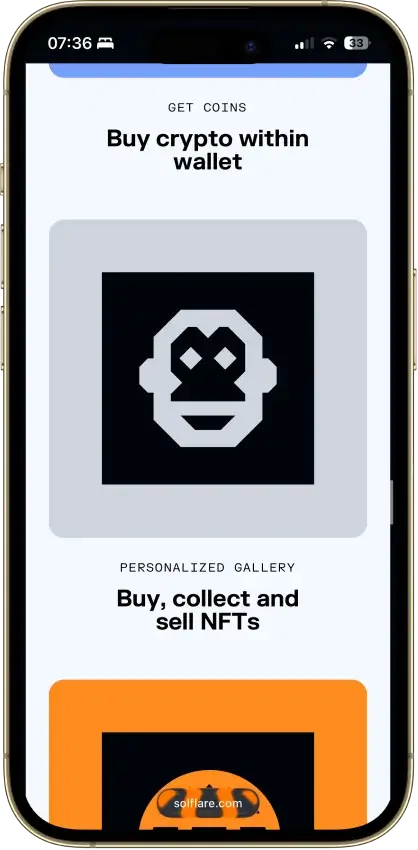
Solflare displays NFTs and selected lending and liquidity-pool positions. Phantom supports NFT display and marketplace connections. Neither wallet's NFT handling was tested side by side here.
Platforms, Hardware, And Daily Use
Solflare offers a web wallet, browser extension, and iOS and Android apps. Phantom's standard wallet platforms are its extension and mobile apps.
Solflare Phantom
Web Wallet Without An Extension
Available, including specified Keystone QR setup
Standard platforms are extension and mobile apps
Documented Mobile Ledger Models
Nano X on iOS and Android
Nano X, Stax and Flex over Bluetooth
Solflare fits Solana users needing computer access without an extension, including owners using the specified Keystone QR setup. Phantom remains attractive to Stax or Flex owners seeking mobile Bluetooth support, and this result does not rank support speed or general app reliability.
Computer And Phone Workflows
Chrome is Phantom's officially supported extension browser. Other Chromium browsers can run it without official support, and Firefox no longer receives updates. Solflare's web option permits wallet access without installing an extension, but a shared or untrusted computer remains unsuitable for exposing a recovery phrase.
For phone-based native staking, Solflare can create the stake account. Phantom mobile can manage a previously opened native stake and use PSOL liquid staking. As of September 11, 2026, PSOL reward viewing is unavailable on Phantom mobile and requires the extension.
Matching The Hardware Connection
Solflare connects Ledger through its web wallet using USB, with the Solana app open on the device. Its mobile troubleshooting guidance identifies Nano X on iOS and Android. Phantom's mobile Bluetooth list includes Nano X, Stax, and Flex. The extension's cable list covers Stax, Flex, Nano S and Nano S Plus, without ruling out every omitted combination.
For Keystone Essential or Pro owners, Solflare's QR connection requires its web wallet, version 1.29 or later. The device must run Multi-Coin firmware starting at M-6.0. Installing Solflare's extension instead provides watch-only access in this setup.
Shield is Solflare's separate battery-free NFC card for mobile signing. It needs no charging or cable, but its screenless design leaves transaction review on the phone. Solflare advertises an EAL6+ secure chip, a claim about that component rather than the wallet around it.
Support
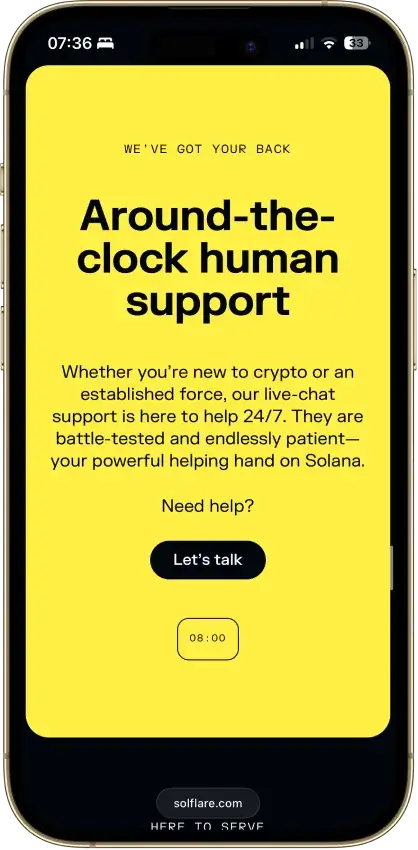
Solflare advertises round-the-clock human chat. Phantom's help center also offers a support-chat entry point. Comparable chat-speed and accessibility results are Not disclosed. Keep recovery phrases out of support conversations.
Swaps, Staking, And Costs
Both apps are free to download, with no required hardware purchase. Network transactions, embedded services, and optional devices cost extra.
Solflare Phantom
Create A Native SOL Stake On Mobile
Available with validator selection
New stakes require the extension
Wallet Swap Pricing
0.5% is default slippage, not a fixed wallet fee
0.85% wallet fee on selected same-network pairs
Solflare wins for phone users opening native stakes and choosing validators without an extension. Phantom still supports mobile management of existing native stakes and PSOL. Choosing the cheaper swap requires equivalent quotes, not just the listed percentages.
Swap Quotes And Optional Hardware
Solflare integrates Jupiter swaps. Its 0.5% default is slippage tolerance, not a fixed wallet fee. A fixed Solflare service charge is Not disclosed in those instructions. Selected same-network pairs carry a 0.85% Phantom charge, alongside network costs and execution effects. Compare equivalent quotes before concluding either produces a better received amount.
Phantom's cross-chain routes use LI.FI for third-party bridge options. Bridge and network costs are separate from its selected-pair same-chain percentage.
On September 11, 2026, Solflare's product page offered Shield Origin at $49, Signature at $59, and Unique at $79. The chosen variant's checkout, shipping, and taxes determine the actual purchase total.
Native SOL And PSOL
Creating a native SOL stake requires at least 1 SOL in each wallet. Solflare supports creation on mobile, while Phantom requires its browser extension. Each lets users choose a validator, whose commission affects rewards. Solflare also describes approximately 0.002 SOL held for the stake account and refunded on withdrawal and closure.
Ordinary native unstaking follows Solana epochs. Solflare estimates one to three days, and Phantom typically two to three days, followed by a separate withdrawal. Solflare's optional Instant Unstake charges 0.5%–3% depending on liquidity.
Phantom Staked SOL, or PSOL, is available on mobile and extension. Rewards change its SOL redemption value without adding tokens to the balance. The protocol takes 4% of staking rewards, with a 0.1% charge on PSOL exit or swap. Immediate redemption depends on reserves. When reserves are insufficient, the fallback is a native stake that must be unstaked and withdrawn manually.
PSOL can be used in supported DeFi services, adding exposure to the pool and any application used. Solflare can display third-party liquid-staking positions. Its own Instant Unstake service is a separate route that exits a native stake. None of these routes guarantees a yield or an immediate exit.
Privacy And Data Collection
Solana addresses and transactions are public with either interface. Connected apps can also see the address shared with them.
Solflare Phantom
Public Solana Activity
Addresses and transactions are public
Addresses and transactions are public
Data Controls And Services
Policy covers usage, wallet and device data
Address-association and analytics opt-outs
No clear winner
Phantom gives users specific opt-out controls, while Solflare's policy describes its own data categories and service recipients. Actual data exposure also depends on the funding providers, connected apps and remote account services a user selects.
Policies And Controls
Solflare's policy covers wallet and transaction data, IP and device information, usage analytics, and support submissions. Under Phantom's July 7, 2026 policy, wallet addresses may be linked to account identifiers unless users opt out in the app. Analytics can also be disabled.
Phantom describes a system designed to avoid connecting an IP address with a user's wallet address, username or email. It still processes IP data for purposes including security, connectivity, and legal requirements. That is a policy commitment, not an independently verified no-tracking guarantee.
Funding And Identity Checks
Solflare fiat purchases use Onramper partners, which apply their own identity and payment requirements. Phantom's current funding flow sends purchases into Cash, including routes using MoonPay, Banxa, or Topper outside its US options. Cash holds the Solana-based CASH token and uses KMS, so it is separate from a local SOL account.
Phantom requires identity verification for its US bank and debit-card Cash features, which are unavailable in New York. These Know Your Customer, or KYC, checks belong to those services, not every phrase-created wallet. Solflare Card is also separate from Shield. Its July 28, 2026 issuer-pause notice and active marketing pages do not confirm a completed replacement program.
Updates, Longevity, And Ecosystem
Solflare retired its Solana MetaMask Snap and Phantom has browser and network retirements. Neither provides a comparable guaranteed support horizon.
Solflare Phantom
Retired Integrations
Solana MetaMask Snap closed May 11, 2026
Firefox updates stopped; Sui retirement announced
Guaranteed Support Horizon
No comparable guarantee disclosed
No comparable guarantee disclosed
No clear winner
Solflare and Phantom have both retired particular integrations or platforms, so neither earns a longevity win from its present feature list. Preserve independent recovery material and reassess any account whose network, browser, or hardware is approaching end of support.
Solflare's Solana MetaMask Snap closed on May 11, 2026, with users directed to the app or extension. Phantom stopped updating Firefox, set an August 26, 2026 Monad cutoff and scheduled Sui retirement for September 24. These are specific product retirements, not proof that either wallet has stopped being maintained.
Neither company discloses a comparable guaranteed support period. A replacement app must support the relevant network and account derivation, so Solflare cannot restore every non-Solana asset held through Phantom.
Final Verdict
Phantom is our overall pick for holders who need more than Solana. Solflare is the better fit if opening native SOL stakes from your phone is the deciding feature.
Affiliate Disclosure
Some links in this comparison are affiliate links. CryptoSlate may earn a commission if you sign up through these links. Our ratings remain editorially independent.
Phantom wins final rating
Phantom’s 8.0 review score is higher than Solflare’s 7.0, so it takes the overall rating. Solflare’s mobile native-staking advantage remains meaningful for a Solana-only user. Neither score proves one wallet safer against every threat.
Solflare vs Phantom FAQs
Is Solflare or Phantom safer for Solana DeFi?
Neither has a proven universal safety advantage. Solflare and Phantom offer transaction warnings and hardware connections. Phantom has published audits and a remediated 2022 browser vulnerability, while Solflare's 2023 Snap audit did not cover the full wallet. Your account setup, backup and the transaction you approve all affect the risk.
Is Solflare or Phantom better for native SOL staking?
Solflare is more convenient for opening a native stake from a phone. Phantom requires its extension for that step, but mobile can view, unstake, and withdraw existing native stakes. Both allow validator selection. Phantom also offers PSOL on mobile, which introduces different pool, liquidity, and fee considerations from direct delegation.
Can Solflare and Phantom use the same recovery phrase?
Yes, compatible Solana phrase accounts can be imported between Solflare and Phantom. Check the public addresses because derivation and account discovery can differ. Sharing the phrase gives both installations access to the same accounts. It does not separate funds, repair an exposed phrase, or bring Phantom's other networks into Solflare.
Is Solflare or Phantom cheaper for swaps?
The cheaper option depends on the quoted trade. Solflare uses Jupiter and describes 0.5% default slippage tolerance, which is not a wallet fee. Phantom applies 0.85% to selected same-network pairs. Compare the same token pair, amount, network, and timestamp, including the received amount and any additional charges, before selecting a route.
Does Solflare or Phantom support Bitcoin and Ethereum?
Phantom supports native Bitcoin and Ethereum accounts, while Solflare's native wallet stays on Solana. Phantom is therefore the relevant option for those original networks. Sui is a separate transition issue: Phantom's September 11 supported list omits Sui, although the retirement notice still gives September 24, 2026 as the cutoff.
Can Solflare and Phantom recover a lost phone without a phrase?
Phantom can use Google or Apple login recovery for wallets created with that option. Solflare software recovery requires suitable backup material or another accessible installation from which to export it. A local Phantom phrase account has similar backup responsibilities. Shield's phrase can be saved only during setup, so losing an unbacked card is a separate risk.
Is Solflare or Phantom fully open source?
Phantom's application is proprietary, though it publishes components and audit reports. Solflare also has public components, but a complete reproducible current client is Not disclosed. The Solflare Snap assessment and Phantom's dated audit reports each cover the specific work in their stated scope. Public code alone would not settle the safety comparison either.

Sharing a recovery phrase between these apps reopens the same accounts rather than creating a backup wallet. Choose separate phrases if you want separate accounts, and check your actual signing method before assuming every Phantom account works locally.