
Quick Take
- Polygon has expanded its payment infrastructure to Solana, giving eligible foreign businesses access to US banking rails without US incorporation.
- The integration opens new payment routes into Solana's $15 billion stablecoin market, connecting banks, wallets and cross-border transfers.
- Access remains limited to approved businesses, with compliance checks and geographic restrictions determining who can use the service.


Polygon has extended its US banking and stablecoin payment infrastructure to Solana, including access for eligible overseas businesses.
The Oct. 29 expansion of its Open Money Stack (OMS) allows qualifying foreign companies to access US banking rails in their own legal names without establishing a US entity.
The service connects traditional banking with Solana's stablecoin infrastructure, enabling businesses to accept deposits through bank transfers, cards, cash or crypto, convert funds into stablecoins and process payouts through the same channels.
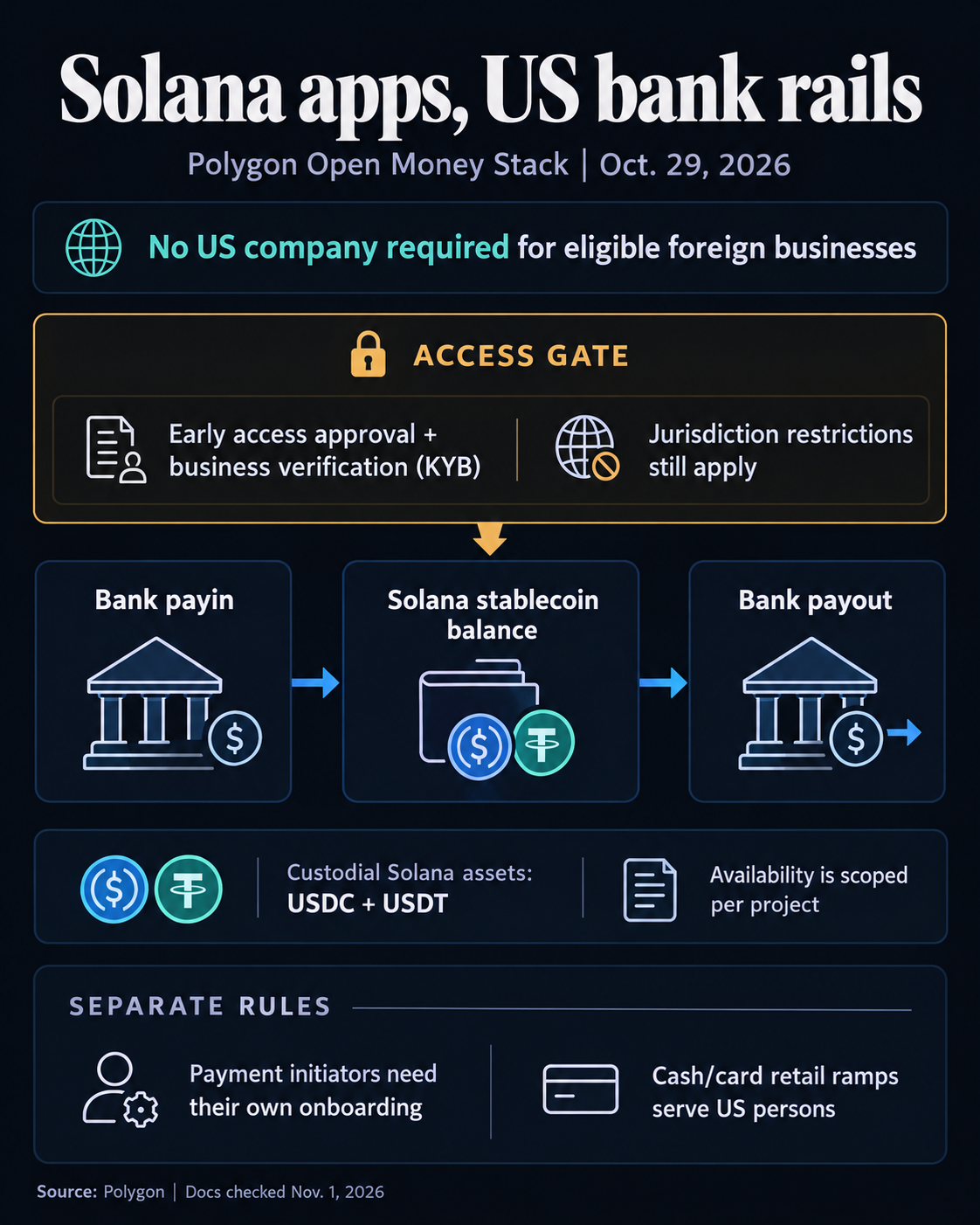
Businesses can also hold funds in embedded or custodial Solana wallets and move assets across Polygon, Ethereum, TRON and other supported networks.
The integration targets fintech companies, remittance providers and payment applications seeking to offer dollar-denominated services across borders without building separate banking, custody and blockchain integrations.
Polygon Labs CEO Marc Boiron said the expansion reflects the company's ambition to support money movement across different blockchains. He said:
“Moving all money onchain means enabling money to move on the chains people want to use.”
Polygon targets Solana's $15 billion stablecoin market
The expansion gives Polygon a foothold in one of the largest stablecoin ecosystems outside its own network.
According to DeFiLlama data, Solana held more than $15 billion in stablecoins, making it the third-largest network behind Ethereum and TRON.
Polygon, meanwhile, ranked eighth with approximately $3 billion, highlighting the difference in the networks' existing stablecoin liquidity.
Solana's payment activity also provides a substantial market for Polygon's infrastructure services. Solana reported that the blockchain had processed more than $5 trillion in stablecoin transfer volume in 2026.
Polygon had already integrated Solana into its Trails routing infrastructure in August, enabling stablecoin and SOL transfers between Solana and more than 20 Ethereum-compatible networks.
The latest expansion adds banking access, customer accounts, stablecoin custody and fiat payouts to that existing routing capability.
Under the arrangement, a remittance provider could receive dollars from a customer, convert them into USDC on Solana, and enable the recipient to withdraw through a supported bank account or other payout channel.
However, access remains subject to regulatory requirements. Businesses must complete know-your-business verification, while customers initiating payments require separate identity checks. Geographic restrictions and supported payment corridors also determine which transactions are available.
The OMS service remains in early access, requiring businesses to apply before using the infrastructure.
Mentioned in this article



Editorial credits