
Quick Take
- Input Output proposed Pogun as a Cardano-funded Bitcoin DeFi product.
- Pogun offered 20% of earnings until repayment, then 5% from Cardano-related products.
- Midnight City V2 was documented on Midnight in July, before the Pogun vote.


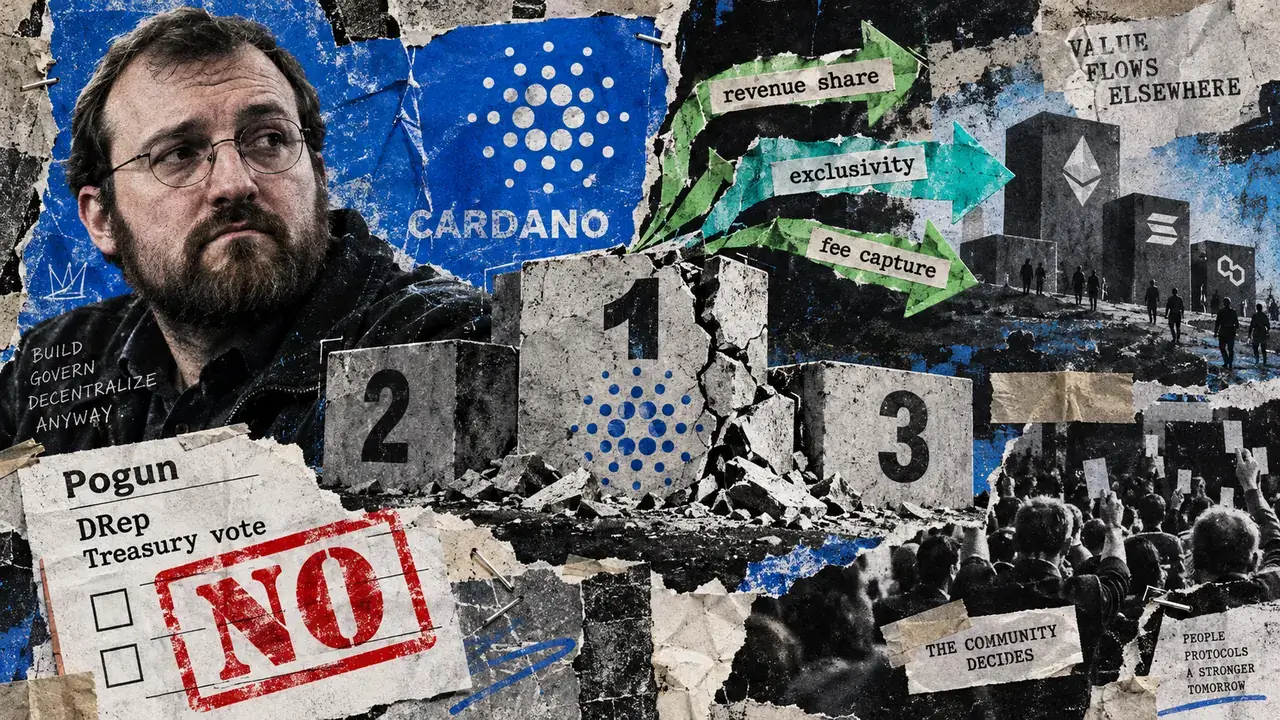
Cardano's delegated governance voters let a 12.29 million ADA request for Pogun expire without ratification, showing that Input Output's history as a founding builder does not guarantee access to the network's treasury.
Pogun is an Input Output-backed credit and liquidity product designed to bring Bitcoin into decentralized finance. Its proposal offered Cardano a share of the business in exchange for development funding. Charles Hoskinson says the product is still headed to Cardano. Future Input Output ventures will follow technical and commercial fit instead of an automatic Cardano-first policy.
The result is a clear test of decentralized control. Cardano's representatives withheld public capital from an affiliated commercial project, while Input Output retained the freedom to deploy products wherever technical and business conditions are strongest.
A vote with two different verdicts
The Pogun governance action asked Cardano's treasury for 12.29 million ADA and expired without ratification or enactment. The final Koios voting summary recorded 35.67% of delegated representative voting power in favor and 64.33% against.
Delegated representatives, or DReps, vote with authority assigned to them by ADA holders. Their result determined whether the withdrawal could advance. The Constitutional Committee performed a different review and recorded seven yes votes, equal to 100% committee approval.
The two results are compatible. The committee's tally showed support from that governance body, while the DRep tally failed to ratify the spending request. Input Output helped build Cardano and remains a major participant. The network's separate institutions still controlled the funding outcome.
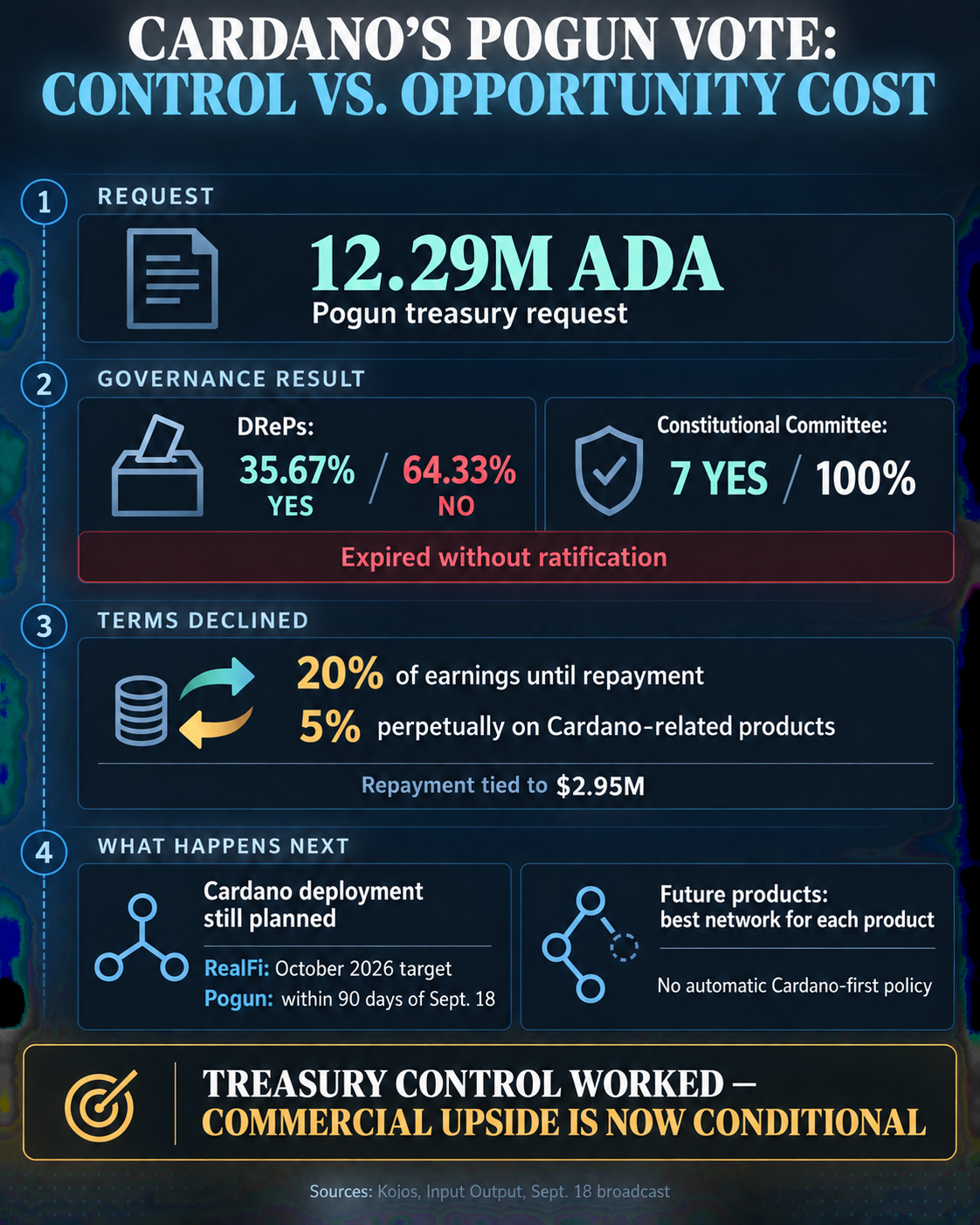
The proposal also gave voters a commercial calculation to make. Input Output's April 2026 overview said Pogun would return 20% of earnings to the Cardano treasury until the initial funding was repaid, followed by a perpetual 5% return on Cardano-related products.
The formal proposal framed the calculation as a share of quarterly earnings before interest, taxes, depreciation and amortization, with repayment tied to $2.95 million. Cardano would have funded product development and gained a proposal-based path to recover that outlay and participate in later earnings.
DReps avoided exposing the treasury to a venture whose revenue and adoption were uncertain. They also declined its defined upside. Pogun has not established the future earnings, usage or network distribution needed to value that trade-off, so claims about the amount Cardano forfeited remain speculative.
In his Sept. 18, 2026 broadcast, Hoskinson said Input Output will choose the best network for each product instead of following a Cardano-first-and-forever policy.
He still described Cardano as the strongest technical choice for Bitcoin DeFi connecting systems that use Bitcoin-like transaction outputs. He also said RealFi would launch on Cardano in October 2026 and Pogun would arrive within 90 days of the broadcast, or by roughly mid-December. The stated dates remain forward-looking targets.
Hoskinson said Pogun could generate transaction fees, total value locked and volume for Cardano if its planned deployment goes live. The economic relationship would be different from the funded proposal: Cardano could benefit from activity on the network without receiving the rejected revenue share.
Input Output's product-by-product approach also has roots that predate the Pogun result. Midnight City V2, an agent-based application tied to the Midnight ecosystem, was already documented on Midnight in July 2026. That earlier placement makes the wider multichain strategy difficult to attribute to one treasury vote.
The vote also shapes Pogun's commercial incentives. Hoskinson said the unfunded product will not be exclusive to Cardano, that traffic may be routed to other networks and that another ecosystem could receive exclusivity in exchange for support.
That exclusivity claim requires careful attribution. The on-chain Pogun proposal reviewed for the vote contains the funding request, repayment structure, perpetual return and intended Cardano deployment. It omits an explicit exclusivity covenant. The written record establishes that Cardano declined revenue participation. Hoskinson's statement describes Input Output's possible next steps; the proposal contains no equivalent term.
Cardano's governance succeeded at limiting a founding company's influence over community funds. The committee and DReps performed separate functions, and the withdrawal did not advance.
Cardano's institutions control treasury spending. Input Output controls its commercial choices and can finance products elsewhere, negotiate with competing networks and direct incentives toward partners willing to provide capital or distribution.
Pogun will test how those two forms of independence interact. A Cardano deployment could bring fees and liquidity while activity also flows to other chains. If Cardano remains Pogun's main venue, the rejected revenue agreement may matter more than Hoskinson's warning about exclusivity. If activity migrates elsewhere, the network's budget discipline will carry a larger opportunity cost.
Either outcome is consistent with decentralized governance. Saying no protected the treasury from a speculative investment. It also required Cardano to compete for Input Output's future products. History alone no longer puts the network first.

Cardano is -0.68% over the past 24 hours and currently sits at rank #14 by market cap.
Mentioned in this article



Editorial credits