
Kraken scores 7.8/10 for security controls, quarterly reserve checks, bank rails and advanced tools. Entry fees, reserve coverage and product restrictions are the main tradeoffs.
Kraken vs Binance for US Access and International Trading
Location decides the first branch in a Kraken vs Binance comparison because Binance.com does not accept accounts from the United States.

Binance.com combines 0.10% entry spot fees with deep liquidity and extensive trading tools, but access, fiat rails, and products vary by jurisdiction.
Affiliate Disclosure
Some links in this comparison are affiliate links. CryptoSlate may earn a commission if you sign up through these links. Our ratings remain editorially independent.
Overview: Geography Decides First
Kraken Binance
Main account scope
Main Kraken.com custodial account in the United States, EEA, and United Kingdom
International Binance.com account, with the United States, Canada, and the Netherlands blocked alongside other named restrictions
US centralized account
Available outside New York and Maine
Not available
Required for the core exchange flow
Required for normal deposits, trading, APIs, and withdrawals
Kraken Pro starts at 0.40% maker and 0.80% taker
VIP 0 spot is 0.10% maker and taker
Published score
7.8/10
7.0/10
Tie
Kraken supplies the US route. Binance.com supplies the lower entry spot commission where it operates.
Kraken vs Binance in One Table
Kraken Binance
US access
Core service outside New York and Maine
Unavailable
0.40% maker and 0.80% taker
0.10% maker and taker, or 0.075% with eligible BNB payment
Listed assets
600+ globally
486 active spot base assets on August 29, 2026
Spot markets
Hundreds, with no fixed current count
1,358 active symbols on August 29, 2026
Margin
Up to 10 times for eligible accounts and markets
Cross up to 5 times and isolated up to 10 times where permitted
Separate global futures plus 16 US dollar-settled perpetuals for qualifying accounts
USD-margined, coin-margined, options, copy trading, and bots where permitted
More than 20 staking assets with published commission bands
More than 300 Simple Earn assets across several product types
US bank rails
ACH, FedWire, RTP withdrawals, PayPal, and debit-card funding with method-specific rules
No Binance.com account
Quarterly Merkle snapshot with independent attestation
Monthly self-published snapshot with Merkle and zero-knowledge inclusion
API test access
Public futures demo, restricted spot test access
Spot Testnet
24/7 messaging or chat, with forms
24/7 chat
Tie
Kraken serves US accounts outside New York and Maine. Binance.com charges less at the entry spot tier and names additional international trading products where permitted.
U.S. access, order-book costs, and product eligibility produce the main differences.
Category Decisions
Kraken Binance
Serves eligible accounts outside New York and Maine
Does not serve US accounts
0.40% maker and 0.80% taker
0.10% maker and taker before the optional BNB reduction
1% for instant or recurring orders and 1.5% for custom orders, plus spread and payment charges
No universal all-in rate
No matched global futures count is published for Kraken
Dated USD-margined, coin-margined, and options counts plus copy trading and bots
16 dollar-settled contracts for accounts passing all checks
No Binance.com account
Named deposits and withdrawals with method-level prices
No Binance.com account
Quarterly snapshot with eight named assets or asset groups
Monthly archive and 53 assets in the August 2026 snapshot
Independently attested quarterly Merkle snapshot
User-verifiable but self-published snapshot
Restricted to qualified and onboarded clients
Public Spot Testnet
No matched outcome data
No matched outcome data
Tie
The category split follows geography, fee surface, derivatives access, reserve method, and API testing.
Kraken takes U.S. access and named bank rails, while Binance.com takes entry spot pricing and the named international product range.
Screenshots
Kraken screenshots

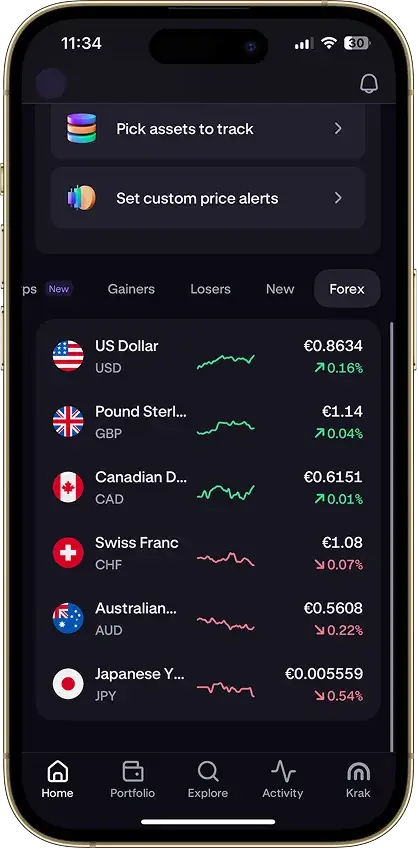
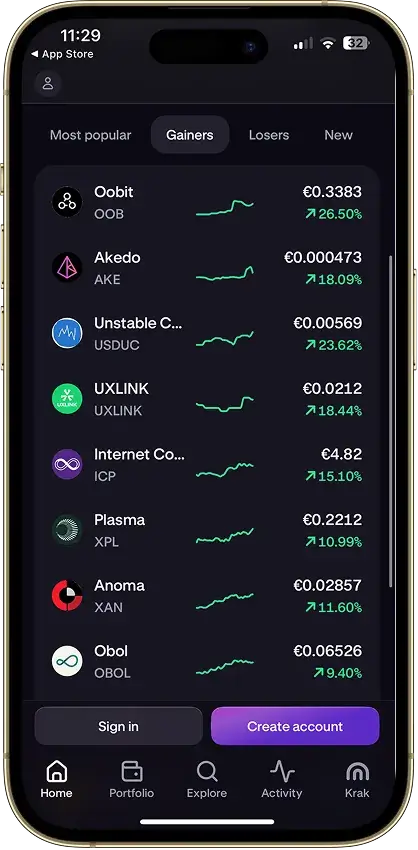
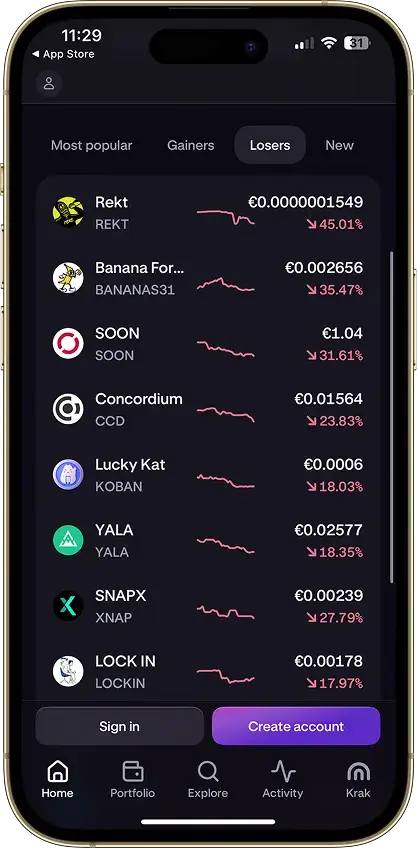
Screenshot 1 of 4
Binance screenshots


Screenshot 1 of 4
Trading Fees and Pricing
Kraken Binance
0.40%
0.10%, or 0.075% with eligible BNB payment
0.80%
0.10%, or 0.075% with eligible BNB payment
Published spot endpoint
0% maker and 0.05% taker at the published endpoint tier, qualified by trailing spot activity or qualifying assets on platform
Higher VIP tiers depend on 30-day volume and BNB holdings
Instant or recurring purchase
1% plus variable spread and payment costs
Executable quote, spread, and provider charge
Custom consumer order
1.5% plus variable spread and payment costs
No matched custom-order schedule
Fee program
Kraken+ costs $4.99 monthly or $49.99 yearly and waives eligible consumer transaction fees up to $10,000 monthly
Eligible BNB payment cuts spot commission by 25%
USD-margined futures entry
Global and US schedules use different fee units
0.0200% maker and 0.0500% taker, or 0.0180% and 0.0450% with eligible BNB payment
$1,000 maker order
$4.00
$1.00 at VIP 0, or $0.75 with eligible BNB payment
$1,000 taker order
$8.00
$1.00 at VIP 0, or $0.75 with eligible BNB payment
$10,000 maker order
$40.00
$10.00 at VIP 0, or $7.50 with eligible BNB payment
$10,000 taker order
$80.00
$10.00 at VIP 0, or $7.50 with eligible BNB payment
Binance wins trading Fees and Pricing
Binance.com charges the lower published entry spot commission. Simple-buy and derivatives total costs remain unranked.
Under the July 9, 2026 schedule, the lowest standard Kraken Pro tier charges makers 0.40% and takers 0.80%. Binance VIP 0 charges 0.10% on either side, falling to 0.075% when an eligible spot commission is paid in BNB.
Using BNB fee-payment economics adds token-price exposure. Kraken+ leaves spread and processing charges in place and excludes Pro trading. The same exclusion applies to futures and API orders as well as OTC trades.
These examples cover order-book commission only. They exclude spread, slippage, payment charges, subscriptions, withdrawals, and BNB price movement, and they do not apply to Kraken Instant Buy or Binance Simple Buy.
Supported Assets, Markets, and Order Controls
Kraken Binance
Asset count
600+ global platform assets
486 active spot base assets in an August 29 API sample
US inventory
Not disclosed
No Binance.com account
Spot-market count
Hundreds of crypto and cash-quoted markets
1,358 active symbols in the dated sample
Margin-enabled markets
Market and account specific
794 active spot symbols in the dated sample
Core orders
Market, limit, stop-loss, take-profit, stop-limit, and OCO
Market, limit, limit-maker, stop and take-profit variants, and OCO
Additional controls
Post-only, trailing, iceberg, conditional-close, and TWAP or bot instructions where available
OTO, OTOCO, trailing, and supported time-in-force instructions
Minimum example
No matched universal spot minimum
BTC/USDT carried a 5 USDT minimum notional in the dated sample
Tie
Binance supplies the precise dated spot count. Kraken states 600-plus assets globally, but the figures cannot be ranked as one inventory test.
Kraken's 600-plus global asset statement does not establish its US inventory, where residency can remove assets or markets. The August 29, 2026 Binance.com API capture produced 1,358 active spot symbols from 486 unique base assets, including 794 margin-enabled symbols and 26 quote assets.
The asset figures use different definitions. Kraken's global platform statement is not the same measure as Binance.com's active spot base-asset count. Wallet-network assets also stay outside both centralized-exchange totals.
Liquidity and Execution Evidence
Kraken Binance
BTC/USDT spread
No matched sample
0.0013 basis points at 21:38 UTC on August 29, 2026
BTC/USDT depth within 10 basis points
No matched sample
About $5.78 million bid and $6.50 million ask
ETH/USDT spread
No matched sample
0.0408 basis points at the same time
ETH/USDT depth within 10 basis points
No matched sample
About $2.89 million bid and $2.50 million ask
Slippage and fill rate
No matched measurement
No matched measurement
Latency and rejected orders
No matched measurement
No matched measurement
Tie
Binance supplies dated one-sided measurements. No matched execution winner is supported.
Binance.com is the only side with dated measurements for two major pairs. Kraken has no same-time spread, depth, slippage, fill-rate, rejection-rate, or latency sample. Binance's one-sided figures therefore cannot decide which exchange would execute the same order at a lower total cost.
Order-menu length does not measure fill quality. A user placing a large order should inspect the live book for the exact pair and consider a limit order or staged execution.
Margin, Futures, Options, Copy Trading, and Bots
Kraken Binance
Spot margin
Up to 10 times for eligible accounts, markets, and jurisdictions
Cross up to 5 times and isolated up to 10 times where permitted
US crypto perpetuals
16 dollar-settled contracts for accounts passing all checks
Unavailable because Binance.com does not serve the US
No current global Kraken count is published
751 active contracts, including 567 standard perpetuals, 180 TradFi perpetuals, and four dated contracts
COIN-M futures
No matched Kraken count is published
30 active contracts across 20 base assets
Options
No matched Kraken options count is published
1,634 active contracts across six underlyings
No exchange-native copy-trading product is documented for Kraken
Separate spot and futures copy accounts
Trading bots
TWAP or bot instructions appear in the Kraken order set
Spot Grid, Futures Grid, funding-rate arbitrage, rebalancing, Spot DCA, Auto-Invest, and Bot Marketplace
Binance wins margin, Futures, Options, Copy Trading, and Bots
Binance.com has the enumerated international product-range win. Kraken has the US crypto-perpetual availability win for accounts passing all checks.
Binance.com is the only side with dated counts for USD-margined, coin-margined, options, copy trading, and bots where local rules allow. Its August 29, 2026 snapshot included 751 active USD-margined contracts, but 180 were TradFi perpetuals. The same capture included 30 coin-margined contracts and 1,634 European-style cash-settled options contracts across six underlyings.
Sixteen dollar-settled perpetuals give Kraken a defined US product, while no matched global Kraken contract count is published. Access requires identity verification and a suitability review plus state approval. Those US contracts use per-contract charges and daily funding, so their cost cannot be placed beside Binance's percentage schedule as if the units match.
A futures exchange account guide separates contract access from spot trading. The fee comparison also follows order-book trading mechanics. Liquidation and funding remain separate costs.
Staking and Earn Products
Kraken Binance
Bonded and flexible staking on more than 20 assets, plus Auto Earn
More than 300 Simple Earn assets across several structures
Flexible commission
30% of rewards
No exchange-wide commission
Bonded commission
25% to 0% according to eligible assets under management
Product and asset specific
Payout timing
Generally weekly
Product specific
Exit terms
Bonded products can require protocol unbonding
Flexible, locked, and onchain products use different redemption rules
US access
Staking is unavailable in California, Maryland, New Jersey, and Wisconsin, in addition to core exclusion from New York and Maine
No Binance.com account
Tie
Kraken publishes commission bands. Binance names more Simple Earn assets under a different product definition. Compare one asset, product, country, term, and exit rule.
Kraken supports bonded and flexible staking on more than 20 assets. Auto Earn and other reward products may also be available. Flexible Staking and Auto Earn charge 30% of rewards. Bonded commission falls through 25%, 20%, 10%, 5%, and 0% tiers according to eligible assets under management.
Binance describes more than 300 Simple Earn assets, divided among flexible and locked terms plus onchain structures. It does not publish one exchange-wide commission or APR. Payout cadence and redemption periods also vary. Comparing 300-plus Earn assets with Kraken's 20-plus staking assets would mix product families.
Proof-of-stake reward mechanics include validator selection and commission. Slashing and unbonding also matter, while payout timing is product specific. A headline APR or asset count cannot replace those terms.
Deposits and Fiat Cash-Out
Kraken Binance
US ACH deposit
$1 minimum, free, near-instant for trading, seven-day hold on the associated amount
No Binance.com account
US FedWire deposit
$1 minimum, free, estimated zero to one business day
No Binance.com account
US PayPal deposit
$1 minimum, near-instant, fee at confirmation, 72-hour hold on each purchase
No Binance.com account
US debit-card deposit
$10 minimum, $0.25 plus 3.75%, with holds that can apply
No Binance.com account
US ACH withdrawal
$1 minimum, free, estimated zero to two business days
No Binance.com account
US FedWire withdrawal
$20 minimum, $4, estimated zero to one business day
No Binance.com account
US RTP withdrawal
$20 minimum, 1.5% capped at $50, near-instant for eligible banks
No Binance.com account
EEA and U.K. routes
SEPA and Faster Payments where eligible
Country-specific access, with a €1 SEPA Instant example on August 29
Other SWIFT examples
Method and residence dependent
USD $0 in and $25 out, CHF 0 in and CHF 35 out, GBP £0 in and £70 out on August 29
Kraken wins deposits and Fiat Cash-Out
Kraken wins named US funding and cash-out access. International fiat routes remain unranked.
Kraken supplies method-level prices and timing for several American cash routes here. ACH deposits are free with a $1 minimum and near-instant trading credit, followed by a seven-day withdrawal hold on the associated amount. FedWire deposits are free with a $1 minimum and an estimated zero to one business-day processing time.
International Binance fiat access changes with country and currency. Payment providers and account rules narrow it further. The August 29 account displayed €1 SEPA Instant deposits and withdrawals. It also showed free USD SWIFT deposits with $25 cash-outs, while GBP SWIFT deposits were free and withdrawals cost £70. Those examples do not prove that a rail appears for every account.
A bank deposit route and withdrawal route need separate checks. A fast purchase method can still place a hold on the funded amount or leave the account without a matching fiat cash-out path.
Crypto Withdrawals and Account Limits
Kraken Binance
Fee basis
Kraken-set asset and network fee shown at confirmation
Asset and network fee shown at confirmation
Minimum basis
Asset and network specific
Asset and network specific
BTC native example
Dynamic confirmation value
0.0001 BTC minimum and 0.00002 BTC fee on August 29
BTC Lightning example
Dynamic confirmation value
0.00002 BTC minimum and 0.000001 BTC fee on August 29
ETH native example
Dynamic confirmation value
0.002 ETH minimum and 0.00007 ETH fee on August 29
USDT network examples
Dynamic confirmation value
0.01 USDT on BEP20, 0.3 on ERC-20, and 1.5 on Tron on August 29
New-address hold
A recent password change can create a 24-hour hold for new or updated addresses
Account and risk checks can delay a withdrawal
Universal daily ceiling
Not disclosed
Not disclosed
Tie
Withdrawal cost and account limits remain unranked because both depend on the live route and account.
Both exchanges price crypto withdrawals by asset and network at confirmation, but only Binance publishes dated examples for these routes. Kraken charges Kraken-set flat withdrawal fees and minimums by asset and network. Binance also uses network-specific fees and minimums. The dated examples cover BTC and ETH plus USDT.
A fair comparison needs the same asset and network plus an identical amount. Account status and timestamp must also match. Selecting a low-fee network that the destination does not support can cause a loss.
KYC, Licensing, and Geographic Availability
Kraken Binance
Identity verification required
Full identity verification required for normal use
US availability
Core service outside New York and Maine
Unavailable
US product restrictions
Staking, margin, derivatives, assets, and rails can add state or account limits
Binance.com has no US product access
EEA position
MiCA-authorized structure with an Irish EMI component
No Binance entity appeared in the MiCA-authorized CASP register checked August 29, 2026
U.K. position
Services include FCA-authorized entities
Not disclosed
ADGM structure
Not applicable to the compared Kraken account
Nest Exchange, Nest Clearing and Custody, and Nest Trading have separate roles
Other prohibited locations
Residence and product rules vary
Canada, the Netherlands, and several sanctioned regions are also on the official prohibition list
Tie
Kraken supplies the US route and holds the MiCA-authorized EEA structure here. Regulatory conclusions remain jurisdiction and product specific.
Normal account activity begins with identity checks on either exchange. Kraken personal accounts use Intermediate and Pro Personal levels. Binance applies full verification before normal deposits or trading. API use and withdrawals stay restricted until KYC is complete. Either exchange can request additional checks.
Kraken Financial is a separate Wyoming-chartered SPDI affiliate. It does not turn an ordinary Kraken exchange account into a bank account and does not create FDIC protection for exchange crypto.
Security, Custody, and Proof of Reserves
Kraken Binance
Account controls
FIDO2 passkeys or keys, authenticator 2FA, Master Key, Global Settings Lock, PGP email, device controls, and address confirmation
2FA, hardware keys, withdrawal allowlisting, anti-phishing codes, device review, and restricted API keys
Custody wording
User title and separate internal ledgers, with shared addresses possible
Internal client ledgers, possible omnibus wallets and pooled fiat, with trust-property and insolvency terms
Customer loss insurance
Exchange accounts and digital assets are not insured against loss and have no FDIC or SIPC coverage
SAFU is an emergency fund, not deposit insurance
Offline custody
Majority of client crypto described as offline
No universal cold-storage percentage is published
Latest snapshot
June 30, 2026
August 1, 2026
BTC 102.9%, ETH 100.5%, SOL 100.6%, XRP 102.3%, ADA 100.3%, stablecoin group 105%+
BTC 100.25%, ETH 100.25%, USDT 103.62%, BNB 100.82%, SOL 100.00%, USDC 107.64%
Publication cadence
Quarterly
First-of-month archive through August 2026
Independent attestation
Yes for the June 30 quarterly report
Current snapshot is self-published
Incident record
Kraken states that no breach has caused client-fund loss
More than 7,000 BTC left a hot wallet in 2019, with Binance saying SAFU covered the loss
Compliance record
Jurisdiction-specific licensing and separate affiliate roles
2023 corporate guilty plea and $4.3 billion resolution, with the separate SEC case dismissed in 2025
Tie
Binance.com wins publication cadence and covered count. Kraken wins independent attestation. Neither method proves full or continuous solvency.
Reserve reporting produces one winner for publication cadence and another for independent attestation. Binance.com publishes monthly snapshots and covered 53 assets in its August 1, 2026 report. Kraken's June 2026 snapshot is independently attested. Both let users verify inclusion for covered balances. Neither report proves every corporate liability or encumbrance, nor does it guarantee future withdrawal capacity.
A reserves versus solvency analysis explains why a ratio above 100% for a covered asset does not establish continuous group solvency.
Website, Apps, APIs, Reporting, and Support
Kraken Binance
Consumer and pro access
Kraken app and web, plus Kraken Pro app and web
Simple-purchase and advanced trading functions under one account
Desktop software
Kraken Desktop
Windows, macOS, and Linux apps
Self-custody
Separate Kraken Wallet
Separate Binance Wallet
API protocols
Spot REST, WebSocket v1 and v2, FIX, futures REST and WebSocket, and Status API
REST, WebSocket streams and order entry, FIX, and separate derivatives APIs
API testing
Public futures demo, with spot testing limited to qualified clients
Spot Testnet
API key controls
Scoped permissions, IP restrictions, expiration, API 2FA, and rate limits
Scoped permissions, IP allowlisting, and RSA signing
Reporting
Kraken does not publish a directly comparable export ceiling
Up to 10,000 rows, six months per website export, and five report generations monthly
24/7 messaging or live chat and forms
24/7 chat
Tie
Binance.com wins ordinary spot API testing. Interface and support quality remain unranked.
Kraken divides consumer and Pro functions across separate interfaces. Kraken Desktop handles advanced desktop trading. Self-custody sits in Kraken Wallet, while Krak manages everyday transfers and the U.K. and EEA card. Binance documents web and mobile access. Its desktop software covers Windows and macOS as well as Linux, with local product availability controlling each interface.
Moving funds to a wallet changes who controls the keys. The non-custodial wallet controls that protect a self-custody balance make the user responsible for the recovery phrase and chosen network. Transaction approval remains the user's job as well.
Choose Kraken If...
Kraken fits US users outside New York and Maine, bank-rail users, and accounts prioritizing independent reserve attestation.
- You live in a US state other than New York or Maine, and Kraken permits the intended product in that state.
- You need published terms for ACH or FedWire funding, PayPal purchases or RTP cash-out.
- You want 16 US crypto perpetual contracts and can pass suitability plus state checks.
- Independent attestation of the covered reserve snapshot matters more than monthly self-publication.
Choose Binance If...
Binance.com fits supported-country users prioritizing entry commission, named international products, monthly reserve publication, and spot API testing.
- You are outside the United States, Canada, the Netherlands, and Binance.com's other named blocked markets, and the required markets appear in your signed-in account. VIP 0 costs 0.10%, reduced to 0.075% when qualifying commissions are paid with BNB.
- A required market appears in Binance.com's 1,358-symbol August 29, 2026 spot snapshot.
- You need both futures formats together with options and automated trading tools.
- Monthly reserve publication matters to your process, and you need a public Spot Testnet before connecting an automated strategy.
Final Verdict
Choose Kraken for US access outside New York and Maine, named US bank routes, and independent reserve attestation. Choose Binance.com outside its named blocked markets for lower entry spot commission and enumerated international trading products.
Kraken serves US accounts outside New York and Maine. It also supplies named US bank routes and an independently attested quarterly reserve snapshot, while Binance.com excludes all US accounts.
Outside the United States, a Binance vs Kraken choice is valid only where both accounts operate. Binance.com then charges 30 basis points less for an entry maker order and 70 basis points less for an entry taker order before the optional BNB reduction. It also documents international options and copy trading as well as named bots, without a matched current Kraken count.
US users considering Kraken should confirm that the required product is permitted in their state and account for its seven-day ACH hold. Binance.com users outside its blocked markets should check whether the required derivatives market is permitted locally and whether the 0.075% spot rate justifies holding BNB for fee payment.
Kraken vs Binance FAQs
Is Kraken or Binance better for US users?
Kraken accepts US accounts outside New York and Maine. Staking and other products add further state restrictions. Binance.com does not serve the United States. Binance.US is a separate exchange and is not covered here.
Is Kraken or Binance cheaper for spot trading?
At the standard entry tier, Binance.com has the lower published order-book commission. VIP 0 sets maker and taker rates at 0.10%, while qualifying BNB fee payment cuts each to 0.075%. Kraken Pro's corresponding entry charges are 0.40% and 0.80%. Total cost also includes trading spread and slippage, funding charges or subscriptions, withdrawal fees, and any BNB price exposure.
Does Kraken or Binance list more crypto assets?
Kraken's 600+ figure covers its global platform, while Binance.com's API returned 486 unique active spot base assets on August 29, 2026. The different scopes prevent a direct inventory ranking.
Does Kraken or Binance have more derivatives products?
Binance.com accounts with derivatives access receive the enumerated international set through USD-M and COIN-M futures plus options. Kraken instead supplies 16 dollar-settled crypto perpetuals to US accounts that clear identity and suitability reviews plus state checks. No matched global Kraken contract count is published.
How do Kraken and Binance withdrawal fees compare?
Both exchanges use network-specific fees and minimums, so no universal withdrawal winner is supported. A fair comparison requires the same asset and network. The amount and account status must also match the timestamp.
Does Kraken or Binance require KYC?
Yes. Kraken requires identity verification for the core exchange flow. Binance.com requires full identity verification before normal deposits or trading. API access and withdrawals stay restricted until KYC is complete. Either exchange can request additional documents or place later activity under review.
Does Kraken or Binance provide independent reserve attestation?
Kraken's June 30, 2026 quarterly snapshot was independently attested and supports user inclusion checks for covered balances. Binance.com's August 1, 2026 report was self-published and covered 53 assets. It supports Merkle and zero-knowledge inclusion checks. Neither is a complete balance-sheet audit.
Is Kraken or Binance better for staking?
Kraken publishes commission rates for more than 20 staking assets, while Binance describes a Simple Earn group of more than 300. The two product families do not support a platform-wide return winner. Binance does not apply one commission or APR to the whole set. Payout schedules and redemption periods also vary. Compare the same asset and country within one product. Match the term and exit rules as well.


Location decides the first branch in a Kraken vs Binance comparison because Binance.com does not accept accounts from the United States. Kraken serves users elsewhere in that country except New York and Maine, with additional product restrictions. For an international Binance.com account outside its named blocked markets, entry spot maker and taker orders cost 0.10%, or 0.075% with eligible BNB fee payment. At Kraken Pro's lowest standard tier, maker orders cost 0.40% and taker orders cost 0.80%.
The 7.8/10 Kraken fee and reserve appraisal assesses the main Kraken.com custodial service in the U.S., European Economic Area, and U.K. Kraken Financial and region-only card benefits are separate products.
The 7.0/10 Binance.com product and access review covers the international exchange only. Binance.US is a separate business and is excluded from this page's fees and markets. The exclusion also covers staking and funding as well as availability.