
Quick Take
- Phemex placed 82 USDT spot pairs under Special Treatment, forcing traders to pass a risk test.
- ETC, XTZ, SNX, YFI and other established tokens are among the markets now under review.
- Special Treatment is not a delisting, but affected pairs could be removed if conditions deteriorate.


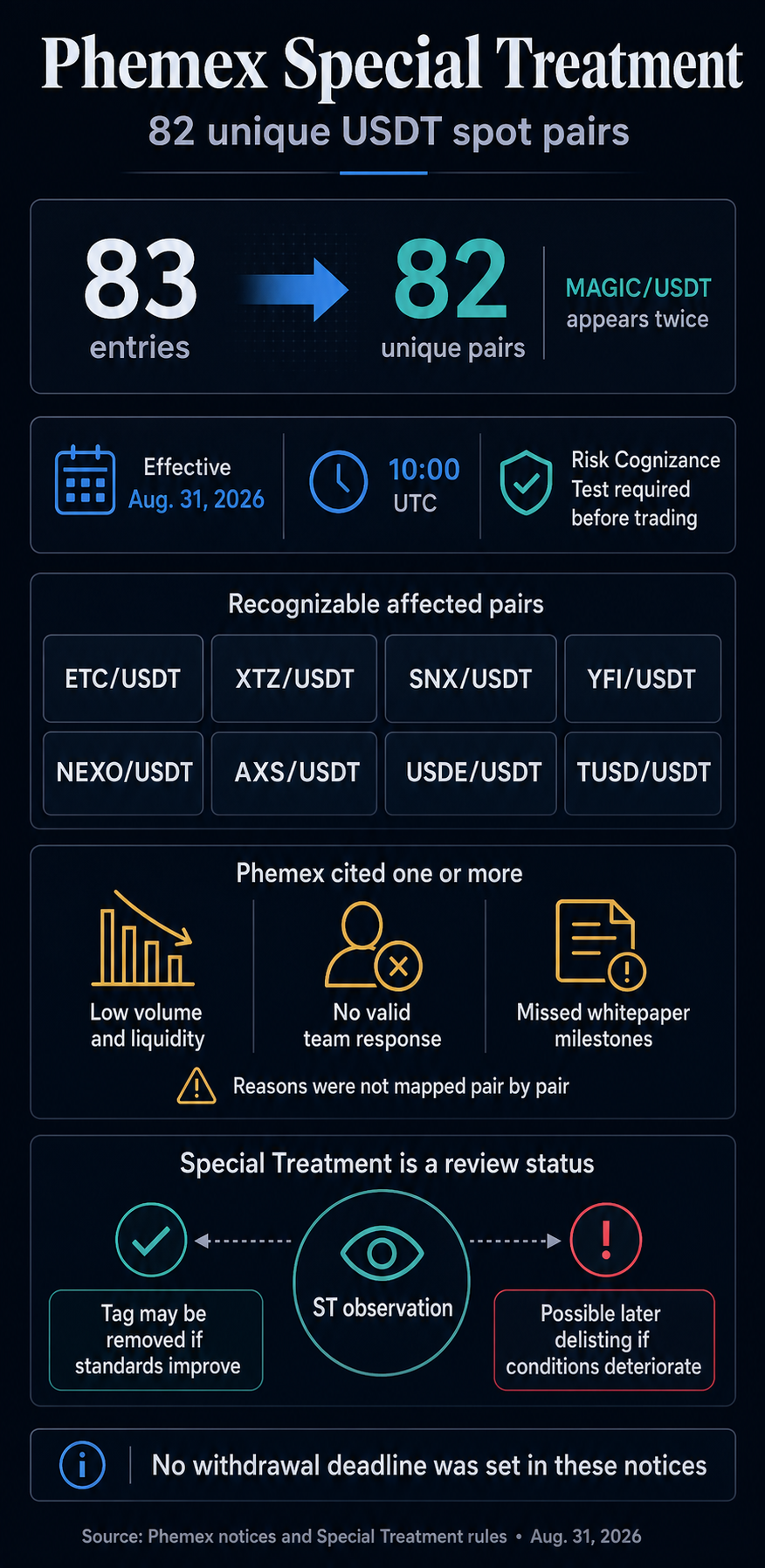
Phemex placed 82 unique USDT spot pairs under Special Treatment on Aug. 31, requiring users to pass a mandatory Risk Cognizance Test before trading them. The restriction took effect at 10:00 UTC and applies to established assets including ETC, XTZ, SNX, YFI, NEXO, AXS, USDe and TUSD.
The exchange announced the move in separate 43-pair and 40-entry notices. Together, the pages contain 83 entries, but MAGIC/USDT appears twice in the second notice, leaving 82 distinct markets.
The 82 pairs under review
The first notice lists SHELL/USDT, PORTO/USDT, ANKR/USDT, SPELL/USDT, OPEN/USDT, CVC/USDT, DOLO/USDT, AIN/USDT, KERNEL/USDT, ORDER/USDT, TURTLE/USDT, GIGA/USDT, KAT/USDT, ZKP/USDT, DOOD/USDT, NS/USDT, WCT/USDT, TKO/USDT, FIDA/USDT, ZBCN/USDT, 1000SATS/USDT, RED/USDT, ALLO/USDT, TFUEL/USDT, GWEI/USDT, 2Z/USDT, SIREN/USDT, RAVE/USDT, HEI/USDT, BANK/USDT, Q/USDT, TST/USDT, BLUAI/USDT, PHA/USDT, AXS/USDT, NEXO/USDT, MMT/USDT, COTI/USDT, KSM/USDT, ALICE/USDT, SLP/USDT, POPCAT/USDT, and C98/USDT.
The second notice has 40 entries but 39 unique pairs: GNS/USDT, API3/USDT, YFI/USDT, MEME/USDT, CFX/USDT, ID/USDT, REZ/USDT, ACT/USDT, ZK/USDT, MAGIC/USDT, CYBER/USDT, MASK/USDT, HMSTR/USDT, CATI/USDT, DOGS/USDT, ME/USDT, AUDIO/USDT, G/USDT, METIS/USDT, XTZ/USDT, ETC/USDT, PORTAL/USDT, XAI/USDT, SNX/USDT, BANANA/USDT, JOE/USDT, USDE/USDT, 1000000BABYDOGE/USDT, GMT/USDT, TUSD/USDT, DIA/USDT, SOLV/USDT, RPL/USDT, 1000CHEEMS/USDT, B2/USDT, ZEUS/USDT, B3/USDT, WET/USDT, and STO/USDT. MAGIC/USDT is the repeated entry.
Phemex said each pair triggered one or more of three reason categories: persistently low volume and insufficient liquidity, a project team's failure to provide a valid response to requests for operational updates, or missed critical whitepaper milestones without a reasonable public explanation.
The notices do not say which reason applies to which pair, so the designation does not show that every project triggered all three.
The exchange's published Special Treatment rules are broader. A project is classified as low-liquidity if it meets three of four tests: a bid-ask spread above 0.5%, subject to a tick-size adjustment, average daily pair volume below 30,000 USDT for three consecutive months, no trades for 120 consecutive minutes outside a technical issue, or market capitalization below 3 million USDT for three consecutive months.
A separate potential-risk classification needs only one listed condition. Those include a technical or security breach, failure to update or disclose project information, possible legal or regulatory violations, negative public reports, market misconduct, a high-risk assessment by Phemex's internal teams, or another situation the exchange considers risky.
Users must pass the Risk Cognizance Test before trading a pair affected by Special Treatment. Phemex said it will continue reviewing the projects and may remove the tag if conditions improve or delist a token later if they deteriorate.
The notices set no withdrawal deadline. Holders were told to monitor Phemex announcements and evaluate the risks while the observation period continues.
Mentioned in this article










Editorial credits