
Quick Take
- Hester Peirce’s Oct. 2 exit leaves Atkins and Uyeda as the SEC’s two listed commissioners for Commission decisions.
- The new exception permits one eligible member’s quorum when every other sitting member is disqualified from that matter.
- Custody and offering rules remain proposals, while tokenized-stock access relief is already an issued conditional order.


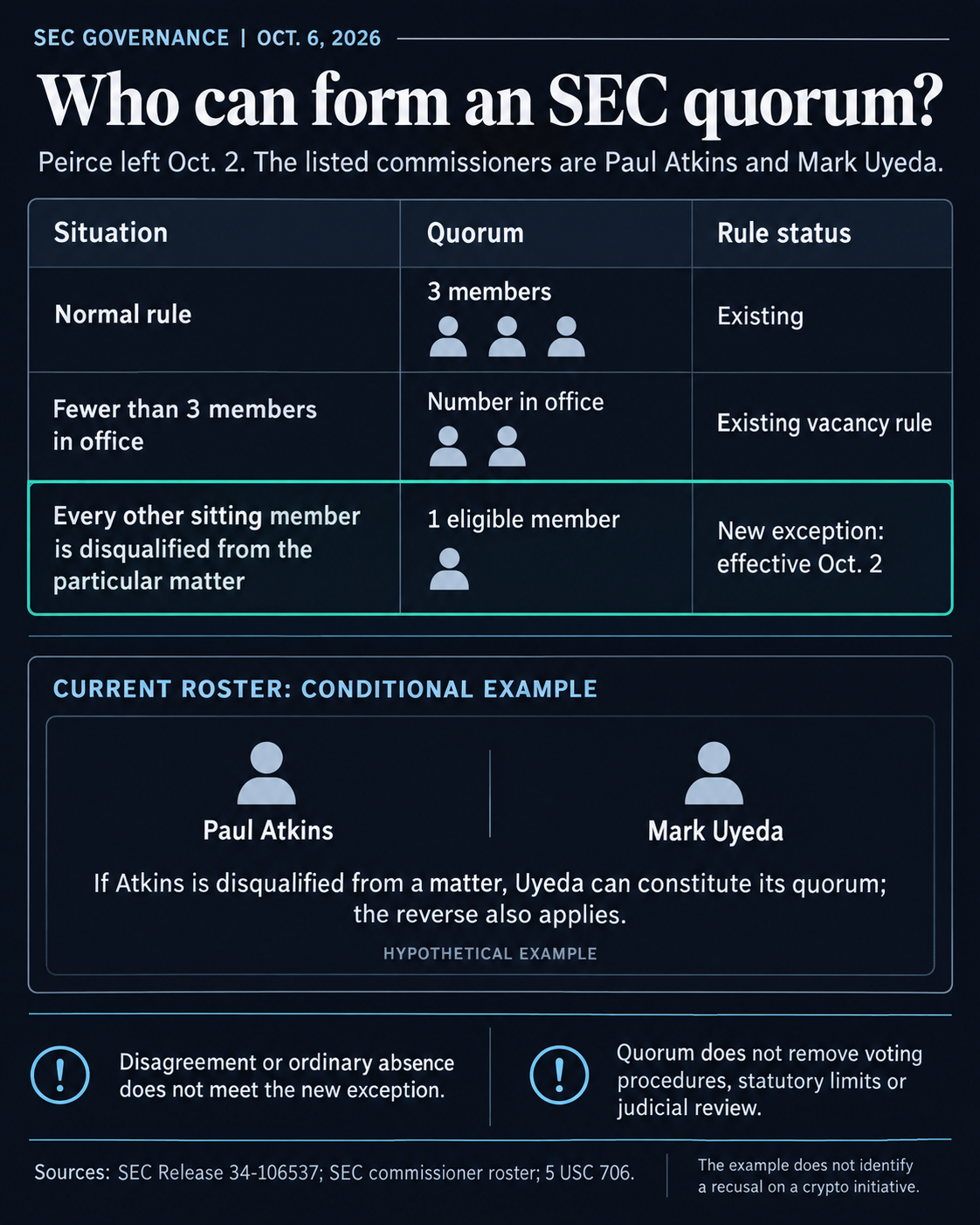
Hester Peirce’s Oct. 2 resignation has left Paul Atkins and Mark Uyeda as the SEC’s two listed commissioners. A new rule permits one eligible member to constitute a quorum when every other sitting member is disqualified from a particular matter.
Under the current roster, that combination puts future Commission decisions on crypto policy in fewer hands.
The one-member exception says it depends on disqualification from the specific matter, and it can allow either remaining commissioner to act as the Commission’s quorum in that situation.
Peirce’s resignation letter, dated Sept. 21, made her departure effective Oct. 2. The current commissioner roster, updated Oct. 3, lists Chairman Atkins and Commissioner Uyeda. The SEC’s historical service table also records Peirce’s tenure ending Oct. 2.
Custody reform and a new offering regime remain proposals, while tokenized-stock trading relief is already an issued conditional order. With the roster reduced to two members, further Commission-level decisions rest with a smaller body, subject to the rules and legal limits governing each action.
The quorum amendment, dated Sept. 30 and effective Oct. 2, changes 17 CFR 200.41, the rule defining how many commissioners must be eligible to conduct Commission business.
The existing vacancy exception already allowed the number of commissioners in office to constitute a quorum when fewer than three were serving. Two filled seats did not prevent the SEC from operating, and that exception already covered even a Commission with only one sitting member.
Previously, the separate provision for disqualifications accommodated two eligible commissioners after others were disqualified. The amendment extends that provision to one eligible commissioner, for the matter concerned, when every other member in office is disqualified.
Under the current roster, if Atkins were disqualified from a particular matter, Uyeda could constitute its quorum, and the same would apply in reverse.
The distinction keeps vacancies, nonattendance and recusal from becoming interchangeable. An eligible commissioner’s disagreement with a proposal does not meet the new provision’s disqualification condition.
In the published rule, the SEC explains that disqualifications arise and that the agency needs to continue conducting business. It describes the amendment as promoting flexibility and finality, and finds that it concerns internal management and organization rather than substantive regulation.
That administrative rationale accompanies a change with practical consequences for who can make Commission decisions. Meanwhile, Peirce’s letter expressed confidence that Atkins, Uyeda and SEC staff will continue to balance individual choice with sensible regulatory protections.
Crypto measures still require different kinds of action
One pending rulemaking is the Oct. 1 custody proposal. It addresses how regulated investment companies may custody crypto securities and similar investments, how registered advisers may custody client crypto funds and securities, and related modernization and reporting requirements.
In his October statement, Atkins placed custody reform alongside the offering proposal, Commission interpretations, and staff tokenization work. That inventory spans several kinds of regulatory action, with different roles for commissioners and staff.
The SEC’s page still classifies the release as proposed and now lists Dec. 7 for public comments. The existence of a smaller Commission, or a new quorum exception, does not turn a proposed custody framework into operative permission.
The action also supplies a concrete example of how the agenda moved before Peirce left. The October voting record shows Atkins, Peirce, and Uyeda all approving release IA-7023 on Oct. 1.
Those were approvals to propose the custody rules, before her resignation and the quorum amendment took effect.
A second pending measure is Regulation Crypto Assets, issued Aug. 18 and published Aug. 21. It would create offering exemptions for certain investment contracts involving crypto assets, alongside disclosure requirements and continuing antifraud and antimanipulation obligations. It also proposes a conditional safe harbor concerning investment-contract status.
Tokenized-stock access is at a different stage. The Sept. 17 Innovation Exemption is a temporary conditional exemptive order that covers specified tokenized National Market System (NMS) stock trading venues and certain liquidity providers.
The order’s fact sheet describes five-year conditional relief, with limits on stock symbols and volume, equivalent shareholder rights, public auditable smart contracts, and operating disclosures. For stock tokenized by an unaffiliated third party, it also requires issuer notice and an opportunity to object.
Those conditions remain part of the pathway available to qualifying participants. A future Commission decision on that relief would occur under the applicable quorum arrangements, but the new quorum rule itself neither broadens the exemption nor removes its safeguards.
A quorum does not replace voting or legal authority
For decisions circulated among commissioners, the SEC’s seriatim rule says a matter is not final until each member reports a vote or intended nonparticipation to the secretary.
Any commissioner can request that a circulated matter be withdrawn and scheduled for joint deliberation.
Under 17 CFR 200.60, commissioners should carefully weigh qualification in matters involving interests and relationships, and an individual member’s qualification rests with that member. The amended quorum clause also covers members otherwise disqualified.
Staff no-action and tokenized-securities statements are a separate part of the policy inventory described by Atkins.
The statutory delegation provision allows delegation through published orders or rules, while excluding general rulemaking from that authorization. It preserves Commission review and permits one member to bring a delegated action before the Commission for review.
The smaller body also remains constrained by applicable law. The Administrative Procedure Act provides notice-and-comment requirements for covered rulemaking, with specified exceptions. The SEC’s finding that its organizational quorum amendment did not require notice and comment is not a general exemption for future crypto rules.
Under judicial-review law, reviewing courts can set aside agency action found unlawful, beyond statutory authority or taken without required procedure. Reducing the number of eligible commissioners does not supply additional substantive authority or insulate a decision from review.
The SEC’s currently posted October tally contains the three-member custody vote, with no later one-member crypto decision listed. The agency says it generally posts votes only when the matter is final, so that tally supports a limited observation rather than an exhaustive claim about every action.
For crypto businesses, the next concrete milestones are the Oct. 20 offering-rule comment deadline, the Dec. 7 custody deadline, and any subsequent Commission decisions on those proposals or conditional trading relief.
Their legal status, recorded approvals, and participating members will show how the reduced Commission operates.
The new exception preserves an ability to act through disqualifications. Its effect on crypto policy will depend on which specific matters arise, who remains eligible to consider them, and the decisions they make.
Mentioned in this article



Editorial credits