
QIE Blockchain Unveils QIE ID & QIE Pass, The Identity Layer of Web3
QIE ID and QIE Pass aim to streamline Web3 payments, reusable identity verification, and trust across participating blockchain platforms.

CapeTown, South Africa, July 23rd, 2026,
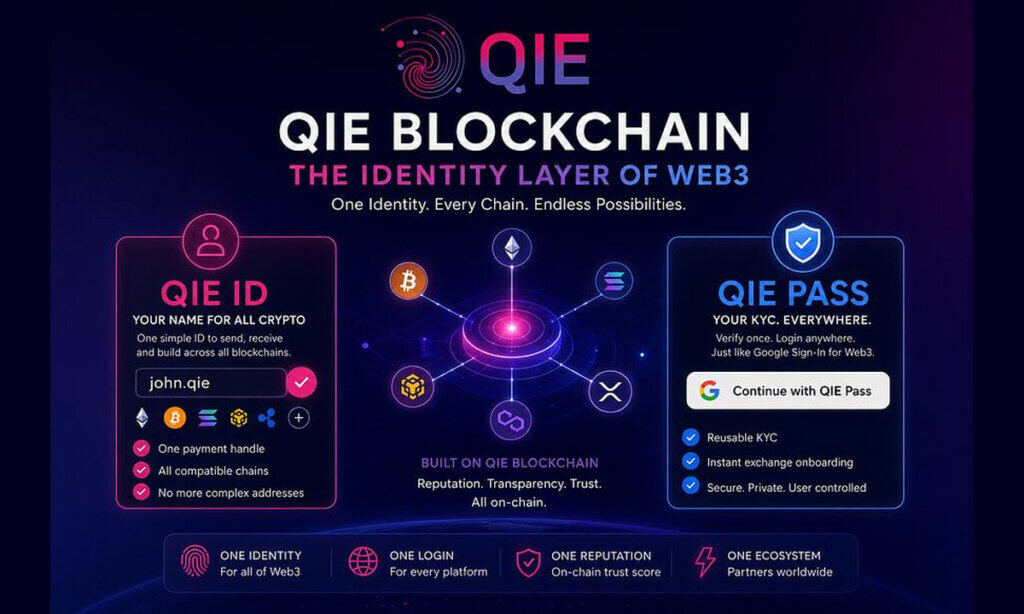
QIE Blockchain unveils QIE ID and QIE Pass, two products designed to simplify cryptocurrency payments, identity verification and trust across participating blockchain applications and exchanges.
Today, cryptocurrency users often manage multiple wallet addresses across different blockchain networks, repeat identity verification every time they register with a new exchange, and have limited ways to determine whether an unfamiliar wallet belongs to a legitimate user or a scammer. As Web3 adoption grows, many developers believe reducing this friction will become increasingly important.
QIE Blockchain aims to address this, with QIE ID and QIE Pass. Together, they aim to simplify cryptocurrency payments, identity verification and trust across participating blockchain applications and exchanges.
How QIE ID Works
QIE ID is designed to replace multiple blockchain wallet addresses with a single human-readable identity.
Instead of sharing separate addresses for Bitcoin, Ethereum, Solana or other supported networks, a user can register a single identifier such as john.qie or company.qie. When someone sends cryptocurrency to that identity, the system routes the payment to the appropriate blockchain wallet associated with the recipient.
From the sender's perspective, the process is intended to resemble sending an email rather than copying and verifying a lengthy wallet address.
QIE ID is available in three tiers. A free version provides randomly generated identities for supported EVM-compatible blockchains, while paid options allow users to register personalised names and extend support across additional blockchain networks. Unlike many blockchain naming services, QIE ID is offered as a once-off purchase without recurring annual renewal fees.
How QIE Pass Works
QIE Pass is designed to simplify this process through reusable identity verification.
Users complete KYC once through compliance provider Sumsub. After verification, they can choose to share their verified status with participating exchanges or applications instead of uploading identification documents again for every new platform.
The concept is comparable to the widely used “Continue with Google” feature. Rather than creating a separate account for every website, users authenticate using an existing verified identity after giving permission. QIE Pass applies a similar approach to regulated identity verification in the cryptocurrency industry.
For users, this can reduce repeated document uploads, selfie verification and waiting periods. For exchanges, reusable verification has the potential to shorten onboarding times, reduce verification costs and improve registration completion rates while maintaining compliance with KYC, AML and Travel Rule requirements through Sumsub.
Exchange Integrations
QIE Blockchain says QIE Pass has already been integrated with Bifinance, Coinstore and Biconomy, while integrations with LBank and Weex are currently underway.
The platform also allows exchanges to create branded identity namespaces for their users.
For example, instead of using a standard blockchain identity, an exchange could offer usernames such as username.lbank. These identities would remain linked to users' blockchain wallets while being visible through the QIE Blockchain Explorer, giving exchanges the ability to provide a branded Web3 identity experience for their customers.
Adding Trust to Wallet Addresses
Another challenge within the cryptocurrency ecosystem is trust.
Blockchain addresses reveal little about the history or reputation of the person controlling them. A wallet created five minutes ago appears similar to one that has been active for many years, making it difficult for users to distinguish between established participants and potentially fraudulent actors.
To address this, QIE Blockchain is developing an on-chain reputation system linked to QIE IDs.
The proposed reputation score combines objective blockchain activity with verified identity signals, including wallet age, transaction history, verified QIE Pass status, staking activity and verified community reports relating to fraudulent behaviour. The intention is not to replace blockchain transparency, but to provide additional context when users interact with unfamiliar wallets.
A Broader Industry Trend
As blockchain technology continues to mature, improving usability is becoming an important focus for developers across the industry.
Human-readable identities, reusable digital verification and on-chain reputation systems are increasingly being explored as ways to reduce friction without changing the underlying principles of decentralised networks.
Whether these approaches become widely adopted will depend on participation from exchanges, wallets, developers and users. However, simplifying payments, reducing repetitive identity verification and improving trust between participants are challenges shared across the broader Web3 ecosystem.
Projects such as QIE Blockchain represent one approach to addressing these issues by introducing identity services that operate alongside existing blockchain infrastructure rather than replacing it.
About QIE Blockchain
QIE Blockchain is a Layer-1 blockchain focused on digital identity, reusable compliance and blockchain payments. Its ecosystem includes QIE ID, a human-readable blockchain identity service, and QIE Pass, a reusable KYC solution designed to simplify onboarding for cryptocurrency exchanges and decentralised applications. The platform also supports smart contracts, decentralised finance, staking and digital identity infrastructure for Web3 applications.
QIE Web3 identities are available through https://qiewallet.me.
Contact
QIE Blockchain PR Team
info@qiewallet.me