
Quick Take
- New York sued Polymarket, alleging its US prediction market operates as an unlicensed gambling platform.
- The state wants restrictions spanning sports, elections and culture, plus restitution, disgorgement and triple-gain penalties.
- Polymarket is now the latest federally regulated prediction market caught in New York’s widening enforcement push.


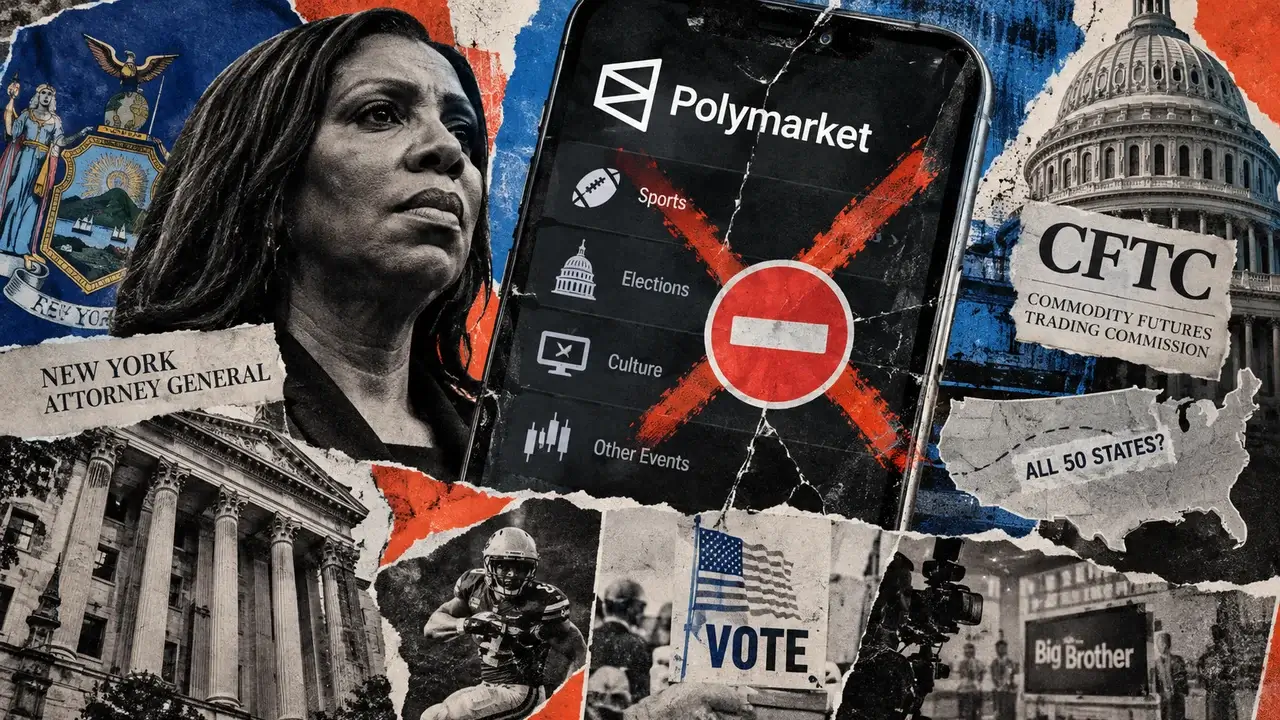
New York has sued Polymarket, alleging its US prediction market is an unlicensed gambling business operating across the state.
On Sept. 24, Attorney General Letitia James asked a New York state court to stop QCX LLC, which operates as Polymarket US, from offering event contracts without a state gaming license and to order restitution, disgorgement, and potentially substantial penalties. The petition covers contracts tied to sports, elections, culture, and other events.
The action targets a company that is also regulated at the federal level. QCX has been a Commodity Futures Trading Commission (CFTC)-designated contract market since July 2025, placing the lawsuit within a broader dispute over how federal derivatives oversight interacts with state gambling laws.
New York says Polymarket contracts amount to gambling
New York's case starts with the structure of Polymarket's contracts.
Users buy contracts tied to the outcome of future events, with winning positions ultimately paying according to whether the specified event occurs. The state argues that because customers risk money on outcomes outside their control, the transactions meet New York's definition of gambling.
The petition describes Polymarket as offering what is “quintessentially wagering” under the guise of event contracts and alleges that the company accepts public wagers despite having no license from the New York State Gaming Commission.
Kathy Hochul, New York's Governor, said:
“Calling it a ‘prediction market’ doesn’t change the facts. If you’re taking bets in New York, our gambling laws apply.”
The state cited Polymarket's marketing in its case. The company announced its US app in December 2025 with “sports—followed by markets on everything” and advertised itself as “legal in all 50 states.” An earlier promotion said users would be able to “TRADE EVERY FOOTBALL GAME IN ALL 50 STATES.”
Investigators said the platform offered markets involving the New York Mets, college football games, the New York governor's race and reality television show “Big Brother.” The petition also alleges Polymarket repeatedly advertised and solicited users located in New York through the internet and social media.
Sports contracts add another layer to the state's case. New York requires mobile sports wagering operators to hold a state license, while Polymarket has none, according to the filing.
The attorney general also alleges violations of the federal Wire Act through the transmission of sports wagers, information used to place them, and communications confirming payments across state lines.
Age restrictions are also central to the complaint. Polymarket allows users aged 18 and above, while New York requires mobile sports bettors to be at least 21. The state is asking the court to prohibit Polymarket from allowing people under 21 to wager on the covered event contracts.
James tied those requirements to New York's broader argument that unlicensed operators avoid safeguards and taxes imposed on licensed gaming companies.
“By skirting New York’s laws, Polymarket is targeting the most vulnerable and depriving New York families of critical services and support,” James said. New York says gambling tax revenue supports schools, youth programs and treatment for problem gambling.
State seeks triple gains and $100,000 penalties
The remedies sought by New York extend beyond shutting down Polymarket's sports contracts.
James wants a permanent injunction preventing the company from operating an unlicensed gambling business within or from New York, including by offering contracts tied to “sports, culture, elections, and other events” without obtaining the required state licenses. The requested order would also cover advertising, marketing, and soliciting participation in those contracts.
That wording would place political and cultural markets alongside sports contracts under the same requested restrictions rather than confining the case to products that resemble conventional sportsbook wagers.
New York also wants Polymarket to provide an accounting that identifies its customers and itemizes bets placed, customer losses, and gains the company received. It is seeking full restitution for customers, damages, and disgorgement of money obtained through the alleged violations.
The state is also seeking a penalty equal to three times Polymarket's gains from the alleged illegal activity.
Sports wagering carries a separate potential cost. The petition seeks $100,000 for each offering or attempt to offer unauthorized sports wagering or mobile sports wagering within or from New York. It does not specify how many offers could ultimately qualify, leaving the size of that portion of any potential penalty unresolved.
The attorney general alleges Polymarket has operated or indirectly operated a sports wagering platform in New York since at least Jan. 23, 2025, and has continued to advertise it to people in the state.
Polymarket becomes latest target of New York prediction-market push
The lawsuit follows a series of similar actions by New York against companies offering event contracts under prediction-market structures.
James sued Coinbase Financial Markets and Gemini Titan in April, alleging their prediction markets constituted unlicensed gambling because customers could bet on sports, elections and entertainment events.
Those cases also sought forfeiture of alleged illegal profits, restitution and fines equal to three times the companies' profits from the challenged activity.
New York followed in July with a lawsuit against Kalshi, another CFTC-designated contract market. That petition similarly sought to stop Kalshi from operating an unlicensed gambling business, recover alleged illegal gains, compensate users and impose fines equal to three times its gains.
The Kalshi dispute had already tested the boundary between federal derivatives regulation and state gambling enforcement.
Earlier in July, James and Hochul said Kalshi had lost a lawsuit against the New York Gaming Commission and pledged to continue applying state gambling laws to prediction markets.
The Polymarket petition now asks the same state court system for a comparable package of relief, while adding allegations tied to Polymarket's own sports promotions and New York activity.
Mentioned in this article





Editorial credits