
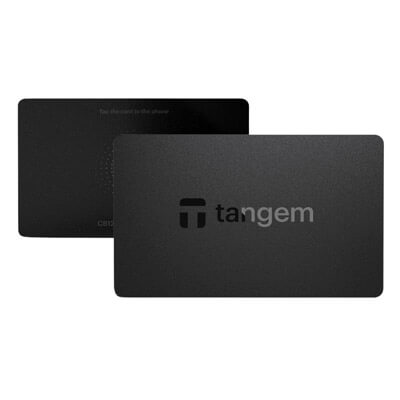
Tangem uses battery-free NFC cards for phone-based signing. Linked cards provide backup access, but there is no independent display, card firmware cannot be updated and lost backup cards cannot be replaced.
Tangem vs Ledger: Which Hardware Wallet Fits You?
A Tangem tap uses your phone’s description of the transaction. Ledger gives you another screen to inspect, but adds device and coin-app maintenance. The featured entry-level comparison is Tangem’s card set against Nano S Plus; iPhone users need a different Ledger model.
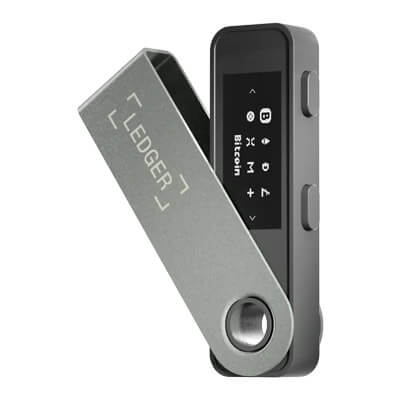
Ledger Nano S Plus is a battery-free USB signer for computers and Android. Its small screen and buttons require careful review, and it cannot sign through an iPhone. Firmware and coin apps need separate updates.
Affiliate Disclosure
Some links in this comparison are affiliate links. CryptoSlate may earn a commission if you sign up through these links. Our ratings remain editorially independent.
Overview
Tangem’s card sets are compared with Nano S Plus, Nano X and Flex. The featured rating belongs specifically to Nano S Plus, not the whole Ledger range. Decide first whether independent transaction display or battery-free phone signing matters more.
Tangem Ledger Nano S Plus
Reviewed hardware
Two-card and three-card sets, plus the Ring bundle
Nano S Plus, Nano X, Flex
Key location
Secure element, seedless on-card generation or phone-based phrase setup
Secure element, device-generated standard backup
Transaction display
Phone only
Separate screen on all three devices
Default backup
Linked cards without a written phrase
24-word BIP39 phrase
Electronic spare
Another card can sign independently
Flex includes Recovery Key, which is not a signer
Card/device updates
Card firmware fixed, app updates available
Device OS and blockchain apps can be updated
Phone connection
NFC on compatible iOS/Android phones
Nano X/Flex Bluetooth, Nano S Plus wired Android only
Advertised USD prices, September 11, 2026
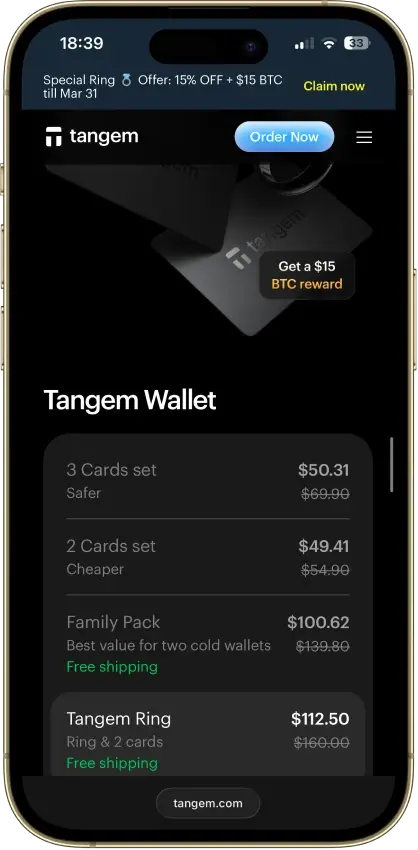
Two cards $59.90, three $69.90, Ring bundle $160
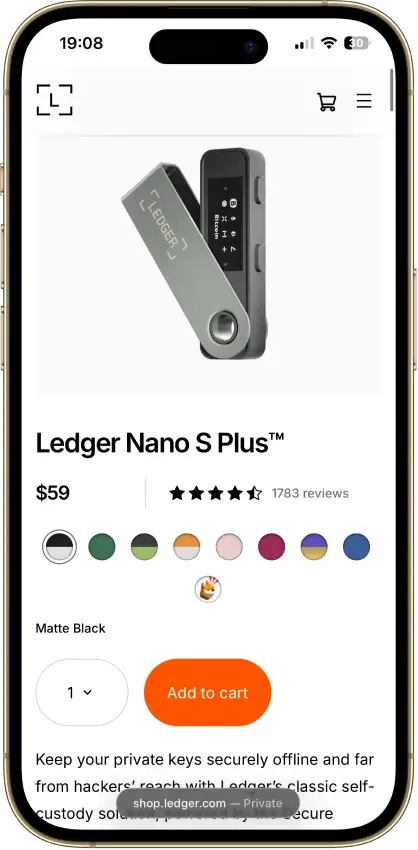
Nano S Plus $59, Nano X $99, Flex $249
Best fit
Battery-free phone signing and distributed card storage
Hardware-screen review and desktop or mobile connections
Ledger Nano S Plus wins overview
Comparison scope: Tangem second-generation-or-later card sets, with Ring and two-card bundle context, versus Ledger Nano S Plus, Nano X and Flex. Other Ledger models and Tangem Mobile are outside scope. Documentation checked September 9–11, 2026, with advertised USD prices rechecked September 11. No hands-on testing or checkout purchase was performed.
Screenshots
Tangem screenshots
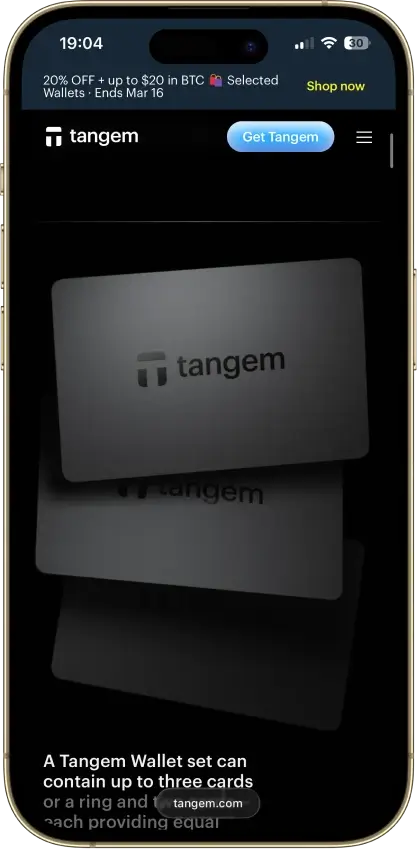
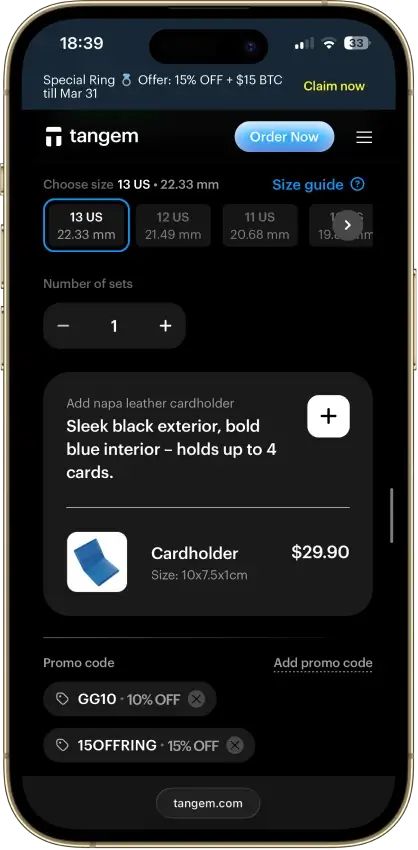
Screenshot 1 of 4
Ledger Nano S Plus screenshots
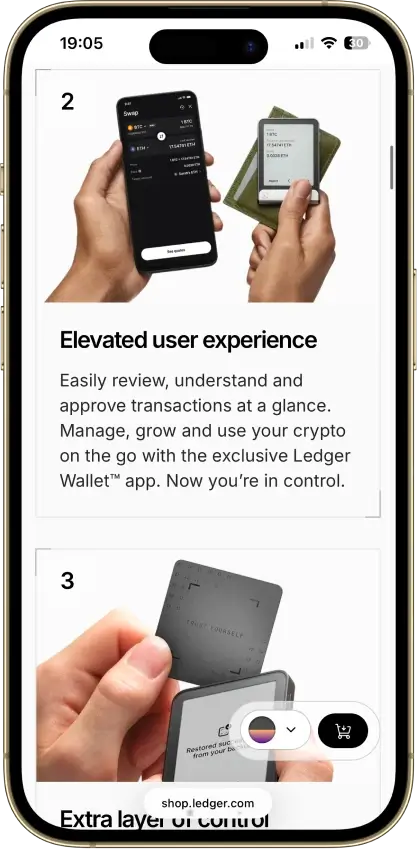
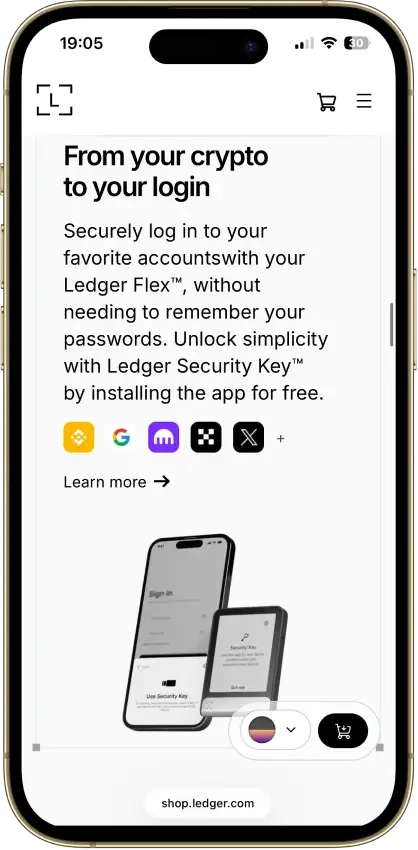
Screenshot 1 of 4
Winners By Category
The compared Ledger models win on having an independent approval screen and updateable device software. Tangem offers battery-free NFC phone signing and linked spare cards. Neither design establishes immunity to software defects or physical attacks.
Tangem Ledger Nano S Plus
Both use hardware-held signing keys, but optional seed creation and recovery services change where backup material exists.
Secure element, seedless on-card generation or phone-based phrase setup
Secure element, device-generated 24-word backup, optional Recover
Users checking a potentially compromised host get an independent display, subject to the installed app correctly presenting the request.
Phone-only transaction display, passive NFC
Separate screen on all three devices, Clear Signing, Transaction Check on Flex
Tangem can avoid written words, while Ledger starts with a portable phrase. Complete card loss and phrase exposure are different risks.
Linked cards without a written phrase, seeded setup on newer cards
24-word BIP39 phrase, Flex Recovery Key, optional paid Recover
Common native assets overlap, but support for a specific NFT, network or frontend must be checked separately.
Native BTC, ETH, SOL and XRP, WalletConnect on Solana and listed EVM networks
Native BTC, ETH, SOL and XRP, Ledger Wallet plus device-specific frontends
Tangem removes cables and charging from phone signing. Ledger supplies direct desktop access and model-specific mobile connections.
Battery-free NFC signing on compatible iOS and Android phones
Nano S Plus wired desktop and Android, Nano X and Flex Bluetooth
One Nano S Plus costs less than a Tangem set, while Tangem includes multiple signers. Swap quotes change with the provider and trade.
Two cards $59.90, three $69.90, Ring bundle $160, Yield Mode takes 15% of yield
Nano S Plus $59, Nano X $99, Flex $249, provider-specific staking terms
Base custody, product orders, blockchain queries and identity-checked services expose different information. Neither setup establishes anonymity.
Stated no collection of addresses or personal data, possible IP visibility
Wallet and IP addresses listed as possible personal data, consent settings
Owners who accept vendor-supplied updates have a device-level correction path unavailable to existing Tangem cards, without a guaranteed support lifetime.
Card firmware fixed, phone app updates, 25-year hardware warranty
Device OS and blockchain apps can be updated
A screen is useful only when the installed app describes the operation correctly. A software patch path is a maintenance advantage, not a promise of longer support.
Custody And Key Control
Both use hardware-held signing keys, but optional seed creation and recovery services change where backup material exists.
Tangem Ledger Nano S Plus
Standard Key Generation
Seedless in-chip setup or optional phone-based phrase setup
Device-generated 24-word phrase
Optional External Backup Holders
Owner controls linked cards and any saved phrase
Optional Recover providers hold encrypted fragments
No clear winner
Tangem offers a hardware-generated, phrase-free choice that Ledger's standard setup does not mirror. Ledger supplies a conventional recovery phrase from the outset, while Tangem's seeded alternative changes the setup exposure. The preferred arrangement depends on which additional copies and recovery dependencies you accept.
Where Keys Originate
Tangem's seedless mode generates keys inside a card and transfers encrypted backup material to the other linked cards. Each card then has spending authority. Adding a third card does not create a voting threshold, and two cards do not need to approve an ordinary payment together.
With newer Tangem cards, you can instead generate a 12- or 24-word phrase in the phone app or import an existing phrase. That places recovery material outside the chip during setup. A claim that the keys have only ever existed in hardware therefore needs the seedless qualification.
Ledger's standard setup generates its backup on the device and displays 24 BIP39 words there. The phrase enables restoration using compatible software or hardware. Any separately configured passphrase must also be preserved for its associated accounts.
Chips And Additional Trust
Tangem's specified chip is Samsung's S3D232A, certified EAL6+. Nano S Plus and Flex list ST33K1M5 chips at EAL6+, while Nano X lists ST33J2M0 at EAL5+. EAL ratings apply to the chips. Wallet-level behavior also depends on transaction-handling software.
Ledger Recover optionally sends encrypted backup fragments to three providers: Coincover, EscrowTech and Ledger. An owner authorizes this subscription backup, and identity-checked restoration uses two fragments. Ordinary local use does not require it. Tangem's seedless configuration depends on its linked devices and compatible software.
Security And Transaction Signing
Users checking a potentially compromised host get an independent display, subject to the installed app correctly presenting the request.
Tangem Ledger Nano S Plus
Independent Approval Display
None on card or Ring
Nanos: screen/buttons; Flex: touchscreen
Whole-Wallet Safety Guarantee
No
No; correct app interpretation still matters
No clear winner
A user worried about a compromised phone or computer gains an independent verification point with these Ledger models. That advantage requires correctly implemented transaction display and careful approval, not merely ownership of a screen. Tangem's hardware signing does not supply the missing second display.
What The Screen Can Verify
Nano S Plus and Nano X have OLED screens and buttons, while Flex has a 2.8-inch E Ink touchscreen. Tangem's cards have no independent display, leaving the phone to describe what a tap will authorize.
A Ledger screen provides a separate place to inspect a recipient and amount, but it depends on the blockchain app presenting the right information. Clear Signing covers supported interactions, not every contract. Flex also supports Transaction Check, using a Blockaid assessment on supported routes. The two Nano models compared here do not have Transaction Check. Treat its assessment as an additional risk signal, with safe approval still dependent on the request itself.
Tangem's Disclosures And Audit Limits
The Tangem card wallet review details its December 2024 logging flaw: seeded setup could leave private keys in logs sent to support within seven days of activation. Cointelegraph reported the incident. Tangem's stated fixes were Android 5.19.2 and iOS 5.19.1, with seedless setup excluded from that bug.
Donjon, part of competing manufacturer Ledger, disclosed a physical access-code guessing attack in September 2025. Tangem disputed the demonstration's practical success in its response to the researchers. These were competing accounts, not an independently replicated result.
Donjon's separate July 2026 laser-assisted password reset required possession of a card and invasive laboratory work, not remote phone access. Tangem accepted that this lab scenario was possible but challenged its everyday relevance. The Block reported both positions.
Donjon said the affected cards could not be patched. This concerns the disclosed card hardware, not a demonstrated attack on every future Tangem product or the Ring.
Tangem's hosted 2018 Kudelski summary excluded physical attack resistance. The public 2023 Riscure PDF withholds the full report. Cure53's February 2026 summary concerned SDK testing in November 2025, with ten fixes validated and two low-impact issues remaining. Read each as a dated, scoped assessment of the tested components.
Ledger's App And Integration History
Ledger's ANSSI-hosted Nano X evaluation target covers OS 2.1.0 and only the Dashboard, Bitcoin and Ethereum apps. Its historical scope is limited to that configuration.
Ledger's August 2026 bulletins described a flaw in affected apps: a compromised host could change signing parameters while the user reviewed the transaction. They also covered two separate Ethereum app flaws. Decrypt reported rival OneKey researchers' laboratory reproduction of that signing-parameter flaw in the Ethereum app, along with Ledger's response. The later parsing and swap-approval problems required Ethereum app 1.22.3, according to Ledger's bulletins. CryptoSlate also reported these disclosures. Updating the hardware OS alone is not a substitute for updating installed blockchain apps.
The family also has a June 2026 Nano-scoped Monero disclosure and a Zilliqa app incident disclosed in 2026 involving legacy signing, account-key exposure and theft, neither established here as a Flex fault. Ledger's December 2023 Connect Kit compromise involved malicious web integration code and deceptive approvals, not secure-element extraction.
Connectivity And Physical Attack Surface
Tangem cards communicate through passive NFC. Nano S Plus uses USB, while Nano X and Flex add Bluetooth. Nano X's documented pairing uses numeric-code comparison, and Bluetooth can be disabled for wired use. Flex protects signing with a device PIN, distinct from the Recovery Key card's PIN. These connection choices alone cannot establish physical-attack resistance.
Recovery And Backup
Tangem can avoid written words, while Ledger starts with a portable phrase. Complete card loss and phrase exposure are different risks.
Tangem Ledger Nano S Plus
Loss Of All Signing Devices
Seedless access ends; seeded wallet needs saved phrase
Restore with phrase and any exact passphrase
Electronic Backup Role
Each linked card can sign independently
Flex Recovery Key backs up words and cannot sign payments
No clear winner
Tangem's card-only option avoids storing words but cannot survive total device loss. Ledger's standard phrase can outlive the device, at the cost of protecting an independently usable secret. Flex's backup card adds convenience without becoming a second signing wallet.
Losing A Signer Is Not Losing Every Backup
A lost Tangem card cannot be remotely disabled or replaced within its completed set. Surviving cards preserve access, but the missing card retains the same keys. Removing that exposure requires a new wallet and transfer of funds.
Seedless Tangem recovery ends when all usable cards are gone. A saved phrase from seeded setup gives another route, subject to the receiving wallet's networks and derivation paths. Losing only the phone is different: a compatible replacement phone can work with a surviving card and its access code.
Ledger's phrase can restore access after the device fails or disappears. A second Ledger may provide a ready spare, but buying one is not necessary to have a backup. A stolen phrase can also restore accounts for someone else, which makes its storage a separate security responsibility.
Two Different Ledger Backup Products
Flex includes a Recovery Key card holding an encrypted backup of the 24 words. That card has its own PIN and erases its backup after three incorrect attempts. It cannot sign payments like a spare Tangem card. Additional passphrases need separate protection, and the written phrase still has to be kept.
Ledger Recover is the optional paid service, not this NFC card. Supported devices, identity documents and service availability constrain its use. Neither recovery product supplies a forgotten additional passphrase.
Networks, Assets, And dApp Access
Common native assets overlap, but support for a specific NFT, network or frontend must be checked separately.
Tangem Ledger Nano S Plus
Native Network Examples
Bitcoin, Ethereum, Solana and XRP
Bitcoin, Ethereum, Solana and XRP
Specialized App Routes
Phone WalletConnect on listed networks
Nanos: Monero interfaces; Flex: documented Phantom route
No clear winner
Shared BTC, ETH, SOL and XRP support does not settle specialized use. Tangem's mobile connections and Ledger's device-specific frontends need to match your intended transactions. Headline token totals hide those distinctions.
Asset Holding And Application Access
Both families support native Bitcoin, Ethereum, Solana and XRP. A ticker match does not prove that every withdrawal network is supported. Ledger distinguishes assets managed in Ledger Wallet, formerly Ledger Live, from those requiring another interface. Tangem's storage list is also broader than its WalletConnect network list.
Tangem documents WalletConnect on Solana and listed EVM networks. A desktop dApp can show a QR code, but authorization still uses the phone and card. For Ledger, compatibility depends on the device and frontend. Phantom documents Flex over Bluetooth on mobile and by cable with its extension.
NFTs And Specialized Assets
Tangem supports NFTs on selected EVM networks and Solana, with sending restrictions for compressed and programmable Solana NFTs and frozen NFTs. The restriction concerns what can be sent, with Solana itself supported.
Monero documents Nano S Plus and Nano X with compatible GUI/CLI software, separately from Ledger Wallet. Flex support needs separate confirmation.
Platforms, Hardware, And Daily Use
Tangem removes cables and charging from phone signing. Ledger supplies direct desktop access and model-specific mobile connections.
Tangem Ledger Nano S Plus
Direct Desktop Signing
Phone and NFC card remain required
USB on all three compared models
iPhone Signing
Compatible NFC phone
Nano X or Flex, not Nano S Plus
Tangem is convenient for holders whose signing already happens on a phone and who do not want charging chores. A desktop user needs the direct connection supplied by Ledger, while iPhone users must exclude Nano S Plus. Flex's larger display costs more than either Nano model.
Phone, Cable Or Touchscreen
Tangem draws power from a compatible phone's NFC field. Thick or metal cases can interfere with scanning. Ring bundles include two cards, without adding a desktop signing interface.
The wired Nano S Plus works with desktop systems and Android over USB-C, without a battery or Bluetooth. It cannot sign with an iPhone. The Bluetooth-capable Nano X adds iOS use and a rechargeable battery while retaining button navigation.
The Ledger Flex touchscreen provides more space than the Nano screens for inspecting transaction details. Flex connects to phones over Bluetooth and to desktop systems over USB-C. Its NFC supports Recovery Key and authentication uses, not Tangem-style general phone tap signing. It charges by cable, not Qi wireless charging.
Maintenance And Support
Tangem's Help Center covers NFC and access-code problems. Support response times and battery endurance were not tested.
Do not confuse a support request with recovery authorization. The genuine help desk should not need a phrase, additional passphrase or card access code. Tangem's previous logging bug also makes sending diagnostic material a different decision from reading troubleshooting instructions.
Swaps, Staking, And Costs
One Nano S Plus costs less than a Tangem set, while Tangem includes multiple signers. Swap quotes change with the provider and trade.
Tangem Ledger Nano S Plus
September 11 Advertised Entry Price
Two cards: $59.90
Nano S Plus: $59
Minimum Recovery Purchase
Linked set for seedless use
One device plus protected written phrase
Nano S Plus has the lowest advertised single-purchase price here, while Tangem supplies multiple signing devices at entry. Higher hardware tiers and optional services change the bill. A matched, executable provider quote is needed to compare ongoing transaction costs.
Compare The Purchase You Actually Need
On September 11, Tangem listed two cards at $59.90, three at $69.90 and the Ring-plus-two-card bundle at $160. Ledger's published lineup advertised Nano S Plus at $59, Nano X at $99 and Flex at $249. These are advertised dollar prices, not observed regional checkout totals with delivery and taxes.
The cheapest Tangem set is $0.90 above one Nano S Plus and includes two signing cards. Two Nano S Plus units would total $118 at the advertised price, but that is a spare-device comparison, not the minimum cost of Ledger recovery. Tangem's third card costs another $10 when choosing the initial set. It cannot be added to a completed two-card wallet later.
Quotes, Providers And Yield
Tangem charges no extra commission for ordinary transfers, while blockchain fees remain payable. Its swaps use providers whose costs are reflected in the quote. Ledger's exchange documentation describes partner, Ledger and withdrawal fees included in the receiving amount, with the pay-in network fee charged separately.
Some integrated exchange routes send funds to a provider to complete the trade. Hardware approval does not remove that counterparty exposure or a possible identity check. Tangem purchase options include MoonPay, Mercuryo, Simplex and Unlimit. Ledger lists MoonPay, Transak, Revolut and Topper. Availability varies with payment method, asset and location.
Tangem integrates staking through services including Yield.xyz and P2P.org. Its separate Aave-based Yield Mode charges 15% of earned yield, and network fees still apply. Ledger staking routes have their own validator, provider and contract conditions. Compare the chosen asset's fees and withdrawal terms, not a headline yield figure. Hardware cannot guarantee funds committed to a lending contract.
Privacy And Data Collection
Base custody, product orders, blockchain queries and identity-checked services expose different information. Neither setup establishes anonymity.
Tangem Ledger Nano S Plus
Data Dependencies
Phone app, blockchain APIs and selected providers
Companion app, blockchain APIs and selected providers
Measured Privacy Advantage
No matched traffic test
No matched traffic test
No clear winner
Tangem's stated app policy and Ledger's consent controls do not amount to a matched privacy test. Separate the information needed for hardware delivery from wallet activity and optional identity-based services. Data collection also depends on the services a self-custody owner uses.
What Leaves The Wallet
Tangem says its app does not collect wallet addresses or personally identifying information, while acknowledging possible IP visibility. That is a vendor statement, not an independent traffic audit. Its continuity documentation describes external blockchain APIs and company services for authenticity, token information and prices. Hardware signing and the app's online data use are separate privacy questions.
Ledger's March 2026 privacy policy identifies wallet addresses and IP addresses as possible personal data and directs users to application settings to withdraw applicable consent. That does not establish that every service collects the same fields or that every setting disables required network communication. Neither product was traffic-tested for this comparison.
Orders And Optional Identity Checks
Ledger's 2020 customer-data breach and January 2026 Global-e order-data exposure concern identifiable buyers. BleepingComputer reported the latter with comments from both companies. Those incidents matter for targeted impersonation, but do not measure today's wallet telemetry or prove a current Tangem privacy advantage.
Tangem Pay has mandatory identity verification separate from the card wallet. Ledger Recover also introduces identity checks, and purchase or exchange providers on either side can request information. Keeping signing keys locally does not erase records supplied to an optional service.
Updates, Longevity, And Ecosystem
Owners who accept vendor-supplied updates have a device-level correction path unavailable to existing Tangem cards, without a guaranteed support lifetime.
Tangem Ledger Nano S Plus
Embedded Software Updates
Existing card firmware is fixed
OS and coin apps can receive corrections
Guaranteed Remaining Support
No verified software-support horizon
No verified software-support horizon
No clear winner
Ledger offers a device-software repair path for owners willing to trust and maintain vendor-supplied updates. Tangem's fixed cards cannot gain that capability through a phone-app release. This is a maintenance advantage, not a promise of indefinite support or immunity to future defects.
Fixed Cards And Patchable Devices
Tangem can update its phone apps but not the firmware inside existing cards. Ledger can distribute OS and blockchain-app corrections. Its Ethereum disclosures show why maintaining only the companion app is insufficient, even when the physical hardware has not changed.
Ledger's January 2025 bulletin described a compromised-host firmware-update attack that could disable Nano X and Flex. Fixes began at OS 2.4.2 and 1.2.2 respectively. Ledger said funds were not at risk from that defect. VulnCheck catalogued the disclosure without independently reproducing it.
Tangem's limited hardware warranty runs for an advertised 25 years. It does not promise equally long software or service availability, or protect against losing every backup card.
Public Code Is Not Unrestricted Maintenance
Tangem's Android and iOS code is publicly readable, but current repository licenses restrict distribution and commercial reuse. Its card firmware is closed. Ledger publishes companion and application code while retaining closed low-level secure-element firmware. Neither entire product should be labeled fully open-source.
Usable cards and compatible software remain necessary for Tangem seedless access. A Tangem or Ledger phrase allows external restoration only where the other wallet supports the accounts and derivation paths.
Final Verdict: Tangem vs Nano S Plus
Nano S Plus is our higher-rated entry-level pick at 7.0 versus Tangem’s 6.5, for compatible computer or Android USB use. Choose Tangem if battery-free phone signing and separately stored spare cards fit your routine better.
Affiliate Disclosure
Some links in this comparison are affiliate links. CryptoSlate may earn a commission if you sign up through these links. Our ratings remain editorially independent.
Ledger Nano S Plus wins final rating
The scores above apply to Tangem and Nano S Plus. Nano X and Flex have their own reviews and are the Ledger options here for iPhone signing. Flex’s Recovery Key is a backup card, not a spare signer like a linked Tangem card.
Tangem vs Ledger FAQs
Is Tangem or Ledger safer for checking transactions?
Ledger offers a separate display on all three compared devices, whereas Tangem cards rely on the phone screen. That favors Ledger when checking a host's request, but only if the installed app renders the operation correctly. Neither a touchscreen nor an NFC tap makes a malicious contract harmless.
Does Tangem or Ledger have better recovery?
Tangem's seedless route avoids written words but requires a surviving usable card. Ledger starts with a 24-word phrase that can restore compatible accounts after device loss. Tangem also permits seeded setup on newer cards. Choose according to which backup you can preserve, including any separate passphrase needed for Ledger accounts.
Can Tangem and Ledger update their hardware software?
Ledger can update device operating systems and blockchain applications. Existing Tangem cards retain fixed firmware, although their phone app can change. This matters when a flaw is inside a card rather than its companion app. Ledger's patch path still depends on owners installing appropriate updates and trusting the supplied software.
Does Tangem or Ledger support more coins?
Both support native BTC, ETH, SOL and XRP, but their broader counts describe different interfaces and operations. Tangem's WalletConnect coverage is narrower than its storage list. Ledger support may depend on another frontend and the exact model. Verify the required transfer, NFT operation or dApp connection instead of choosing by token count.
Is Tangem cheaper than Ledger?
On September 11, 2026, two Tangem cards were $59.90 against Ledger's advertised $59 Nano S Plus. Tangem includes a spare signer, while Ledger includes phrase recovery without requiring another device. Nano X was advertised at $99 and Flex at $249. Delivery, tax, accessories and optional services can change the final cost.
Can Tangem and Ledger work with iPhones?
Tangem uses NFC on compatible iPhones. Ledger Nano X and Flex connect to iPhones through Bluetooth, while Nano S Plus cannot sign with iOS. A Tangem desktop dApp connection still needs the phone and card to authorize requests. Check current phone and app compatibility before choosing either family's mobile setup.
Do Tangem and Ledger require identity verification?
Ordinary hardware-wallet setup does not require an identity-verified financial account. Tangem Pay and optional Ledger Recover have their own identity requirements, while integrated buy or swap providers may request documents. These services are separate from generating local wallet keys, and their processing rules can still apply to a self-custody user.
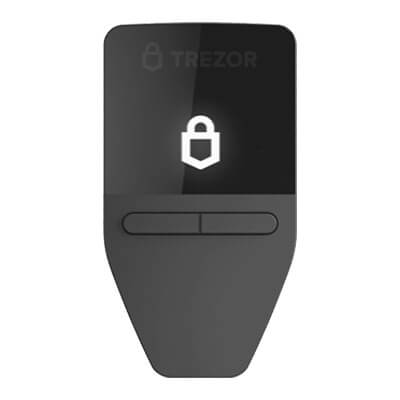
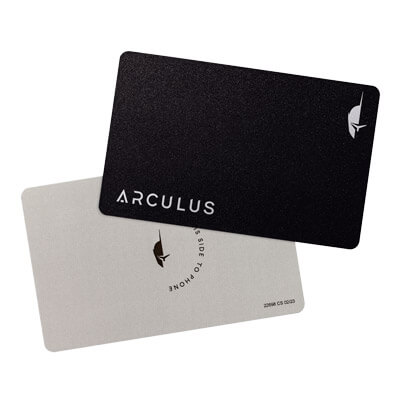

The September 11 advertised entry prices were $59.90 for two Tangem cards and $59 for one Nano S Plus. The card set supplies two signers, while a Ledger phrase already provides recovery without buying another device. Nano X and Flex add Bluetooth at higher prices.