
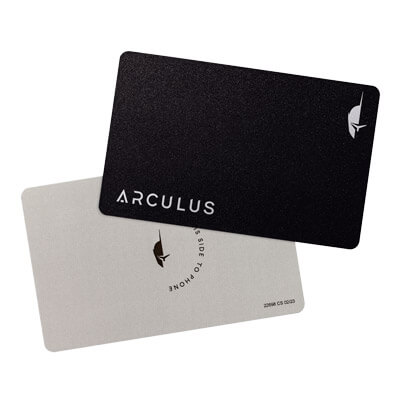
Arculus pairs a battery-free NFC signing card with a phone app. Recovery uses saved words and any passphrase, while transaction checks stay on the phone. Separate wallets each need their own card.
Arculus vs Tangem: Which Card Wallet Fits You?
Which backup can you protect more reliably: written recovery words or spare signing cards? Arculus builds around the written phrase. Tangem offers seedless setup with linked cards, but losing every card ends access in that mode. Neither gives you a transaction screen separate from your phone.
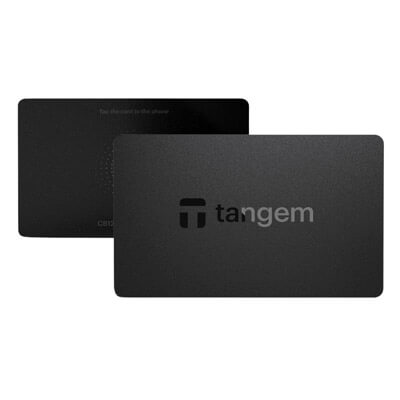
Tangem uses battery-free NFC cards for phone-based signing. Linked cards provide backup access, but there is no independent display, card firmware cannot be updated and lost backup cards cannot be replaced.
Affiliate Disclosure
Some links in this comparison are affiliate links. CryptoSlate may earn a commission if you sign up through these links. Our ratings remain editorially independent.
Overview
Both use battery-free NFC cards with a phone app. Their recovery choices differ more than the near-equal entry prices: Arculus includes phrase recovery, while Tangem’s two-card set gives you a spare signer for the same wallet.
Arculus Wallet Tangem
Compared package
One consumer NFC wallet card
Two-card or three-card hardware set
Key creation
Local app/card process, phrase displayed on phone
Chip-generated in seedless mode, phone phrase optional
Transaction display
Phone, no card screen
Phone, no card screen
Recovery
12 or 24 words and any enabled passphrase
Linked signers, optional phrase on newer cards
Replacement-phone access
Restore using recovery information
Existing linked card and access code with compatible app
App licensing
Proprietary usage terms
Public repositories under proprietary licenses
Network examples
Native BTC, ETH, SOL and XRP
Native BTC, ETH, SOL and XRP
Browser connections
WalletConnect plus MetaMask hardware connection
WalletConnect through phone app
Signing hardware
Battery-free NFC card, phone required
Battery-free NFC cards, phone required
Advertised USD price, September 11, 2026
$59.76 sale price for one card, reduced from $99
$59.90 for two cards, $69.90 for three
Tie
Comparison scope: current consumer Arculus wallet card versus Tangem second-generation-or-later two/three-card sets. Product documentation checked September 9–11, 2026, with US-dollar store prices checked September 11. No hands-on device, recovery or transaction testing was performed.
Screenshots
Arculus Wallet screenshots
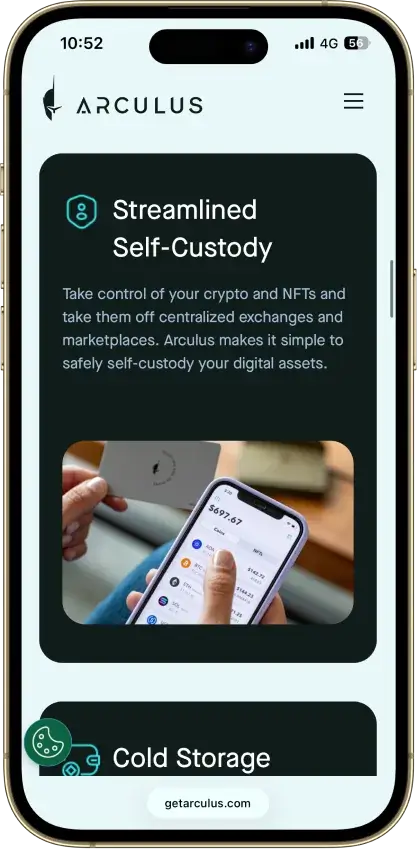
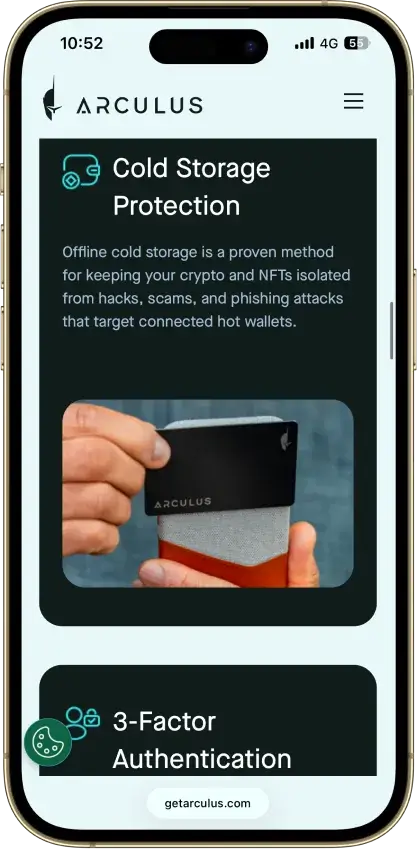
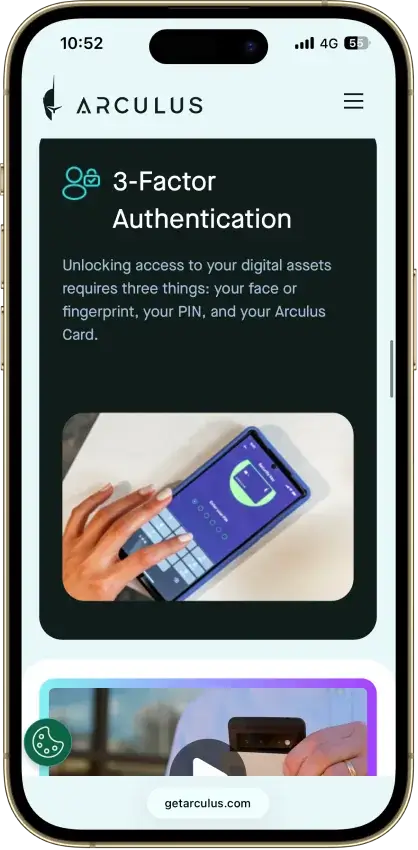
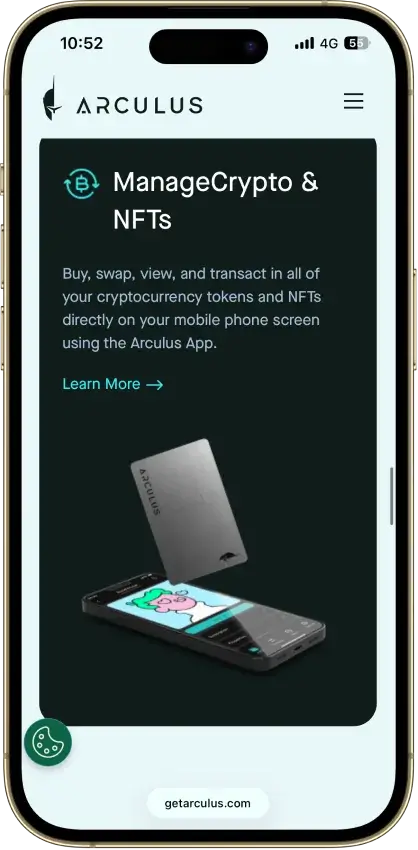
Screenshot 1 of 4
Tangem screenshots
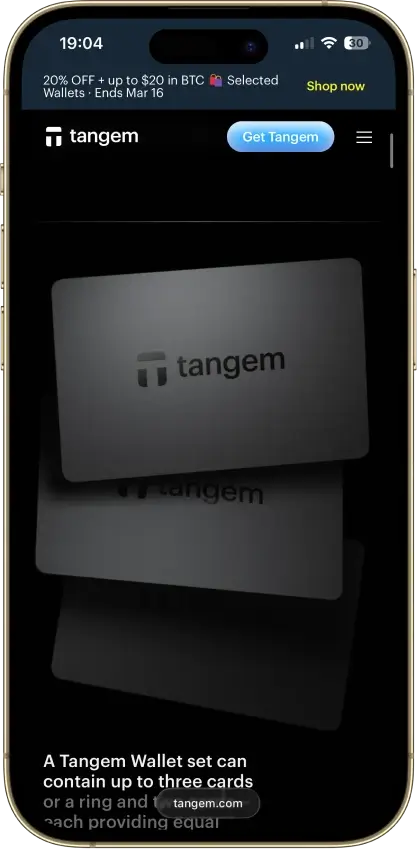
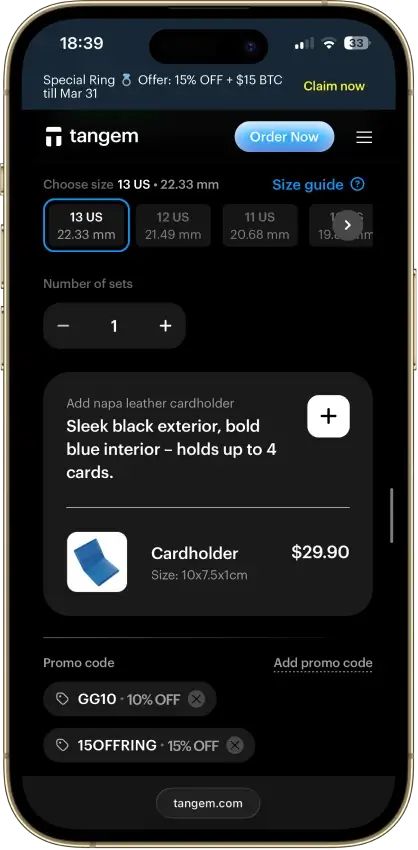
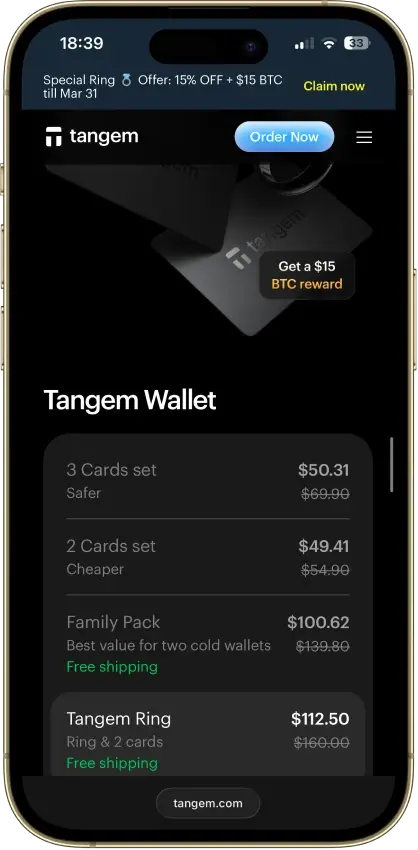
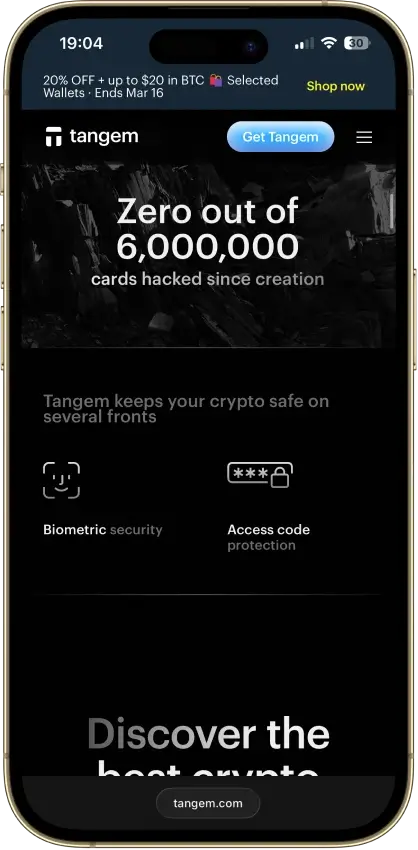
Screenshot 1 of 4
Winners By Category
Arculus is the fit for its specific MetaMask browser connection and normal phrase recovery. Tangem is the fit for seedless backup cards. These are different workflows, not evidence that one card is safer overall.
Arculus Wallet Tangem
Both provide self-custody, with different exposure during phrase-based and seedless setup.
Secure element, phrase displayed on the phone during setup
Secure element, chip-generated seedless keys or optional phone phrase
Neither card has an independent display. Tangem's disclosed attacks do not establish Arculus's resistance.
Phone-only display, six-digit PIN plus optional biometrics, Webacy address checks
Phone-only display, access code, unpatchable July 2026 laser finding on affected cards
Arculus makes a portable phrase standard. Tangem offers spare signers and optional phrase recovery, with fixed backup membership.
12 or 24 words and any enabled passphrase
Linked spare signers, optional phrase on newer cards, fixed set membership
Shared major networks cover storage, but exact dApp and NFT actions differ. Arculus adds a documented MetaMask connection.
Native BTC, ETH, SOL and XRP, WalletConnect plus MetaMask hardware connection
Native BTC, ETH, SOL and XRP, WalletConnect through the phone app
Tangem provides interchangeable signers. Arculus manages separate card wallets in one app. Matched usability testing is Not disclosed.
Android 11+ or iOS 17.5+, separate card wallets in one app, two-year warranty
iOS 16.4+ or NFC Android, interchangeable signers, 25-year hardware warranty
Entry prices are nearly equal for different backup arrangements. Unmatched service quotes cannot establish lower ongoing costs.
$59.76 sale price for one card, Changelly and n.exchange swaps, native ADA and SOL staking
$59.90 for two cards, $69.90 for three, Yield Mode takes 15% of earnings
The companies disclose different data scopes. Matched app-traffic testing is Not disclosed.
Policy covers contact, payment and connection events, no send or receive tracking stated
Stated no identity or address collection, possible IP visibility
App updates cannot make fixed card hardware patchable. Recovery portability and software licensing constrain continuity differently.
Locked card hardware, app 3.12.x current, proprietary usage terms
Fixed card firmware, public app repositories under proprietary licenses
A spare Tangem card can sign alone. It is not a second approval in a multisignature wallet, cannot be remotely revoked and cannot be replaced within a completed set.
Custody And Key Control
Arculus and Tangem keep signing keys in a secure element. A phrase-based setup also exposes sensitive recovery information on the phone.
Arculus Wallet Tangem
Recovery Material At Setup
Phrase displayed on phone
Seedless in-chip option or phone-based phrase setup
Independent Backup Signers
Normal setup relies on saved phrase
Each linked card signs the same wallet independently
Tie
Arculus and Tangem leave control with the owner. Tangem's seedless option removes a phone-displayed recovery phrase, while phrase-based users gain portability and must protect the additional secret.
Key Generation And Storage
CompoSecure's December 2024 filings describe Arculus key creation through local software and card/app functions. The phrase appears on the phone during setup. The Arculus NFC wallet review covers that phone-and-card design, including the six-digit PIN and optional biometrics.
Tangem's seedless process generates keys in the chip. Its backup protocol copies them through an encrypted channel to the other cards, with the phone unable to decrypt that transfer according to Tangem. Each completed backup card can sign independently. These are copies of one wallet, not separate approvals in a multisignature arrangement.
Newer Tangem cards also support a phone-generated or imported phrase. That choice exposes recovery material outside the card, unlike seedless generation. Arculus and Tangem both describe EAL6+ secure elements. That certification covers the component alone, leaving the complete app and backup process outside its scope.
Portability And Vendor Dependence
Arculus's 12- or 24-word BIP39 backup can support recovery outside Arculus, provided the destination wallet supports the assets and address-derivation paths. Preserve any enabled passphrase too. Tangem offers external recovery only if a phrase was saved during seeded setup.
A seedless Tangem owner depends on surviving cards and software able to use them. Its separate software-only Mobile Wallet does not provide the same card-held custody model.
Security And Transaction Signing
A card tap authorizes a signature without supplying an independent view of its contents. Neither Arculus nor Tangem has a hardware screen for comparing the destination or contract request against the phone. A compromised phone can therefore misrepresent what it asks the card to sign.
Arculus Wallet Tangem
Independent Transaction Screen
None, checks remain on the phone
None, checks remain on the phone
Comparable Whole-Wallet Attack Test
Not available
Disclosed physical card attacks, not a matched comparison
No clear winner
Both require trust in the phone's transaction display. Tangem's disclosures warrant caution where targeted card theft is plausible, and Arculus's chip certification does not establish resistance to those attacks.
Audits And Public Disclosures
Arculus company filings identify Halborn testing in 2024 and a 2023 Kirkpatrick Price SOC II review of development processes. Two filings disagree on the year of a Stratum audit. They do not provide detailed findings establishing the security of the current wallet build.
The 2018 Kudelski firmware summary excludes physical resistance. Tangem's 2023 Riscure PDF does not release the findings. Cure53's February 2026 summary of November 2025 SDK testing confirmed ten fixes, leaving two low-impact findings open. These audits do not guarantee protection against later card attacks. Comparable public bug-bounty and disclosure-program coverage is Not disclosed.
In December 2024, Tangem disclosed a seeded-setup logging bug that could expose private-key information through support emails sent shortly after activation. The fixes shipped as version 5.19.1 on iOS and 5.19.2 on Android. Coverage by Cointelegraph included the company response. Seedless setup was outside that bug's stated scope.
Connectivity And Physical Attack Surface
Both cards exchange transaction data through NFC. They are not air-gapped devices. Tangem's app checks card authenticity, but that check cannot eliminate physical attacks.
Ledger's Donjon lab disclosed physical guessing attacks in September 2025, which Tangem disputed, followed by a laser-assisted access-code reset in July 2026. The latter requires possession and invasive laboratory work. The Block reported the disclosure and Tangem's response, not an independent reproduction. Affected fixed-firmware cards cannot receive a patch. The Tangem card wallet review separates these incidents and their limitations.
Signing And Scam Resistance
Arculus pairs card possession with a six-digit PIN and optional phone biometrics. Tangem protects card access with an access code. Those controls concern permission to use the hardware, not whether an unfamiliar token allowance or contract is sensible to approve.
Arculus lists Webacy address checks. Tangem's iOS release notes describe Blockaid checks for staking transactions, not every operation. Transaction checks remain confined to the phone. A missing warning should not be interpreted as approval of a transaction.
Arculus also warns about fake update messages requesting recovery words. Its locked card hardware does not receive over-the-air updates.
Recovery And Backup
Arculus uses a recovery phrase. Tangem's recovery options depend on the setup method and surviving cards.
Arculus Wallet Tangem
Loss Of One Card
Restore replacement using recovery information
Use surviving linked card and access code
Loss Of Every Card
Recover with saved words and any passphrase
Seedless: no recovery; seeded: saved phrase may restore
No clear winner
Arculus suits owners prepared to maintain a separate written recovery secret. Tangem provides spare ready-to-use signers, but seedless owners must accept fixed backup membership and the consequences of losing every card.
Losing A Card Or Phone
For Arculus, a replacement card or phone uses the recovery information to restore the wallet. Three incorrect PIN entries also force that same restore path. The words and any enabled passphrase must remain accessible to you without depending on the missing phone.
A Tangem owner can use another linked card and its access code after losing one card. Replacing the phone means installing the app on a compatible NFC device and using an existing signer. The lost card cannot be remotely revoked, and a new card cannot join an already completed backup set.
A third Tangem card preserves another spare after one loss. It does not create a two-of-three approval requirement. Store cards separately so a single lost bag does not remove every signer.
Losing Every Backup
Arculus cannot recover forgotten words. Losing the written backup does not immediately stop a working phone/card setup, but failure of that remaining access leaves no recovery route. A phrase and passphrase stolen together can let someone restore without the original card or PIN.
Losing every seedless Tangem card ends access to the keys. A previously saved phrase can rescue a seeded wallet through compatible software, subject to network and derivation-path support. A phrase cannot be reconstructed afterward from seedless setup.
Networks, Assets, And dApp Access
Native Bitcoin, Ethereum, Solana and XRP are supported by both wallets. That overlap is more useful than treating each company's aggregate token count as a measure of the assets you can actually use.
Arculus Wallet Tangem
Native Network Examples
Bitcoin, Ethereum, Solana and XRP
Bitcoin, Ethereum, Solana and XRP
MetaMask Hardware Route
Documented webcam/QR workflow via phone and card
No equivalent MetaMask hardware route established here
No clear winner
Arculus's MetaMask hardware connection is useful for owners who specifically want that browser workflow. For other users, the exact network and dApp action decide compatibility, not a total coin count or WalletConnect logo.
Networks And NFTs
Arculus lists supported networks separately from buying, swapping and staking availability. Its custom-token feature covers Ethereum, Polygon and BNB Smart Chain. Tangem also requires a supported network when adding assets. An exchange withdrawal on the wrong chain cannot be corrected by matching the ticker alone.
Arculus's September 10 release notes still list compressed Solana NFT sending as coming soon. Tangem's support page excludes sending compressed and programmable Solana NFTs, along with frozen NFTs. A gallery displaying an asset does not establish that every transfer action is available.
WalletConnect And Browser Use
Arculus offers WalletConnect on the networks it lists for dApp connections and a QR-based MetaMask hardware connection. The latter needs a computer webcam to read a code from the Arculus app and selects the wallet's first address. It connects the hardware wallet without importing its recovery words into the extension. Signing still depends on the phone and card.
Tangem's WalletConnect route supports Solana and listed EVM networks, a smaller set than its storage coverage. A desktop website can display the pairing QR code, but the phone remains the wallet interface. Unsupported signature formats can prevent a particular dApp from working.
An Arculus address can also be an owner of a separate Safe account through WalletConnect. Safe's other owners and approval threshold belong to that smart-contract account, not the Arculus card itself.
Platforms, Hardware, And Daily Use
Arculus and Tangem draw power from the phone's NFC field, removing the need to charge a battery. Desktop use still requires the phone.
Arculus Wallet Tangem
Power
Phone NFC field, no battery
Phone NFC field, no battery
Card Organization
One distinct wallet per card, several in one app
Linked cards are spare signers for one wallet
Tangem's extra signers simplify access after a single card loss, while Arculus accommodates distinct card wallets in one app. Choose around the phone you own and whether you need separate wallets or spare signers.
Phone And Card Requirements
Arculus specifies Android 11+ with NFC, or iOS 17.5+ on iPhone XR or newer. Tangem's US iPhone listing requires iOS 16.4+. Its Android app also needs a compatible NFC phone. Check the current store requirements before buying for older hardware.
Arculus can manage separate wallets in one app, with a dedicated card for each. Creating or restoring another wallet on a card overwrites its previous keys. Tangem's linked set provides several cards with equal authority over the same wallet.
Tangem advises keeping the card near the phone's antenna and checking for interference from thick or metal cases. Arculus's quick setup activates a smaller initial asset list to reduce NFC timeouts. Comparable durability testing of these cards is Not disclosed.
Warranty And Support
Arculus's direct-sale warranty covers qualifying card faults for two years. Tangem's advertised limited hardware cover lasts 25 years. Neither term promises reimbursement for stolen crypto or app support throughout that period.
Arculus's Help Center explains PIN-triggered restoration, while Tangem's guides address card scanning and device loss. Comparable measured response times and accessibility testing are Not disclosed.
Swaps, Staking, And Costs
The two entry packages cost almost the same and use different backup arrangements. Service charges need a separate comparison because neither hardware price includes all future transaction costs.
Arculus Wallet Tangem
September 11 Entry Offer
One card: $59.76 sale offer
Two cards: $59.90
Ordinary Transfers
Network fee, no extra wallet transfer commission
Network fee, no extra wallet transfer commission
Arculus's sale price and Tangem's two-card price are effectively level for different recovery arrangements. Tangem offers another signer at that entry cost, but provider quotes and actual service use determine ongoing expenses.
Purchase And Ownership Cost
On September 11, 2026, Arculus displayed one card at $59.76, discounted from $99. Tangem advertised two cards at $59.90 and three at $69.90. These are USD storefront prices, not completed regional checkout totals. Both exclude some delivery destinations, with taxes and delivery determined by the order.
Tangem's two-card pack adds a second signer for $0.14 more than that Arculus sale price. Arculus already has phrase-based recovery without buying a second card, so the prices do not establish equivalent backup resilience. Tangem's extra card benefits someone choosing physical redundancy.
Swaps, Bridges, And Fiat Services
Ordinary supported sends and receives carry no extra wallet commission at Arculus or Tangem. Network fees remain payable. Buying and swapping add provider charges and exchange-rate effects.
Arculus names Changelly and n.exchange for swaps. Assets pass to the liquidity provider during execution before the output returns. Tangem offers centralized and decentralized swap routes, and a centralized provider can request identity verification or delay processing. Card-held keys do not make every exchange step noncustodial.
Tangem lists purchase services including MoonPay and Mercuryo. Arculus identifies Onramper among its providers and offers MoneyGram cash access using USDC on Stellar at participating locations. Compare the final output of a matched transaction before choosing a route.
Staking And Earn
Arculus supports native ADA and SOL staking, plus liquid and third-party routes. Yield.xyz and P2P.org provide staking integrations in Tangem. Validator charges, warmup and exit conditions depend on the asset and provider, so neither earns a standing reward-rate advantage.
Tangem takes 15% of the earnings from its Aave-based Yield Mode. That charge is not on the deposited principal, and network costs also apply. Committing assets to lending contracts adds protocol risk beyond holding them in the wallet.
Privacy And Data Collection
Self-custody leaves blockchain activity visible and does not eliminate data collection by connected services.
Arculus Wallet Tangem
Setup Identity Documents
Not required by basic wallet setup
Not required by basic wallet setup
Measured App Data Exposure
No matched traffic measurement
No matched traffic measurement
No clear winner
Arculus and Tangem disclose different scopes of collection, without matched app-traffic testing. Owners concerned about privacy should assess the provider attached to the transaction as well as the wallet's policy.
Wallet-Level Data
Arculus's published privacy policy covers its websites, mobile sites and communications with the company. It lists contact, browsing and payment information, plus connection events for buy/swap and send/receive. Arculus says it does not track where assets are sent or received. Matched wallet-app traffic measurements are Not disclosed.
Tangem says it does not collect identifying details or wallet addresses and acknowledges possible IP visibility. Its iPhone disclosure lists usage and diagnostics data not linked to identity. These remain company disclosures rather than independently tested assurances. Exact comparative telemetry defaults, retention and custom-RPC controls are Not disclosed.
Third-Party And KYC Boundaries
The basic setup instructions do not require submitting identity documents to either wallet company. A card order can still identify its buyer through shipping and payment details. Connecting a dApp or using an exchange service creates another data relationship.
Arculus's MoneyGram flow requests personal details. Tangem purchase providers can impose their own verification, and Tangem Pay has separate identity and country requirements. Those services should not be described as anonymous because the underlying wallet is self-custodial.
Updates, Longevity, And Ecosystem
Arculus's release notes identify 3.12.x as current, with 3.13 features still planned. Tangem also updates its phone software, including the fixes for the 2024 logging issue. Changes to the app must not be confused with changes to the card's embedded software.
Arculus Wallet Tangem
Embedded Card Software
Locked hardware, phone-app updates separate
Fixed firmware, phone-app updates cannot patch physical finding
Guaranteed Software Support End
No fixed date disclosed
No fixed date disclosed
No clear winner
Arculus makes external phrase recovery part of normal setup, and Tangem users can choose it before funding. Neither a long hardware warranty nor visible app code guarantees indefinite operation, particularly for an owner relying entirely on seedless cards.
Fixed Hardware And Changing Apps
Arculus describes its card hardware as locked. Tangem installs card firmware once, leaving affected cards unable to patch the July 2026 laser finding. Adding networks through app releases does not demonstrate that either card's underlying security code was updated.
Arculus's proprietary usage terms restrict modification and reverse engineering. Tangem makes its Android and iOS repositories public, but their actual licenses restrict redistribution and commercial use. Those restrictions distinguish the published code from unrestricted open-source software. Future community maintenance remains uncertain.
Access If A Vendor Disappears
Arculus Holdings LLC belongs to CompoSecure's business under parent GPGI Inc. Tangem AG is based in Zug, Switzerland. Neither company's continued existence is guaranteed by its corporate structure.
Arculus and seeded Tangem owners can use compatible external recovery software with their saved secrets. Seedless Tangem use requires a working card and compatible software/network services.
Tangem describes vendor services for authenticity checks and token information, alongside public interfaces for broadcasting transactions. No server-side key custody does not mean every app function is independent of the company. A fixed software-support end date is Not disclosed for either wallet.
Final Verdict
Both reviews score 6.5, so the overall result is a tie. Choose Arculus for phrase-based recovery and its MetaMask connection, or Tangem for seedless use with separately stored spare cards.
Affiliate Disclosure
Some links in this comparison are affiliate links. CryptoSlate may earn a commission if you sign up through these links. Our ratings remain editorially independent.
Tie
The equal ratings do not establish equal resistance to attacks. Tangem’s disclosed physical findings and fixed card firmware need particular attention if targeted theft is plausible. Arculus’s chip certification does not demonstrate resistance to those same attacks.
Arculus vs Tangem FAQs
Is Arculus or Tangem safer?
Neither Arculus nor Tangem provides an independent hardware display for verifying transactions. Tangem has disclosed software and physical-card incidents with different scopes, including the unpatchable July 2026 laser finding on affected cards. Arculus's chip certification does not prove resistance to that attack. Choose a screen-equipped device if phone-only verification is unacceptable.
Does Arculus or Tangem have better recovery?
Arculus uses 12 or 24 words and any enabled passphrase. Tangem offers linked backup cards, with a phrase optional on newer hardware. Spare Tangem cards preserve access after one is lost, but a completed set cannot accept a replacement. The suitable choice depends on whether you can better secure recovery words or several physical signers.
Is Arculus or Tangem open source?
Arculus's wallet license is proprietary. Tangem publishes its Android and iOS app repositories under proprietary licenses that restrict distribution and commercial use, and its card firmware is closed. Neither should be described as fully open source. Chip certification and the availability of audit documents do not change those license terms.
Does Arculus or Tangem work with MetaMask?
Arculus documents a QR-based MetaMask hardware connection using a computer webcam and the Arculus phone app. It selects the first wallet address and retains the phone/card signing workflow. Tangem documents WalletConnect for compatible dApps. These are different connections, so do not interpret Tangem's WalletConnect support as the same MetaMask hardware integration.
Is Arculus or Tangem cheaper?
Arculus's September 11, 2026 sale price was $59.76, reduced from $99. Tangem listed two cards at $59.90 and three at $69.90. Arculus provides phrase-based recovery without a second device, while Tangem includes spare signers. Delivery, taxes and provider charges can change the total. Neither price establishes a lower-cost winner for every use.
Do Arculus and Tangem require KYC?
Basic Arculus and Tangem wallet setup does not require submitting identity documents. Buying crypto, exchanging through certain providers or using optional payment services can introduce separate verification. Arculus's MoneyGram flow asks for personal details, and Tangem Pay has its own identity and regional requirements. Those services are separate from control of the card's keys.
Can Arculus and Tangem work after losing a phone?
Arculus requires restoration using the recovery information on a replacement phone. Tangem can use an existing linked card and access code with its app on another compatible NFC phone. Preserve Arculus's words and any passphrase, and keep Tangem backup cards separate. Neither company's support can recreate secrets that you have lost entirely.

The September 11 offers were $59.76 for one Arculus card and $59.90 for two Tangem cards. Fourteen cents does not make these equivalent recovery packages. Decide whether you want recovery words, spare ready-to-use signers or a device with an independent display.