 Released in 2022
- Monthly or deferred interest choice
- Custody with Anchorage Digital
- Gold-token collateral options
Arch Lending Overview
Key facts
- Product Name
- Arch Lending
- Release Date
- 2022
- Service model
- centralized
- Product status
- available
- Collateral & debt
- BTC, ETH, SOL, XRP, PAX Gold (PAXG), Tether Gold (XAUT); Debt currency: USD or USDC
- Borrowing rate
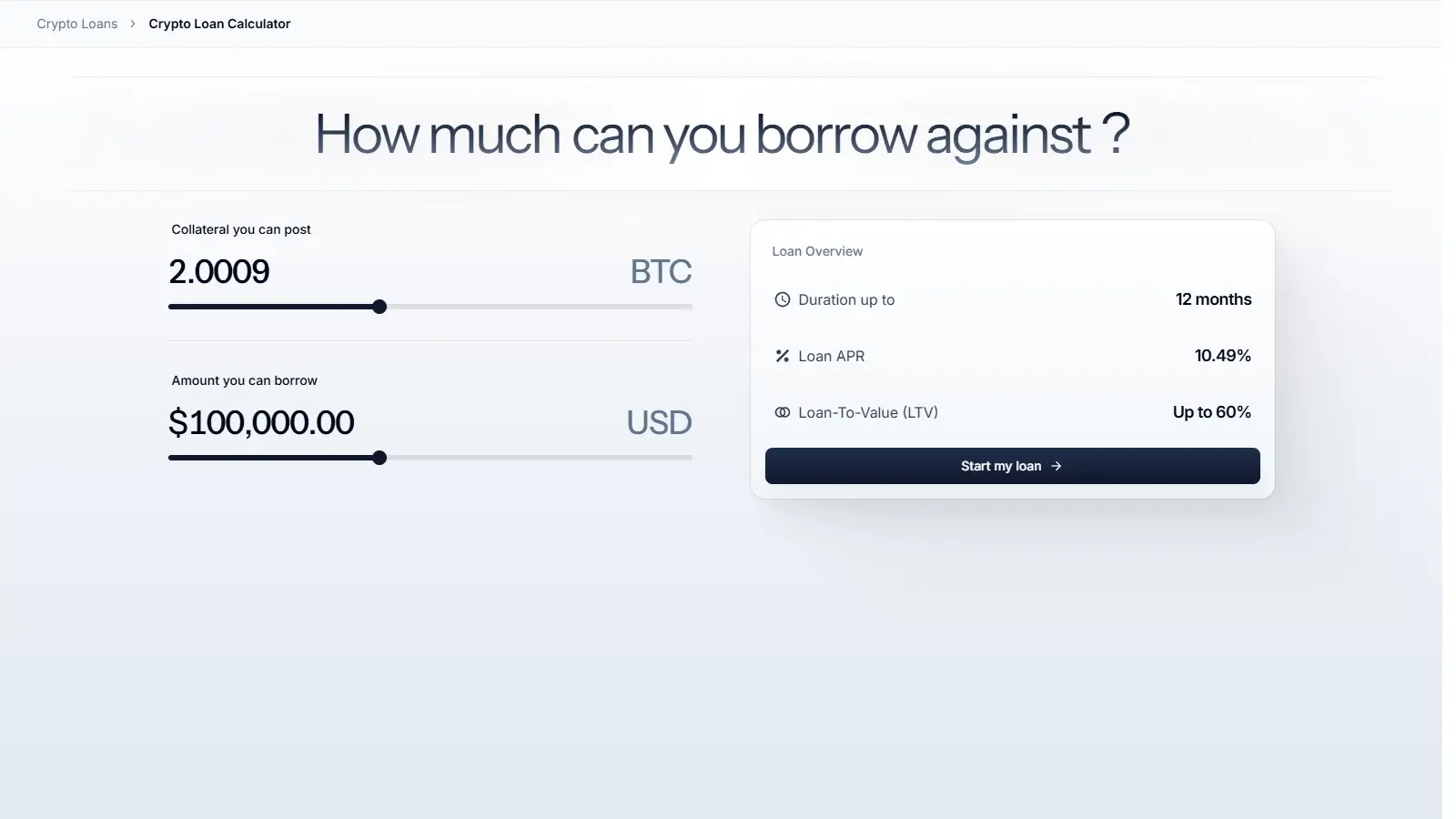
- 10.49–10.99% apr / annual; fixed; Fixed · 12-month BTC/ETH/SOL under $250,000 · 10.49% APR monthly / 10.99% APR deferred
Additional details
- Offer scope
- Arch Crypto-Backed Loan; Consumer crypto-backed loan for eligible US individuals, one collateral type per loan, for up to 12 months. The headline rate is the 12-month BTC, ETH, or SOL tier below $250,000.
- Amount & term
- From $5,000 · Asset/state minimums · Up to 12 months; Loan structure: Term loan; Minimum: USD or USDC 5000; Maximum: Individual quote required; From $5,000 · Asset/state minimums
- LTV & liquidation
- Asset-specific LTV · Partial sales · Uncured call, late interest. BTC starts at up to 60% LTV, with a margin call at 70% and partial liquidation at 80%. ETH 55%, SOL/XRP 45%, gold tokens 75% starting LTV.; Maximum initial LTV: 60%
- Fees
- Origination · Collateral-sale fees · Late fees may apply
- Repayment
- Monthly interest or deferred · Early payoff
- Availability
- 8 states excluded · Check HI, MD, SC; KYC: Required; Credit check: Not required
- Payout
- Bank/USDC · Same-day processing estimate
- Custody
- Anchorage Digital · No-reuse policy
Arch Lending Screenshots
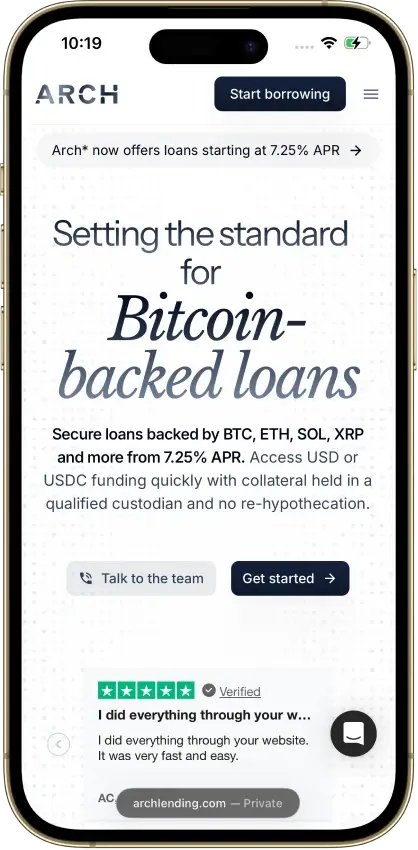
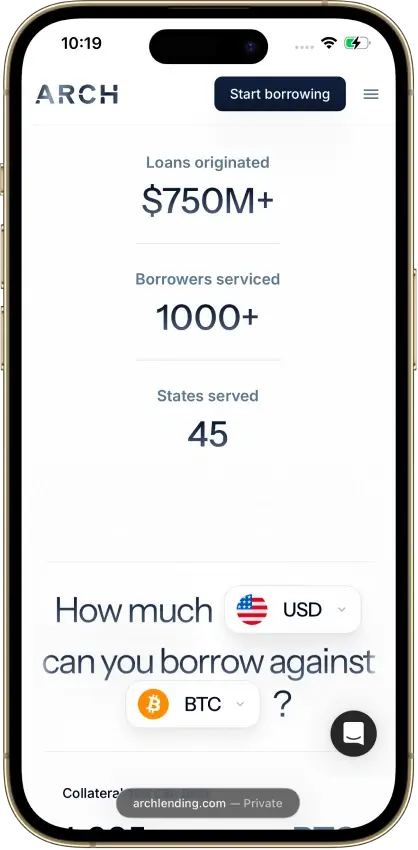
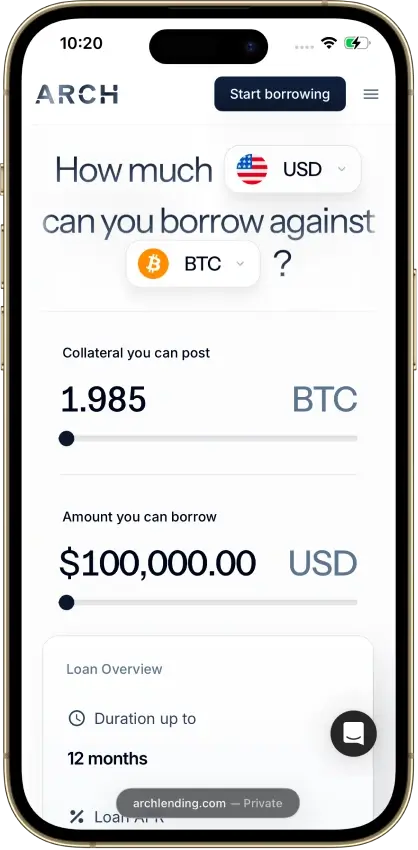
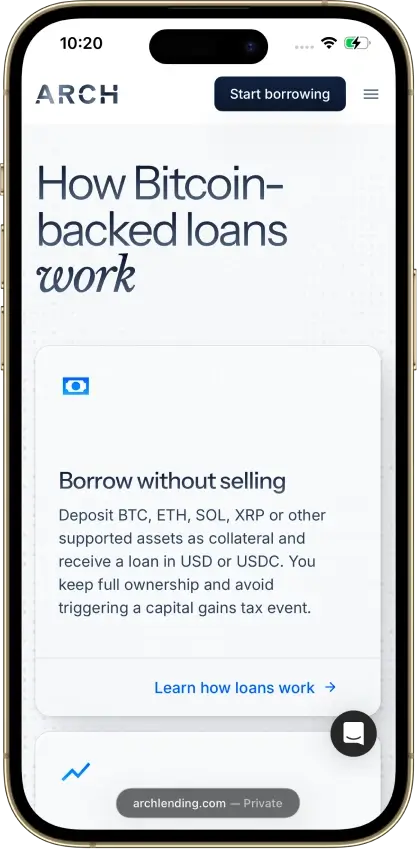
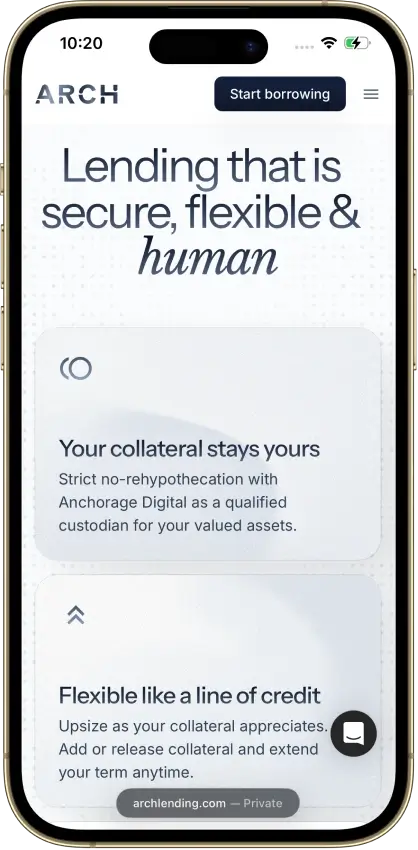
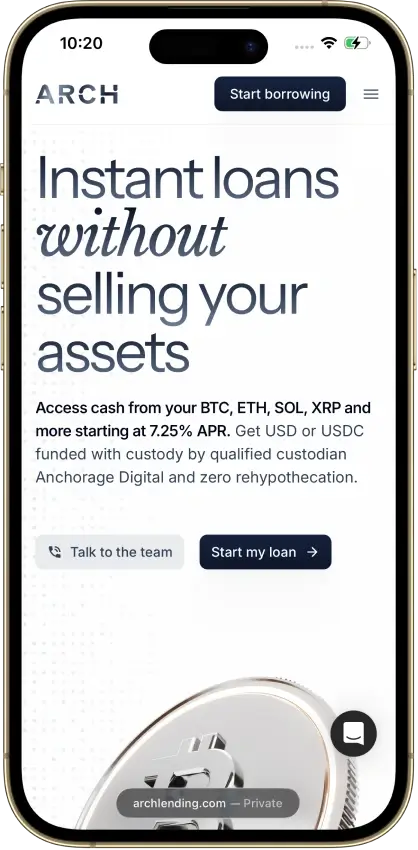
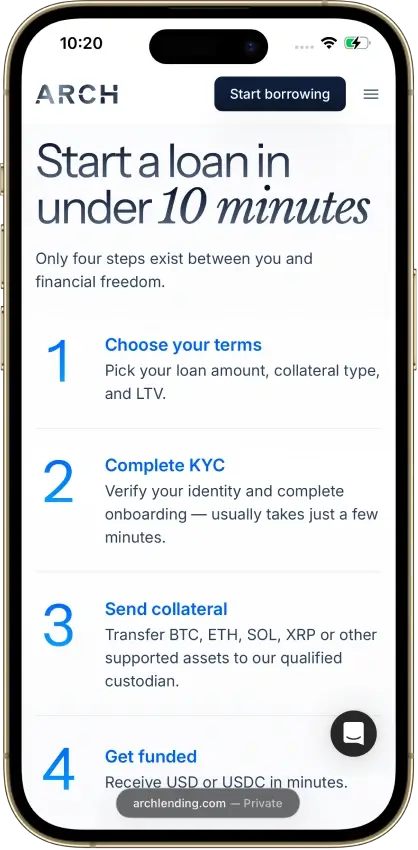
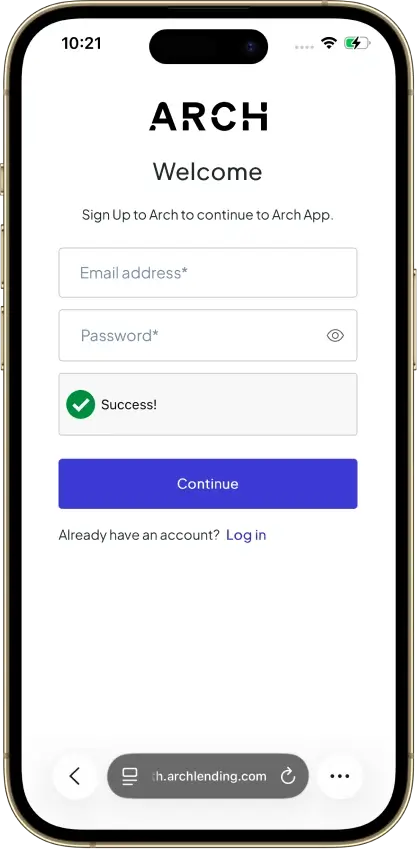
Screenshot 1 of 8
Arch Lending Pros and Cons
Pros
- Bank and stablecoin disbursements
- Early repayment has no penalty
- Optional excess collateral withdrawals
Cons
- ACH payoff delays collateral release
- Deferred interest uses higher rates
- Rollover can increase the debt
Rates and Fees
Arch sets a fixed rate when the loan opens, so the opening offer determines the cost of keeping that balance outstanding. Loan size and payment schedule affect that offer. BTC, ETH, and SOL share the tiers below, with higher rates when interest is deferred. XRP and the two gold-backed tokens use separate schedules.
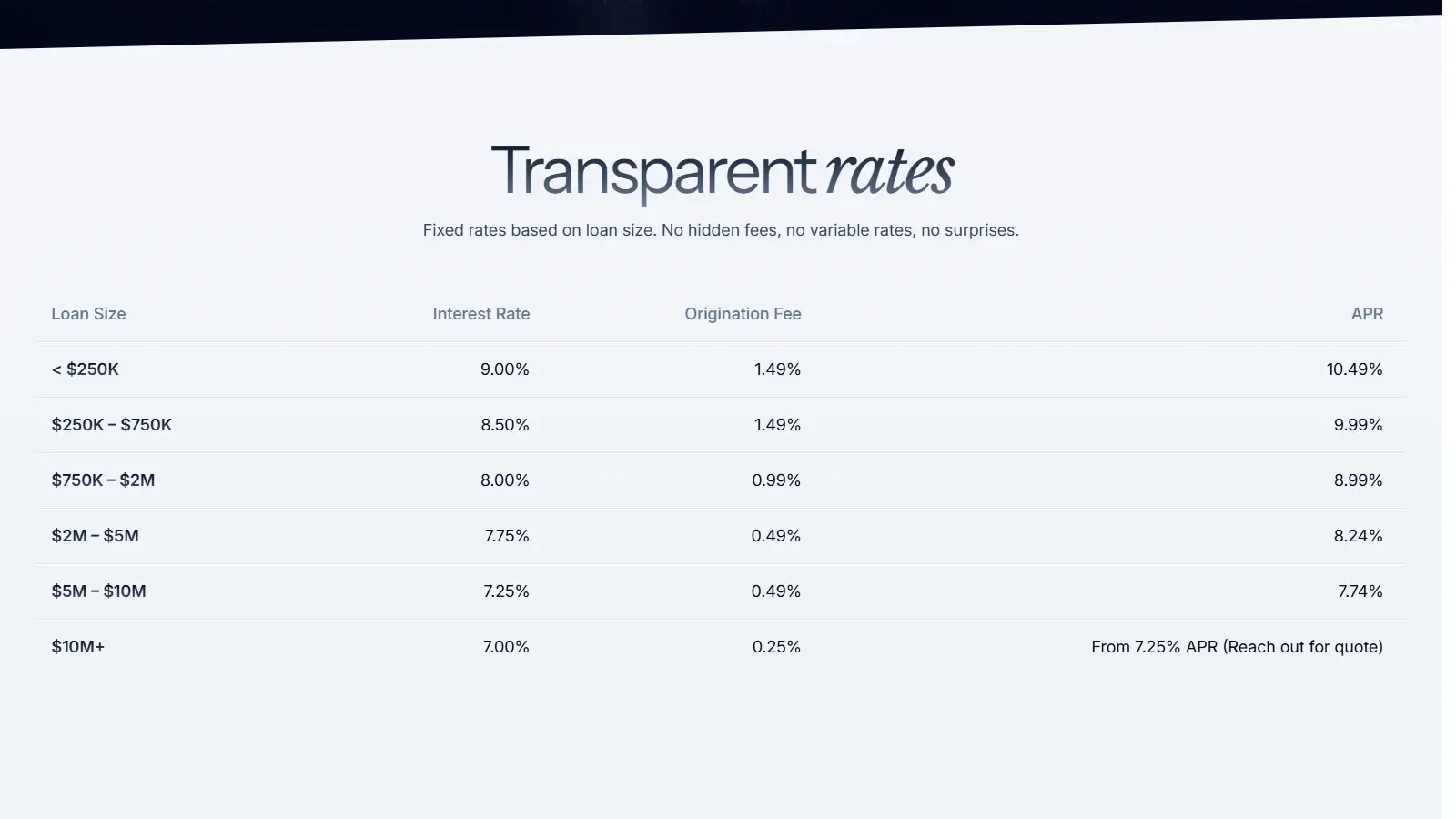
| BTC, ETH, or SOL loan size | Monthly-pay interest | Monthly-pay advertised APR |
|---|---|---|
| Below $250,000 | 9.00% | 10.49% |
| $250,000 to below $750,000 | 8.50% | 9.99% |
| $750,000 to below $2 million | 8.00% | 8.99% |
| $2 million to below $5 million | 7.75% | 8.24% |
| $5 million to below $10 million | 7.25% | 7.74% · Quote required |
| $10 million and above | 7.00% | From 7.25% · Quote required |
The lower rates require larger loans, and the origination deduction also changes how much money you receive. Fees range from 1.49% in the lower BTC, ETH, and SOL tiers to 0.25% at the top. On a $10,000 principal loan with a 1.49% fee, Arch deducts $149, leaving $9,851 before other transfer charges, even though you still owe $10,000 of principal.
The table shows Arch’s advertised 12-month APRs, with loans above $5 million subject to a custom quote. Arch says rates can also vary by state of residence, so the signed consumer disclosures determine the actual APR and payment schedule, including the fee deduction. Early payoff has no penalty. If the upfront fee is not refunded, a shorter loan still includes that charge, increasing the cost per month borrowed.
Below $250,000, choosing deferred interest on BTC, ETH, or SOL raises interest from 9.00% to 9.50% and advertised APR from 10.49% to 10.99%. XRP loans from $25,000 to below $500,000 list 12.00% interest and 13.50% APR for monthly payment, without a deferred option at that tier. PAXG and XAUT start at $250,000, where Arch advertises 9.25% APR for a 12-month loan with monthly interest.
Collateral sales have their own charges, separate from ordinary repayment. A voluntary sale to repay costs 2% of the assets sold, and forced partial liquidation typically costs 2% where permitted. The detailed liquidation policy allows a different fee up to 2.5%, while the individual agreement sets applicable late charges. Include those terms when judging the cost of an exit that requires selling collateral.
Collateral, Loan Amounts, and LTV
Each Arch loan uses one collateral type, chosen from BTC, ETH, SOL, XRP, PAXG, and XAUT. Pledging several assets therefore means managing separate loans and collateral positions. Gold-backed tokens also retain their issuer, custody, and market-liquidity risks after they are pledged.
The default minimum is $5,000, subject to asset and state limits. XRP starts at $25,000, and either gold token requires at least $250,000, so the general minimum does not describe every collateral option. The selected asset also determines the loan-to-value (LTV) limits.
| Collateral | Maximum starting LTV | Margin call | Partial-liquidation threshold |
|---|---|---|---|
| BTC | 60% | 70% | 80% |
| ETH | 55% | 65% | 75% |
| SOL | 45% | 55% | 65% |
| XRP | 45% | 55% | 65% |
| PAXG or XAUT | 75% | 85% | 90% |
A $10,000 loan against Bitcoin at 60% initial LTV needs about $16,666.67 of BTC collateral. With debt unchanged, a 25% collateral-value decline takes LTV to the 80% partial-liquidation threshold. Any interest or fees added to the debt can bring that point closer, while principal repayment or added collateral can move it further away.
Liquidation and Collateral Management
A margin call gives you up to 24 hours to add collateral or repay enough debt to restore the required LTV. For BTC, that target is 60%, including a loan opened at a lower ratio such as 40%. Email alerts and the dashboard show how much collateral or repayment the correction needs.
The 24-hour cure window can end early if LTV reaches the asset’s partial-liquidation threshold. For BTC, a price decline that raises LTV from the 70% margin-call level to 80% can trigger a sale before the 24 hours expire.
A partial sale reduces both the debt and the collateral, which can require selling a large share of the assets. Ignoring fees, $60,000 owed against $75,000 of collateral gives 80% LTV. Selling $37,500 and applying it to debt leaves $22,500 owed against $37,500, restoring 60% LTV after half the collateral has been sold.
The loan can continue with that smaller position, but another price fall can produce another margin call or sale. Late payments create an additional trigger, because Arch can sell collateral to settle overdue interest after its 20-day payment grace period. A position below the price-based sale threshold can therefore still face a sale for overdue interest.
The dashboard displays each loan’s trigger prices. Arch uses a CoinMarketCap price feed and describes checks for stale or extreme prices, but those safeguards do not guarantee an execution price during a rapid move. Use the trigger as the point at which a sale can begin, rather than the price you are certain to receive.
Custody, Collateral Use, and Security
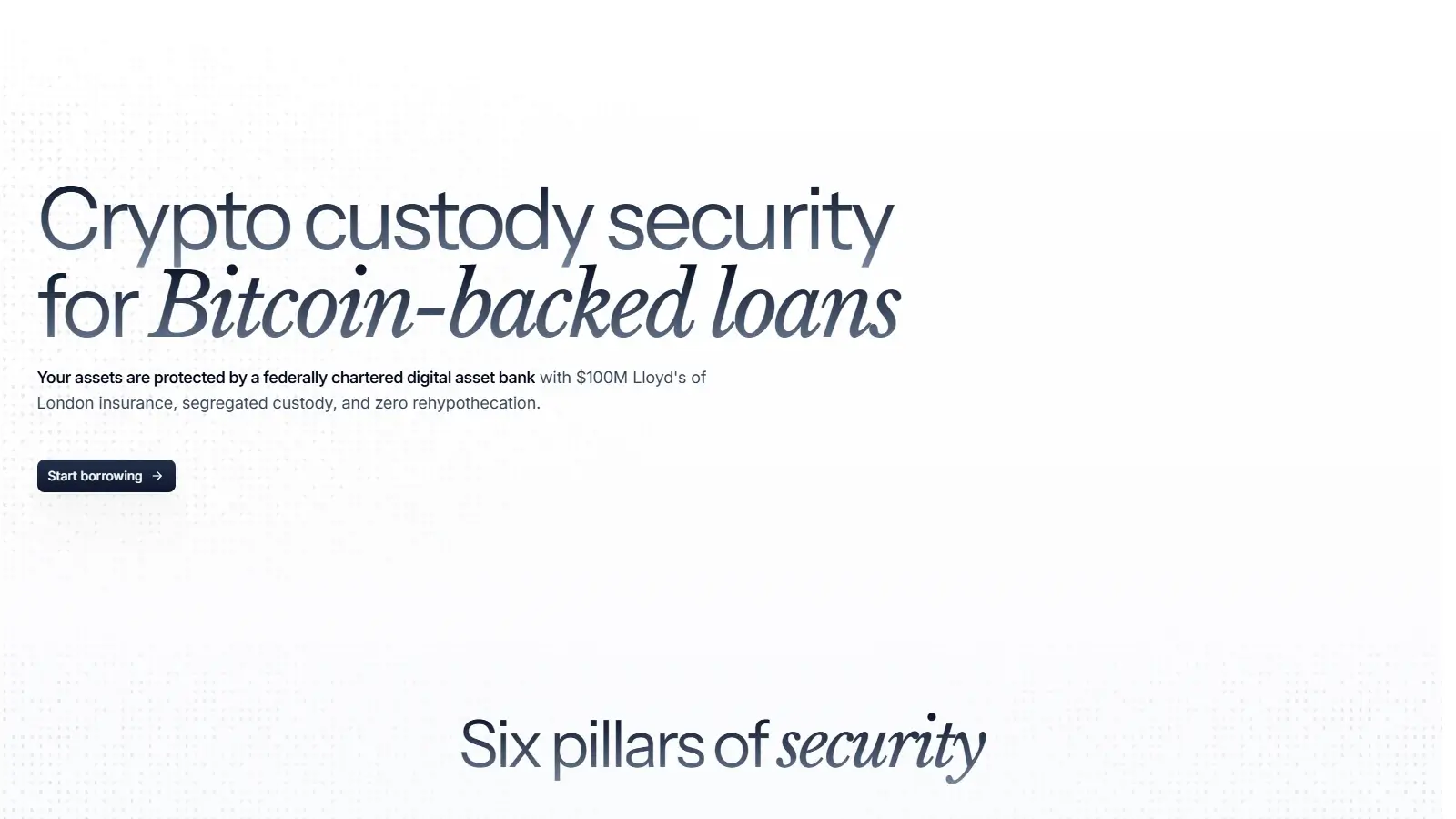
ChainFi, Inc., a nonbank lender, does business as Arch Lending, and names Anchorage Digital as its custodian. Arch states that borrowers’ collateral is not lent, staked, or otherwise reused. The assets nevertheless remain pledged under a lending agreement, so access depends on satisfying the loan’s collateral and payment obligations.
Arch describes the custody as segregated, with individually segregated wallets and block-explorer visibility offered for loans over $100,000. Below that loan size, the borrower needs Arch to explain how the collateral is identified within custody before funding.
The advertised $100 million Lloyd’s of London coverage is Anchorage’s commercial crime insurance, subject to its terms and exclusions. It is not an individual $100 million guarantee and does not cover price-driven liquidation. Arch also describes the structure as bankruptcy-remote, which is a claim about the arrangement rather than a guarantee of when or how much a borrower would recover in insolvency.
Arch’s lending terms allow it to replace the custodian on reasonable notice and keep a security interest in the collateral until everything owed is paid.
Availability, KYC, and Credit Checks
Check whether Arch lends to individuals in your state before comparing rates. Arch does not lend to individuals in California, Delaware, Mississippi, Montana, Nevada, North Dakota, Rhode Island, or Vermont. Its help pages and legal footer disagree on Hawaii, Maryland, and South Carolina. If you live in one of those three states, ask Arch whether it offers the loan to individual borrowers there before sending collateral.
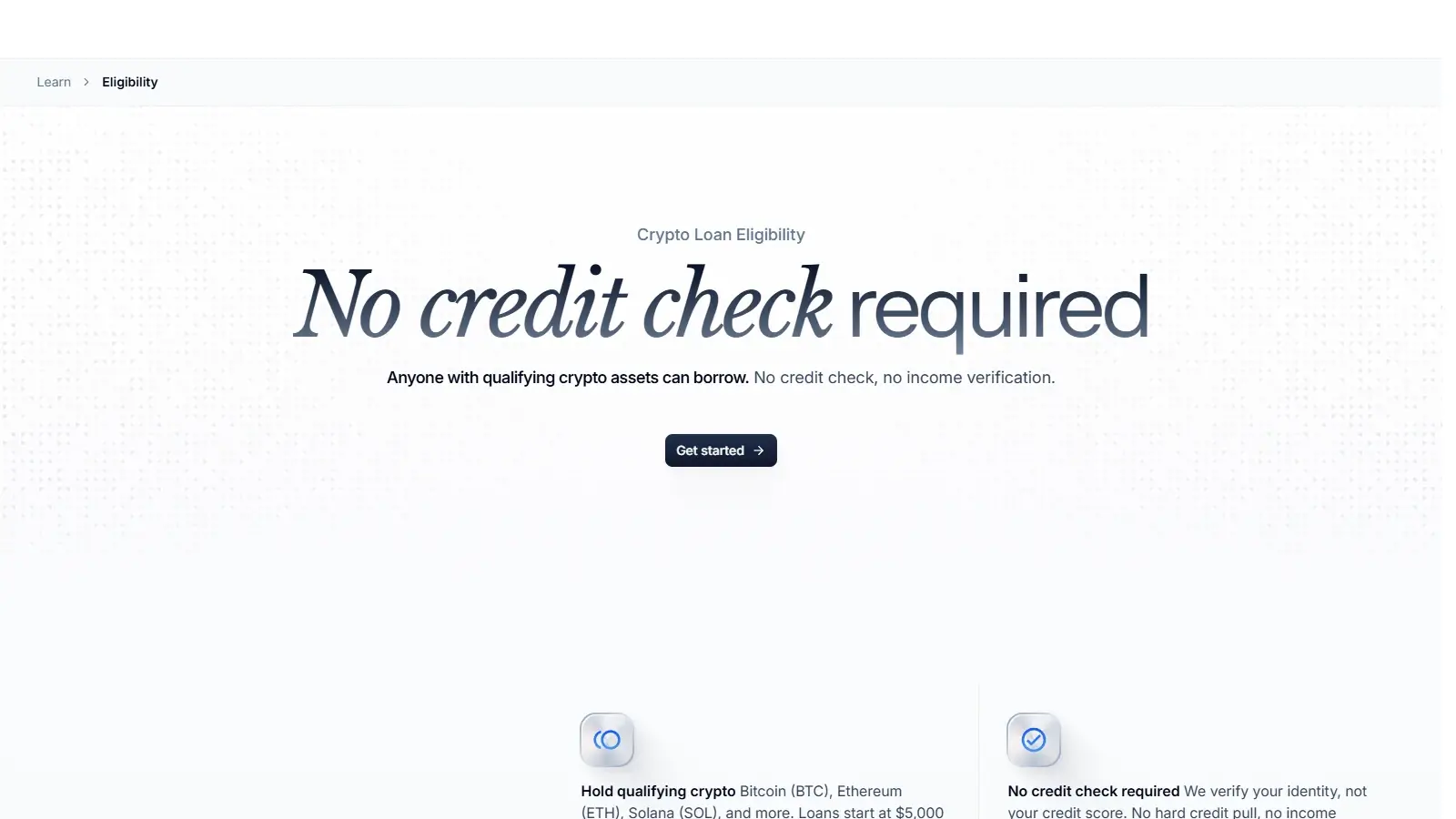
An individual needs an eligible US consumer offer and must be at least 18, or the local age of majority if higher. Know-your-customer (KYC) identity checks apply without a credit-bureau check, and Arch can still request financial information or underwriting documents.
Consumer loans are for personal, family, or household purposes. Business and trust applicants follow a separate state list, and business loans must be used for business or commercial purposes, with international entities considered where permitted. Eligibility under one list does not establish eligibility under the other.
Application, Payout, and Timing
The loan setup screen uses collateral, loan amount, term, and jurisdiction to show the applicable offer. Identity checks and signed documents precede funding. After approval and signing, you have 24 hours to send collateral, with extensions available on request. Signing starts that deadline, and the disbursement estimate begins after collateral confirms.
US dollars can be sent to a bank by wire or Automated Clearing House (ACH) transfer. USD Coin can be sent to a wallet that accepts USDC on Ethereum. Choose between bank funding and that wallet payout before sending collateral.
Arch estimates same-business-day disbursement processing after collateral confirms onchain. Identity verification can be near-instant or take up to 24 hours for manual review. Those estimates cover different stages and do not guarantee same-day bank arrival, and the origination deduction means the arriving amount can be below the loan principal.
Repayment, Renewal, and Collateral Return
Monthly-pay loans require interest during the term and principal at maturity. Deferring interest removes those monthly payments but uses a higher rate, with principal and accrued interest due at the end. Paying down principal during a deferred term reduces the balance on which later interest accrues.
Repayment supports USDC on Ethereum or Polygon, bank wire, and ACH. Connected US bank accounts use Plaid for one-time payments or autopay. An ACH credit can reach the loan balance before the transfer settles, so a failed transfer reverses that credit, requiring a new payment to avoid late fees. A failed autopay payment also suspends autopay until you reactivate it.
Rollover normally becomes available during the final three months, subject to account conditions and LTV below 65% for BTC, 60% for ETH, or 50% for SOL and XRP. It uses the prevailing rate and can add an origination fee to the new principal without paying out more cash. Any unpaid deferred interest also needs settling or inclusion in the new loan, so renewal can extend the loan with a larger balance.
A BTC position at 65% to below 70% LTV misses the rollover limit while remaining below the margin-call threshold. It may therefore need extra collateral or a debt reduction to qualify, even though no price-based margin call has begun. The individual agreement sets the consequences of reaching maturity without repayment or an approved rollover.
After payoff, request collateral withdrawal manually. ACH payoff adds a five-day hold after payment receipt, and Arch estimates release within 24 hours of an approved withdrawal request. An optional test transfer adds a borrower-confirmation step. Paying the balance is therefore not the same event as receiving the collateral back.
You can also ask support by email to sell collateral toward principal or interest, specifying the loan ID and amount. The 2% voluntary-sale fee applies, and Arch does not accept sale instructions through its AI chatbot.
Account Controls and Support
The dashboard displays LTV, margin-call and sale prices, and loan activity, helping you judge whether the position can support a change. BTC borrowers can request excess collateral release below 50% LTV, with thresholds of 45% for ETH and 35% for SOL. Use the active loan’s applicable threshold to judge whether the lower LTV permits a release.
Upsizing instead draws extra cash while keeping the original maturity date. Arch charges origination fees on the additional amount, prorated for the remaining term. If Arch’s prevailing rate has changed, Arch blends the existing principal’s rate with the new borrowing rate, so the extra cash can change the combined cost without adding time to repay.
Drawing back up to the maximum starting LTV leaves less room before a price-based margin call. Upsizing or rollover also switches off autopay, so the new loan needs that payment setting restored before its next statement. Making those changes requires account access, and active borrowers must use authenticator-app two-factor authentication.
Chat, email, and phone support are available. Phone hours are 9:00 am to 7:00 pm Eastern on weekdays and 10:00 am to 5:00 pm on weekends, and chat starts with an AI assistant that can pass questions to the team. A cure must be completed inside the 24-hour window, or before LTV reaches the partial-liquidation threshold if that happens sooner. Ask support questions early enough for a top-up or repayment to complete in time.
Alternatives
-

Ledn
Ledn’s Dollar Loan is a BTC-focused alternative for US borrowers eligible for both services. Arch accepts ETH, SOL, XRP, and gold tokens as well as BTC, giving borrowers with those assets an option beyond the Bitcoin-backed Dollar Loan. Compare cash received after fees for the same amount, term, and eligible state before judging cost.
-
Coinbase Borrow
Coinbase Borrow’s variable BTC-backed USDC loan uses Morpho markets on Base and has no scheduled maturity. That differs from Arch’s payoff or renewal decision within 12 months. Coinbase also has fixed-rate loans with maturity deadlines and a conditional option to convert to variable terms, so the repayment comparison depends on the actual variant the borrower can use.
Pillar Scores
- Cost and pricing clarity 20% weight Interest, mandatory fees, pricing conditions, and the cost of early repayment.8.0 / 10
- Collateral control and counterparty risk 25% weight Custody, permitted collateral use, and recovery rights.7.0 / 10
- Liquidation rules and risk controls 20% weight Sale triggers, warnings, penalties, and tools for managing collateral.8.0 / 10
- Repayment and flexibility 15% weight Partial payments, maturity, renewal, and collateral return.7.0 / 10
- Access and funding 10% weight Eligibility, verification, payout routes, and usable funds.7.0 / 10
- Account controls and support 10% weight Security controls, loan records, monitoring tools, and customer support.7.0 / 10
Final Verdict
Arch suits eligible US borrowers who expect to change a loan during its fixed term and can plan around a deadline that upsizing never extends. Someone who needs an open-ended loan should choose another structure. Borrowers in states Arch excludes need another lender. If Arch’s state lists disagree about where you live, confirm access before funding. Upsizing debt or withdrawing excess collateral leaves less room before a margin call. An uncured margin call, LTV reaching the asset’s partial-liquidation threshold, or interest left unpaid beyond the grace period can still lead to a sale. The controls therefore suit someone who can keep extra collateral and payoff funds available as the balance changes.
Best For
US borrowers with eligible collateral who want a fixed term and controls to adjust the loan
Avoid If
- Borrowers wanting no maturity date or living in a US state where Arch excludes individuals
CryptoSlate may earn a commission when you use partner links, at no extra cost to you. Our reviews, ratings, and editorial decisions remain independent of advertisers. Read How CryptoSlate Makes Money for funding details.