Crypto loans in the US depend on where you live and how you plan to use the money. A covered state may still have a minimum loan above the amount needed. Dollar borrowing can credit a platform balance first, while stablecoin borrowing adds a conversion and bank-withdrawal step.
Compare only offers available in the borrower’s state and at the requested amount. An advertised rate cannot price an offer the borrower does not qualify for. Work from the cash you need to spend through to the final repayment, allowing for the risk of collateral being sold along the way.
Top Crypto Loans in the US
- Borrowing terms
- Fixed rate · Up to 12 months
- Collateral & risk
- BTC sale: 80%/uncured 70% LTV
- Availability
- US · CA, NV & others excluded
- Monthly or deferred interest choice
- Custody with Anchorage Digital
- Gold-token collateral options
- Borrowing terms
- Variable USDC borrowing
- Collateral & risk
- BTC wrapped as cbBTC
- Availability
- US except NY · Limited UK/CA
- USDC borrowing inside Coinbase
- Borrowing network fees covered
- Optional automatic collateral top-up
- Borrowing terms
- 12-month fixed-term loan
- Collateral & risk
- Standard: 90% LTV full sale
- Availability
- US · 9 states & DC excluded
- Optional price-liquidation protection
- Loan-specific collateral sub-wallet
- Standard loans support Solana collateral
CryptoSlate may earn a commission when you visit partner sites through links on this page, at no extra cost to you. Our rankings and reviews remain editorially independent and based on our published methodology. Read disclosure
Disclaimer: CryptoSlate may receive a commission when you click links on our site and make a purchase or complete an action with a third party. This does not influence our editorial independence, reviews, or ratings, and we always aim to provide accurate, transparent information to our readers.The state rules for these three offers include Florida for individual borrowers. The alphabetical order does not indicate which costs least. Individual approval and amount limits decide whether you can borrow the requested amount. A full quote to the bank account then establishes its cost.
The examples use Bitcoin (BTC) at 50% loan-to-value (LTV), meaning debt equals half the collateral’s value. The higher opening ceilings shown above permit more borrowing against the same BTC, leaving less room for a price fall before a margin call or liquidation.
US Crypto Loan Comparison
| Brand | Borrowing terms | Collateral & risk | Availability |
|---|---|---|---|
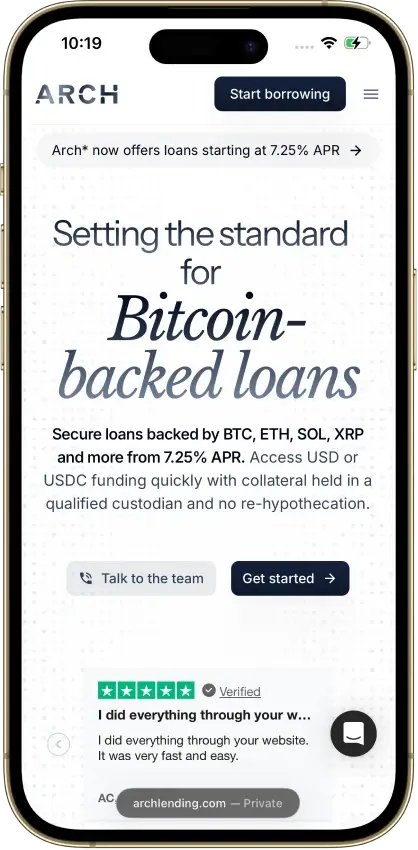
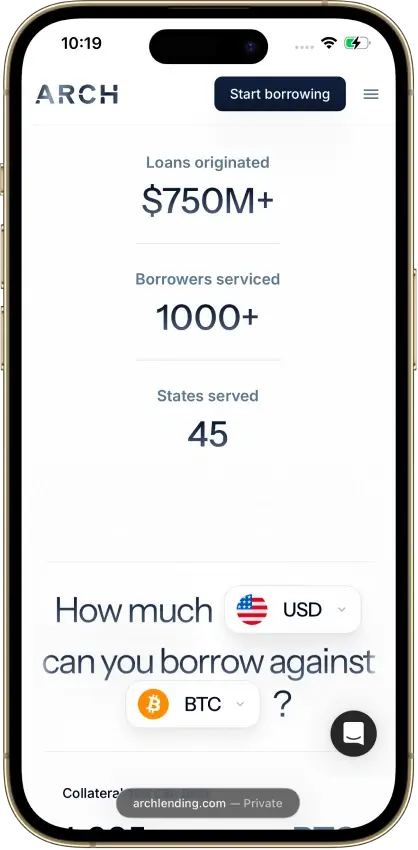
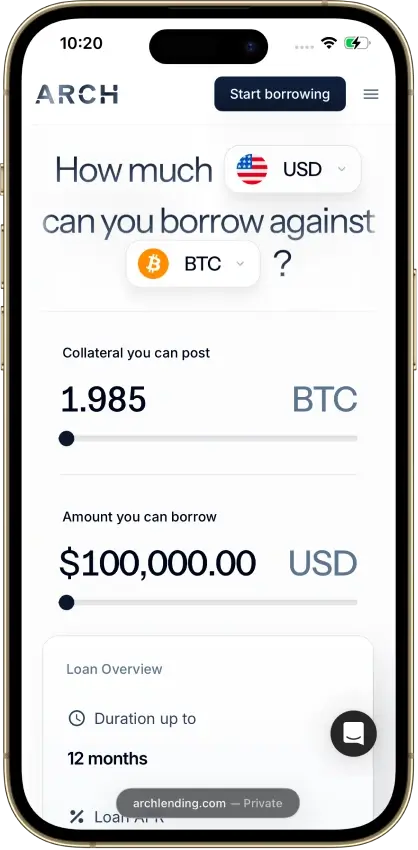
 Arch Lending | Fixed rate · Up to 12 months | BTC sale: 80%/uncured 70% LTV | US · CA, NV & others excluded |
 Coinbase Borrow | Variable USDC borrowing | BTC wrapped as cbBTC | US except NY · Limited UK/CA |
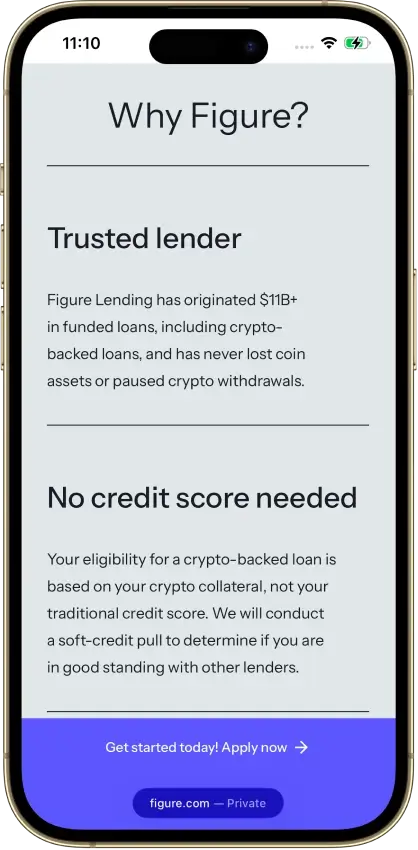
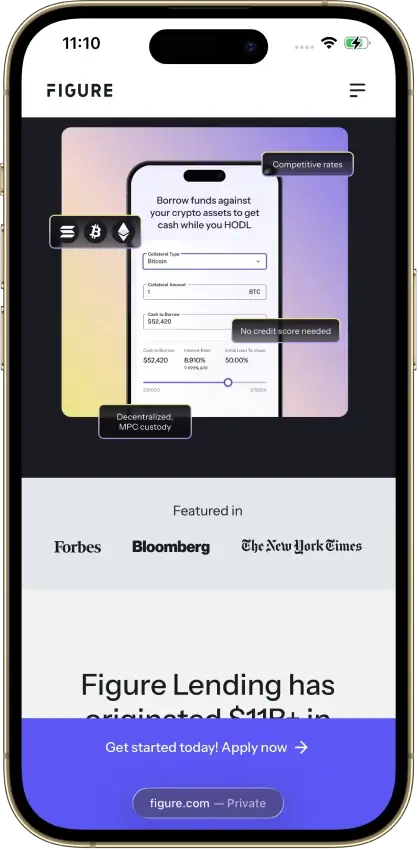
 Figure Crypto-Backed Loan | 12-month fixed-term loan | Standard: 90% LTV full sale | US · 9 states & DC excluded |
The comparison assumes a Florida resident seeking $10,000 in their own US bank account for a personal expense, with repayment after a 365-day holding period. Eligibility for that exact amount and bank route depends on the individual offer.
A platform balance becomes spendable bank cash only after withdrawal. Stablecoin proceeds may also need conversion. The payout destination shows which further steps need pricing, whether converting tokens, withdrawing a platform balance, or receiving a bank transfer.
US Crypto Loan Reviews
Arch Lending
- Borrowing terms
- Fixed rate · Up to 12 months
- Collateral & risk
- BTC sale: 80%/uncured 70% LTV
- Availability
- US · CA, NV & others excluded
Pros
- Bank and stablecoin disbursements
- Early repayment has no penalty
- Optional excess collateral withdrawals
Cons
- ACH payoff delays collateral release
- Deferred interest uses higher rates
- Rollover can increase the debt
Coinbase Borrow
- Borrowing terms
- Variable USDC borrowing
- Collateral & risk
- BTC wrapped as cbBTC
- Availability
- US except NY · Limited UK/CA
Pros
- No fixed term on variable loans
- Partial repayments supported
- No credit check
Cons
- Processing fees also accrue interest
- BTC collateral adds a cbBTC dependency
- Loan protection must be funded and re-enabled
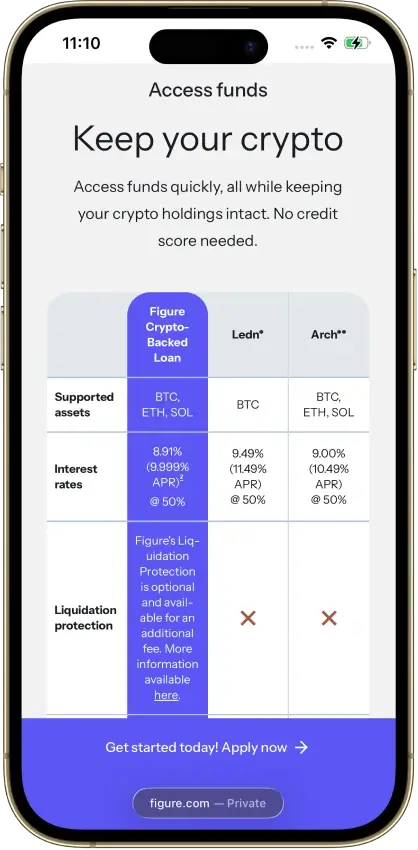
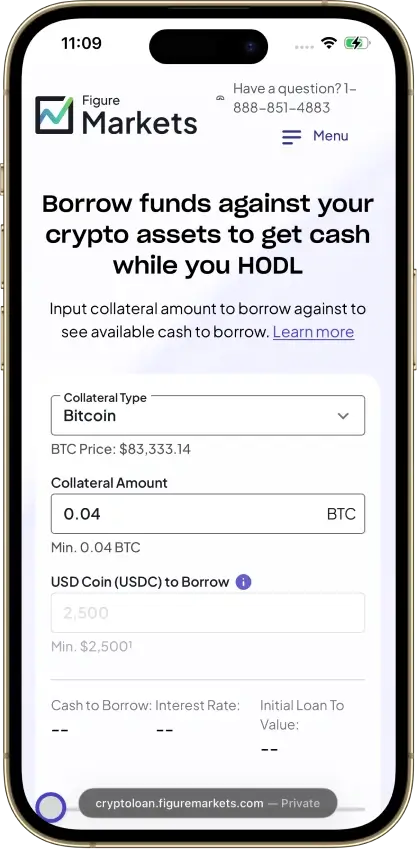
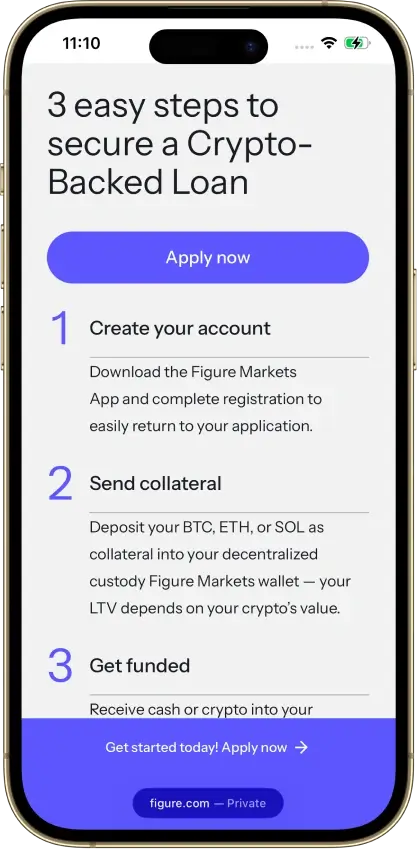
Figure Crypto-Backed Loan
- Borrowing terms
- 12-month fixed-term loan
- Collateral & risk
- Standard: 90% LTV full sale
- Availability
- US · 9 states & DC excluded
Pros
- Fixed rate during the loan term
- Early repayment without penalty
- BTC, ETH, and SOL collateral options
- Optional interest deferral
Cons
- Principal due at 12-month maturity
- Standard loans can be fully liquidated
- Protection restricted by state and loan type
- Deferral raises the balance due at maturity
Both fixed-term loans leave principal due at maturity, while the variable position has no maturity date. Interest-deferral options change the final balance and payment schedule. Optional liquidation protection changes sale provisions for an added fee. Compare those variants using their own payment amounts and conditions.
How We Rank
- Cost and pricing clarity 20% weightWhat we assess
Interest, mandatory fees, pricing conditions, and the cost of early repayment.
What earns 10/10 The quoted terms show every ordinary charge and the net proceeds before you commit, the rate is fixed or capped for the planned borrowing period, and the price needs no paid membership or token. - Collateral control and counterparty risk 25% weightWhat we assess
Custody, permitted collateral use, and recovery rights.
What earns 10/10 The collateral secures only your debt, recovery rights are clear across every custodian or wrapper, and independent security review and incident handling are documented. - Liquidation rules and risk controls 20% weightWhat we assess
Sale triggers, warnings, penalties, and tools for managing collateral.
What earns 10/10 Every sale trigger and price source is clear, the position survives a 30% collateral fall, sale charges stay at or below 5% of the debt cleared, and you can add collateral or repay at any time. - Repayment and flexibility 15% weightWhat we assess
Partial payments, maturity, renewal, and collateral return.
What earns 10/10 Partial and full repayment work on demand, collateral comes back once the debt is cleared without pool liquidity or approval, and the payoff can be checked before and after you pay. - Access and funding 10% weightWhat we assess
Eligibility, verification, payout routes, and usable funds.
What earns 10/10 You can confirm eligibility, collateral, payout route and amount before depositing, and funds arrive within the expected time, with clear steps if funding fails. - Account controls and support 10% weightWhat we assess
Security controls, loan records, monitoring tools, and customer support.
What earns 10/10 Secure access, usable loan records, clear management screens, accountable support, and a working backup route to repay or close during an outage.
How We Compare US Crypto Loans
We compare public product terms, without opening or funding the loans, for an adult Florida resident borrowing for a personal or household expense. The example starts with native Bitcoin and aims to deliver $10,000 to the borrower’s own US bank account at 50% initial LTV, counting financed charges as debt.
The planned repayment point is day 365. A complete cost check also needs a day-30 payoff amount for an earlier repayment. A 12-month quote needs its actual start and maturity dates, while a variable loan uses the same modeled borrowing period without acquiring a contractual deadline.
The tables compare loan structures. A cost comparison requires complete quotes delivering the same bank amount over the same period, with each fee counted once according to whether it is deducted or financed. Monthly payments and conversion charges can then reverse an apparent rate advantage.
The included candidates have public state rules covering individual borrowers in Florida. This researched selection is not a survey of every US lender, and omission does not establish that another lender is unavailable.
Check State, Borrower, and Loan-Purpose Restrictions
Your exchange or wallet account can work in a state where the same company restricts lending. Individual and business loans may also have separate state lists. US crypto-backed loans need their own eligibility check, even when you already use another service or have read about an international offer.
Confirm your state before configuring a Bitcoin loan amount. Then check the minimum and maximum for your collateral asset in your state.
The agreement must permit the intended spending, whether household, business, or trading, and the application must match that purpose. Owning the collateral does not make a household-purpose loan available for business funding. State-specific minimums, identity checks, and approval for the amount still apply after the purpose qualifies.
The agreement names the company providing the loan, or the separate roles of the platform and lending protocol. A change of account entity or product can change the counterparty and agreement. Use the terms attached to the loan offered, including its repayment and collateral provisions.
Your offer needs to meet each of these conditions:
- Your state and borrower type appear within the offer’s coverage.
- The requested amount meets the applicable minimum and limit.
- The agreement permits your intended use of the money.
- Required identity checks and any credit screening are complete.
- The collateral asset and repayment schedule match the quote.
Save the agreement and disclosures as a record of the accepted terms. If two official pages from the same lender list the state differently, ask which one applies to the particular loan.
Compare Bank Proceeds with Stablecoin Funding
Start at the expense you need to pay. If a contractor or household bill requires dollars from your bank, compare the amount that reaches that bank after charges.
There can be several stages between the debt opening and the money arriving. Origination fees deducted before disbursement reduce the first transfer. With a platform cash balance, you must also arrange a withdrawal. Stablecoin borrowing first creates a token balance, followed by conversion and a transfer through an eligible bank route.
The receiving account must support the payout currency and intended transfer size. Where conversion is needed, its quoted rate and fee determine how many dollars become available for withdrawal. Account limits can restrict how much can move at once, while withdrawal charges reduce the amount reaching the bank.
Allow time for collateral confirmation and account funding as well as bank settlement. Even with same-day processing at one stage, the money may not arrive before the bill is due. Bank cutoffs and payment holds may leave you owing interest while the transfer is still in progress.
Trace repayment in the opposite direction before accepting the loan. To repay stablecoin debt, you need the accepted token and a supported payment route.
Dollar repayment may use Automated Clearing House (ACH) or wire, each with its own processing period. Repayment funds need to be available early enough to settle before maturity or a collateral deadline. A cheaper payment route does not meet the obligation if it settles after the due date.
Read the Full Borrowing Cost
The full borrowing cost is the difference between the cash received and all payments required to close the debt. The interest rate is only one input. Origination, processing, conversion, transfer, and early-close conditions can change the total even when two offers advertise similar rates. An annual percentage rate (APR) can help compare disclosed borrowing charges, but check which costs its calculation includes.
For the same hypothetical $10,000 before fees, deducting a 1% fee reduces the cash received, while financing it raises debt and the collateral required at 50% LTV. Both rows charge the fee on that same $10,000 base, with no other initial costs.
| Hypothetical Fee Treatment | Cash Received | Opening Debt | Collateral at 50% LTV |
|---|---|---|---|
| $100 deducted from $10,000 before fees | $9,900 | $10,000 | $20,000 |
| $100 added to $10,000 before fees | $10,000 | $10,100 | $20,200 |
Matching both structures to $10,000 received changes the comparison. A deducted 1% fee requires $10,101.01 of principal, a $101.01 fee, and $20,202.02 of collateral at 50% LTV. Financing 1% of the $10,000 received instead produces $10,100 debt and $20,200 collateral. The larger fee base in the deducted case requires $1.01 more debt and $2.02 more collateral.
These are hypothetical structures, not matched lender quotes. A full cost comparison also adds interest and other charges.
For fixed borrowing, calculate interest using the agreement’s accrual method and actual dates. Monthly interest payments and interest deferred until maturity produce different cash flows. A deducted fee sits inside the principal and accrues interest, while a financed fee may or may not accrue interest, depending on the terms. Fees added to the balance at origination remain part of the debt at early payoff unless the terms provide a refund.
For a variable loan, model more than one rate path over the intended holding period. Rates may rise or fall during the year, changing the eventual cost. The day-30 payoff includes any charges retained on early repayment, which can outweigh a short period of interest.
Calculate both the day-30 cost and the planned-close total in dollars. Charges triggered only by collateral sales belong in a separate risk scenario.
Understand Custody, Liquidation, and Repayment
Pledged crypto may remain visible in an app while withdrawal control belongs to another party. The custody agreement sets out where the collateral is held and any permission for onward lending or pledging. Restrictions on reuse limit how pledged assets may be handled, while recovery after a counterparty failure remains uncertain.
Native BTC and a token representing BTC also create different dependencies. With a wrapped asset, repayment and collateral recovery can involve the token issuer and the route back to native Bitcoin. Protocol borrowing also relies on smart-contract execution and price oracles, the feeds supplying asset values. You retain exposure to those systems when accessing them through a familiar account interface.
Starting LTV determines the debt relative to collateral value when borrowing begins. The margin-call and liquidation levels govern what happens later. Falling collateral prices or growing debt can push LTV upward.
During a margin-call window, you may be able to add collateral or reduce debt. Automatic-liquidation rules can override that window if prices move quickly, including while a bank payment or crypto transfer is still settling. Read the sale rules as well as the warning schedule. Liquidation may involve part or all of the collateral, with charges reducing what remains.
Where a lender sells optional liquidation protection, check its fee, which states and collateral qualify, and the highest starting LTV it allows. Protection can change specific price-based sale triggers, but exceptions for default and the lender’s risk rules may remain, and the full debt is still due.
Monthly interest payments can leave the entire principal due at maturity, so that final payment needs its own funding plan. Renewal may need fresh approval and add costs. For early payoff, request a payoff quote for the payment date and confirm when interest stops accruing.
Repayment, release of the pledge, and withdrawal to your wallet are separate steps. Payment holds or a required withdrawal request can delay access after the balance is cleared. Build that delay into any plan to sell or reuse the returned crypto. Only collateral that remains after any sales can be returned.