


Quick Take
- Anthropic published research showing how Claude reconstructed P-256’s public seed from a timestamp-based generator.
- Ethereum’s EIP-7951 connects the curve to secure hardware and WebAuthn signing, making the finding relevant to passkey wallet builders.
- Anthropic says no user action is needed, while skipped-candidate criteria and P-256’s base-point origin remain unresolved.


Anthropic said on Oct. 16 that Claude had helped reconstruct the public seed behind P-256, a NIST-standardized cryptographic curve supported for Ethereum passkey signing. The finding gives wallet builders new evidence about a longstanding concern over the curve’s origins.
The seed is a public design input used to derive a coefficient in the curve’s equation. It is separate from the private signing credentials that authorize wallet activity. Anthropic says unexplained seeds supplied by the U.S. National Security Agency had fueled suspicion about deliberately weakened parameters.
The company’s published recipe initializes the old C-library generator lrand48 with the timestamp for Aug. 16, 1997, at 01:52:34 UTC. The generator produces a sequence of candidate seeds. Advancing to candidate 1,842 returns the published P-256 value, providing a repeatable recipe for that public constant.
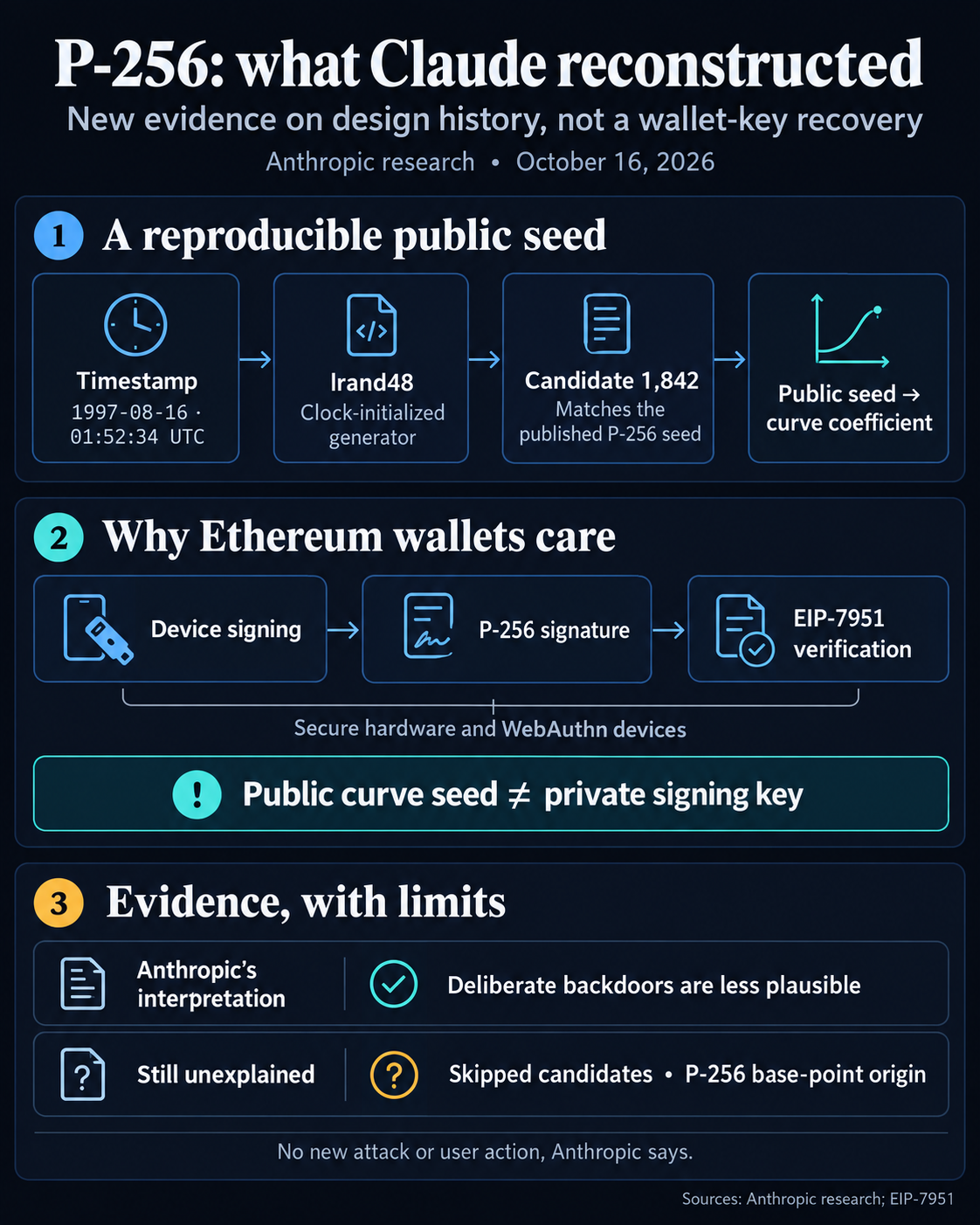
Anthropic says this makes deliberate backdoors less plausible. It describes no new attack or curve weakness and says users need take no action.
The Ethereum connection runs through EIP-7951, which specifies verification of signatures using P-256, also called secp256r1. It names Apple Secure Enclave, Android Keystore and FIDO2/WebAuthn devices as relevant hardware. This connects wallet authorization with signing capabilities built into devices and authenticators.
EIP-7951’s motivation lists device-native signing, multifactor authentication and simpler key management as uses for account abstraction.
Ethereum’s account documentation distinguishes private keys that sign transactions from public information used to verify them; contract accounts are controlled by code.
EIP-7951’s P256VERIFY operation takes a message hash, a signature and a public key, then checks the signature’s validity. The reconstructed public seed is separate from those private signing credentials.
P-256 also differs from secp256k1, the curve already used in Ethereum. The relevance is to P-256-compatible signing, rather than every Ethereum wallet.
Anthropic reports that candidate 876 also yielded a prime-order curve of the required size, leaving selection criteria unclear. The number of generation runs and the origin of P-256’s base point, a separate fixed mathematical point, remain unknown.
Mentioned in this article


Editorial credits