
Quick Take
- Threshold's unexpected Bitcoin redemption shutdown prompted Aave and Gauntlet to restrict exposure to the tokenized BTC asset.
- Approximately $136 million in tBTC sits on Aave, with holders facing potential liquidity risks if the bridge suspension persists.
- Despite assurances that no funds were lost, Threshold has yet to explain the security issue or confirm when Bitcoin redemptions will resume.


Aave has restricted new deposits and borrowing against $136 million in tokenized Bitcoin after Threshold Network suspended tBTC minting and redemptions.
The Oct. 31 intervention followed Threshold's decision to halt operations on its Bitcoin bridge while conducting undisclosed security maintenance, prompting decentralized lending protocols to limit their exposure to the asset.
In an Oct. 31 security update, Threshold said the token remained fully backed, with approximately 4,320 BTC held in bridge wallets against 4,185 tBTC in circulation.
“tBTC remains fully backed, and no funds have been lost,” the project stated, adding that investigators had found no unauthorized token minting.
The reserves exceed the circulating supply by about 135 BTC, reassuring holders about the assets backing the token even as they temporarily lose access to direct Bitcoin redemptions.
Threshold maintained that the situation was contained and that bridge functionality would return after remediation. However, it has not disclosed the specific security issue that prompted the suspension or provided a reopening date.
Existing tBTC remains transferable across Ethereum and layer-2 networks, although new Bitcoin deposits, token minting and redemption requests are suspended. Pending transactions will be completed when operations resume.
Aave and Gauntlet move to contain Bitcoin lending exposure
The suspension prompted Aave risk service provider LlamaRisk to recommend an immediate freeze of tBTC on the protocol's Ethereum V3 Core market.
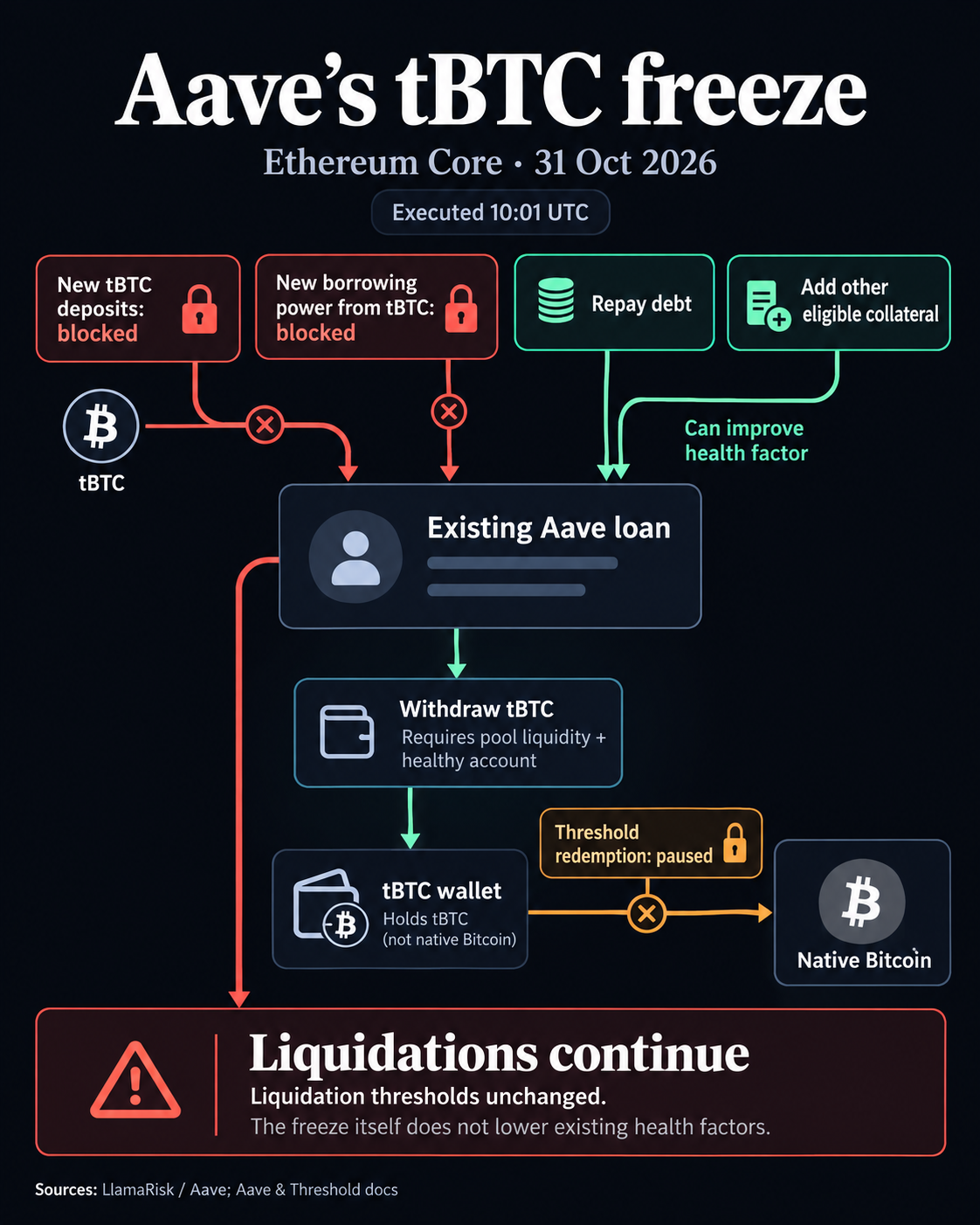
According to an Oct. 31 governance notice, Aave's guardian multisig executed the restriction at 10:01 UTC, preventing users from depositing additional tBTC or using the token to increase borrowing power.
At the time, approximately 1,760 tBTC worth $136.6 million was supplied to the market, representing roughly 42% of the token's circulating supply.
The concentration highlights the significance of Aave's decision, especially because tBTC lets Bitcoin holders deploy their assets as collateral for loans across decentralized finance.
The restriction applies only to Aave's Ethereum Core tBTC reserve, as the token's markets on Base and Arbitrum had already been frozen during earlier asset deprecation rounds.
Existing users can continue repaying loans and withdrawing eligible collateral, while liquidations remain active under existing risk parameters.
LlamaRisk said it would continue monitoring collateral positions and secondary-market liquidity before recommending that Aave restore normal operations.
Other DeFi risk managers have also moved to reduce exposure.
In an Oct. 31 statement, Gauntlet disclosed that its Ethereum Morpho USDC Core vault had approximately 704,000 USDC supplied to a lending market backed by tBTC collateral.
The firm placed the market on its emergency exclusion list and withdrew approximately 65,000 USDC in available liquidity, leaving around 640,000 USDC supplied.
Gauntlet warned that the redemption suspension could affect tBTC's secondary-market liquidity and the ability of lenders to exit positions during liquidations.
The concern arises because tBTC holders who want native Bitcoin must rely on secondary-market buyers while Threshold's redemption mechanism remains suspended.
Any significant deterioration in liquidity or a discount to Bitcoin could make collateral liquidations more difficult, particularly for lending markets with substantial exposure to the token.
Threshold has urged users not to send Bitcoin to previously generated deposit addresses or repeat pending transactions. It pledged to provide another security update within 24 hours of its Oct. 31 announcement, or sooner if circumstances change.
Mentioned in this article






Editorial credits