
Quick Take
- Ethena Pay launched Earn+ with a leveraged USDe strategy whose disclosed oracle follows USDT, creating a potential valuation blind spot.
- An assumed 11-times assets-to-equity position loses 22% of initial equity under a 2% USDe discount, before costs.
- Withdrawal requests are permitted anytime, but processing can be delayed.


Ethena Pay’s new Earn+ vault design pairs USDe collateral with USDT borrowing, creating a potential gap between the value a lending protocol reports and the money a user could recover.
The app’s Oct. 28 launch disclosure describes a strategy targeting roughly 11 times leverage whose USDe oracle follows USDT.
If USDe falls against USDT, the two measures can diverge. A price reference that follows the debt token can miss the collateral’s discount, leaving reported collateral health insensitive to a market move that reduces the value remaining after debt repayment.
Earn+ is an external vault service run by Upshift and Steakhouse through Aave v4 on Avalanche. Ethena Pay supplies the interface and advertises up to 12% APY.
The oracle follows a different asset
An oracle supplies the prices a lending protocol uses to value collateral and debt. Aave’s health factor compares collateral value, adjusted for its liquidation parameter, with borrowing. That calculation determines proximity to liquidation.
In its Oct. 20 technical assessment, Aave Labs explicitly said the Avalanche USDe price reference follows USDT and would miss a USDe-specific downside depeg. The assessment describes a Chainlink USDT/USD feed and an adapter with a $1.04 upper price cap.
If both sides of a position follow the same USDT reference, a USDe-only market discount can leave oracle-valued collateral health unchanged in response to that discount. Debt growth, changes in balances, and risk parameters can still move that ratio.
LlamaRisk’s onboarding recommendation, amended Oct. 19, proposed a 93% USDe collateral factor and capped USDT pricing for an Ethena Ecosystem Spoke.
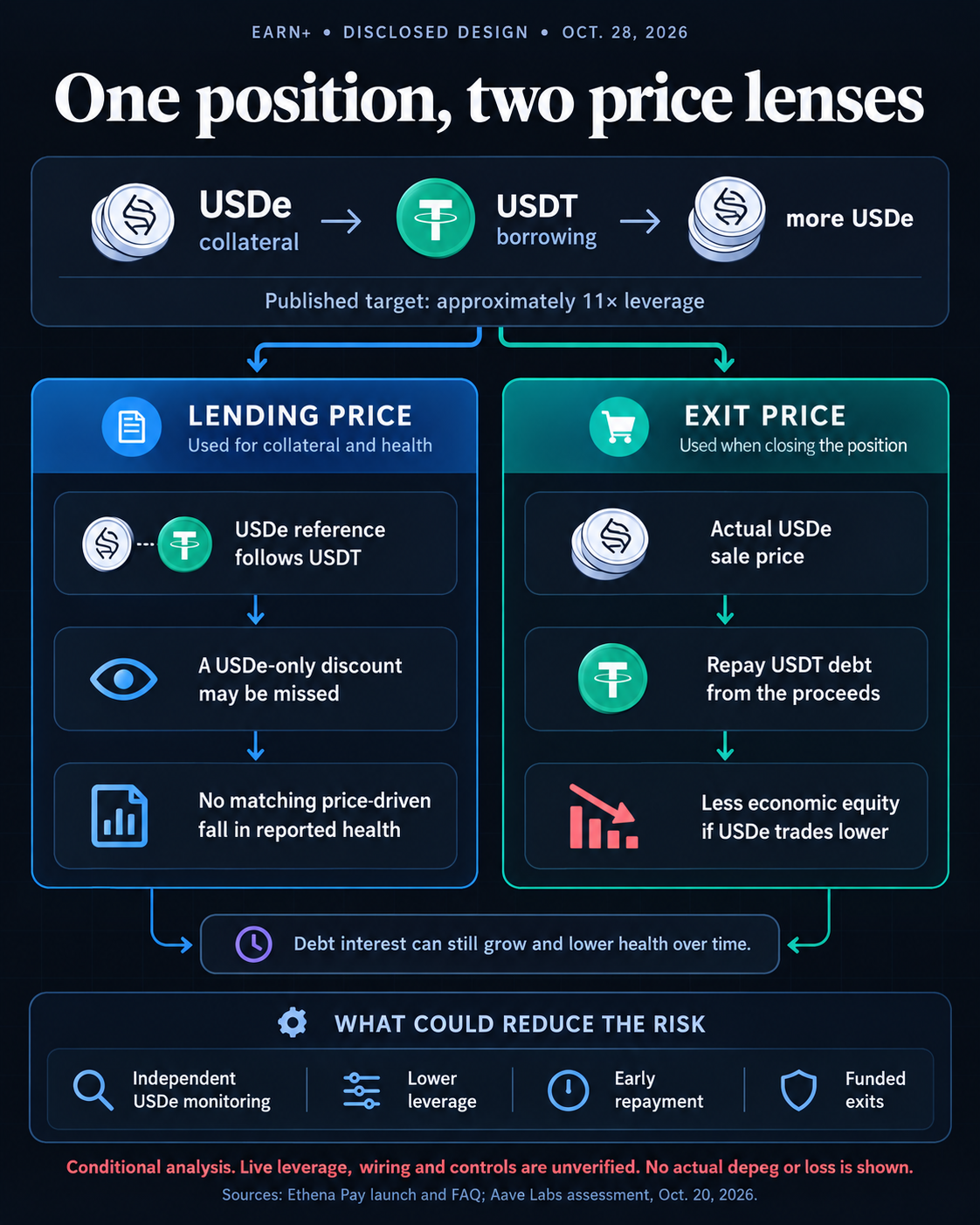
The recommendation's exact vault account, current collateral and debt, and live oracle wiring remain unverified, so the disclosed leverage target cannot be treated as an observed position.
Consider an explicitly hypothetical position, defining leverage as gross assets divided by equity. At 11 times leverage, $100 of initial equity supports 1,100 USDe worth $1,100 and 1,000 USDT of debt worth $1,000, with both tokens initially at $1.
Hold USDT at $1 and the debt balance unchanged. Ignore interest, rewards, fees, trading costs, and rebalancing. The value left after debt repayment is then 1,100 multiplied by USDe’s market price, minus $1,000.
| Hypothetical USDe price | USDe asset value | Equity after debt | Loss of initial equity |
|---|---|---|---|
| $0.99 | $1,089 | $89 | 11% |
| $0.98 | $1,078 | $78 | 22% |
| $0.95 | $1,045 | $45 | 55% |
The table shows economic marks under the stated assumptions and supplies no observed Earn+ losses or liquidation thresholds. A realized loss would depend on the price and costs of an exit.
A manager that reduced exposure earlier, or a vault operating below the target, would produce different results. A position can remain above its protocol liquidation trigger while its economic equity falls.
Ethena's FAQ caps allocations at $4.5 million overall, with individual limits of $20,000 for Standard users, $50,000 for Pro and $200,000 for VIP.
The launch’s more than $8 million of USDe balances and approximately 1,400 active users refer to Ethena Pay as a whole. Access also remains restricted: the app lists 47 live countries, with the US, EU, and UK still coming soon, plus additional eligibility rules for certain features.
Borrowing costs can erode returns before liquidation
The same assumed position has debt equal to ten times its starting equity. A 1% increase in its annual USDT borrowing cost would reduce simple annual return on initial equity by about 10%, holding all other inputs fixed.
The cost calculation holds debt at ten times initial equity for a year, ignores compounding, and makes no forecast of Earn+ returns. Aave says borrow rates depend on supply, demand, and governance-set curves, while its V4 interface guide distinguishes a market’s base borrow APY from the rate applicable to a particular position.
Accrued interest also increases debt and can lower health factor over time. Debt accrual gives financing costs a route into the lending calculation.
Aave Labs identifies plain USDe as non-yield-bearing, while sUSDe is the separate yield-bearing asset. An sUSDe staking rate cannot simply be inserted as the return on Earn+’s disclosed USDe collateral.
The app’s reward rate can fall, and Earn+ is excluded from Daily Boost. Ethena Pay’s fee waiver covers its own entry and withdrawal charges, while underlying vault costs require separate consideration.
Upshift’s general fee documentation provides for per-vault management and performance fees, plus a fee for instant redemption. An Earn+-specific fee schedule and the yield and incentive components needed to reconstruct a net return remain unverified.
Managers could also use independent market prices to decide when to unwind. Independent monitoring of USDe’s market price, lower leverage, and early debt repayment could reduce exposure to the modeled discount.
Their effectiveness would depend on who can act, how quickly they respond, and what liquidity is available.
Upshift’s general risk framework describes configurable withdrawal buffers and limits on changes in reported net asset value (NAV), and also gives an owner multisig immediate powers to pause withdrawals and initiate an emergency withdrawal.
Earn+’s settings and any independent USDe-price trigger remain unverified. Economic losses remain even when reported NAV changes are bounded.
Its general redemption documentation describes a standard epoch queue, settled in batches, and an instant route funded by a liquidity buffer. Neither description proves which route the app exposes or how much cash would be available during stress.
For the collateral itself, Aave Labs says issuer redemption from Avalanche requires bridging USDe to Ethereum before using Ethena’s permissioned process. Local secondary markets and an Avalanche peg stability module offer other exit context.
Ethena Pay says withdrawal requests have no lock-up and are processed into the USD Account within 24 hours, while its FAQ separately warns they can take longer.
Upshift’s general terms allow transfer delays and service-specific supplemental terms. Its public vault-terms index lists none, although Ethena Pay’s terms require first-time acceptance of Earn+ disclosures. That leaves the applicable in-app detail distinct from the public processing description.
An Aave collateral analysis described the broader separation between oracle valuations and cash exits. Earn+ makes that distinction an app allocation decision: the lending health reading, net return after financing, and money available on withdrawal answer different questions.
The outcome for users depends on leverage, the manager’s response to a USDe discount, and the price and timing of a funded exit.
Mentioned in this article


Editorial credits