
Quick Take
- Fortitude reported selling borrowed ZEC for about $8.3 million before its October 5 announcement, with debt repayable in dollars.
- The 9,000-rig order schedules October and November shipments, separate from the nonbinding next-generation equipment plan.
- Additional mining work could dilute unchanged rivals’ expected coin output after difficulty adjusts, without increasing scheduled per-block issuance.


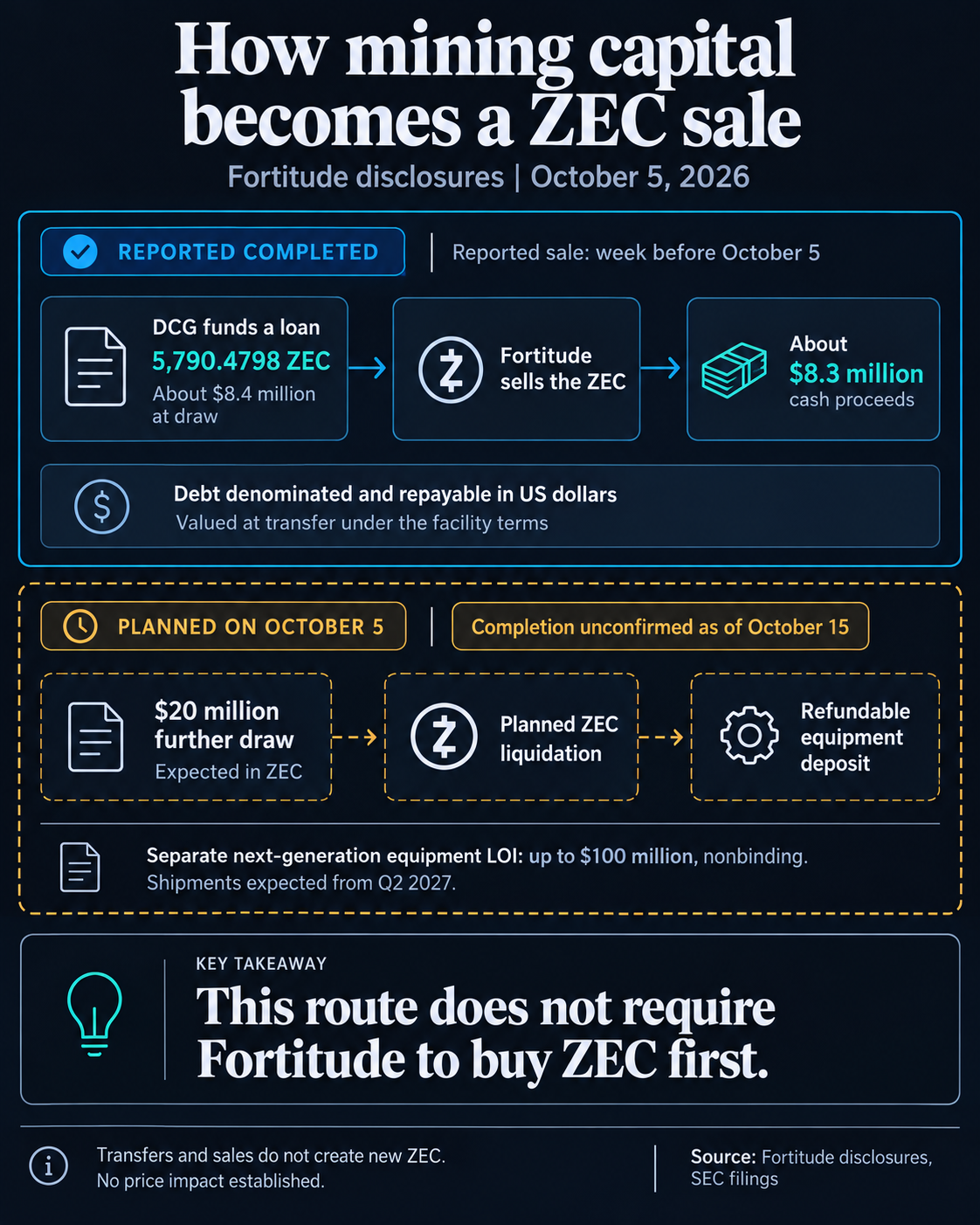
Zcash mining operator Fortitude Mining’s expansion shows how investment in infrastructure can bring existing ZEC to market without requiring the miner to buy the token first. The company can receive ZEC through borrowing from its parent, Digital Currency Group, sell it for cash and owe dollars.
That route has already produced a disclosed sale. In its October 5 announcement, Fortitude said it had received 5,790.4798 ZEC through a roughly $8.4 million draw the previous week, then liquidated those coins for about $8.3 million.
The distinction matters during the company’s scheduled October–November equipment shipment window. Financing can turn coins into equipment, and scheduled deliveries could add machines competing with existing miners for rewards. For ZEC holders and mining investors, those are separate consequences of the same expansion.
From borrowed coins to mining capacity
Under the amended DCG facility, ZEC-funded loans are denominated and repayable in US dollars, with their value determined at transfer under the facility’s terms. Fortitude therefore does not have to repurchase the same number of ZEC to satisfy that repayment obligation.
Investment in Fortitude’s mining capacity therefore need not create a fresh spot purchase by Fortitude.
The next financing step was prospective. Fortitude said on October 5 that it planned a further $20 million draw, expected in ZEC, followed by liquidation to fund a refundable deposit for the separate next-generation equipment arrangement. The October 5 disclosure described those steps as plans.
Two hardware timelines
The nearer capacity question concerns Fortitude’s July 30 definitive agreement for 9,000 BITMAIN Antminer Z15 Pros, priced at $3,499 each, or approximately $31.5 million. The contract scheduled 3,000 units to ship in October and 6,000 in November.
The contract’s shipment timetable is not a count of operating machines. The capacity figures below model additional running equipment.
BITMAIN’s typical specifications put each Z15 Pro at 840 KSol/s, a measure of mining work, and 2,780 watts. Multiplying those ratings gives the first 3,000 machines 2.52 GSol/s of nameplate capacity and 8.34 megawatts of miner wall draw. All 9,000 would represent 7.56 GSol/s and 25.02 MW before additional site loads. Actual output depends on operating conditions and availability.
The October 5 next-generation equipment arrangement is separate: an indicative, nonbinding commitment of up to $100 million, requiring a later binding agreement after specifications and pricing are released. Shipments were expected to begin in the second quarter of 2027.
Revenue draws miners into competition
Hashrate Index’s October 13 study helps explain the incentive to add machines. Using ZEC at $1,185, a 27.8-GSol/s network and electricity at 8 cents per kilowatt-hour, it estimated Z15 Pro revenue near $773 per megawatt-hour, versus about $135 for efficient Bitcoin fleets. A rented H100 graphics processor reached roughly $1,679 per MWh only at full rental utilization, using about 1.74 kilowatts of facility power per GPU. Rental utilization, capital costs and fees determine how such revenue comparisons translate into returns.
For an updated illustration, assume a ZEC price of $1,236.60 and electricity at 8 cents per kWh. Use ZecStats’ 30.2-GSol/s network estimate, timestamped October 16 at 08:09 UTC.
Using those inputs, a stock Z15 Pro running continuously would earn an expected 0.04005 ZEC, or about $49.53, per target day from subsidy alone. Its typical 2.78-kilowatt draw costs about $5.34 daily, leaving $44.19 before other costs.
The residual excludes pool and service fees, hardware and facility capital costs, and other operating expenses. The illustration assumes full uptime and excludes transaction fees.
The two inputs can pull in opposite directions: a higher ZEC price raises dollar revenue for a given coin output, while more competing mining work reduces an unchanged machine’s expected share of rewards. Future ZEC prices and competing mining work determine how long that incentive lasts.
A smaller share of each block
Zcash’s current total block subsidy is 1.5625 ZEC. Miners receive 1.25 ZEC, or 80%, plus transaction fees. Under the NU6.1 funding model, 8% goes to Zcash Community Grants and 12% to coinholder-controlled funding.
At the 75-second target interval, the network would produce about 1,152 blocks per day, implying approximately 1,800 ZEC of total subsidy and 1,440 ZEC for miners. Those daily figures are target-derived estimates. Actual daily issuance varies with block production; the subsidy per block follows the protocol schedule.
CryptoSlate’s alternative scenarios begin at the October 16 estimate of 30.2 GSol/s. If additional machines join while every incumbent’s mining work stays unchanged, an incumbent’s expected subsidy output falls as its share of total work shrinks.
| Alternative scenario | Additional nameplate work | Expected coin output of an unchanged existing miner |
|---|---|---|
| No additional work | 0 GSol/s | Baseline |
| 3,000 additional Z15 Pros | 2.52 GSol/s | About 7.7% below baseline |
| 9,000 additional Z15 Pros in total | 7.56 GSol/s | About 20.0% below baseline |
Both scenarios start from the same baseline and show expected output after difficulty adjusts. The 9,000-machine case includes the first 3,000. They assume full uptime, unchanged per-block subsidy, no other entries or exits and all added work outside the measured baseline. Machines already counted in the network estimate must not be added again. Fees are excluded.
More Fortitude production would partly displace the expected rewards of competing fleets while per-block issuance remains governed by the protocol. A miner can face lower coin output even while a higher token price supports its dollar revenue.
Fortitude says it currently sells or otherwise monetizes all the digital assets it mines. As its fleet expands, it may receive and monetize rewards that would otherwise have gone to competing miners.
The next consequential disclosures are completed financing conversions, delivered machines and additional operating capacity.
Mentioned in this article




Editorial credits