
Kraken scores 7.8/10 for security controls, quarterly reserve checks, bank rails and advanced tools. Entry fees, reserve coverage and product restrictions are the main tradeoffs.
Kraken vs Coinbase: Which Exchange Should You Choose?
Kraken combines user-verifiable proof of reserves, 24/7 standard messaging, margin, and named US perpetual contracts.

Coinbase fits U.S. users who fund by ACH and use Advanced, but Simple Buy costs and regional product rules require attention.
Affiliate Disclosure
Some links in this comparison are affiliate links. CryptoSlate may earn a commission if you sign up through these links. Our ratings remain editorially independent.
Overview
Kraken Coinbase
Overall score
7.8 / 10 for Kraken's flagship account across the US, EEA, and UK
7.6 / 10 for Coinbase's US retail and Advanced account
Listed crypto assets
600+ globally
Roughly 270–315 in its US retail range
Advanced entry fees
0.40% maker, 0.80% taker
0.40% maker, 0.60% taker
Published advanced range
0.00%–0.40% maker, 0.05%–0.80% taker
Entry tier at 0.40% maker and 0.60% taker, with no exact retail floor published
Simple purchase cost
1% for instant and recurring transactions, 1.5% for custom orders, or 3% for small-balance conversions, plus applicable spread and payment cost
Often 2.5%–3.5% on small orders
US bank funding and cash-out
Free ACH, $4 outgoing FedWire, and RTP at 1.5% capped at $50
Free ACH, instant eligible RTP with fee not disclosed, $10 incoming and $25 outgoing wires, plus PayPal and debit cards
Proof of reserves
Quarterly Merkle-tree attestation with user verification
No exchange-wide Merkle proof, uses audited public reporting
Cold storage
A majority of client crypto held offline
Most customer digital assets stored offline
Staking availability
Unavailable in New York, Maine, California, Maryland, New Jersey, and Wisconsin
New principal paused in California, Maryland, New Jersey, and Wisconsin
Mobile apps
Separate Kraken and Kraken Pro apps
Consumer and Advanced features in the Coinbase app
API access
REST, WebSocket v1/v2, FIX, qualified spot testing, and futures demo
REST, WebSocket, and static mocked Advanced responses
Customer support
24/7 messaging, chat, and forms
Help center, chat, email, tickets, and plan-specific support on eligible Coinbase One tiers
Kraken wins overview
Kraken provides reserve verification, margin, named US perpetuals, and a separate Pro interface. Coinbase provides all-state US spot access, same-account purchase and Advanced Trade functions, and eligible real-time cash-outs.
Winners by Category
Kraken Coinbase
Kraken for reserve verification, 24/7 standard messaging, margin, and named US perpetuals
Coinbase for all-state US spot access and one-account retail and Advanced trading
0.80% taker
0.60% taker
0% maker and 0.05% taker
Exact retail Advanced floor: Not disclosed
600+ global inventory
Roughly 270–315 in its US retail range
Separate consumer and Pro workflows
Buy, receive, cash-out, and Advanced Trade inside one account
Unavailable in six named states
New principal paused in four named states
Free ACH, $4 outgoing FedWire, paid RTP, and funding-method holds
Free ACH, instant RTP where available, and $10 incoming / $25 outgoing wires
Quarterly Merkle attestations with balance verification
No exchange-wide Merkle proof
No equivalent recurring public-company reporting described
Quarterly reporting and annual audits as a listed company
Consumer, Pro, Desktop, Wallet, and Krak interfaces with REST, WebSocket v1/v2, FIX, and futures APIs
Main app with Advanced Trade, separate Base app, Advanced REST and WebSocket, and static mocked sandbox responses
24/7 messaging without a paid membership
Standard channels plus plan-specific support on eligible Coinbase One tiers
Kraken wins winners by category
Kraken leads on user-verifiable reserve inclusion, its lower published fee endpoint, and stated standard support access. Coinbase leads on entry taker pricing, same-account purchase and Advanced Trade functions, staking geography, and public financial reporting.
Screenshots
Kraken screenshots

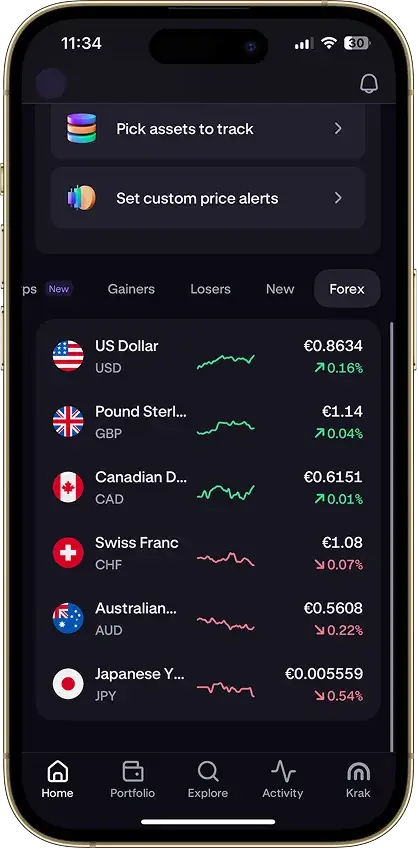
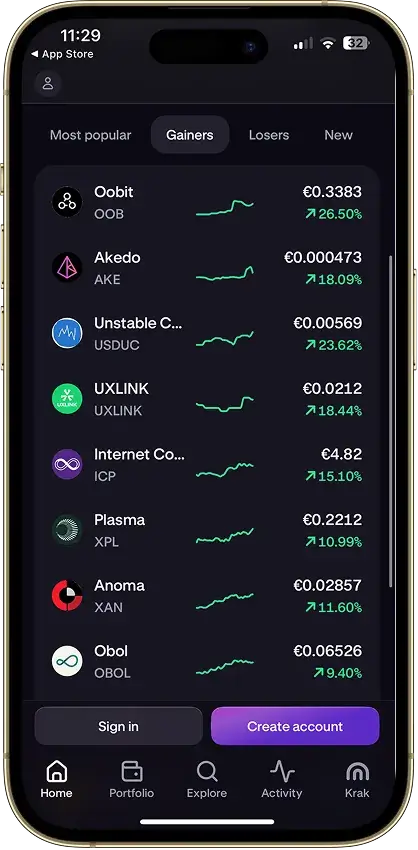
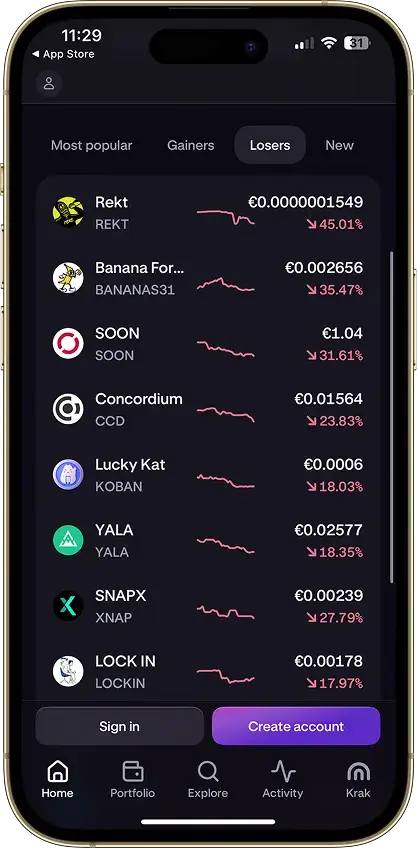
Screenshot 1 of 4
Coinbase screenshots

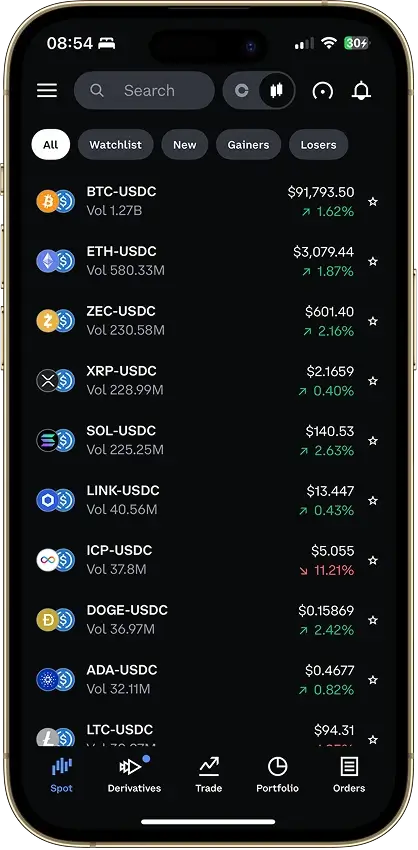
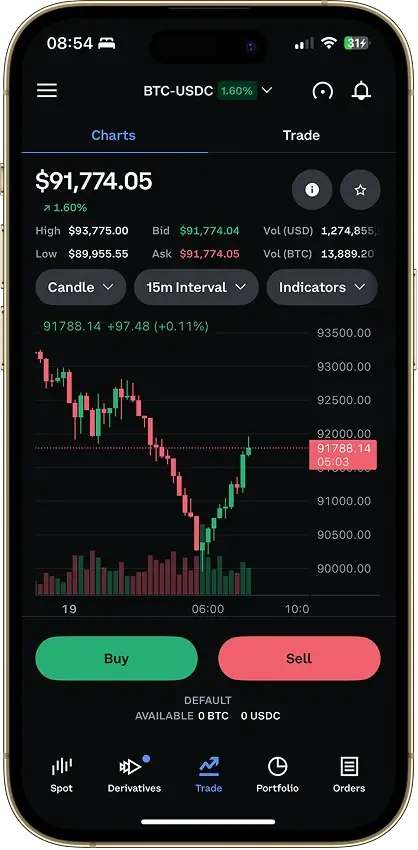
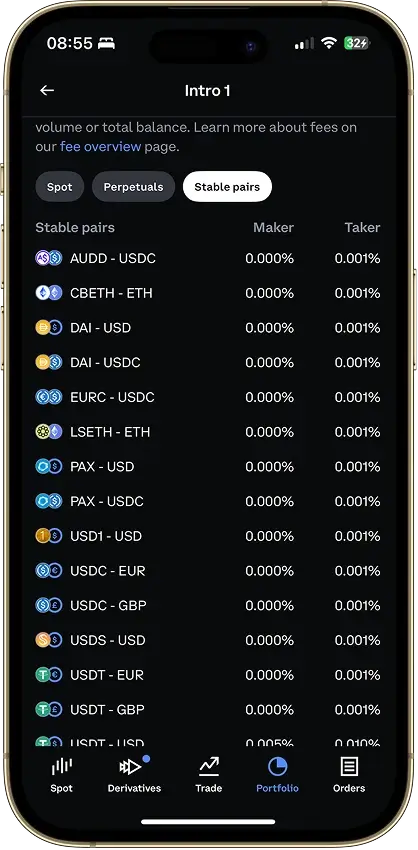
Screenshot 1 of 4
Trading Fees and Pricing
Kraken Coinbase
Entry tier
0.40% / 0.80%
0.40% / 0.60%
Intermediate tiers
Rates fall from $2,500, with further thresholds at $10,000 and $25,000
Pair- and volume-based schedule. Matching percentages: Not disclosed
Published lower endpoint
0.00% maker / 0.05% taker
No exact retail Advanced floor published
No clear winner
Coinbase has the lower published entry taker fee. Kraken publishes a lower endpoint. Kraken's intervening percentages and Coinbase's matching retail ladder are not disclosed, and Coinbase One rebates can change realized costs.
Trading costs depend on the order type, qualifying tier, interface, and any applicable membership benefit.
Supported Crypto Assets and Markets
Kraken Coinbase
Listed crypto assets
600+ globally
Roughly 270–315 in its US retail range
Trading pairs
No matched global count
About 460 in its US retail range
USDT transfer disclosure
ERC-20 and a separate low-fee supported route
Supported network, not named
USDC transfer disclosure
Routes vary by account and destination support
Networks not named
Equities
Not included in the compared Kraken product scope
US stock trading rollout
Event markets
Not advertised
Prediction markets in supported US accounts
No clear winner
Kraken's 600-plus figure is global, while Coinbase's roughly 270–315 assets and about 460 pairs cover its US retail range, so the figures do not support a matched inventory winner.
Spot, Margin, Derivatives, Staking, and Earn
Kraken Coinbase
Spot trading
Kraken and Kraken Pro
Coinbase and Advanced Trade
Margin trading
Available through Kraken Pro where eligible
Not advertised
Crypto derivatives
Futures and perpetual contracts where available
Crypto futures and perpetual contracts where available
International derivatives
Global futures under regional rules
Perpetual futures for eligible non-US accounts, with Australian access limited to qualifying wholesale investors
US derivatives structure
Eligible clients can access a 16-contract perpetual lineup denominated in dollars and a distinct CME futures route
Crypto futures and perpetual-style contracts through separate derivatives entities
US staking availability
Unavailable in six named states
New principal paused in four states
OTC and self-custody
OTC service and Kraken Wallet
Base app. OTC service not disclosed
No clear winner
Kraken provides eligible margin access and named US perpetuals. Coinbase provides US crypto derivatives and international perpetuals through separate routes and pauses new staking principal in fewer named US states.
The relevant differences are margin eligibility, derivatives structure, staking geography, and product-specific regional access.
The Ethereum staking guide explains how platform commissions interact with network rewards and exit queues.
Liquidity, Orders, Execution, and Limits
Kraken Coinbase
Advanced order types
Market, limit, stop, trailing, iceberg, OCO, and additional Pro controls
Market, limit, stop-limit, and additional Advanced controls
Trading interface
Live order books and advanced charts
Live order books and advanced charts
API access
Spot REST, WebSocket v1/v2, FIX, and futures APIs
Advanced REST and WebSocket
Testing environment
Public futures demo, with qualified access for spot testing
Static mocked Advanced responses
Matched liquidity metrics
No matched measurement
Same-basis figure unavailable
Crypto withdrawal limits
Account- and verification-specific
Account- and risk-specific
No clear winner
Neither exchange publishes matched spread, slippage, uptime, order-book depth, or withdrawal-cap figures that establish a liquidity or limits winner.
Kraken provides a public futures demo and qualified spot-testing access. Coinbase provides static mocked Advanced responses. Their API permission models and account limits also differ.
Deposits, Withdrawals, and Fiat Rails
Kraken Coinbase
US ACH deposits
Free and near-instant for trading, with a seven-day hold on the associated amount
Free, with retail timing of one to five business days
US ACH withdrawals
Free, estimated zero to two business days
Free, with retail timing of one to five business days
US FedWire
Free deposit, then $4 withdrawal with an estimated zero-to-one-business-day window
$10 incoming and $25 outgoing
Real-time cash-out
1.5% capped at $50, near-instant where eligible
Instant up to $100,000 per transaction where eligible. Fee: Not disclosed
Instant purchase methods
Cards and PayPal
Cards and PayPal
Funding-related holds
Seven days for ACH, plus 72 hours for PayPal and qualifying card or wallet purchases
Account- and risk-dependent, without one universal schedule
Crypto transfers
Asset- and network-specific Kraken fees shown at confirmation
Network-based charge shown before transfer
No clear winner
Coinbase documents instant eligible RTP cash-out with a $100,000 transaction ceiling but does not disclose a fee. Kraken charges less for an outgoing FedWire and states a shorter ACH withdrawal estimate, while its funding holds remain separate.
The best US dollar rail depends on speed, transaction cost, eligibility, and when deposited funds become withdrawable.
KYC, Regulation, and Availability
Kraken Coinbase
KYC
Required for normal trading and withdrawals
Required for normal trading and withdrawals
US operating structure
Payward, Inc. for the retail exchange, with Kraken Financial as a separate Wyoming SPDI affiliate
Separate regulated entities for retail spot and derivatives products
US derivatives access
Separate perpetual and CME-listed futures routes after account, location, and product checks
Separate onboarding, entity, contract, and state eligibility
US spot availability
Excludes New York and Maine
All states, with product-level restrictions
US staking
Unavailable in New York, Maine, California, Maryland, New Jersey, and Wisconsin
New principal paused in California, Maryland, New Jersey, and Wisconsin
Australia retail account
Not disclosed
Supported under local rules
Coinbase wins KYC, Regulation, and Availability
Coinbase's Nasdaq-listed parent publishes quarterly filings and annual audits, and its centralized spot account reaches every US state. Product-level eligibility still applies to both exchanges.
Both exchanges require identity verification, but their US entity structures and state coverage differ.
Security, Custody, and Proof of Reserves
Kraken Coinbase
Custody model
Custodial account with user title recorded in internal ledgers and assets that can use shared addresses
Custodial account with customer assets held 1:1
Cold storage disclosure
A majority of client crypto held offline
Most customer digital assets stored offline
Proof of reserves
Quarterly Merkle attestations with user balance verification
No exchange-wide user-verifiable Merkle proof
Financial reporting
No equivalent recurring public-company reporting described
Quarterly filings and annual audits as a listed company
Account protection
Global Settings Lock, master key, hardware keys, withdrawal controls
Passkeys, hardware keys, allowlisting, security prompts, device controls
Cash protection
Exchange balances have no FDIC or SIPC coverage
Pass-through FDIC or NCUSIF protection up to $250,000 for qualifying cash, with crypto excluded
Disclosed security incident
2024 funding flaw mitigated in under one hour with no client assets affected
2025 support-contractor data incident with no custody loss reported
No clear winner
Kraken leads on user-verifiable reserve inclusion. Coinbase leads on recurring public financial reporting and qualifying US cash protection.
The exchanges use different disclosure models, so reserve inclusion, financial reporting, custody language, and cash protection are evaluated separately.
Moving assets to wallet custody options such as Kraken Wallet or Base transfers key control to the user, along with the recovery responsibility described in the custody model explainer.
Website, Mobile Apps, API Access, and Support
Kraken Coinbase
Consumer interface
Standard app for simple purchases, funding, and portfolio tracking
Buy, sell, receive, cash-out, and same-account Advanced Trade
Advanced interface
Separate Kraken Pro app and Kraken Desktop
Advanced Trade within the Coinbase experience
Mobile availability
iOS and Android
iOS and Android
Developer access
Spot REST, WebSocket v1/v2, FIX, and futures APIs
Advanced REST and WebSocket
Testing environment
Public futures demo, with qualified onboarding for spot testing
Static mocked Advanced responses
API controls
Scoped keys and IP controls
Scoped keys. IP controls not disclosed
Standard support
24/7 messaging, chat, and forms
Help center, chat, email, and tickets
Plan-specific support
No membership required for 24/7 messaging
Available on eligible Coinbase One tiers
No clear winner
Coinbase keeps retail purchases and Advanced Trade inside one account, while Kraken requires switching interfaces to reach its Pro and Desktop workflow.
Interface consolidation, separate professional tools, API scope, testing access, and support channels suit different workflows.
Final Verdict
Affiliate Disclosure
Some links in this comparison are affiliate links. CryptoSlate may earn a commission if you sign up through these links. Our ratings remain editorially independent.
Kraken wins final rating
Choose Kraken for reserve verification, margin, named US perpetuals, its published fee endpoint, and standard support. Choose Coinbase for same-account purchase and Advanced Trade functions, the lower entry taker fee, all-state US spot access, bank rails, staking coverage, and audited public reporting.
Kraken wins overall for users who prioritize user-verifiable reserve disclosure, 24/7 standard messaging, margin, and named US perpetuals. Coinbase remains the more practical choice for all-state US spot access, same-account purchase and Advanced Trade functions, eligible real-time cash-outs, and public-company reporting.
Choose Kraken If…
Kraken fits users who prioritize reserve verification, margin, named US perpetuals, separate advanced tools, or standard support access.
- You want a global inventory of more than 600 crypto assets.
- You want to verify your balance in quarterly proof-of-reserves attestations.
- You want a published fee schedule that falls from the entry tier to an endpoint of 0% maker and 0.05% taker.
- You need margin trading or a separate advanced-trading app.
- You want 24/7 messaging without paying for a membership.
- You can plan around the seven-day ACH hold and qualifying 72-hour payment-method holds.
Choose Coinbase If…
Coinbase fits users who prioritize one-account trading, all-state US spot access, bank cash-outs, or public-company reporting.
- You want buy, receive, cash-out, and Advanced Trade functions inside one account.
- You place entry-tier market orders and want the lower published taker fee.
- You frequently move dollars through ACH, wires, or PayPal and use eligible RTP cash-outs.
- You value audited filings and public-company reporting over Merkle verification.
- You want staking access in New York or Maine, where Kraken Rewards is unavailable but Coinbase staking remains open.
- You prefer one main app with an optional Advanced Trade interface.
- You will use Advanced Trade or an eligible Coinbase One benefit for larger buys, since the fee and spread on small simple purchases can consume about 2.5% at the low end and 3.5% at the high end.
- You are comfortable with standard support channels or plan-specific support on an eligible Coinbase One tier.
Kraken vs Coinbase FAQs
Is Kraken or Coinbase cheaper for trading?
Coinbase is cheaper for an entry-level taker order at 0.60% versus Kraken's 0.80%, while both entry maker rates are 0.40%. Kraken's schedule falls from thresholds beginning at $2,500 until makers pay 0% and takers pay 0.05%. Coinbase's matching retail ladder and exact floor are not disclosed. Coinbase One Preferred and Premium return 25% of eligible Advanced spot charges, with Preferred limited to 100 USDC monthly.
Is Kraken or Coinbase safer?
Both exchanges use offline storage and advanced account controls, but their disclosure models differ. Kraken's June 30, 2026 Merkle-tree attestation lets customers verify inclusion of in-scope balances. Coinbase provides audited public-company filings and says most customer digital assets are stored offline. Kraken discloses user-level reserve inclusion, while Coinbase discloses more recurring corporate financial information.
Is Kraken or Coinbase better for beginners?
Coinbase places purchases, deposits, receipt, cash-out, and Advanced Trade inside one account. Kraken's standard app handles simple purchases, funding, and portfolio tracking, while Kraken Pro is a separate interface for order books, advanced order types, and fee tiers.
Does Kraken or Coinbase list more crypto assets?
Kraken puts its worldwide crypto inventory above 600. Coinbase gives a US retail interval with a lower bound near 270 and an upper bound near 315. Because those figures cover different geographies, they do not establish a matched asset-count winner. Country and state rules affect listings. Product and account limits can narrow them further.
Does Kraken or Coinbase offer staking?
Both exchanges offer staking on supported proof-of-stake assets, subject to different US restrictions. Kraken is unavailable in New York and Maine. Its staking restrictions also cover California and Maryland, plus New Jersey and Wisconsin. Coinbase has paused new principal in California and Maryland, plus New Jersey and Wisconsin. Neither exchange provides a stable matched net yield. Users must compare current rates and commissions, then check supported assets and unstaking periods.
Is Kraken or Coinbase faster for bank withdrawals?
The rail and account eligibility determine cash-out speed at each exchange. Coinbase RTP can settle instantly for qualifying banks and accounts, subject to a $100,000 transaction ceiling. Kraken's RTP withdrawal is near-instant but costs 1.5%, capped at $50. Kraken states zero to two business days for free ACH withdrawals, while Coinbase states one to five business days for its current US retail ACH surface. A Kraken ACH-funded amount can remain locked from withdrawal for seven days.
Do Kraken and Coinbase require KYC?
Identity checks are mandatory at each exchange before an account can trade normally. Verification controls trading and funding access, as well as withdrawals. Staking and derivatives have further eligibility rules. Either exchange can request more documents during a compliance or security review, and manual checks can extend the stated processing time.
Does Kraken or Coinbase have a trading API?
Both exchanges provide trading APIs, although their protocol lists and testing environments differ. Kraken documents spot REST and FIX endpoints alongside WebSocket v1/v2 and futures APIs. Its futures demo is public, while spot testing requires qualified onboarding. Coinbase Advanced provides REST and WebSocket access, but its sandbox returns static mocked responses. Automation remains subject to account limits and KYC. Regional product permissions also apply.



Kraken combines user-verifiable proof of reserves, 24/7 standard messaging, margin, and named US perpetual contracts. Coinbase keeps simple purchases, bank deposits, receipt, cash-out, and Advanced Trade within one account and offers real-time US cash-outs through eligible banks. Trading costs depend on the interface, order type, monthly tier, and membership benefit.
Kraken scores 7.8 out of 10, compared with 7.6 for Coinbase, under different account scopes. Kraken reports more than 600 assets globally, while Coinbase reports roughly 270–315 for its US retail lineup. The centralized exchange directory helps users check regional account availability, while reserve checks are detailed in the Kraken exchange evaluation. The Coinbase platform assessment covers its same-account retail and Advanced surface.