

Overview
Introduction
Volatility measures how widely returns vary over a stated period. It does not mean price is falling, and it does not predict direction. An asset can be volatile while rising, falling or moving rapidly in both directions.
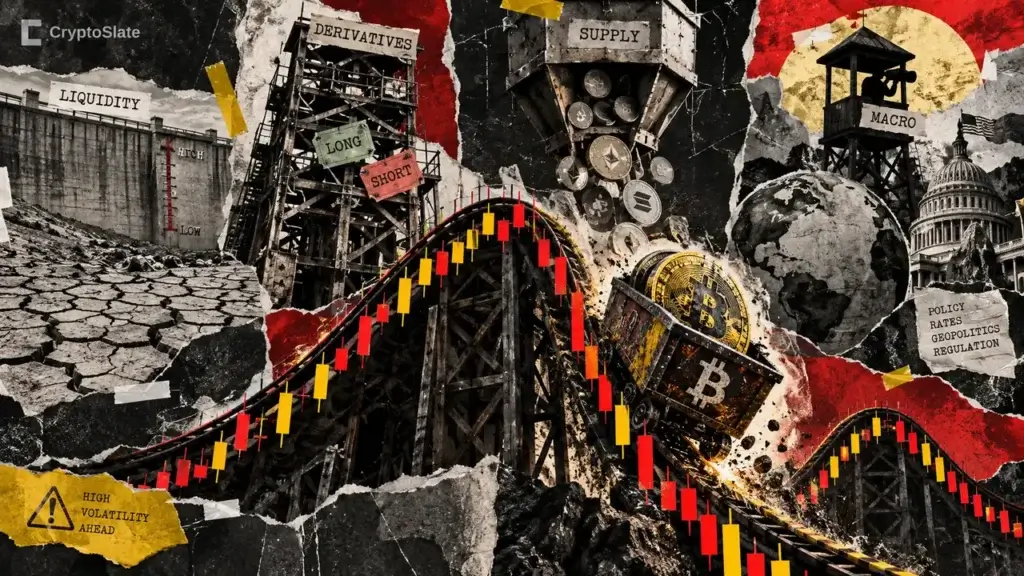
Crypto markets combine several conditions that can amplify change: trading never closes, liquidity is fragmented across exchanges, some assets have concentrated holders, derivatives allow positions larger than posted collateral and the value of many tokens depends on expectations about future adoption. When one condition changes, the others can transmit the shock.
Key takeaways
How Crypto Volatility Is Measured
Analysts usually calculate returns first, then measure how dispersed those returns are. A simple daily return is:
daily return = (today's price ÷ yesterday's price) - 1
Historical, or realized, volatility can be estimated from the standard deviation of returns over a window such as 30 days. To annualize a daily estimate, multiply it by the square root of the number of periods in a year. Crypto trades every day, so reports must state whether they use 365 calendar days, a trading-day convention or another method.
The volatility term definition covers the basic idea. A complete report should also state price source, interval, window and return formula. Changing any of them can change the result.
Volatility is not the same as drawdown. Volatility counts movement in both directions. Drawdown measures decline from a prior peak. A stable-looking weekly series can also hide sharp intraday moves, so match the sampling interval to the risk being studied.
Liquidity and Order-Book Depth
The next order that trades sets the observed price. A market with many buy and sell orders near the current price can absorb a larger order with less movement. A thin book forces the order through several price levels.
Assume one token has $5 million of sell orders within 1% of the current price and another has $50,000. The same $100,000 market buy can have little effect on the first and a large effect on the second. The displayed market cap does not reveal that difference.
The meaning of market liquidity and crypto order-book execution explain how depth, spread and price impact shape the move.
Market cap and crypto price adds supply to the picture.
Liquidity also changes over time. It can fall during weekends, exchange outages, market stress or uncertainty. Market makers may widen quotes when hedging becomes costly. A position that looked easy to exit under normal conditions can become difficult during the event that creates the need to exit.
Derivatives and Liquidation Cascades
Derivatives let traders control a position larger than their posted collateral. If price moves against the position, the exchange can close it to prevent further loss. Those forced orders can move price again and trigger more liquidations.
For example, a negative information shock leads to selling in a shallow spot book. The lower spot price affects perpetual futures. Long positions with little collateral reach liquidation levels, creating additional sell orders. Arbitrage traders transmit the lower derivatives price to other exchanges. Stop orders and risk systems add more selling.
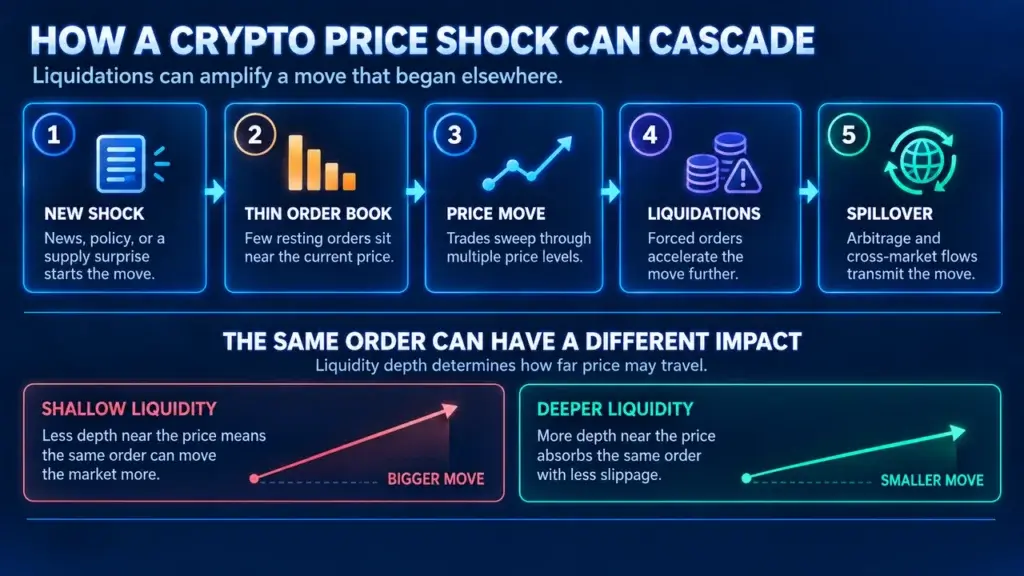
The same process can run upward when short positions are forced to buy. Liquidations amplify a move that has already started. They are not its original cause, and reported liquidation estimates can differ by provider coverage.
The CFTC's virtual-currency risk advisory notes volatile price swings, flash crashes, manipulation and amplified gains and losses in margined products. Trading strategy controls should therefore include collateral limits, exit liquidity and failure scenarios.
Supply Releases and Concentrated Holders
Crypto assets use different supply systems. Bitcoin has a published issuance limit and scheduled reductions in new block rewards. Other tokens may use ongoing inflation, treasury releases, vesting, burns or governance-controlled minting.
A scheduled token release can raise the amount available to sell, but it does not guarantee a sale. Expectations can move price before the date. Actual impact depends on recipient behavior and liquidity. A surprise mint or change in supply policy can create a larger information shock because it alters assumptions about scarcity and control.
Concentrated ownership matters because one holder can represent a large share of available supply. A top wallet may be an exchange custodian for many users, so address concentration is not identical to beneficial ownership. The on-chain data interpretation process explains why an address cannot automatically be read as one owner.
Use the Bitcoin price and supply record and Ethereum market profile as separate examples. Their issuance, use and market structure differ, so their volatility cannot be attributed to one shared supply rule.
Information and Uncertain Value
Many crypto assets have short histories and uncertain future use. Their values depend heavily on expectations about adoption, fees, regulation, technology and competitive position. New information can change a wide range of plausible outcomes.
Social media accelerates distribution but does not make every post important. A rumor can move a thin asset before verification. An official disclosure can move a large asset if it changes cash access, legality, supply or security. The analytical task is to identify the information and the path by which it changes demand or available supply.
The SEC's crypto investor alert lists volatility, illiquidity, opaque ownership, platform failure, technical faults and regulatory action among significant risks. Those risks can interact. An exchange outage during a fast move can reduce available liquidity and prevent arbitrage that might otherwise narrow price differences.
Fragmented and Continuous Markets
Crypto trades across centralized exchanges, decentralized markets and derivatives exchanges in many jurisdictions. There is no universal close. One exchange can lead a price move while others catch up through arbitrage.
Fragmentation creates different prices, liquidity and access. A local banking interruption can affect one exchange. A blockchain halt can prevent deposits and withdrawals. A stablecoin failure can affect every market that prices its coins in that stablecoin. The current exchange directory and an exchange record such as Kraken's market-access profile help show why exchange-specific conditions belong in any practical risk assessment.
Continuous trading also means news can arrive when some participants are offline and books are thinner. There is no overnight pause for all exchanges to process information before the next open.
Macro Conditions and the Crypto Cycle
Crypto assets often move together. An IMF study of the crypto cycle and U.S. monetary policy used a panel of long-running tokens to identify a common crypto price factor and connect it with equity-market participation and monetary-policy risk channels. A separate IMF study found time-varying return and volatility spillovers within crypto and between crypto assets and traditional financial markets.
The findings do not mean every coin has the same driver. They show that asset-specific analysis needs market-wide context. Interest rates, dollar liquidity and broad risk appetite can affect many tokens at once, while a software flaw can affect one project more directly.
Use current crypto market prices and broader market conditions to separate a common move from an asset-specific one. A simultaneous decline across many liquid assets points to a different initial hypothesis than a fall isolated to one token.
Technology, Governance, and Platform Shocks
Crypto prices can react sharply to:
- contract exploits or network failures
- bridge losses
- exchange insolvency or withdrawal pauses
- collateral that loses its peg
- administrator-key compromise
- governance votes
- delistings
- court or regulatory decisions
These events alter more than sentiment. They can change access, expected supply, custody, settlement or the ability to use the asset. Researching a cryptocurrency fully maps those operational facts to token value and risk.
For the dated explanation of a specific incident, see CryptoSlate's current analysis coverage. This guide covers the transmission process rather than individual events.
Why Stablecoins Can Still Be Volatile
A stablecoin targets a reference value, but the market price can move away from it. The cause can be reserve concerns, redemption limits, liquidity gaps, technical failure, legal action or stress in the collateral.
A one-cent deviation may be material for a holder who needs to exit at exactly $1, so volatility should be judged against purpose and tolerance. The market price is also separate from whether the issuer continues to redeem the coin at $1.
Do not assume a stablecoin removes all crypto risk. Check issuer, reserves, redemption, chain, contract, banking access and market depth.
A Worked Shock-to-Price Example
Consider a fictional token trading at $10. A verified disclosure says the network's main bridge has paused withdrawals after a security incident.
- Holders reduce their estimate of usable assets and future activity.
- Sell orders consume bids near $10, moving the price to $9.60.
- Perpetual long positions begin liquidating.
- Forced sales push the derivatives price lower.
- Arbitrage links spot and derivatives across exchanges.
- Market makers widen spreads because hedging and withdrawal status are uncertain.
- Related ecosystem tokens decline as traders reassess shared exposure.
If the bridge restores service and losses are limited, some assumptions may reverse. If the incident reveals permanent insolvency, a lower valuation can persist after short-term liquidation pressure ends.
How to Manage Volatility Exposure
Volatility cannot be removed, but exposure can be bounded. Practical controls include:
- use position sizes that allow for a total loss
- avoid borrowing against a position when it could force an exit during an ordinary adverse move
- use limit orders when market depth is thin
- check custody and withdrawal access before stress
- separate a long-term thesis from a short-term chart setup
- predefine invalidation and review conditions
- diversify by actual risk driver, not token count alone
Owning ten tokens that share the same collateral, exchange or investor base may provide little diversification. Position discipline and trading psychology can prevent a sharp move from forcing an improvised decision.
A disciplined crypto chart reading order helps describe what price did without treating it as a forecast. AI forecast model testing explains why a model should be tested separately in calm and stressed markets.
Frequently Asked Questions
Is crypto more volatile than stocks?
Many crypto assets have shown wider and faster price changes than large diversified equity indexes, but the answer depends on the asset, period and measurement. A thin new token can be far more volatile than Bitcoin, while a stablecoin may show low day-to-day movement until a depegging event.
What causes sudden crypto price drops?
Possible causes include new information, thin liquidity, large holders, liquidations, exchange or network failures and broad risk-off moves. A drop can begin with one factor and be amplified by others. Check market-wide behavior, order-book depth, derivatives and asset-specific disclosures before assigning a cause.
Does high volatility mean crypto will go up?
No. Volatility measures the size and dispersion of moves, not their direction. High volatility can accompany rallies, declines or repeated reversals. It can also raise trading costs and liquidation risk without improving expected return.
Why is Bitcoin less volatile than some altcoins?
Bitcoin generally has deeper liquidity, wider exchange coverage and a longer market history than many small tokens. Those features can help absorb orders. It can still move sharply, and comparisons depend on the period, return interval and market conditions used.
Will crypto volatility decrease over time?
It may decline for some assets as liquidity and participation deepen, but no fixed path is guaranteed. New positions larger than posted collateral, fragmented markets, regulation, technical changes and concentrated ownership can preserve or raise volatility. Measure the actual asset over comparable windows instead of assuming age alone reduces risk.