


Overview
Introduction
Prop trading, short for proprietary trading, is trading conducted for a firm's own account and economic benefit. The firm supplies or controls the capital and owns the market positions. The resulting profit or loss belongs to it. A prop trader can be an employee, partner, contractor, or an automated strategy operated by a team.
Paid remote programs also use the prop-trading label, but many begin in simulation. They create a different legal and financial relationship from an institutional trading job.
Key takeaways
What Is Prop Trading?
Proprietary trading means acting as principal in a trade. The business commits its own risk capacity to a position and keeps the resulting gain or loss. This differs from executing an order for a customer or managing a portfolio owned by outside investors.
The activity can sit inside a specialist proprietary company, market maker, bank, broker-dealer, commodity business, or digital-asset firm. The relevant test is economic. The organization is trading for its own account, and its own balance sheet is exposed to the result.
A prop firm is the organization. Prop trading is the activity. A funded account is an account or contractual status used by some firms.
How Proprietary Trading Works
A traditional proprietary operation starts with a capital allocation. Management decides who or what can use that capacity and sets limits for the positions held. The trader's task is to find opportunities whose expected return justifies the risk and execution cost as well as the capital required.
The process usually contains six functions:
- Allocate capital. The firm assigns risk capacity to a desk, strategy, trader, or model.
- Develop a trading idea. Research can come from market data, pricing relationships, fundamental analysis, order flow, or a quantitative signal.
- Set the risk envelope. Position, concentration, liquidity, and stop limits define how the idea can be expressed.
- Execute and manage the position. Orders reach an exchange, dealer, liquidity pool, or bilateral counterparty. The team manages fills, hedges, fees, and changing exposure.
- Attribute profit and loss. Gains and losses belong to the firm. The desk records which strategy, instrument, and risk factor produced them.
- Review and reallocate. Risk managers can increase capital, reduce it, pause a strategy, or close a position. Compensation follows the trader's employment, partnership, or contractor agreement.
Market making is one application. A firm can use its own capital to quote buy and sell prices, earn spreads, and manage inventory risk while providing liquidity. Other prop desks may hold directional, relative-value, or arbitrage positions instead.
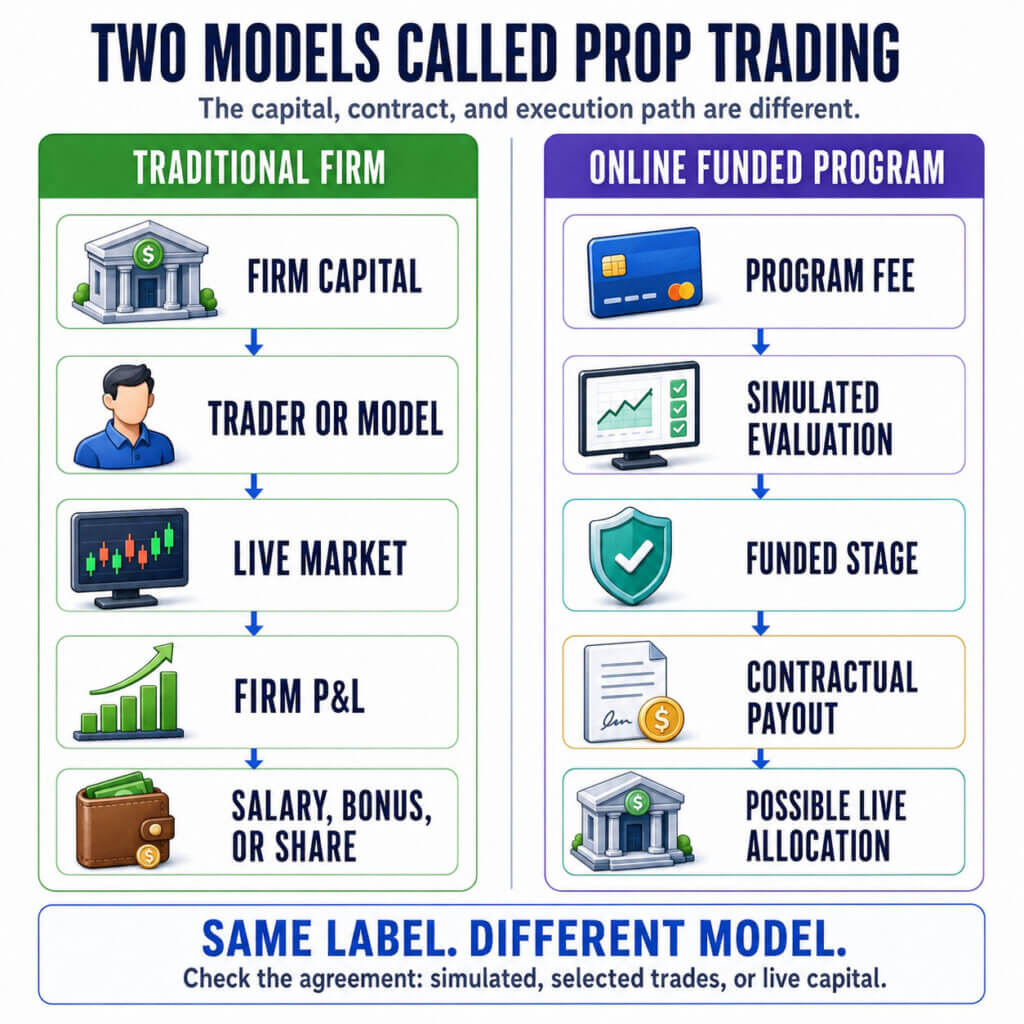
Whose Capital Is at Risk?
Traditional prop trading and online funded programs can both involve firm-defined risk limits, but the capital and contractual relationships can differ at every stage.
| Traditional Proprietary Trading | Online Funded-Trader Program |
|---|---|
| Capital: The firm commits money or balance-sheet capacity to live positions. | Capital: The program may provide simulated buying power, live firm capital, or a staged path between them. |
| Execution: Orders reach a live exchange, market, or counterparty. | Execution: Evaluation orders are commonly simulated. Funded-stage orders may also remain simulated. |
| Ownership: The firm owns the positions and receives their P&L. | Ownership: The participant generally owns neither the displayed account nor any position created in a firm-controlled live account. |
| Loss: The firm’s capital absorbs live market loss within the mandate. | Loss: In simulation, the participant’s direct loss is usually the cost already paid and any reward lost under the contract. |
| Relationship: The trader can be an employee, partner, member, or contractor. | Relationship: The participant commonly purchases an evaluation first and may sign a contractor-style reward agreement after qualification. |
| Payment: Salary, bonus, partner distribution, or desk P&L participation can apply. | Payment: Qualifying results can create a contractual payout after the program’s rules and reviews are satisfied. |
A large funded trading account tier does not establish that the same amount has been placed in a live account. The tier can serve as the reference for position limits, objectives, and loss rules.
What Strategies Do Prop Traders Use?
Prop traders use strategies that match the firm's technology, time horizon, capital, and market access. A strategy can depend on small repeated edges, a pricing relationship, or a larger directional view.
| Strategy | What It Attempts to Earn |
|---|---|
| Market making | Quotes both sides of a market and seeks spread income while controlling inventory and adverse-selection risk. |
| Arbitrage | Trades a price difference between exchanges, instruments, expiries, or related assets before the gap closes. |
| Relative value | Takes offsetting positions in related assets when their pricing relationship moves away from the firm’s model. |
| Directional trading | Takes long or short exposure based on an expected move in price, volatility, rates, or another market variable. |
| Systematic trading | Converts a defined signal and risk process into repeatable rules that software can execute and monitor. |
| High-frequency trading | Uses low-latency systems to act on short-lived order-book or pricing opportunities at high speed. |
These categories overlap. A market maker can use a systematic model, hedge inventory with relative-value trades, and rely on low-latency execution. A discretionary trader can also combine a directional thesis with quantitative position sizing.
Individual traders and prop desks can use similar strategy families, but a prop desk applies them inside a firm-level capital and risk system.
Crypto arbitrage becomes a prop strategy when the firm commits its own balance sheet to cross-exchange or cross-instrument positions. A visible price gap is not necessarily collectible after fees, transfer constraints, and execution risk.
Which Markets Support Prop Trading?
Proprietary traders operate wherever a firm can price risk, obtain market access, and enforce its mandate. The instrument changes how capital is posted, when positions can trade, and what can go wrong.
| Market | What Changes for the Prop Desk |
|---|---|
| Equities | Borrow availability, corporate actions, fragmented exchanges, and closing auctions affect execution and short positions. |
| Options | Volatility, time decay, exercise, assignment, and multi-leg hedging matter alongside the underlying price. |
| Futures | Contract expiry, exchange sessions, margin, daily settlement, and delivery rules shape exposure. |
| Fixed income | Credit, rates, inventory, financing, and dealer relationships can dominate the trade. |
| Foreign exchange | Currency pairs trade across a decentralized dealer network with rollover, margin, and counterparty considerations. |
| Commodities | Storage, transport, seasonality, delivery, and the futures curve can be part of the position. |
| Crypto | Continuous trading, funding rates, liquidation, exchange risk, custody, and on-chain settlement add distinct controls. |
Online programs can reference the same asset classes without providing the same instrument. A forex symbol may be a simulated contract for difference. A futures program may follow exchange prices while enforcing its own session and position rules. Identify the actual contract, execution environment, settlement method, and counterparty before treating the symbol as market access.
How Prop-Trading Firms Control Risk
Risk control determines how much capital a trader can use and how long the firm will tolerate a losing position. A profitable history does not give a trader unrestricted access to the balance sheet.
Firms can impose several layers at once:
- Desk capital: the maximum capital or risk capacity assigned to a team
- Gross exposure: the total size of long and short positions before offsetting them
- Net exposure: the remaining directional position after offsets
- Concentration: limits on exposure to one asset, issuer, sector, exchange, or risk factor
- Position and order size: caps on inventory, borrowed exposure, contracts, lots, or order quantity
- Loss authority: intraday stops, strategy stops, and escalation thresholds
- Liquidity controls: limits based on expected market depth, exit time, or price impact
- Model controls: testing, change approval, monitoring, and shutdown procedures for automated strategies
- Operational controls: permissions, reconciliations, system health, and incident procedures
A risk manager can reduce an allocation even when no formal loss threshold has been breached. The decision can reflect higher volatility, thinner liquidity, correlated positions elsewhere in the firm, or uncertainty about a model.
Online programs often convert risk control into automatic daily and total loss rules. A brief threshold touch can end access because the rule protects the program's risk budget. Prop firm drawdown calculations can use static, trailing, balance, or equity references, placing the threshold at different levels.
How Prop Traders Are Paid
The firm's trading P&L and the trader's compensation are separate accounting questions. A live position belongs to the firm, even when an individual trader originated and managed it.
Employees may receive a base salary plus a discretionary or formula-based bonus. Desk P&L and individual contribution often matter. Firmwide results, risk use, conduct, and longer-term performance can also affect the award. Partners or members can participate through distributions tied to ownership and the firm's governing agreement. Contractors can receive a negotiated share of qualifying results.
Online program participants are commonly paid under a reward or funded-trader contract. A quoted profit split describes how eligible performance is divided. It does not make the participant an owner of the account or every gain shown on the platform. The prop firm payout rules determine which results qualify, when a request can be made, and what review occurs before payment.
A poor result can reduce a bonus or end a contract. The firm may also remove a capital allocation. In an online program, the participant may lose paid fees and an unpaid reward. The signed agreement controls which outcome applies.
Prop Trading vs Brokerage, Hedge Funds, and Personal Trading
Several financial businesses place trades, but they do not all trade for the same owner or purpose.
| Activity | Capital and Economic Purpose |
|---|---|
| Proprietary trading | The firm takes positions for its own account and receives the resulting gain or loss. |
| Brokerage or agency execution | The business executes, routes, or facilitates orders for customers. Customer assets and instructions drive the transaction. |
| Hedge fund or asset management | The manager invests pooled or separately managed client capital under a mandate and owes duties defined by the fund documents and law. |
| Personal trading | The individual deposits the capital, owns the account, makes the decisions, and absorbs the market result. |
A group can operate more than one activity through separate entities. A broker can have a market-making affiliate. An asset manager can seed a strategy with company capital. The contracting legal entity identified in the account documents and signed agreement determines which relationship applies.
Personal trading gives the trader control over the deposited balance and available withdrawals. It also places the full market loss on that trader, subject to the provider's margin and liquidation terms.
What Prop Trading Looks Like in Crypto
Crypto prop trading can involve spot assets, perpetual contracts, dated futures, and options. Some firms also use lending markets and on-chain protocols. Institutional crypto firms may make markets or arbitrage prices across exchanges. Others trade the spread between spot and perpetual contracts or manage directional and volatility exposure.
Continuous trading removes the conventional weekend close. Funding payments and liquidations can change a position while other markets are shut. Exchange maintenance, API failures, and thin weekend liquidity can interfere with execution. Stablecoin exposure and exchange solvency create another layer of risk. Cross-exchange strategies depend on custody and reliable transfers or withdrawals. On-chain execution introduces gas costs, smart-contract risk, block timing, and transaction-ordering effects.
In crypto prop trading, an online program can provide a simulated symbol without buying or holding the underlying asset. The firm may keep the activity internal, copy selected exposure, or route an order to a market maker or exchange. The participant's contract determines the rights attached to that process.
Simulated execution can also omit live slippage, order-book depth, and price impact. Large or fast orders may appear fillable in a demo environment at prices a live market would not provide. That difference matters most during volatility and in smaller crypto markets.
How People Become Prop Traders
People enter prop trading through institutional recruitment, direct capital partnerships, or paid online evaluations. Each route creates a different relationship with the firm.
Institutional Recruitment
Traditional firms recruit traders, quantitative researchers, and engineers through internships, graduate programs, or experienced hires. Interviews can test probability, mental arithmetic, programming, market structure, risk judgment, and decision-making under uncertainty. The mix depends on the role. A discretionary commodities trader and a low-latency systems researcher do not need identical skills.
Candidates should identify the actual work before optimizing for a job title. Market making, quantitative research, execution, and discretionary risk-taking use different daily processes. Employment terms should also explain compensation, intellectual property, outside trading, non-compete restrictions, and responsibility for losses.
Direct Partnership or Capital Backing
An experienced trader may negotiate capital backing directly with a firm's owners or join as a partner or member. This route does not require a standard employment intake or a public paid challenge. The governing agreement should state who owns the positions, how losses affect the allocation, how qualifying results are divided, and when either side can end the relationship.
Online Evaluation
A remote participant can purchase a standardized prop firm evaluation without being hired first. The program grants access to a simulated test under preset objectives and loss rules. Qualification may lead to a contractor-style agreement and payout eligibility, but it does not establish employment, partnership, or ownership of firm capital.
A suitable strategy must fit the program's instruments, holding periods, execution model, and loss thresholds. The entire attempt budget should be affordable without relying on a future payout. Prop firms for beginners can be filtered by cost and rule structure, but the current contract remains the final check before payment.
How Prop Trading Is Regulated
The rules governing prop trading depend on the legal entity and jurisdiction, as well as the instrument and service involved. A firm risking only its own capital is the principal to its trades. It is not holding customer assets in the way a broker does. Market-conduct, exchange, licensing, reporting, prudential, and employment rules may still apply.
Banking restrictions can limit proprietary trading by regulated banking entities without banning standalone proprietary firms as a category. Broker, dealer, exchange, derivatives, and customer-asset rules may apply when a group performs those functions through the same or an affiliated entity.
Consumer-facing evaluation programs require separate analysis. Simulation does not remove contract, advertising, payment, privacy, tax, or consumer-protection obligations. It also does not turn a reward agreement into a brokerage account.
Check which company signs each agreement and what service it promises. A regulated affiliate does not automatically extend its customer protections to a separate evaluation business.
Is Prop Trading Worth It?
The answer depends on the model and the person's objective. An institutional role can provide resources that would be expensive to assemble independently, including capital, data, and trading technology. Training and peer review give a new trader feedback on execution and risk decisions. In return, the firm sets risk limits and strategy permissions. It also controls compensation and continued access to capital. Performance pressure and variable pay are part of the arrangement.
A paid online evaluation can cap the participant's direct market exposure at the program costs while creating access to contractual payouts. Fees can accumulate, and a simulated result may not transfer to live execution. One rule breach can end the account. Payment also depends on the provider honoring its agreement.
Match the strategy's typical loss range and holding period against the program rules. Then calculate the total cost of all planned attempts and verify the capital and payout model. A large account label or high profit split cannot answer those questions.
FAQ
What is prop trading in simple terms?
Prop trading is a firm trading for its own account and benefit. The firm owns both the capital at risk and any resulting market position. Gains and losses accrue to it. Traders are paid under employment, partnership, contractor, or reward agreements.
How does prop trading work?
A firm first allocates risk capital. A trader, team, or model then acts on opportunities within position and loss limits. The resulting P&L belongs to the firm. Risk managers can change or end the allocation, and the trader is paid under the applicable agreement.
What is the difference between prop trading and a prop firm?
Prop trading is the activity of trading for a firm’s own economic benefit. A prop firm is the company that conducts the activity or operates a trader-evaluation and capital-allocation program.
Do prop traders use their own money?
Traditional employees and contractors generally trade firm-controlled capital. Partners can also have personal ownership in the business. Online evaluation participants usually pay program costs but may trade simulated buying power before any live capital is allocated.
Who takes the loss when a prop trade loses?
The firm absorbs a live market loss on a position it owns. The trader can lose compensation, capital access, or a job under the agreement. In a simulated online program, the participant commonly loses the paid fees and may forfeit an unpaid reward after a rule breach.
Is prop trading the same as hedge-fund trading?
No. A pure proprietary firm trades its own capital for its own benefit. A hedge fund manager trades capital supplied by fund investors under the fund’s mandate and fee structure. A business group can operate both activities through separate funds or legal entities.