Tether’s $20 billion mountain of gold – equal to a national reserve – to be used for lending
Tether's gold position now rivals that of several sovereign nations, and a new partnership with a lending platform is testing whether tokenized bullion can function as collateral in the same way Bitcoin already does.


Quick Take
- Tether and Ledn will let users borrow stablecoins against XAUT, turning tokenized gold into lending collateral.
- The move gives retail holders gold liquidity without selling, while extending Tether's bullion beyond reserves and into credit.
- The test now is whether borrowers want gold-backed loans, amid unresolved collateral thresholds, regulation, and liquidation risk.


Tether is already the world's largest stablecoin issuer, with approximately $141 billion in direct and indirect exposure to US Treasuries. It reported $15 billion in revenue in 2025 and $1.04 billion in net profit for the first quarter of 2026, mostly from that yield alone, making it one of the more unusual companies in global finance.
Over the past year, though, it has added a second identity: one of the world's biggest private holders of physical gold, with roughly 154 metric tons of bullion spread across reserves backing both USDT and its tokenized gold product, XAUT.
At roughly $20 billion at current prices, that position puts Tether near sovereign-scale territory. If it were a central bank, it would rank just outside the top 20 globally by gold reserves.
For a while, Tether stacked bullion as a hedge against dollar exposure, a bet on macro instability, a reserve-diversification move. Then on June 18, Ledn announced it would add XAUT as eligible collateral on its platform, with gold-backed loans denominated in USDT and Tether's newer USAT token expected to go live later in 2026.
That made Tether's relentless accumulation much more interesting, as it showed that the gold is finally going to work.
Tether's numbers
About 132 of those 154 tons are held in USDT reserves, according to Reuters data as of the end of March 2026. It represents roughly 10% of USDT's total reserve composition, while Treasury bills remain dominant at $117 billion and Bitcoin makes up another $7 billion.
The remaining roughly 22 tons back XAUT directly, with each token representing one fine troy ounce of London Good Delivery gold held in Swiss vaults. At the end of Q1 2026, XAUT accounted for 54% of the broader tokenized gold market.
For context on the scale, gold ETFs dwarf all of it. SPDR Gold Shares alone holds about $133 billion in assets as of July 11, and the World Gold Council puts total global gold ETF holdings at around 4,137 tons.
But Tether isn't competing with GLD. Its product strategy is different: put gold on crypto rails, then use those rails as credit infrastructure. The deal with Ledn is the first realization of that ambition, and we're about to see how well the market will accept it.
What Ledn has built with Bitcoin-backed loans, and intends to replicate for XAUT, is a collateralized lending mechanism. A user deposits XAUT as collateral and receives a stablecoin-denominated loan from Ledn. The user receives liquidity without selling the underlying asset, retains exposure to gold's price, and reclaims the collateral on full repayment.
Throughout the loan, Ledn's policy is to hold client collateral 1:1 without lending it out or rehypothecating it for additional yield. In February 2026, S&P assigned a BBB- investment-grade rating to the senior notes issued through Ledn's inaugural $188 million Bitcoin-backed asset-backed securitization. The rating applies to those notes rather than to Ledn itself, its platform, or individual customer loans.
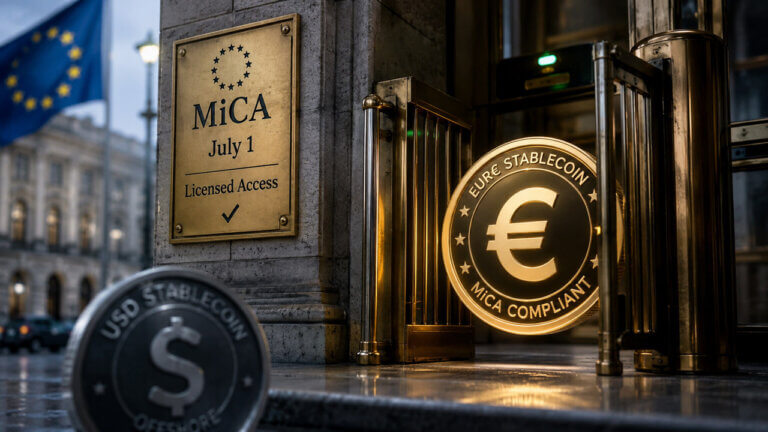
However, the S&P rating most likely won't be of any use to Ledn's customers, as the XAUT lending product won't be available to residents of Canada or the European Union. Tether has no current plans to seek MiCA licensing, and the EU's final MiCA transitional deadline expired July 1.
What tokenized gold can do that gold ETFs can't
Gold ETFs are extraordinarily successful investment products. They're highly regulated, liquid, and trusted by both institutional and retail investors globally.
Their use as collateral, though, follows a conventional path: an ETF share sits in a brokerage account and can be pledged against a margin loan through a traditional broker, in a transaction that has to go through clearinghouses, custodians, and banking hours.
XAUT, on the other hand, is on a blockchain, settles 24/7, and can be deposited directly into a crypto lending platform in a single transaction with no intermediary steps.
The table below captures the structural differences that matter most for investors choosing between the two.
| XAUT (Tether Gold) | Gold ETF (GLD) | |
|---|---|---|
| Backing | 1 troy oz allocated gold per token | Pool of allocated gold bars |
| Settlement | 24/7, on-chain | T+1, exchange hours |
| Market cap / AUM | ~$2.5B (July 2026) | ~$133B (GLD alone) |
| Collateral use | Crypto lending platforms (Ledn, Antalpha) | Brokerage margin loans |
| Rehypothecation | No (per Ledn policy) | Varies by broker |
| Regulation | El Salvador registered; no MiCA | SEC-registered, CFTC oversight |
| Physical redemption | Yes, for verified customers subject to minimum sizes, fees and Swiss delivery terms | Authorized participants can redeem large baskets for gold; retail investors cannot redeem directly |
| Closest competitor | PAXG (~$2.2B) | iShares Gold Trust (IAU, ~$50B+) |
Tokenized gold can move inside the same ecosystem as USDT. A borrower can pledge XAUT, receive USDT, deploy that USDT elsewhere in crypto, and manage the whole position without a broker or a bank. The settlement layer is consistent across all three legs of the trade. Traditional gold lending goes through bullion banks, clearinghouses, and multiple custody handoffs, none of which are accessible to a retail user holding XAUT on a lending platform.
Gold-backed credit has long existed in traditional finance, with central banks, bullion dealers, and private banks lending against the metal. Access has historically skewed toward institutions and wealthy clients. Ledn would expand a custody-based version of that model to eligible XAUT holders, subject to regional availability and loan terms that have yet to be disclosed. Specific LTV ratios have not been published.
XAUT's competitive position against Paxos Gold (PAXG), its closest rival in the tokenized gold market, could improve if Ledn attracts meaningful borrowing demand. PAXG is already accepted as collateral on some crypto lending platforms, so XAUT's prospective advantage would come from a dedicated centralized lending integration tied to Tether-issued stablecoins.
All that is gold does not glitter
Every step in this very complex chain of borrowing against tokenized gold carries a certain risk, and users need to understand how each one works before committing collateral.
Custody is the foundational layer. XAUT's gold is held by TG Commodities, a Tether affiliate, in Swiss vaults meeting LBMA Good Delivery standards. Tether publishes quarterly attestations from BDO Italia confirming the reserve balance. Those attestations verify that the gold exists and matches the token count, but they aren't full forensic audits. Tether announced a Big Four audit in March 2026, but it hasn't been completed as of publication; final results are expected by April 2027.
Redemption access is very limited in practice. Physical redemption of XAUT into gold bars is available only to holders who meet Tether's verification requirements and takes 1 to 5 business days. Most holders sell on secondary markets, which is fine under normal conditions. The relevant question is who has priority access to the underlying metal under stress, and the answer depends on Tether's terms, not the borrower's position.
Liquidation risk is the most immediate concern for borrowers. Gold is less volatile than Bitcoin, which makes collateral buffers more predictable, which is an advantage over BTC-backed loans. But gold prices do move, sometimes sharply. If prices fall far enough for XAUT to cross a loan-to-value threshold, Ledn manages the margin call and, if it is unmet, liquidates the position. The specific LTV ratios and liquidation thresholds for the XAUT product haven't been disclosed yet, and Ledn did not respond to questions about loan-to-value ratios, liquidation thresholds, or launch timing.
Issuer concentration is an underrated risk. Tether controls both the dollar-liquidity rail (USDT) and the gold-backed token, XAUT, so the same company is at the center of both legs of the trade. While that certainly makes the product coherent, as Tether can design an ecosystem where its products reinforce each other, it also means that a credibility problem at Tether affects USDT and XAUT simultaneously.
Tether's reserve strategy has already drawn criticism from the S&P, which downgraded its assessment because gold and Bitcoin are harder to liquidate quickly under redemption pressure than Treasury bills.
Tether's counterargument was that its $8.23 billion in excess reserves and the roughly $15 billion in 2025 profit estimated by CEO Paolo Ardoino provide a buffer against price volatility before it reaches USDT holders. However credible, the argument depends on market conditions remaining stable enough to hold.
Meanwhile, Tether built and then cut a physical gold-trading desk staffed by former HSBC traders in early 2026, a move that raised more questions than it answered about the company's direction in bullion markets.
The regulatory environment is also unsettled. Whether XAUT-backed lending falls under commodity lending rules, whether the CFTC has jurisdiction over centralized crypto lenders offering commodity-backed products, and how those loans would be treated in bankruptcy are all questions we don't currently have answers to.
Tether's accumulation of gold started as a reserve-composition decision. Its CEO, Paolo Ardoino, said that the 10% to 15% gold target was a hedge in hard assets that can't be frozen or sanctioned the way custodial dollar holdings can.
The investment in Gold.com, the Antalpha partnership on XAUT lending and physical redemption, the shutdown of the synthetic aUSDT the day before the Ledn announcement, and now the Ledn integration itself together show a company consolidating around XAUT as its primary gold-facing product and pushing it toward active credit use.
If XAUT-backed lending gains traction, Tether will end up at the intersection of three markets that no single institution in traditional finance covers at scale: stablecoins, physical gold, and collateralized credit. Bullion banks lend against gold but don't issue a digital dollar, stablecoin issuers hold Treasuries but not gold, and crypto lenders handle Bitcoin but not physical commodities.
Through USDT, XAUT, and Ledn, Tether would have a presence across all three.
Whether that turns out to be successful or an overextension depends on one thing: whether XAUT-backed loans generate real credit demand, or whether most holders simply bought gold exposure and have no interest in borrowing against it.
The gold is stacked, the rails are built, and we'll find out which kind of holder is actually on the other side when Ledn's product launches.