Quick Take
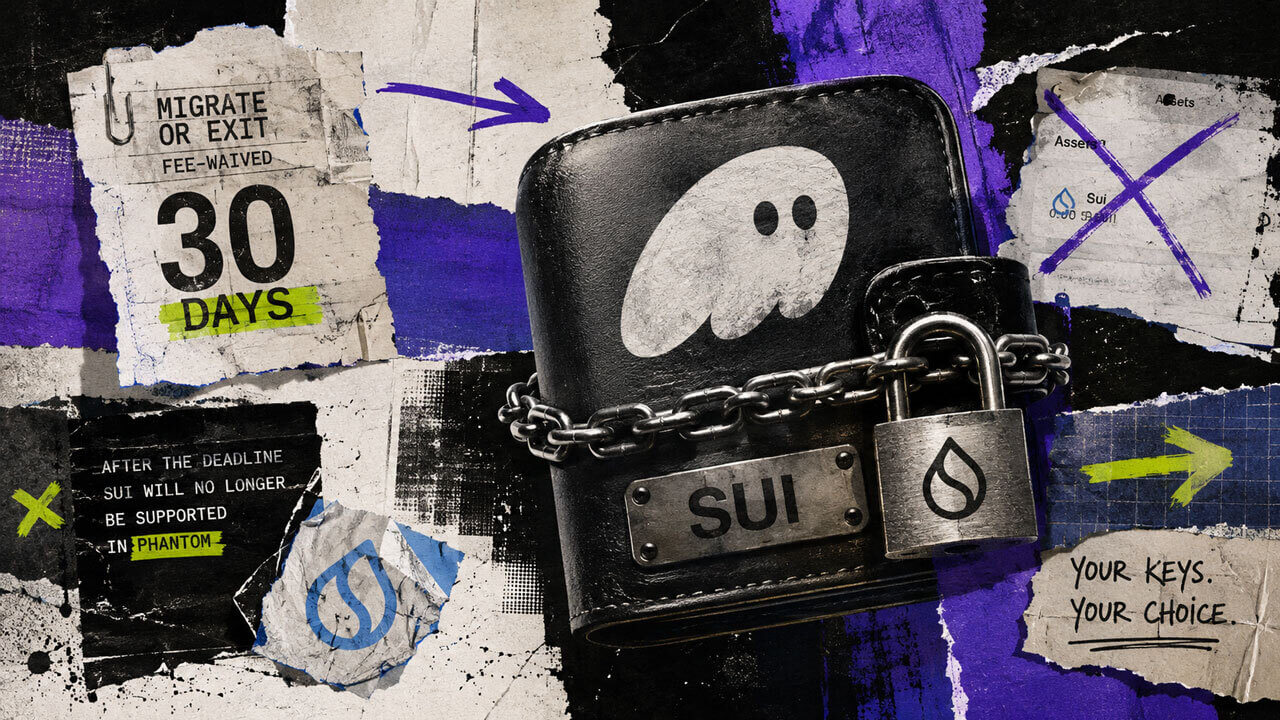
- Phantom will end Sui support on Sept. 24, removing Sui balances, swaps, sends, and dapp connections from its app.
- Sui assets remain onchain; users can swap them, import the same wallet into Slush, or connect a Ledger.
- The sunset shows how access a wallet interface controls, but Phantom and Sui disclose no reason or affected-user count.


Phantom will remove Sui from its wallet interface on Sept. 24, one month after announcing that it and Sui had decided to end the integration. After the transition, Phantom will no longer display Sui balances, support Sui sends or swaps, or connect to decentralized applications.
The assets will remain on the Sui blockchain, tied to the credentials that authorize the account. Phantom's transition guide says users can restore access through a compatible wallet even after the cutoff. Sept. 24 ends access through Phantom; it does not end ownership or later access to the funds.
That separation turns a product sunset into a test of power in a self-custodial market. A wallet provider cannot erase a user's coins, but it can withdraw the screen, transaction tools and app connections through which people use a chain.
What Phantom is removing and what remains
Sui support went live in Phantom on Jan. 29, 2025. At launch, the Sui Foundation said Phantom users could send, receive and manage Sui assets, swap SUI and connect to applications including Suilend, Navi, Aftermath and Bluefin.
Those functions made Phantom a distribution surface for Sui as well as a place to display balances. The interface brought the network into an app used across several chains; the same interface can now remove Sui from view.
Phantom's Aug. 24 announcement said the wallet and Sui had jointly decided to end support while leaving open the possibility of other collaborations. The announcement and operational guide give no reason for the split.
The scale of the immediate impact is also unknown. Sui's launch post cited 15 million monthly active users for Phantom as a whole, up from seven million in a December 2024 integration announcement. Those figures describe Phantom's total user base, not the number of people who held or used Sui through the wallet. The shutdown materials provide no affected-user count.
The decision therefore demonstrates the ability to remove a chain from a major interface, but the public record cannot show how much Sui activity depended on Phantom.
What disappears on Sept. 24
The Sept. 24 reversal will be concrete inside the product. Phantom will remove Sui from its network list and stop displaying balances or supporting Sui transactions. Connections that users made to Sui applications through Phantom will also stop, requiring them to reconnect through another compatible wallet. These lost functions are the practical link between interface support and blockchain distribution.
For users, that platform-level decision becomes a practical choice between changing assets and changing wallet interfaces, with different fees and credential risks attached to each route.
The underlying choice is between moving value to a network Phantom still supports or accessing existing Sui assets through software that continues to support Sui.
Three paths put different risks on users
Phantom's options divide users by what they want to keep and how their account is secured. People who want to remain inside Phantom can swap out of native SUI. Recovery-phrase users who want to keep native Sui exposure can import the same account into Slush. Ledger users have a separate connection path that keeps keys inside the hardware wallet.
| Path | What changes | Credential exposure | Fee caveat |
|---|---|---|---|
| Native SUI to wrapped SUI on Solana | The user keeps a SUI-linked asset on a Phantom-supported network | No recovery-phrase migration is required for this route | Only Phantom's fee is waived through Sept. 24; network and exchange fees still apply |
| Swap into SOL, ETH or USDC | The user exits SUI into another supported asset | No recovery-phrase migration is required for this route | Standard fees apply |
| Recovery-phrase wallet into Slush | The same Sui address and assets become visible in another interface | The user must handle and import a high-value recovery phrase | No asset transfer is required merely to restore access |
| Ledger connection to Slush | The hardware-controlled Sui account becomes available through Slush | Private keys remain offline under the documented hardware-wallet model | Separate Slush and Ledger setup applies |
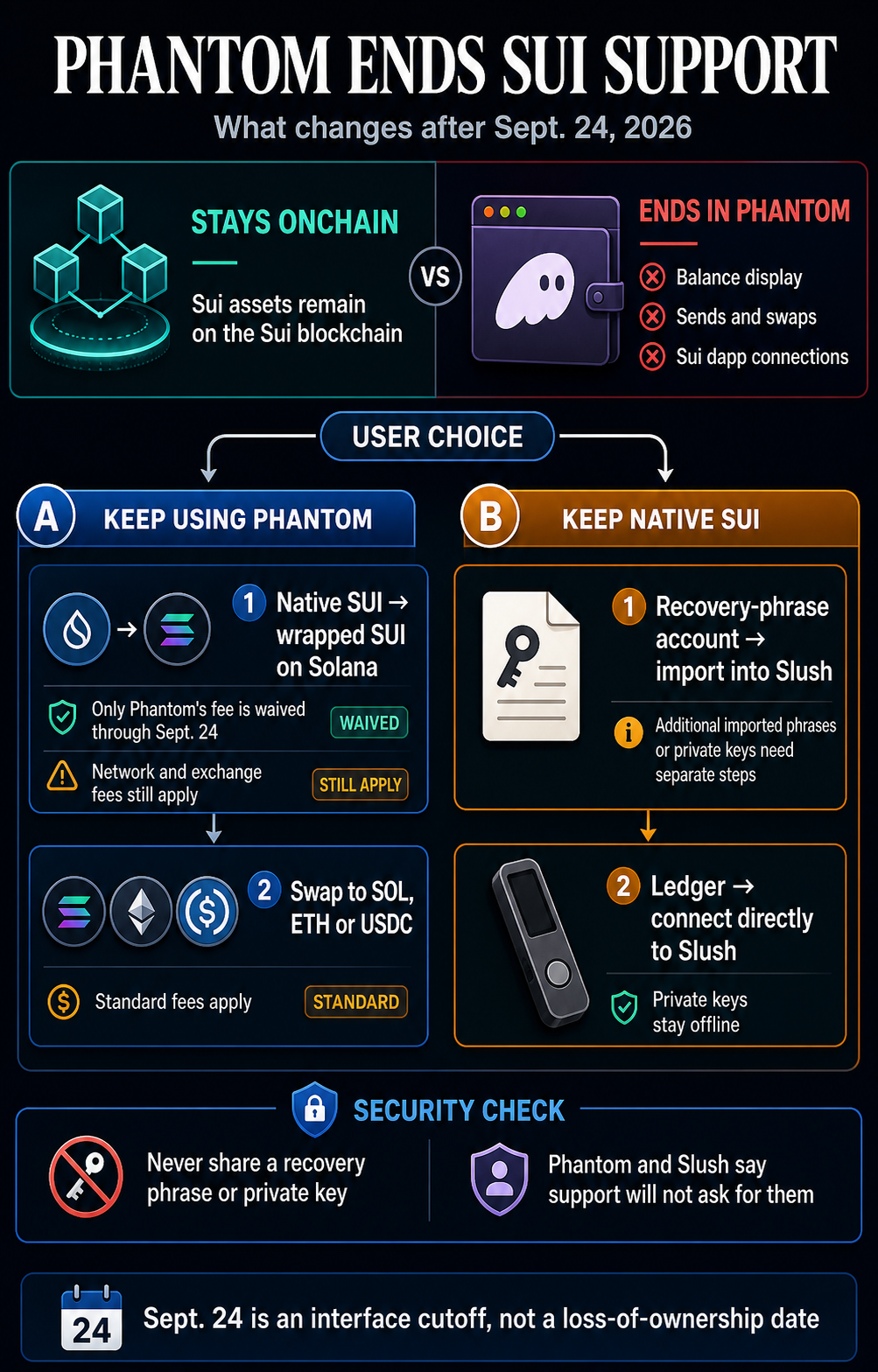
The fee waiver is more limited than Phantom's short announcement might suggest. The full guide limits it to Phantom's fee on cross-chain swaps from native SUI to wrapped SUI on Solana. Network and exchange fees still apply. Swaps into assets such as SOL, ETH or USDC carry standard fees.
Account structure determines the migration work. Phantom's guide tells recovery-phrase users moving to Slush to access the phrase inside Phantom, record it offline and import it into the destination wallet. Additional recovery phrases or private keys previously imported into Phantom must each be handled separately.
Hardware-wallet users are a distinct case. Phantom says a supported hardware wallet keeps private keys offline, and its credential guide says the phrase and private keys are not exposed to the app. Slush separately documents a direct Ledger connection for Sui accounts. The general sunset guide does not spell out that key-preserving path.
Migration carries a security risk
Recovery phrases make self-custody portable, but anyone who obtains one can control the wallet. A dated migration event creates an obvious period for impersonation because users expect new instructions, downloads and credential prompts.
Phantom warns that it will not contact users first, request a recovery phrase or private key, or offer to move assets. Slush's security guidance similarly says its staff will not initiate direct messages or ask for a recovery phrase.
The shutdown leaves Sui's cryptography unchanged. The practical risk comes from handling a high-value secret during a forced interface change. One response from Ivan on Tech criticized key export as bad for security. His post is a single attributed reaction rather than evidence of a wider consensus, but it captures the tension: portability gives users an escape hatch only when they can move access safely.
Wallet support is a form of distribution power
The episode separates two controls that crypto products often bundle together. Users control the credentials that authorize transactions. Wallet providers control which networks, balances, swaps and app connections their software makes easy to reach.
Sui continues operating onchain and Phantom holds no custody of the assets. Yet after Sept. 24, a Sui holder who opens Phantom may see no Sui network, no balance and no way to transact through that product. Existing Sui dapp connections through Phantom will stop, requiring users to reconnect with the wallet where their credentials are available.
Wallet support can therefore shape discovery and routine access to a blockchain even when the ledger remains permissionless and ownership remains with the user. That is distribution power at the interface layer.
The unknowns set a firm boundary around the conclusion. Phantom and Sui have disclosed neither the reason for ending support nor the number of affected users. The evidence establishes an interface-power story while leaving any economic, market or security cause unproven.
Sept. 24 marks the end of Phantom's Sui support. Users who miss the date keep their Sui and can restore access through a compatible wallet later. What disappears is the convenience and distribution Phantom supplied, showing how consequential the wallet layer can become.
Mentioned in this article



Editorial credits