
Overview
Introduction
Prediction market arbitrage is a set of positions designed to produce a positive net settlement outcome after all costs under every outcome state covered by the contracts. A simple candidate appears when Yes and No contracts covering the same binary event can both be bought for less than $1 in total.
An executable arbitrage needs more than a price gap on two screens. Both orders must fill at the assumed size, total execution costs must remain below the gross gap, and both contracts must have equivalent wording and resolution sources. Capital can remain locked until settlement. An unmatched leg or asymmetric void can create directional exposure. Delays can reduce returns, eligibility restrictions can make the trade impermissible, and collateral problems can cause funding or recovery losses.
Key takeaways
- What it is. Prediction market arbitrage combines outcome positions whose net settlement value should exceed their all-in cost.
- Why it matters. Price discrepancies may result from fragmented liquidity, temporary order imbalances, differences in participants' information or differences between the contracts. The discrepancy alone does not identify the cause.
- Main risk or limitation. A gross gap is not risk-free when fills, fees, rules, collateral and settlement timing differ.
The Basic Complete-Set Calculation
For a binary market where exactly one of Yes or No settles at $1:
gross edge = $1 - Yes purchase price - No purchase price
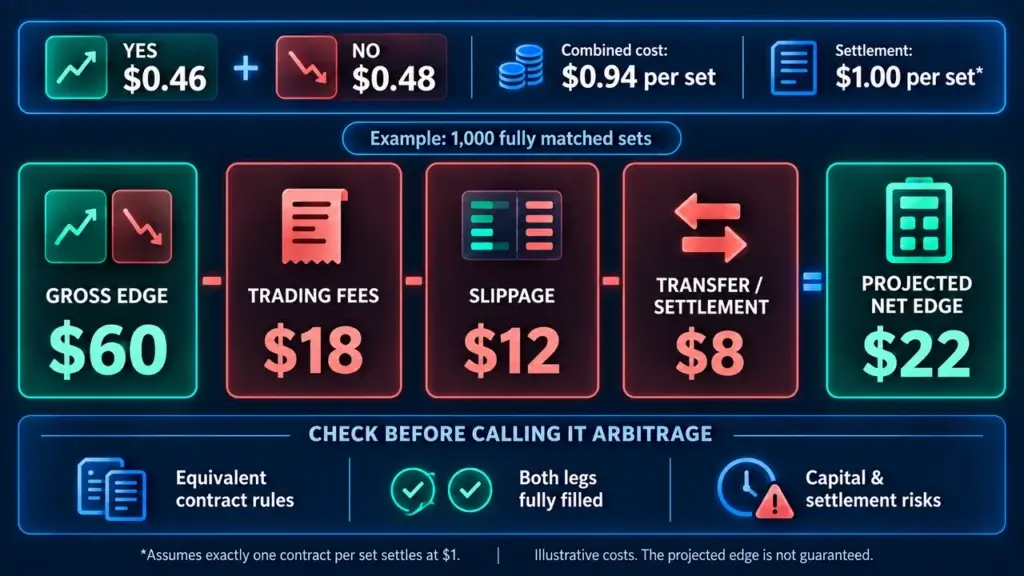
Assume the immediate Yes ask is $0.46 and No ask is $0.48. Buying one of each costs $0.94. One contract should settle at $1, creating a six-cent gross edge.
| Item | Per complete set |
|---|---|
| Yes purchase | $0.46 |
| No purchase | $0.48 |
| Combined cost | $0.94 |
| Fixed settlement value | $1.00 |
| Gross edge | $0.06 |
One thousand matched sets produce a $60 gross edge under those prices. If trading fees total $18, slippage costs $12 and transfer or settlement costs allocate another $8, the projected net edge falls to $22. Any missing fill can create much larger directional exposure.
The need to use executable ask prices explains why last trades do not belong in the purchase calculation.
Same-Platform Arbitrage
One platform can briefly quote a complete outcome set below its stated settlement value under the applicable rules. The gap may arise from separate books, stale offers, rebates or a fast move.
Same-platform execution removes a transfer step while keeping leg risk and collateral exposure active. If the Yes order fills and the No offer disappears, the trader owns an unhedged Yes position. A platform can also charge different maker, taker or settlement fees by contract.
For a multi-outcome market in which every winning unit pays the same amount, add the all-in purchase price of one contract for every mutually exclusive and exhaustive outcome. If per-unit payouts differ, choose quantities and test the combined net payoff in every resolution state. Do not assume one unit of each produces a fixed settlement.
gross edge = fixed complete-set settlement - sum of outcome costs
The word exhaustive matters. If an “other,” tie, cancellation or partial-settlement path exists outside the purchased set, the payout may not be fixed.
Cross-Platform Arbitrage
Two platforms can quote different prices for apparently identical events. Differences in user bases, market-maker activity, funding methods, participants' information and position limits can produce different prices.
Suppose Platform A offers Yes at $0.43 and Platform B offers No at $0.52. The combined gross cost is $0.95. The five-cent gap looks attractive, but the products need an equivalence audit.
| Equivalence field | Questions |
|---|---|
| Event wording | Do both contracts ask exactly the same factual question? |
| Outcomes | Are all win, tie, cancellation and partial-payout states aligned? |
| Cutoff | Do trading and observation times match, including timezone? |
| Resolution source | Do both use the same authority and data revision policy? |
| Dispute path | Can one platform delay or reverse while the other becomes final? |
| Settlement value | Does each winning unit pay the same cash-equivalent value? |
| Eligibility | Can the same user legally hold and settle both positions? |
Two election contracts can differ if one follows certification and another follows inauguration. Two sports contracts can differ on overtime or abandonment. Two crypto contracts can use different exchanges, indices or timestamps.
The resolution and settlement mechanics must match across platforms, not only the title.
Fees and Execution Can Erase the Edge
All-in cost can include:
- Trading fees on each leg
- Slippage across book depth
- Funding and withdrawal charges
- Crypto gas, bridge and conversion costs
- Currency conversion
- Settlement or redemption fees
- Borrowing cost or lost yield while capital is locked
Use executable asks for purchases and executable bids for modeled exits. Add a spread adjustment only when converting a midpoint or last trade into an executable estimate. Do not add it again when executable prices are already used.
Calculate at the intended quantity. A one-contract quote cannot support a 10,000-contract return estimate. Inspect cumulative depth at every price level.
An order that rests on the book and adds liquidity may receive maker pricing or a rebate, but it might never fill. An order that immediately matches resting liquidity receives taker pricing and can still fill only partially when insufficient size is available. The choice trades potential price improvement for a higher likelihood of immediate execution, and neither leg is guaranteed to fill.
The explanation of how liquidity providers earn covers broader market-making incentives. Prediction contracts add discrete settlement and rule risk.
Leg Risk and Order Sequencing
Leg risk is the exposure created when one side fills without the other. It is often the largest practical risk in a small price gap.
Consider 5,000 Yes contracts filled at $0.46 while only 1,500 No contracts fill at $0.48. The trader has 1,500 matched sets and 3,500 unhedged Yes contracts. A two-cent move changes the marked value of the unhedged position by $70. For comparison, the 1,500 matched sets carry a $90 gross edge before costs.
Execution controls may include immediate-or-cancel orders, which fill available quantity immediately and cancel the rest. Fill-or-kill orders require the entire order to fill immediately. Small synchronized batches or automated API orders can also help. Availability varies, and independent platforms cannot guarantee that every leg fills as one all-or-nothing transaction.
Automation introduces additional failure modes, including software bugs, API errors or rate limits, clock drift and connectivity outages. Human review of rule equivalence should happen before a bot reacts to the numeric gap.
Resolution Mismatch and Void Risk
A price difference can be rational compensation for different rules. One platform may have a clearer source or faster dispute process. Another may reserve broader cancellation authority.
Void treatment changes the fixed-payout assumption when either contract follows a cancellation path. A platform might refund the purchase price, credit a specified void value to both sides or apply another series-specific rule. If one leg voids while the other loses, the combined payout is no longer fixed.
Saving both rule versions before entry preserves evidence of the terms used in the original equivalence test, making later clarifications easier to assess. Record every clarification issued while the market is open. If the wording requires legal or subjective interpretation, treat the trade as rule risk instead of pure arbitrage.
Onchain products depend on a resolution process. Some use an oracle with bonded proposals, disputes or governance review, so traders should audit the specific oracle process and its delay or failure modes.
Capital, Settlement and Counterparty Constraints
A low-risk gross payoff can still offer a poor annualized return when capital remains locked. A two-cent edge earned after six months is economically different from the same edge settled tomorrow.
Estimate:
simple return = net edge ÷ total capital committed
Annualizing a short observed return can be misleading because comparable opportunities may not repeat. Funding and withdrawal delays also prevent instant reuse of capital.
Cross-platform positions expose two separate service stacks. One platform can pause withdrawals, delay resolution, restrict an account or change collateral value while the other settles. Regulatory status, smart-contract design and published reserves each provide information about a different subset of those risks, but none resolves them all.
Readers can compare prediction-market platforms before choosing one. Use company reviews such as Coinbase's event-contract structure to identify the contracting entity, exchange and current fees. Do not infer them from the app's marketing name.
Arbitrage, Hedging and Directional Trading
Arbitrage seeks a locked positive net outcome across eligible states. Hedging reduces an exposure but may still lose overall. Directional trading accepts event probability risk to seek a profit.
Buying No on a second platform after a Yes position rises can be a hedge without being arbitrage. The combined cost might exceed the fixed payout. A trader may accept that loss to cap risk.
A price convergence trade is also not necessarily arbitrage. Buying a cheaper contract and hoping it rises toward another platform's price depends on future trading and exit liquidity. The position can remain mispriced or move farther away.
The mechanics behind cross-market crypto price gaps apply more broadly. Event contracts require the extra outcome-equivalence and resolution tests described here.
Legal, Tax and Account Risks
Holding positions across platforms requires legal eligibility for both products. A person cannot turn a restricted contract into a safe trade by combining it with an allowed one. Apply the platform eligibility test before funding.
Account rules may restrict coordinated trading and automation, and they may prohibit manipulative orders. Review each platform's rules for restrictions on the use of information. A strategy that relies on misleading orders or prohibited conduct is not legitimate arbitrage.
Every leg needs records. Fees, transfers, crypto collateral, settlement plus voids can have separate reporting consequences. Build a transaction ledger instead of relying on a profit total.
A Net-Edge Checklist
- Copy both complete contract rules.
- Prove outcomes are mutually exclusive and exhaustive.
- Match cutoff, timezone, source, dispute and void treatment.
- Map each leg's cash-equivalent payout in every resolution state and normalize quantities before calculating the edge.
- Calculate the volume-weighted purchase cost from executable ask depth at the full intended size.
- Add fees, funding, gas, conversion, withdrawal costs and only slippage not already included in the depth-based purchase cost.
- Model partial fills and the maximum unhedged leg.
- Estimate capital-lock and settlement delays.
- Confirm legal and account eligibility.
- Save records for both positions and transfers.
If any field is unknown, report a price discrepancy instead of an arbitrage.
Monitoring and Record Discipline
A live strategy needs synchronized clocks and immutable records. Save each quote with its timestamp, book side, requested quantity and rule version. Record rejected and partial orders as carefully as fills because they explain residual exposure. The same discipline for rapid execution applies, although event contracts add fixed resolution and eligibility checks.
Do not size a position from the gross gap alone. Define the maximum unmatched leg, acceptable settlement delay, collateral exposure as well as loss if one platform voids while the other settles. Favoring process over price chasing helps separate a repeatable method from impulse.
If either leg uses crypto collateral or funding methods, check broader crypto trading conditions. In every case, verify actionable prices on the actual contract book. Commentary about a discrepancy is not an executable order.
Recalculate after every fill. A partial execution changes the remaining quantity, average cost, available balance plus required hedge. If the new all-in price removes the edge, continuing to chase the original size converts the plan into a directional position. The stopping rule should be written before the first order.
Reconciliation matters after settlement too. Confirm the payout credited for each winning unit, the settlement value applied to losing or voided units, the fees charged and whether the resulting cash or collateral is available. A small unexplained adjustment can consume a narrow edge across repeated trades. Keep support correspondence with the transaction record.
Frequently Asked Questions
Is prediction market arbitrage risk-free?
No. A mathematical complete set can still face execution, fee, resolution, collateral, account, legal as well as settlement risks. “Risk-free” is not an appropriate practical claim.
Why do prediction markets show different prices?
They have different participants, liquidity, market makers, fees, funding plus rules. A price difference can reflect a real contract difference instead of an error.
Can you arbitrage Yes and No on the same market?
A candidate exists if the all-in cost of a complete set is below its fixed settlement value. Both legs must fill and void or partial-payout rules must preserve that value.
Do bots remove prediction market arbitrage?
Automation can identify and trade gaps quickly, but it does not eliminate rule interpretation, partial fills, rate limits, outages or settlement risk.
How are arbitrage profits taxed?
Each leg can create its own reporting record. Preserve fills, fees, transfers plus settlements, then ask a qualified professional how the relevant instrument is treated in your jurisdiction.
