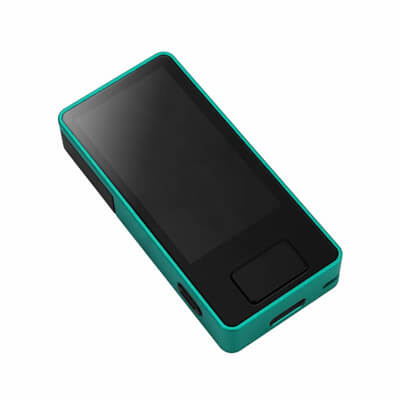



 Released in 2025
- Only fully open-source hardware we review
- SeedQR temporary-signing option
- JadeLink storage for offline file signing
Blockstream Jade Plus Overview
- Crypto Wallet Name
- Blockstream Jade Plus
- Release Date
- 2025
- Wallet Type
- Hardware wallet
- Custodial Status
- Non-custodial
- Built-in Swaps
- Yes
- Open-source
- Fully open-source
- Fiat On-ramp
- Yes
Additional details
- Supported Blockchains
- Bitcoin
- Platforms
- iOS, Android, Desktop (Windows), Desktop (macOS), Desktop (Linux)
- Hardware Wallet Support
- No
- Staking Support
- None
- Hardware Connection Methods
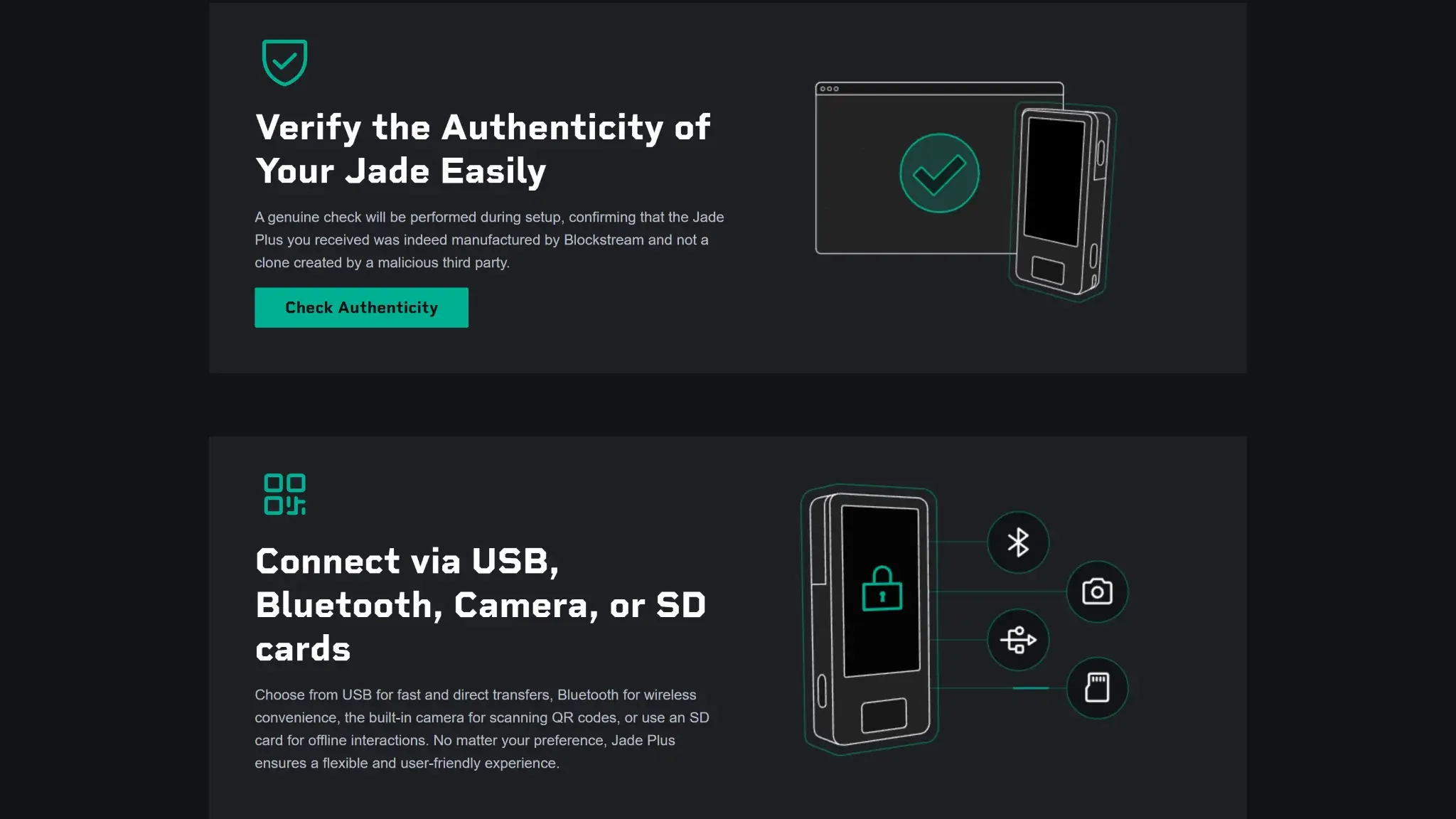
- USB, Bluetooth, QR (air-gapped)
Blockstream Jade Plus Screenshots
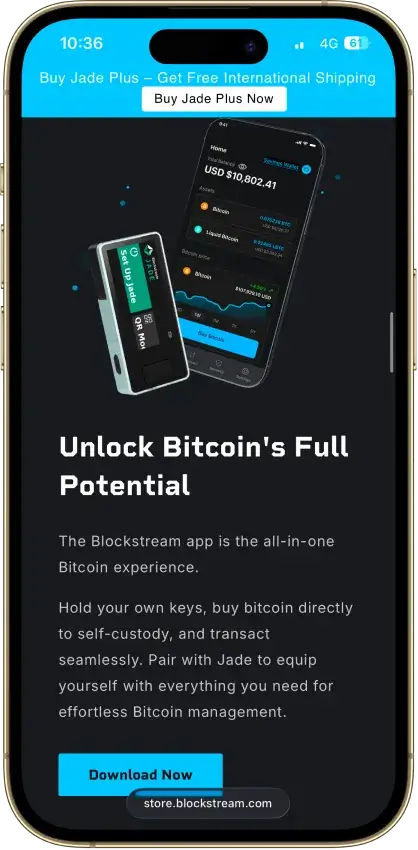
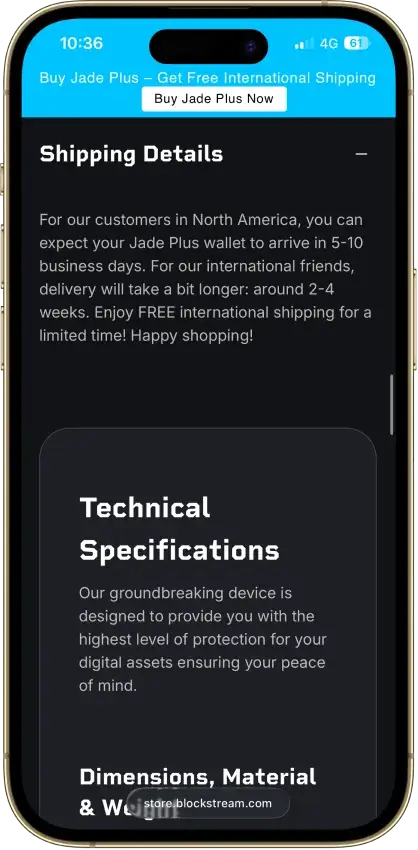
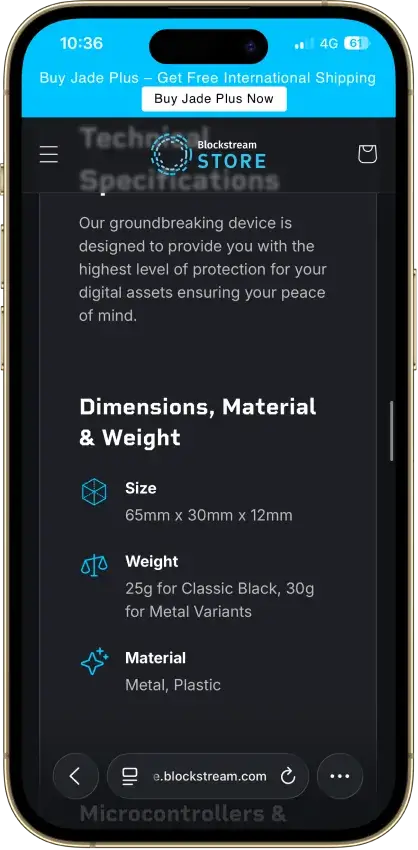
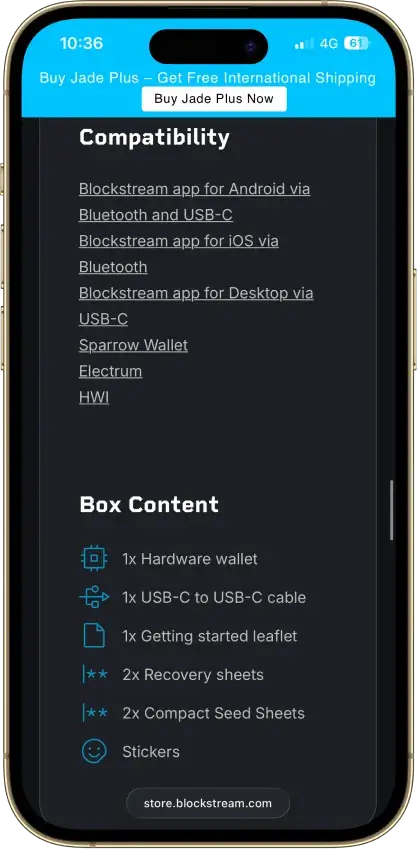
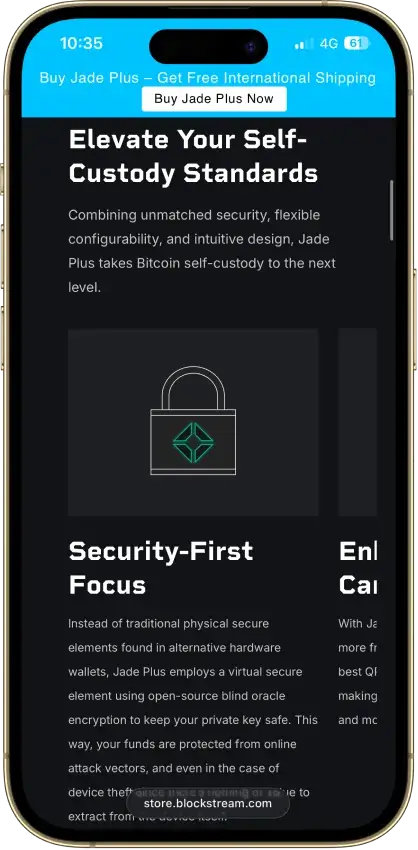
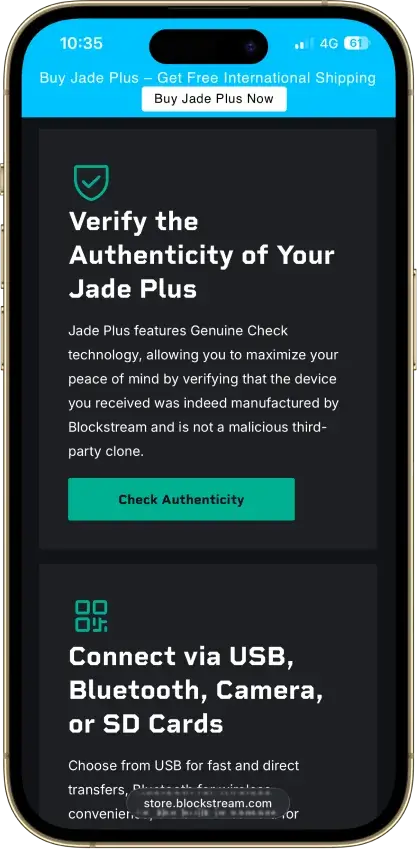
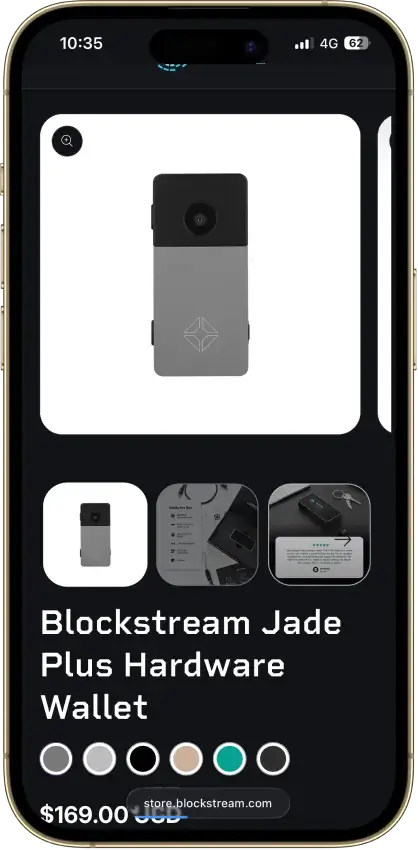
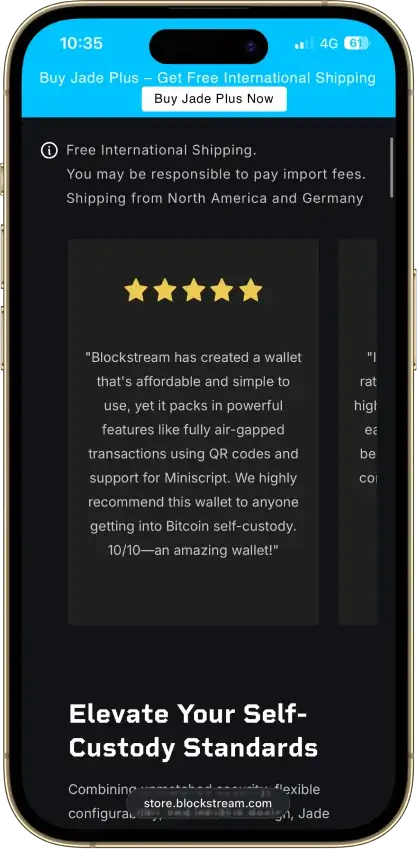
Screenshot 1 of 8
Blockstream Jade Plus Pros and Cons
Pros
- Bitcoin signing by camera, cable or Bluetooth
- Works with Sparrow, Electrum and Nunchuk
- Optional BIP39 passphrase wallets
- Board-design files open to anyone
- Firmware updates from removable storage
Cons
- Normal PIN access depends on an online oracle
- QR transaction signing excludes Liquid
- App Lightning balance uses an app-held key
- Liquid peg-outs limited after a September incident
Jade Plus Key Facts
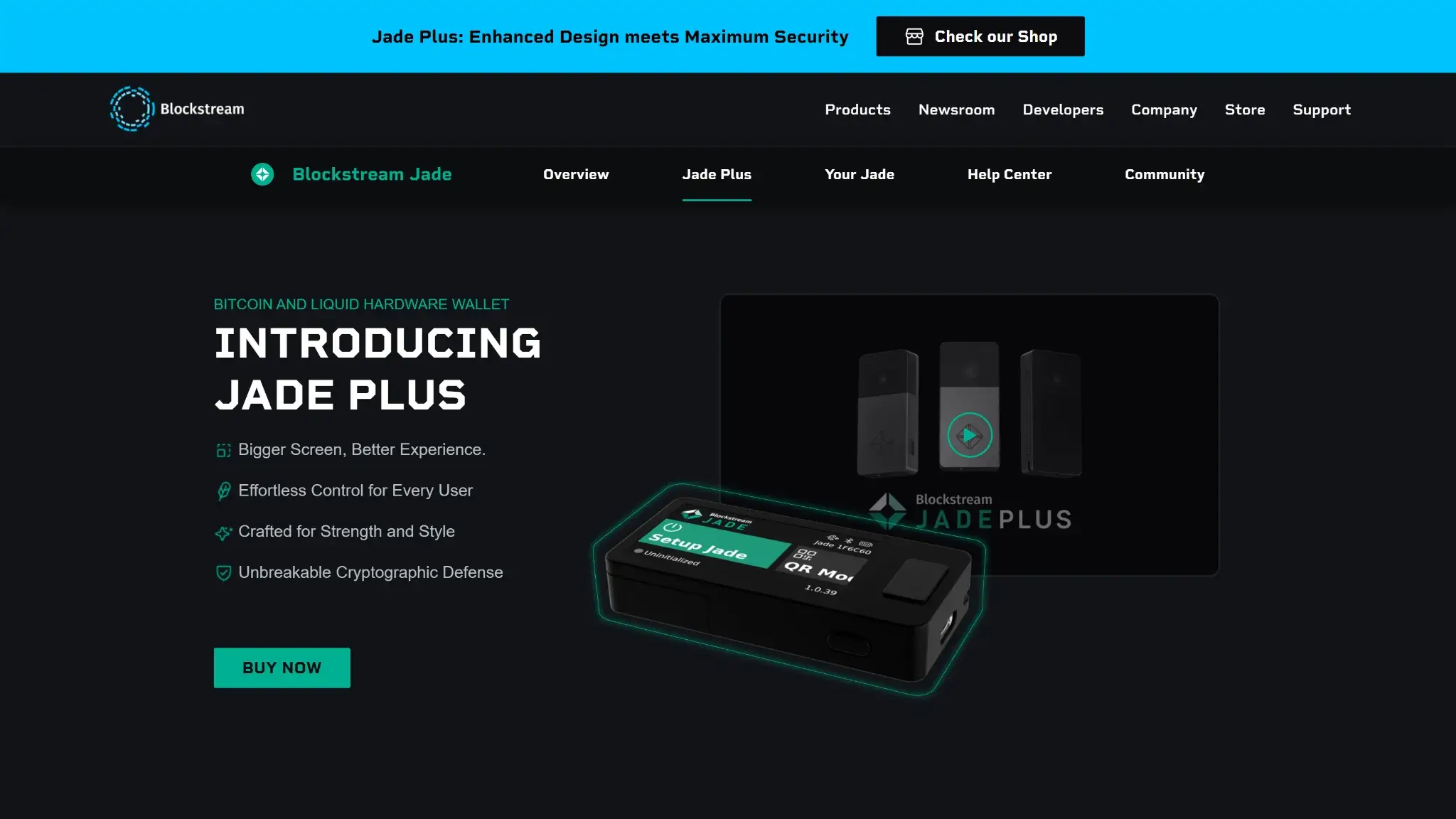
Liquid's September 10 notice, checked September 13, 2026, said transactions had resumed but peg-outs remained disabled after a September 6 security incident. Check the latest network notice before relying on Liquid-to-Bitcoin withdrawals or associated services.
| Detail | What Jade Plus Offers |
|---|---|
| Wallet type | Non-custodial hardware wallet |
| Manufacturer | Blockstream |
| Assets | Bitcoin and Liquid assets, with different connection requirements |
| Source availability | Published firmware and board-design files |
| PIN model | Blind-oracle-assisted protection, rather than a conventional secure-element chip |
| Connections | USB-C, Bluetooth and camera-based QR workflows |
| Companion platforms | Desktop and mobile, depending on the app and connection |
| Display and power | 1.9-inch screen and built-in battery |
| Recovery | 12- or 24-word phrase, optional BIP39 passphrase and SeedQR |
| Standard advertised price | Plastic from $149, metal from $169, checked September 13, 2026 |
| Buying and swaps | Connected app and third-party services, with separate fees and eligibility |
| Lightning | App-held Lightning account or a separate Liquid payment route |
What Is Blockstream Jade Plus?
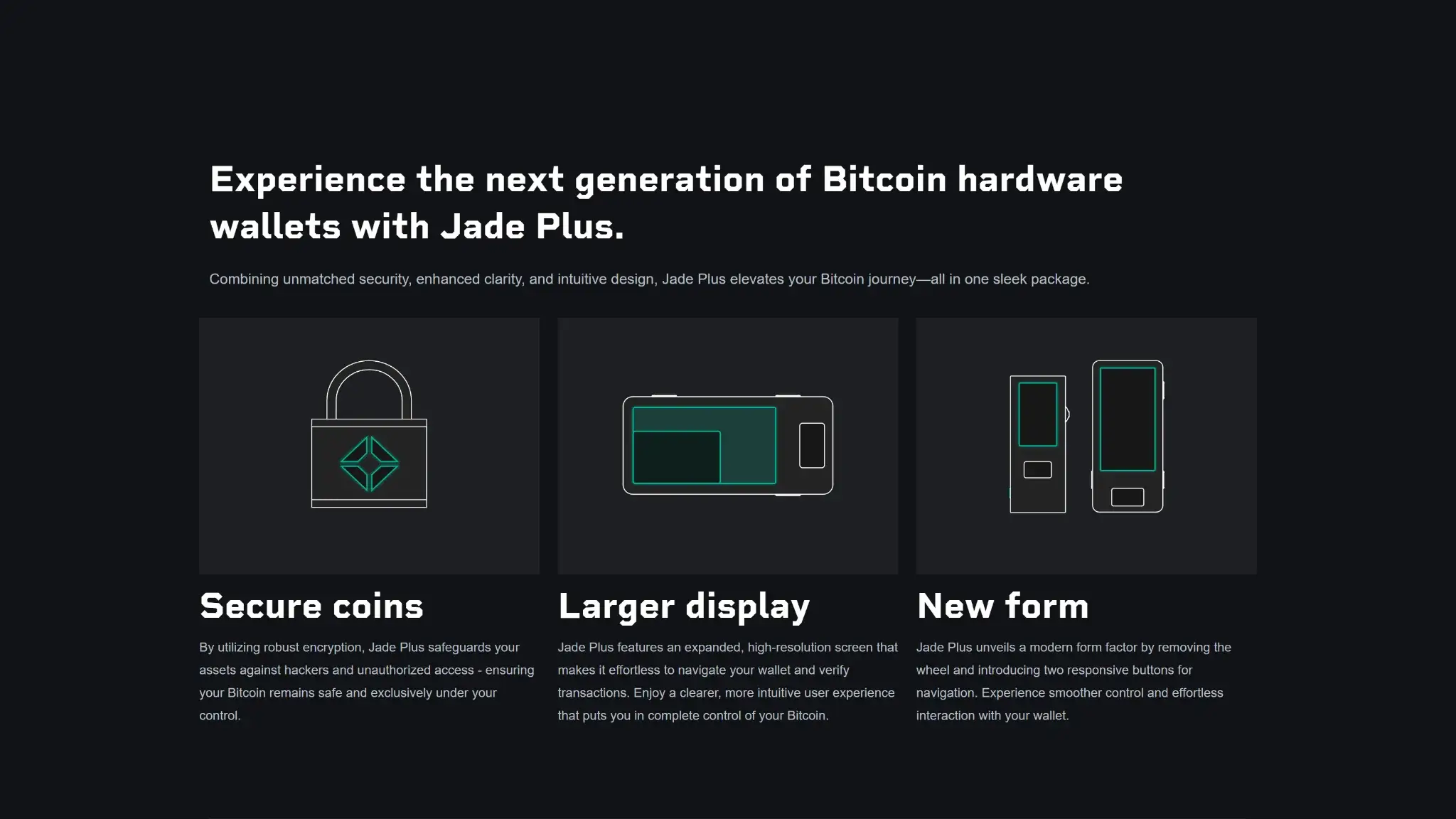
Jade Plus is Blockstream's camera-equipped hardware signer, launched in January 2025. It works alongside a phone or computer. The companion prepares and broadcasts a transaction, while the device displays information for approval and signs with the wallet's keys.
Blockstream also supplies technology to the Liquid Federation. Holding LBTC exposes you to Liquid's network and Bitcoin-reserve arrangements, alongside the security of your signing device. It carries different dependencies from holding BTC on Bitcoin's main chain.
Jade Plus is one of the Bitcoin-and-Liquid hardware wallets in our crypto wallet directory. Its published source materials and choice of Bitcoin signing connections are the reasons to consider it over a multichain alternative.
Security and Custody
How the Blind Oracle Protects PIN Access
Blockstream describes three inputs to its PIN protection: the user's PIN, a secret held by Jade and a secret held by the blind oracle. In normal saved-wallet use, a companion relays the encrypted exchange needed to access the device. The vendor calls this a virtual secure element, but that is an architectural description, not a chip certification.
The oracle adds a service dependency to everyday PIN access. Even QR PIN access needs a connected companion to reach it. The benefit of that QR route is avoiding a direct USB or Bluetooth data connection to the signer, not making the entire payment process internet-free.
Three incorrect PIN attempts erase the relevant keys, according to Blockstream, requiring recovery from the backup. A PIN therefore cannot replace the recovery phrase. Owners need an offline copy they can still access if the device is lost or normal unlocking fails.
Published Code and Security History
Jade's published firmware-reproduction instructions exclude the vendor signature block. Blockstream also makes Jade Plus board-design materials available. Those files support firmware and board inspection. An independent assessment of the complete device would also need to examine its components and how they interact.
In a February 2023 report, Ledger's Donjon researchers described invasive work against the original ESP32-V3-based Jade, extracting a firmware-encryption key and outlining an evil-maid modification scenario. That is an original-Jade laboratory finding, not a demonstrated remote attack against Jade Plus. Ledger is also a competing wallet manufacturer.
In December 2025, Blockstream disclosed a separate firmware vulnerability reported by DARKNAVY. According to its disclosure, exploitation required an initialized, unlocked device and access through the same RPC connection used for unlocking. The affected interface was not exposed through QR mode. BTC Times independently reported the disclosure and subsequent updates, although the technical account comes from Blockstream.
Versions 1.0.24–1.0.36 could crash, according to Blockstream's disclosure, with potential code execution on 1.0.24–1.0.35 and that possibility not ruled out for 1.0.36. Version 1.0.37 addressed the flaw, followed by rollback protection in 1.0.38. Those are historical fixes, not a recommendation to stop updating there.
The official changelog lists firmware 1.0.41, dated August 22, 2026, and Blockstream's accompanying developer update says it fixed additional reported issues. Use the latest supported official release when setting up or maintaining Jade. A camera connection does not make firmware maintenance optional.
Liquid's Separate Network Risk
Liquid's September 2026 incident concerned an Elements validation vulnerability and the network's Bitcoin reserves, a separate layer from Jade's signing-key protection. LBTC holders depend on the Liquid Federation's reserves and network operation as well as their own key protection.
Supported Coins and Connection Limits
Jade Plus supports Bitcoin and assets on Liquid. It is not an Ethereum, Solana or Monero hardware wallet. Companion choice changes the interface and available connections within those supported networks.
Blockstream's QR guide limits QR transaction signing to Bitcoin. Liquid transactions require USB or Bluetooth with the Blockstream app. The camera workflow therefore cannot replace a cable or Bluetooth for every supported asset.
Setup, Daily Use and Recovery
Creating and Checking a Wallet
Jade saves a new wallet only after PIN setup is complete. Create the recovery phrase on the device, record it offline and confirm the recorded words, then finish the companion connection and PIN steps for normal oracle-assisted access. Make a small initial transfer before committing a substantial balance.
If your goal is a new cold-storage wallet, do not assume restoring an old phone-generated phrase achieves it. That phrase may already have existed on an internet-connected device. A newly generated hardware-wallet phrase and a subsequent transfer establish a different history from importing the old one.
Use Jade's 1.9-inch display to check the destination and transaction details before approving a payment prepared by the companion. The camera passes transaction data to the signer, while approval stays on the device.
Choosing a Companion
The Blockstream app supports desktop and mobile use. Sparrow and Electrum provide desktop alternatives, but they do not share all of the same connection options.
| Companion | Documented Jade Plus Connections |
|---|---|
| Blockstream app | USB, Bluetooth and QR |
| Sparrow | USB, QR and JadeLink |
| Electrum | USB |
| Nunchuk | USB, QR and JadeLink |
Check the app's instructions for your operating system before buying an adapter or planning a mobile workflow. For example, Jade's Bluetooth connection works with the Blockstream app, but the published Electrum route uses USB.
Phrase, Passphrase and SeedQR
Jade supports recovery from a 12- or 24-word phrase. If you used an additional BIP39 passphrase, you need that same passphrase to reach the same wallet. A different spelling, capitalization or space produces a different wallet rather than a helpful “wrong password” warning.
SeedQR is another way to represent the recovery phrase. It is a secret backup, not the same kind of QR code used to pass a transaction between devices. Scan it with Jade when following the recovery or temporary-signer instructions. Do not scan it with an online phone, photograph it for convenience or enter it into a website.
Temporary, or stateless, use loads the recovery phrase for that session and forgets the wallet after reboot. You can use this temporary route with your recovery phrase when the oracle is unreachable. It avoids normal saved-wallet PIN access, but introduces repeated handling of the backup. Frequent users must weigh that extra exposure against the convenience of saved-wallet access.
Lightning, Swaps and Offline Files
Two Distinct Lightning Routes
Jade users can create a dedicated Lightning account in the Blockstream app. During setup, Jade generates a separate key that the app uses to authorize Lightning payments without a Jade approval step. That balance is app-held for signing purposes, even though its recovery is tied to the existing phrase.
A separate feature pays Lightning invoices from LBTC and receives LBTC from Lightning payments. Blockstream's instructions for that route require confirmation on Jade when using a Jade-secured wallet. It involves Liquid and swap services, so it has different operating dependencies from an app Lightning balance. The current Liquid incident is another reason to check availability before relying on it.
Lightning support is described as beta in the app's documentation. The first inbound payment to an Instant Lightning account may include a one-time funding fee. Compare the amount paid, the amount received and any service charge before approving a payment.
Purchases and Removable Storage
The app's buy function can send purchased BTC to a Jade wallet. It forwards the purchase to a third-party exchange for completion. Check that provider's quote, payment requirements and eligibility before proceeding. Jade is the destination signer, not the seller of the bitcoin.
JadeLink provides a removable-storage route for transaction files and firmware updates. It plugs into USB-C. Jade Plus does not have a built-in SD slot. Blockstream also documents compatible FAT32 storage alternatives, so its branded accessory is not mandatory for every supported file workflow. The signed transaction still needs a connected companion for broadcast.
Jade Plus Price and Ongoing Costs
On September 13, 2026, Blockstream's store listed Jade Plus in plastic from $149 and metal from $169. Accessories and bundles should be compared separately. Check the final order total for taxes, import charges and delivery costs, including the expiry and eligibility terms of any shipping promotion.
Using the wallet also involves transaction costs. Bitcoin and Liquid network fees are separate from the device purchase. Swaps in the Blockstream app incur a network fee plus a swap fee. Third-party purchases have their own quotes.
Consider the returns policy before selecting a model or color. Blockstream's published store policy says it does not refund purchases merely because the buyer dislikes the product. It permits cancellation before fulfillment and handles damaged or incorrect orders through support. That describes the store's policy, not the extent of any statutory consumer rights.
Who Should Choose Jade Plus?
Jade Plus makes sense for Bitcoin holders who want to inspect published firmware, choose between supported desktop and mobile companions, and sign by camera when that fits their routine. It is also relevant to users willing to learn the difference between normal PIN access and temporary signing.
Look elsewhere if you need one hardware wallet for Bitcoin and unrelated chains, or if you want a conventional secure-element chip without an oracle-assisted PIN design. Buyers primarily interested in Liquid should first assess the network's recovery status. A hardware purchase does not resolve that service risk.
Jade Plus Alternatives
The Trezor Safe 3 offers a USB-C, two-button workflow with Trezor Suite. Its universal version supports assets beyond Bitcoin, while a separate Bitcoin-only version exists. Consider it if multichain support matters more to you than Jade's camera.
The Ledger Nano S Plus is another cable-first option for desktop and Android users. It supports Bitcoin, Ethereum and other networks, but does not work with iOS. Check that restriction against the phone you intend to use.
The ELLIPAL Titan 2.0 uses QR exchanges with its companion app and a 4-inch touchscreen. It is worth examining if you want a larger transaction display.
Final Verdict
Jade Plus earns consideration through its choice of Bitcoin signing workflows, published firmware and explicit recovery options. Normal PIN access depends on the blind oracle even when signing by camera. Buyers should understand that dependency, keep their backup offline and update beyond the historical 2025 fixes. With plastic models starting at $149, Jade Plus offers a choice of camera, cable and Bluetooth signing for Bitcoin. Liquid holdings add network and reserve dependencies, while the app's Lightning balance uses an app-held signing key. Choose those features separately from the device's on-chain Bitcoin storage.
Disclaimer: CryptoSlate may receive a commission when you click links on our site and make a purchase or complete an action with a third party. This does not influence our editorial independence, reviews, or ratings, and we always aim to provide accurate, transparent information to our readers.