


 Released in 2024
- Built by the team behind Kraken exchange
- Native Dogecoin support, not wrapped
- Token risk scoring and spam-NFT filter
Kraken Wallet Overview
- Crypto Wallet Name
- Kraken Wallet
- Release Date
- 2024
- Wallet Type
- Multi-platform wallet
- Custodial Status
- Non-custodial
- Built-in Swaps
- Yes
- Open-source
- Fully open-source
- Fiat On-ramp
- No
Additional details
- Supported Blockchains
- BNB Smart Chain, Avalanche, Bitcoin, Ethereum, Arbitrum, Base, Optimism, Polygon, Solana
- Token Standards
- ERC-20, SPL
- Platforms
- iOS, Android
- Hardware Wallet Support
- No
- Staking Support
- Limited
Kraken Wallet Screenshots
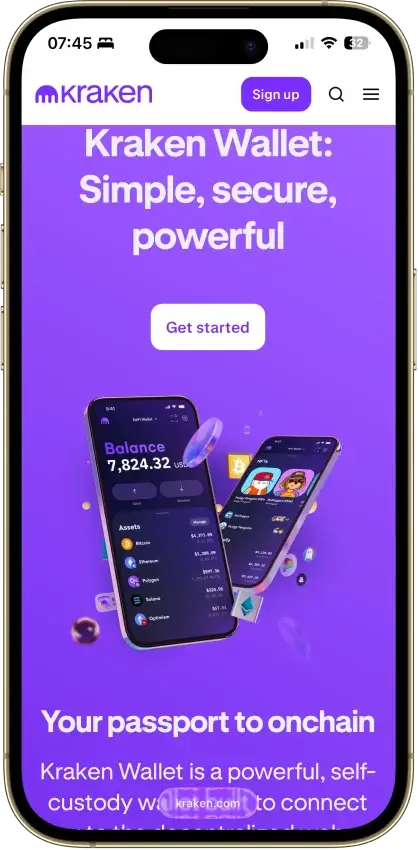
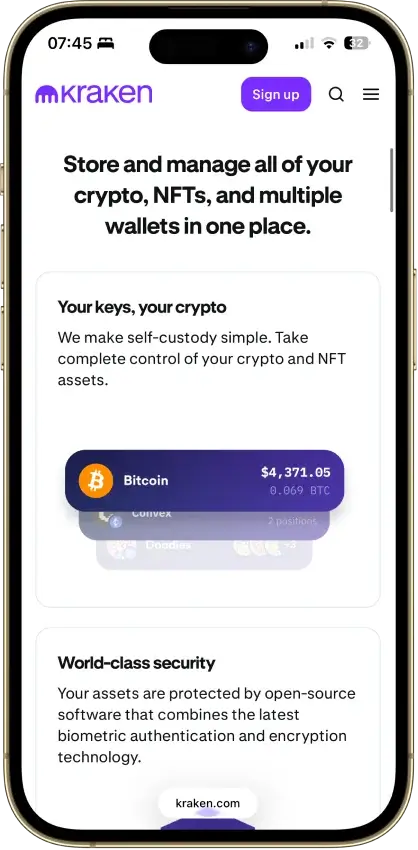
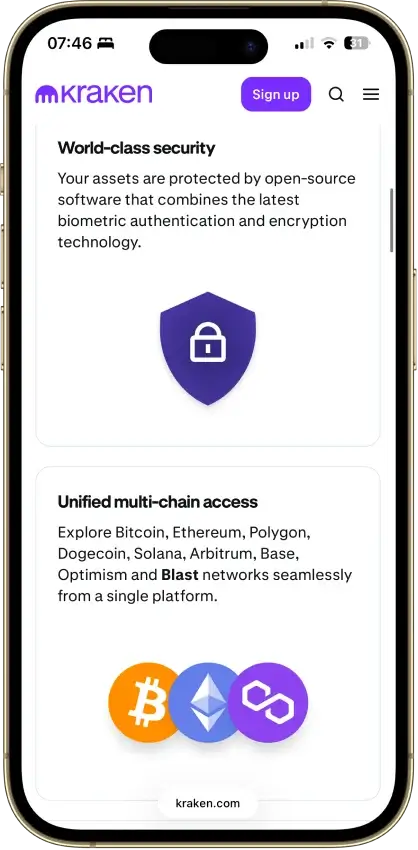
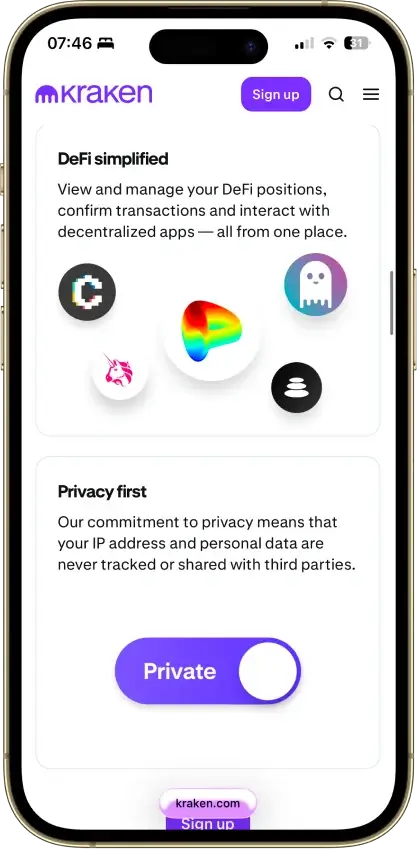
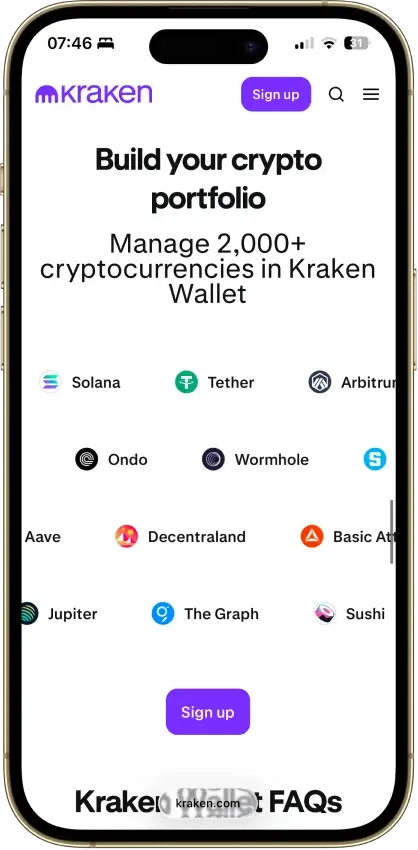
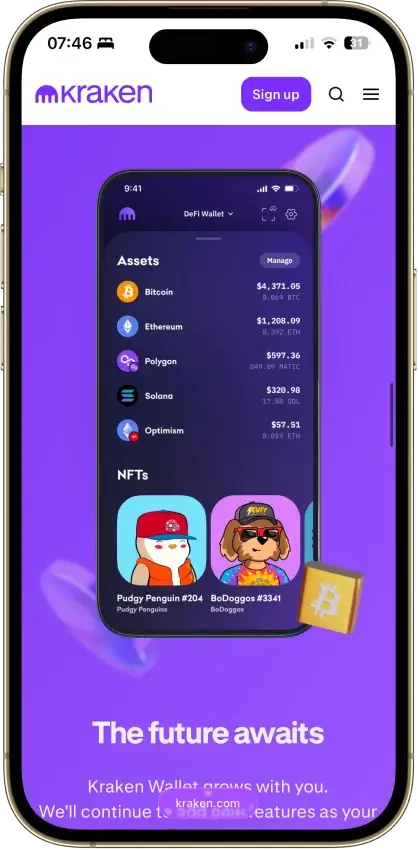
Screenshot 1 of 8
Kraken Wallet Pros and Cons
Pros
- Mobile code released under MIT in 2024
- Trail of Bits audited the mobile wallet
- Works without a Kraken exchange account
- Kraken Connect links your exchange account
- Available to US users
Cons
- No hardware pairing for mobile seed wallets
- No browser extension
- Swap routes and fees vary
- Exchange transfers need an eligible account
- No passphrase option
Who Kraken Wallet Is Best For and Who Should Skip It
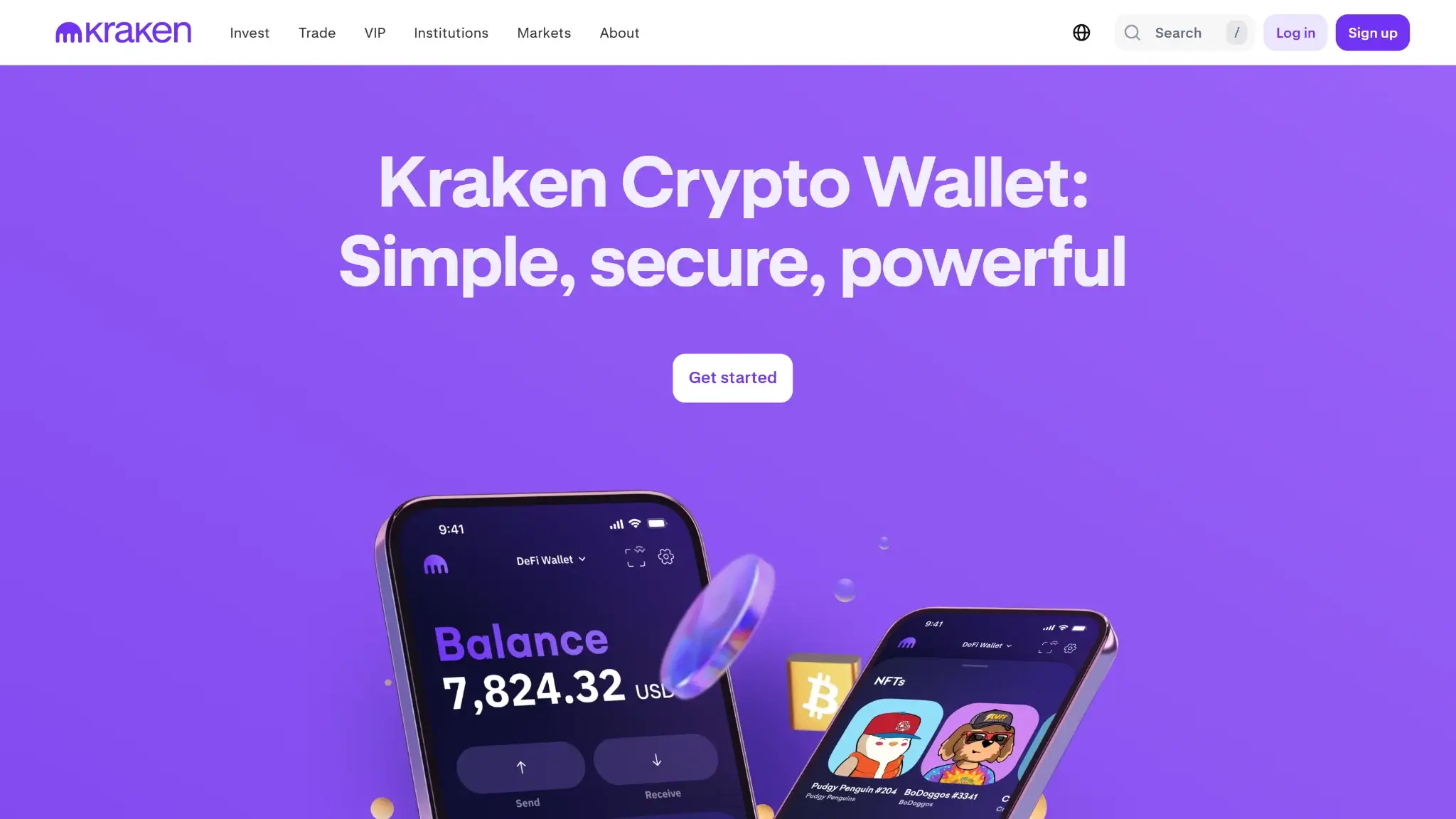
Kraken Wallet supports seed-phrase and embedded accounts, with mobile apps and a web interface. Check the supported networks for your wallet type before transferring assets.
Get it if any of these apply to you.
- You want to manage seed-phrase and embedded wallets in the same app
- You are a US user and need a self-custody wallet available in your app store
- You keep coins on Bitcoin and Ethereum networks plus Solana or Dogecoin and want one app for all of them
- You already use Kraken and want transfers through Kraken Connect
Skip it if any of these apply to you.
- You are securing a large balance that belongs behind hardware signing
- Your desktop dApp requires a browser extension
- Your portfolio includes XRP or Litecoin, or you need Cosmos chains or Ordinals
- You need BIP39 passphrase or individual private-key import
What Is Kraken Wallet and How Does It Work
Kraken Wallet launched in April 2024 as a standalone non-custodial mobile app, separate from the Kraken exchange. The exchange account is custodial and requires KYC. You can create or import a seed-phrase wallet without that account. The app also supports an optional embedded wallet with sign-in recovery.
The company behind it is Payward, Inc., the San Francisco firm that has operated the Kraken exchange since 2011. Kraken released the mobile app code under MIT in April 2024, and Trail of Bits assessed that mobile wallet. Those historical disclosures do not establish the audit coverage of the newer web and embedded components.
Security and Custody
Kraken released its mobile wallet code under the MIT license in April 2024 and published reproducible-build instructions. The linked krakenfx/wallet repository returned 404 on October 24, 2026, so current public code access remains unconfirmed. Build instructions describe how to compile code and compare it with an app-store binary, but they do not prove the two match. The published Trail of Bits assessment covers the mobile codebase and client architecture. It does not establish audit coverage of the current web interface or embedded-wallet components.
In the mobile seed-phrase wallet, the private key is decrypted into the phone's memory during signing. Secure storage does not keep the signing key inside a secure element throughout that operation, and this mobile mode cannot pair with a hardware signer. A compromised phone puts its signing credentials at risk, even with app authentication. Kraken adds the protections software can offer, from a biometric app lock to transaction simulation that previews what a signature will do. Address validation and token risk scoring help too, along with spam-NFT filtering. Those tools can flag risky approvals, but the signing keys still reside on the phone.
On the exchange side, a June 2024 bug let a research firm extract roughly $3 million, which was returned after a white-hat dispute. Kraken also paid a $30 million SEC settlement over its US staking service in 2023. These events concerned the exchange and its custodial staking service.
Supported Chains and Assets
As of October 23, 2026, Kraken Wallet supports Bitcoin, Ethereum, Solana, Ink, Base, BNB Smart Chain, Robinhood Chain, Polygon, Arbitrum One, Avalanche C-Chain, Linea, Optimism and Dogecoin. Blast remains available for existing self-custody activity, but you cannot create a new receive request for it. Embedded wallets exclude both Blast and Dogecoin. Asset availability varies by network and wallet type.
Token support covers ERC-20 and SPL tokens alongside native assets. Kraken’s July 16, 2026 NFT list names Ethereum, Arbitrum, Base, Optimism, Polygon and Solana. Its September 15 guide describes ERC-721 and ERC-1155 transfers on supported EVM wallets without clarifying whether the earlier Solana scope has changed. Check the NFT network and available action in your selected wallet.
Bitcoin, Solana and Dogecoin are supported natively alongside the listed EVM networks. XRP and Litecoin are missing, as are Cosmos chains. The app also has no support for Bitcoin Ordinals or for BRC-20 tokens and Runes. If your portfolio lives on those networks, pick one of the alternatives below.
Usability and Recovery
Seed-phrase setup creates a wallet without an exchange login or identity check. Kraken supports 12-, 18- and 24-word recovery phrases. On supported iPhones, seed-phrase wallets can use password-encrypted iCloud Drive backup files. Encrypted Google Drive backup is also available. Kraken cannot restore a lost phrase or cloud-backup password.
The older iCloud passkey backup has a separate recovery warning. Kraken’s May 20, 2026 guidance remains published on October 24 and warns that an iOS update can prevent recovery on a new or reinstalled device. Its troubleshooting page still says a fix is in progress for the Import from iCloud flow. The notice does not establish whether the newer password-encrypted file flow is affected. Keep a separate manual backup of the Secret Recovery Phrase.
You can import multiple recovery phrases and keep each as a separate wallet group. There is no BIP39 passphrase or hidden-wallet option, and no private-key import for bringing in a single account from another wallet. These limits affect migration from a passphrase-protected wallet or a single private key. An optional embedded wallet supports email, Google, Apple or passkey sign-in and private-key export. You can keep both wallet types in the same app.
Features
In-app swaps support EVM and Solana routes, including cross-chain swaps and bridges. The quote shows the provider and fees, the minimum amount you will receive and any approval or bridge steps. Check the rate and slippage setting before approving each transaction.
The DeFi section offers curated protocols and vaults where you can deposit supported assets, track positions and withdraw. Supported DeFi actions can include protocol staking as well as vault deposits. Check each opportunity’s network, fees and withdrawal terms. Returns are variable and protocol risks apply. The built-in dApp browser and WalletConnect also connect to external dApps. Kraken Connect lets you fund the wallet with supported crypto from an eligible Kraken exchange account, and it stays optional. Purchases through Kraken Exchange take place in that separate custodial account. NFT management is built in.
Kraken Wallet has iOS and Android apps plus a browser-based interface at wallet.kraken.com. There is no browser extension. The support FAQ updated September 15, 2026 describes only iOS and Android device support, while the September 16 launch update explicitly includes web access. Neither provides a complete feature-parity matrix for the web interface, mobile seed-phrase wallets and embedded accounts.
Cost
The app is free. Seed-phrase wallets need no exchange login or identity check. Transactions can incur network and route fees. Some eligible embedded-wallet EVM transactions receive fee sponsorship, but it is not guaranteed. Check the quoted fees and minimum received amount before confirming. There is no subscription tier, though serious balances still belong on a hardware signer, which the mobile seed-phrase wallet cannot connect to.
Alternative Wallets Like Kraken Wallet
-

Trust Wallet
Trust Wallet combines multichain accounts with optional cloud backup and a separate SWIFT passkey wallet. Classic and SWIFT recovery differ, and the September network changes require checking continued access for affected assets.
-

MetaMask
MetaMask combines EVM dApp access with native Bitcoin, Solana and TRON accounts. It offers hardware connections and optional linked-login recovery, with a 0.875% wallet swap fee.
-

Edge Wallet
Edge is a self-custody wallet that uses a username and password to restore encrypted account backups. Setup does not require recording a seed phrase, but recovery still depends on saved credentials, device...
Kraken Wallet has mobile and web access, with network support that depends on wallet type. You can fund it with crypto transferred from Kraken or an external wallet. Some other self-custody wallets add a browser extension or in-app fiat purchases.
- Trust Wallet supports Litecoin, which is absent from Kraken Wallet’s supported-network list.
- MetaMask suits desktop DeFi users through its browser extension.
- Edge Wallet suits users who want password login recovery and in-app fiat purchases.
Choose another wallet if you need Litecoin support or a browser extension.
Crypto Wallets Pillar Scores
- Custody and key security 30% weight Who can authorize spending, protection of keys and signing, and independent access to every reviewed account type.9.0 / 10
- Security validation and track record 25% weight Independent security assessments, their coverage and findings, plus updates and the handling of known incidents.8.0 / 10
- Transaction safety and signing 20% weight Transaction details, signing warnings, scam checks, permission controls and the handling of unreadable requests.9.0 / 10
- Backup and recovery 10% weight Repeatable backup checks, complete restoration, recovery dependencies, costs and resilience after backup loss.8.0 / 10
- Usability, privacy and costs 10% weight Setup and everyday tasks, accessibility, support guides, data-sharing choices and device, service and transaction costs.8.0 / 10
- Assets, networks and compatibility 5% weight Asset and network support, devices, companion apps and connections needed for the uses covered in the review.9.0 / 10
Final Verdict
Kraken Wallet offers seed-phrase and embedded accounts, plus integrated swaps and DeFi vaults. Its mobile code was released under MIT, but the linked repository returned 404 on October 24, 2026. The seed-phrase mobile wallet needs no exchange account and signs on the phone without hardware pairing. Anti-scam features do not remove the risk of a compromised device.
Disclaimer: CryptoSlate may receive a commission when you click links on our site and make a purchase or complete an action with a third party. This does not influence our editorial independence, reviews, or ratings, and we always aim to provide accurate, transparent information to our readers.