




- Power E*TRADE Pro desktop with paper trading
- Overnight trading from Sunday night to Friday
- Every IRA type and a Solo 401(k)
E*TRADE Overview
- Broker Name
- E*TRADE
- Broker Type
- Self-Directed Broker
- Main Products
- Stocks, ETFs, Fractional Shares, Options, Mutual Funds, Bonds / Treasuries, Futures, International, Spot Crypto, Crypto ETFs
- Stock / ETF Commission
- $0 online for US exchange-listed shares. OTC stocks $6.95
- Options Fee
- $0.65/contract; $0.50 at 30+ trades/quarter; index options add up to $0.66
- Default Cash Yield
- 0.01% APY below $500,000 in the Bank Deposit Program
- Transfer-Out Fee
- $75 for a full transfer. Partial: Not disclosed
- Account Minimum
- $0
- Spot Crypto
- Zero Hash LLC; BTC, ETH and SOL
- Crypto ETF Access
- Spot crypto ETFs listed; no stated restriction; account eligibility must be checked
- Retirement Accounts
- Traditional, Roth, Rollover, SEP, SIMPLE, Inherited, Solo 401(k)
- Protection
- SIPC at Morgan Stanley Smith Barney for broker failure, not market loss, plus excess cover. Swept cash: FDIC for bank failure. Crypto at Zero Hash: neither.
- Regulator / CRD
- SEC and FINRA. Morgan Stanley Smith Barney LLC, CRD 149777
- Subscription
- None
E*TRADE Screenshots
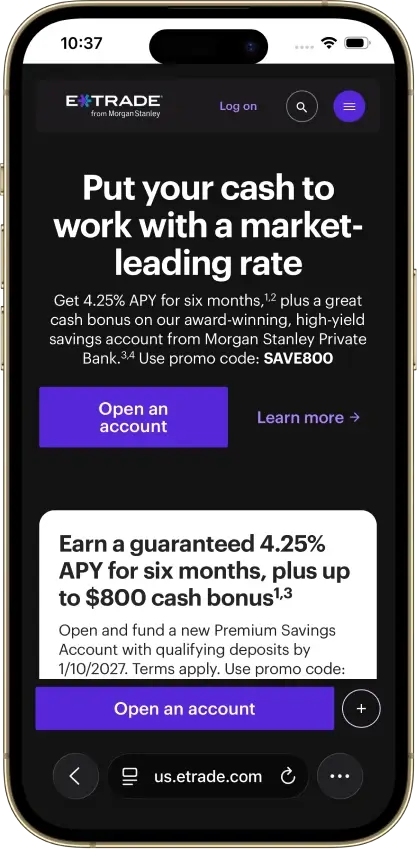
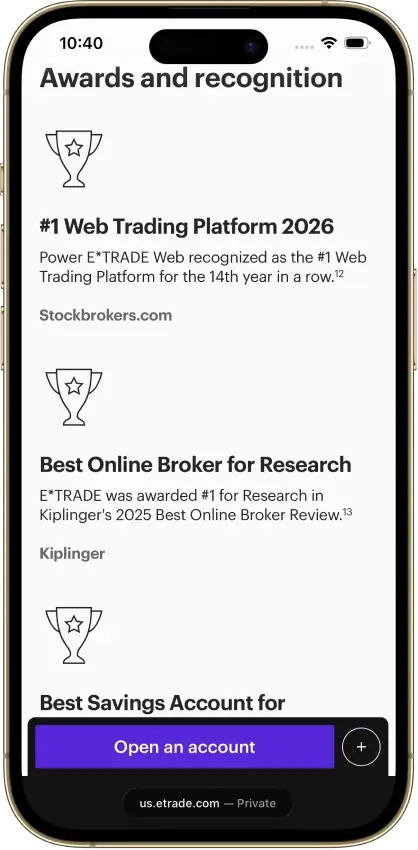
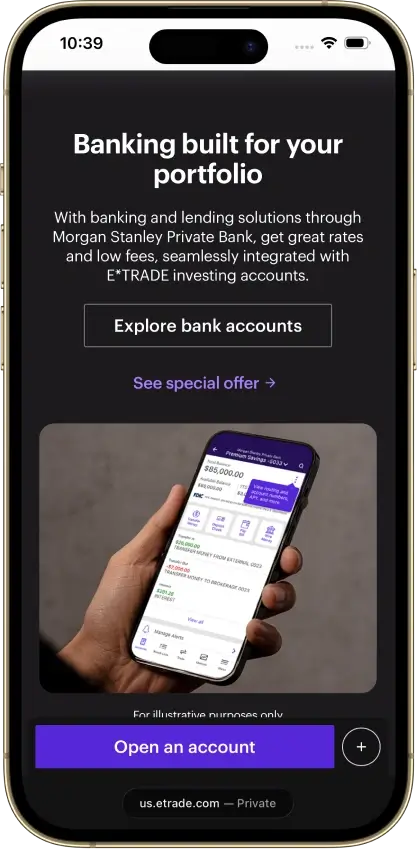
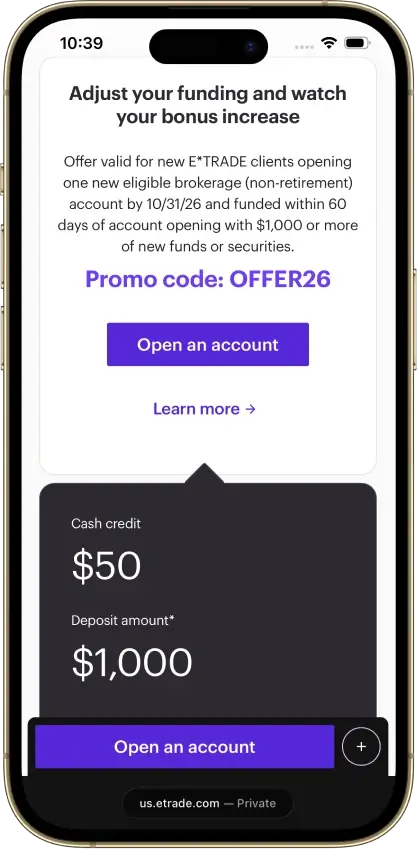
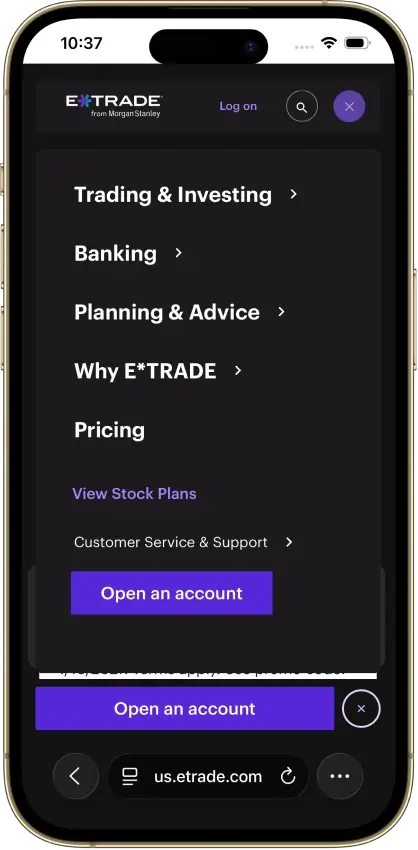
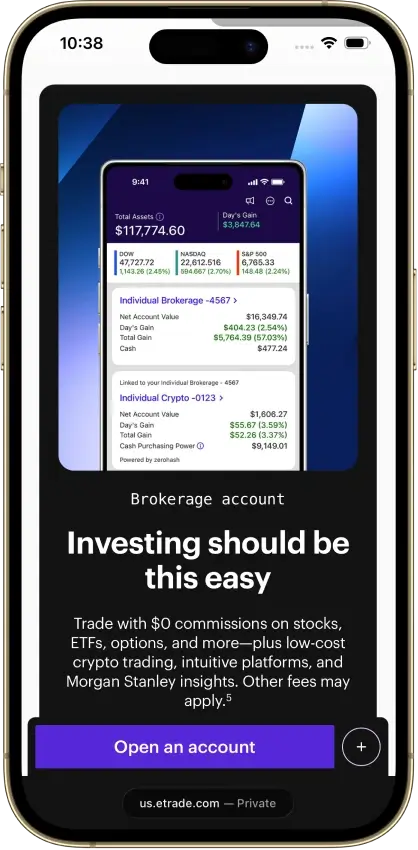
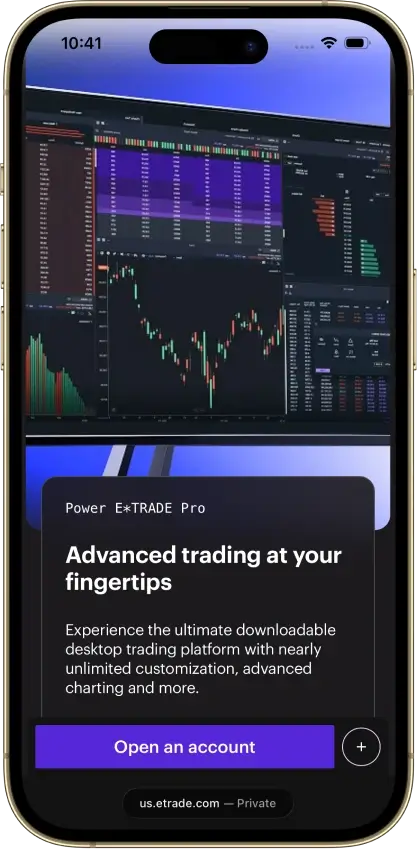
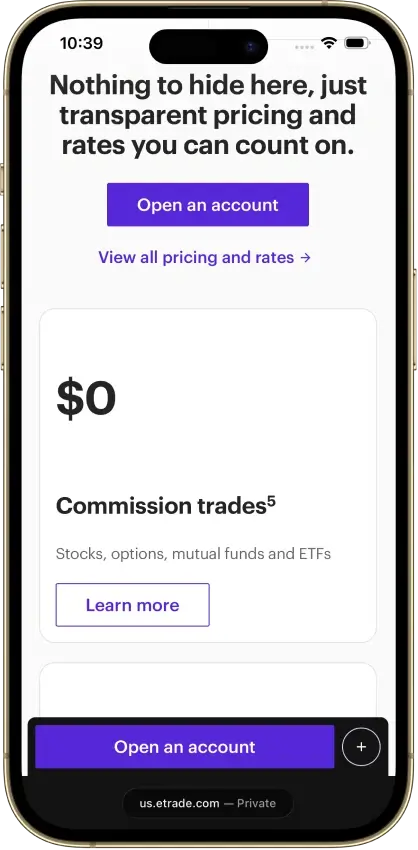
Screenshot 1 of 8
E*TRADE Pros and Cons
Pros
- Custom scans and an ETF screener on Power E*TRADE
- Options fall to $0.50 at 30+ trades a quarter
- Paper trading funded with play money
- Solo 401(k) and SIMPLE IRA for small businesses
- $0 minimum, ACH deposits usable on day three
Cons
- Default sweep pays 0.01% APY below $500,000
- Three coins and no crypto transfers yet
- $75 fee to move the whole account out
- SEC orders over data and advisor theft
Is E*TRADE Worth It?
APY, the annual percentage yield, measures what idle cash earns, and the 0.01% default pays $10 a year on $100,000. Morgan Stanley Smith Barney belongs to SIPC, the Securities Investor Protection Corporation, whose cover answers a broker collapse with missing customer assets and ignores market losses. FDIC, the federal deposit insurer, covers swept cash only if a bank fails.
For options traders, E*TRADE puts a desktop platform and an app on one account, and contracts cost $0.50 each at 30 or more trades a quarter, with nothing charged on exercise. Limit orders on stocks can go in overnight from Sunday night to Friday morning. The retirement menu reaches small-business owners through the Solo 401(k) and the SIMPLE IRA.
Uninvested cash is the weak point, because the default Bank Deposit Program pays 0.01% APY below $500,000, and E*TRADE calls it the only sweep vehicle for most clients. Crypto buyers get three coins they cannot yet move, and the firm holding the accounts carries Morgan Stanley's regulatory record.
E*TRADE earns its place when options and retirement accounts need to sit behind one desktop platform. Crypto you can withdraw and a cash sweep paying a market rate are the gaps.
Who E*TRADE Suits And Who Should Skip It
Active accounts do well at E*TRADE, and quiet accounts with money sitting in them pay for it in lost interest.
An options trader placing 30 or more trades a quarter gains most here, as does a sole owner who wants a Solo 401(k) beside a brokerage account.
A $50,000 balance left in the sweep earns $5 a year, and moving everything to a broker with a better default costs $75.
What You Can Invest In At E*TRADE
Every core securities class trades at E*TRADE, while spot crypto sits with a separate company, Zero Hash LLC. Fractional shares are still a pilot, and foreign companies come through OTC quotes, the over-the-counter dealer market, or ADRs, American depositary receipts that stand in for foreign shares on US markets.
The fractional pilot matters most to small accounts, and investors who want foreign shares get them as OTC quotes or ADRs.
Crypto At E*TRADE: Spot Crypto And Crypto ETFs
You can buy crypto on E*TRADE in two ways, and each sits with a different company. Coins come from Zero Hash LLC, and crypto funds sit beside stocks at Morgan Stanley Smith Barney, each with its own fees and protections.
Spot Crypto Through Zero Hash LLC
Zero Hash LLC, known as zerohash, sells and holds E*TRADE's spot crypto in a separate, non-brokerage account linked to an individual brokerage account. Bitcoin, Ethereum and Solana are the only coins. The full rollout finished on July 16, 2026, and orders run from $10 to $500,000 on E*TRADE's website and app. New York regulators license Zero Hash both for virtual currency and for money transmission. E*TRADE offers no staking.
E*TRADE charges 0.50%, and its crypto supplement lets zerohash include fees in the quoted price. Zerohash collects that commission and passes a share to E*TRADE. E*TRADE advertises 24/7 crypto trading, and its supplement lets it restrict orders outside banking hours.
Transfers are not available yet, so no coin bought on E*TRADE can reach self-custody crypto wallets today. Investors who want that route can buy on crypto exchanges that serve US investors and withdraw from there.
Zerohash holds the coins today, and Morgan Stanley plans to move crypto services to a trust bank that has preliminary approval from the Office of the Comptroller of the Currency. Under E*TRADE's Digital Assets Supplement, the investor accepts “the risk of zerohash's insolvency” for coins and for sale proceeds not yet received by Morgan Stanley Smith Barney. Zerohash's own account agreement appears at account opening.
Crypto ETFs At E*TRADE: Bitcoin, Ether, Solana And XRP
Crypto ETFs, from the spot Bitcoin ETFs to Solana and XRP funds, are held in the brokerage account under the same broker-dealer rules as stocks. E*TRADE's quote pages carry 58 funds from CryptoSlate's list of 62 open US spot crypto ETFs, and E*TRADE does not publish whether it accepts orders for each.
| Asset | Spot ETFs Listed At E*TRADE | Notes |
|---|---|---|
| Bitcoin | 13 of 13 | Includes Morgan Stanley's own trust, flagged as affiliated |
| Ethereum | 11 of 12 | Includes Morgan Stanley's own trust |
| Solana | 9 of 10 | Includes Morgan Stanley's own trust |
| XRP | 5 of 5 | All listed |
| Other altcoins | 20 of 22 | Two OTC trusts carry the $6.95 commission |
E*TRADE asks for no extra agreement or acknowledgment and adds no surcharge for crypto ETFs, and says crypto exchange-traded products are available in brokerage accounts and IRAs, with no per-fund list. Morgan Stanley issues three of the listed funds, MSBT, MSSE and MSOL, and its disclosure says the sponsor fee means “we have a conflict of interest to promote MSBT, MSSE, and MSOL.”
Costs: What You Actually Pay At E*TRADE
E*TRADE's costs land on investors who borrow, trade off-exchange or leave, since online trades in listed US shares cost $0 here as at other large US brokers.
The $75 exit fee applies when a whole account leaves by ACATS, the Automated Customer Account Transfer Service. Investors placing 30 or more options trades a quarter cut their contract cost by 23%.
What This Table Does Not Include
E*TRADE's fee schedule never lists a fund's expense ratio, because each fund deducts it inside the fund. Morgan Stanley issues some of the products sold on E*TRADE, including its three crypto trusts and affiliate mutual funds, and their running costs stay inside each fund.
E*TRADE Margin Rates
Morgan Stanley Smith Barney sets E*TRADE margin rates at its discretion from a 10.20% base rate, and a margin account needs $2,000 in equity.
Borrowing $10,000 for a year at 12.45% costs about $1,245 in interest.
Costs That Do Not Show On The Fee Page
- E*TRADE charges 0.50%, and its crypto supplement lets zerohash include fees in the quoted price. E*TRADE keeps a share of that commission.
- Regulatory pass-through fees, charges set by regulators and passed on, can differ from or exceed the fees E*TRADE pays.
- The Client Agreement reserves the right to charge inactive-account fees and further transfer fees, with no amount given.
- Paper statements cost $2 a quarter unless the account qualifies for an exemption.
- Withdrawals paid out in a foreign currency carry up to 2.50%.
- Crypto futures cost $1.50 a contract a side on one E*TRADE page and $2.50 on another.
Uninvested Cash: What It Earns And Who Holds It
A sweep is the automatic overnight move of uninvested cash into a bank deposit or fund, and at E*TRADE the default rate is near zero.
The E*TRADE Bank Deposit Program
The Bank Deposit Program, or BDP, is the default sweep at opening for taxable accounts and IRAs alike, and it pays 0.01% APY below $500,000. Investors can leave the program and ask to put cash in a money market fund instead, subject to eligibility, but E*TRADE calls BDP the only sweep vehicle for most clients.
Swept cash goes to Morgan Stanley Bank, N.A. or Morgan Stanley Private Bank, N.A., then to outside program banks. A bank failure triggers FDIC, which covers up to $500,000 for an individual account and $1,000,000 for a joint account once the program's conditions are met. The BDP disclosure puts sweep-bank balances outside SIPC and Morgan Stanley's excess policy, since the cash has left the broker-dealer.
Morgan Stanley says its banks benefit from the deposits and pay it a fee that affects the rate investors receive, and its BDP disclosure states that “Morgan Stanley's ability to influence the interest rate on your Deposit Accounts presents a conflict of interest.” The rate is the subject of two pending private class actions, In re E*TRADE Cash Sweep Litigation in New Jersey federal court and Estate of Sherlip v. Morgan Stanley in New York, and Morgan Stanley is answering state securities regulators' requests about swept cash.
E*TRADE Premium Savings And Money Market Funds
Premium Savings is a savings account at Morgan Stanley Private Bank, N.A., sold on the E*TRADE site and kept apart from the brokerage account. It carries a promotional 4.25% APY for six months with no minimum deposit, and E*TRADE does not state the rate that follows. Brokerage cash never flows there on its own.
For accounts eligible for BDP, a money market fund is a purchase the investor requests, and the fund's expenses are deducted from the yield it pays.
A year at the default 0.01% turns $10,000 of idle cash into $10,001, since $10,000 × 0.0001 = $1. At the 3.43% seven-day yield E*TRADE lists for its sweep money fund, the same $10,000 would earn about $343, a rate most accounts reach only by buying a fund.
Account Types And Retirement
The account menu leans toward retirement savers, with every IRA type, including SEP and SIMPLE, and a Solo 401(k).
Core Portfolios, the automated portfolio service, charges 0.30% a year with a $500 minimum. Investors who want advice are pointed to Morgan Stanley financial advisors, and employer stock plans run through a separate unit, E*TRADE Financial Corporate Services.
E*TRADE Solo 401(k) And IRAs
The E*TRADE Solo 401(k) comes in Traditional and Roth versions under the name Individual 401(k), and the SIMPLE IRA serves businesses with fewer than 100 employees. The IRA custodian is Morgan Stanley Smith Barney or an affiliate. Crypto ETFs can go into an IRA, because E*TRADE lists crypto exchange-traded products as open to IRAs, while spot coins stay out because the zerohash account links only to an individual brokerage account. IRA cash lands in the same 0.01% sweep.
Order Execution And Payment For Order Flow
E*TRADE orders run through Morgan Stanley Smith Barney, and its Rule 606 report, a quarterly SEC filing that lists the firms receiving its customers' orders and the payments involved, covers two businesses at once. The 606 combines full-service and E*TRADE orders, so no trading firm's share can be read as E*TRADE's. Morgan Stanley & Co. receives every full-service stock order and took 26.97% of combined S&P 500 orders in June 2026 and 27.47% in March. The rest went to market makers, trading firms that fill orders from their own accounts, led by Citadel Securities, Hudson River Trading, Virtu and Jane Street, and Dash/IMC led combined options routing at 34.56% in June.
E*TRADE publishes no retail Rule 605 statistics on fill speed or price improvement.
Extended-hours trading covers a pre-market session from 4:00 a.m. ET and an after-hours session until 8:00 p.m. ET, and an overnight session covers the hours between, from Sunday night to Friday morning, with limit orders only outside the regular session. E*TRADE's agreement library includes a conditional order agreement.
How E*TRADE Makes Money From Order Flow
Market makers pay Morgan Stanley Smith Barney for E*TRADE's self-directed orders, a practice called payment for order flow. For stocks priced at $1.00 or more, it gets $0.002 a share on marketable orders, priced to execute against the current quote, and $0.0031 on limit orders set away from the market. Equity options pay $0.43 a contract. The rates held steady from the first quarter of 2026 to the second, and index options pay nothing.
Beyond order flow, Morgan Stanley's investment arm earns fees on its crypto trusts and money funds.
Is E*TRADE Safe? SIPC, Entities And Regulatory Record
Three protection systems apply to an E*TRADE investor, SIPC, Morgan Stanley's excess policy and FDIC, and none pays out when an investment loses value. SIPC steps in only when a member broker-dealer collapses with customer property missing, and crypto at Zero Hash sits outside all three.
E*TRADE accounts are held at Morgan Stanley Smith Barney LLC (MSSB), which describes itself in its audited 2025 statement as a clearing and carrying broker-dealer, meaning it settles trades and keeps customer assets on its own books. Morgan Stanley & Co. clears only its futures. MSSB's audited net capital, the liquid assets a broker-dealer holds against its obligations, was $7.1 billion against a $767 million minimum at the end of 2025.
| Role | Entity | Protection |
|---|---|---|
| Brokerage and IRA accounts | Morgan Stanley Smith Barney LLC (MSSB) | SIPC if MSSB fails, never for market losses, with an excess policy |
| Futures accounts | E*TRADE Futures LLC | No SIPC cover, even in a failure |
| Swept cash | Morgan Stanley Bank, N.A., Morgan Stanley Private Bank, N.A., program banks | FDIC once conditions are met |
| Spot crypto | Zero Hash LLC | No SIPC, FDIC or private insurance |
| Planned crypto custodian | Morgan Stanley Digital Trust, N.A. | Not operating |
| Legacy broker-dealer | E*TRADE Securities LLC | Ceased business 12/14/2023 |
What SIPC And FDIC Cover At E*TRADE
An MSSB collapse is the only event that triggers SIPC for an E*TRADE account. Morgan Stanley states that it adds excess-SIPC insurance, private cover above SIPC's own limits, with a firmwide cap of $1 billion for securities and a $1.9 million per-client limit for uninvested cash, and it does not say who the carrier is. FDIC works on a different trigger, a bank failure. Zerohash coins fall under neither, and the crypto supplement says Morgan Stanley Smith Barney carries no liability for fraud, theft or insolvency at zerohash.
Who Owns E*TRADE
E*TRADE from Morgan Stanley is the name Morgan Stanley Smith Barney LLC uses for its self-directed business. Morgan Stanley completed its acquisition of E*TRADE on October 2, 2020, and the old broker-dealer, E*TRADE Securities LLC, ceased business on December 14, 2023.
FINRA's BrokerCheck record for MSSB lists 66 final regulatory events and no pending regulatory action, and the sweep lawsuits and state requests fall outside that count. The $35 million customer-data order predates the E*TRADE merger, and the $15 million order covers financial advisors who stole from advisory and brokerage accounts.
FINRA's notice SD-2459 of February 5, 2026 records an SEC exam that found MSSB failed “to adopt written policies and procedures reasonably designed to protect customer records and information.”
The record speaks more to Morgan Stanley's advisor business than to E*TRADE's self-directed business, yet the pending sweep cases and state requests concern the cash vehicle every E*TRADE investor starts in.
Platform, Apps And Research Tools
E*TRADE runs a basic website and app next to its Power E*TRADE platforms. Research includes Morgan Stanley equity reports, an ETF screener, custom and preset scans, and ETF quote pages that show each fund's gross expense ratio and holdings.
Power E*TRADE, Power E*TRADE Pro And Paper Trading
Power E*TRADE Pro is the downloadable desktop platform, and paper trading, funded with play money, runs on Power E*TRADE and its app. The Pro desktop replaced E*TRADE Pro, retired between November 2025 and January 2026, and about 70 r/etrade threads from October 2025 to March 2026 described features missing at launch. An API is offered under a developer license agreement. Crypto has not reached the Power platforms.
Across 380,771 iOS ratings the main app averages 4.72 stars. Recent sentiment runs the other way, with one- or two-star scores on 44 of the latest 50 App Store reviews. Eighteen of them mention trouble logging in, many tied to a version 15.6 login loop in late August 2026. On Google Play, one- and two-star reviews made up 59% to 77% of each month's total from January to September 2026.
Opening, Funding And Withdrawals
Brokerage accounts and IRAs at E*TRADE carry no minimum. External ACH deposits sent by 4 p.m. ET are available for investment or withdrawal on the third business day, and internal transfers are immediate, except into an IRA. Mobile check deposits top out at $250,000 a day, and an account left unfunded for 90 days can be closed. Leaving costs $75 for a full transfer and $25 for a wire.
E*TRADE Deposit Holds And Account Restrictions
E*TRADE's Client Agreement contains no 60-day or 90-day lock on newly linked bank accounts, and uncollected funds can be invested before they can be transferred out. One Trustpilot review describes a 60-day block on new transfer accounts, and several r/etrade posts describe a 90-day lock.
Restrictions and freezes form the largest complaint theme, with more than 40 r/etrade posts from September 2025 to September 2026 and about 20 of the 80 most recent Trustpilot reviews. Roughly half the Reddit posts concern checking and Premium Savings accounts at Morgan Stanley Private Bank and bank promotions, and the rest involve brokerage accounts.
Support And Complaints
E*TRADE lists 800-387-2331 for brokerage and bank accounts, and runs separate numbers for futures and fixed income. Crypto complaints go to zerohash. Brokerage disputes go to arbitration. Investors can file a complaint about Morgan Stanley Smith Barney with FINRA, the brokerage industry's self-regulator.
Trustpilot shows 1.1 on 762 reviews, and hold times of one to two hours or repeated document requests appear in about 16 of the 80 most recent reviews there. Login trouble ranks next, with outages on March 20, 2026 and July 30, 2026. Since September 8, 2026, five r/etrade threads have described options accounts limited to closing trades after many small orders, a cause the posters report and E*TRADE has not explained.
E*TRADE Alternatives
None of the four beats E*TRADE on both cash and crypto, and Schwab beats it on neither.
Moving $10,000 of idle cash to Vanguard by bank transfer would add about $372 a year at Vanguard's 3.73%, and moving the whole account would cost a one-time $75.
Broker Pillar Scores
- Investments & account choice 28% weight Available securities, fractional investing, crypto access, account types, eligibility, and product restrictions within each account.9.0 / 10
- Safety, custody & transparency 20% weight Serving entities, asset custody, investor protections, account security, regulatory record, and clarity of terms and conflicts.5.0 / 10
- Fees & cash returns 18% weight Trading, margin, currency conversion, account and exit costs, plus default cash yields, subscription charges, and eligibility.4.0 / 10
- Execution & order handling 10% weight Execution prices, fill rates, speed, order controls, routing, payment for order flow, and relevant trading sessions.5.0 / 10
- Platform, tools & research 10% weight Web and app usability, reliability, portfolio records, research, screeners, and tools relevant to the intended investor.8.0 / 10
- Funding, withdrawals & transfers 8% weight Opening minimums, deposit availability for trading and withdrawal, settlement, holds, payout timing, and account transfers.8.0 / 10
- Support & issue resolution 6% weight Human support availability, response quality, urgent account help, and escalation of unresolved cases.5.0 / 10
Final Verdict
E*TRADE gives options traders and self-employed savers a desktop platform, an overnight session and a deep retirement menu. Idle cash earns 0.01% APY below $500,000 by default, crypto is three coins with no transfers, and the account sits at a firm carrying Morgan Stanley's regulatory record.
Best For
Options traders and self-employed retirement savers
Avoid If
- You hold idle cash or want to move crypto on-chain
Disclaimer: CryptoSlate may receive a commission when you click links on our site and make a purchase or complete an action with a third party. This does not influence our editorial independence, reviews, or ratings, and we always aim to provide accurate, transparent information to our readers.