

Quick Take
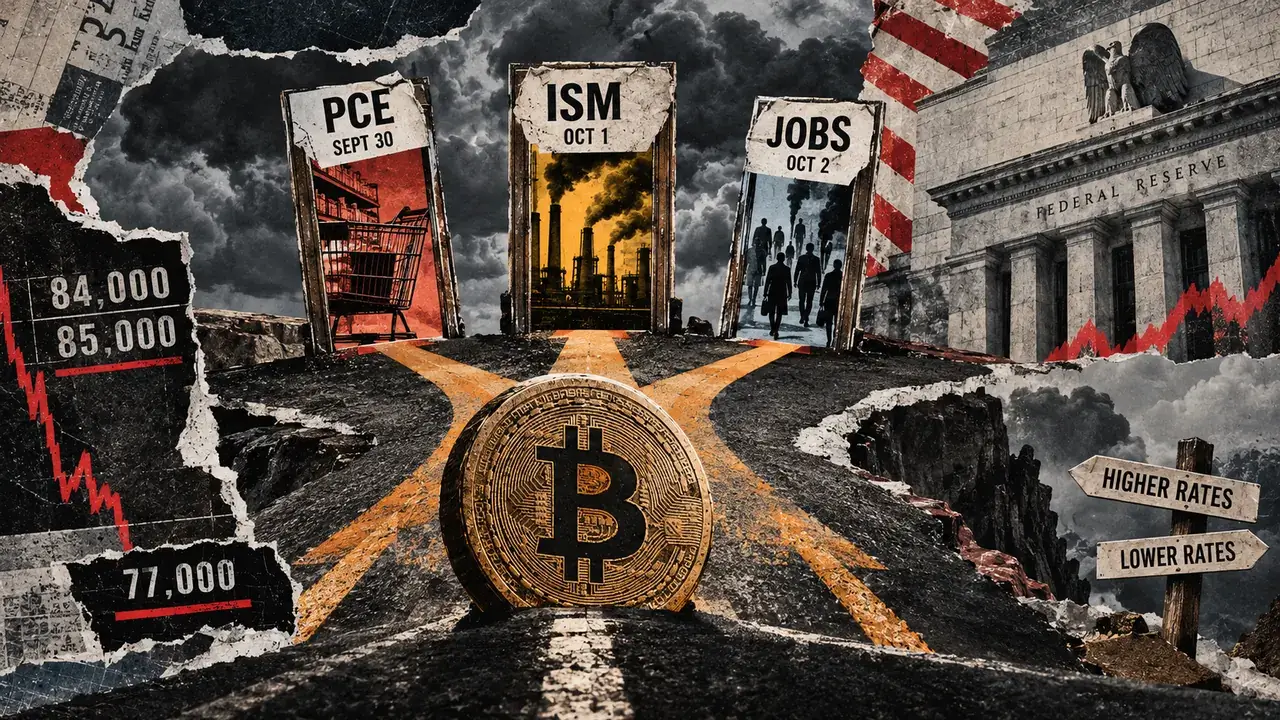
- Bitcoin fell to $82,563, below Glassnode’s $84,000–$85,000 long-term holder cluster.
- August PCE may look softer before September ISM reveals newer fuel, freight and factory cost pressures.
- Reclaiming $84,000-$85,000 favors $96,700, while sustained weakness keeps the $77,000 reference in view.


Bitcoin hit an intraday low of $82,563 on Sept. 28, just below a concentration of long-term holders' purchase prices that Glassnode identified last week.
Three US data releases now threaten to send different signals about the inflation and labor outlook that drives interest-rate expectations. On Sept. 30, the personal income and outlays report will measure August. The Oct. 1 ISM manufacturing survey covers September, followed by the Oct. 2 September employment report.
A reassuring consumer inflation reading could arrive a day before a less comfortable snapshot of factory input costs. They measure different things, but traders may have to revise their view of the Fed as each lands.
Glassnode's Sept. 23 analysis mapped a large cluster of long-term holder supply at $84,000 to $85,000. That area marks where many longer-term holders acquired coins, making Bitcoin's ability to reclaim it a measurable response to the week's news.
Glassnode also identified a deeper True Market Mean reference near $77,000 and an overhead mean MVRV reference near $96,700.
Glassnode's Sept. 21 Market Pulse showed net spot taker buying, rising volume and elevated futures leverage, alongside weekly ETF outflows. Fresh spot buying, stronger volume and ETF demand would lend a rebound more weight than futures covering alone.
How a missing month could affect Bitcoin
The Energy Information Administration estimated Brent spot crude averaged $91 a barrel in August, $7 above July, as Middle East exports remained constrained.
The International Energy Agency found Gulf diesel and gasoil exports severely restricted in August and recorded a further jump in a physical crude benchmark by Sept. 9.
The Sept. 30 PCE report cannot measure the later September evolution of fuel, freight and factory costs. The International Maritime Organization recorded vessel damage in and near Hormuz on Sept. 21 and 23, evidence that shipping risk persisted after the PCE reference month.
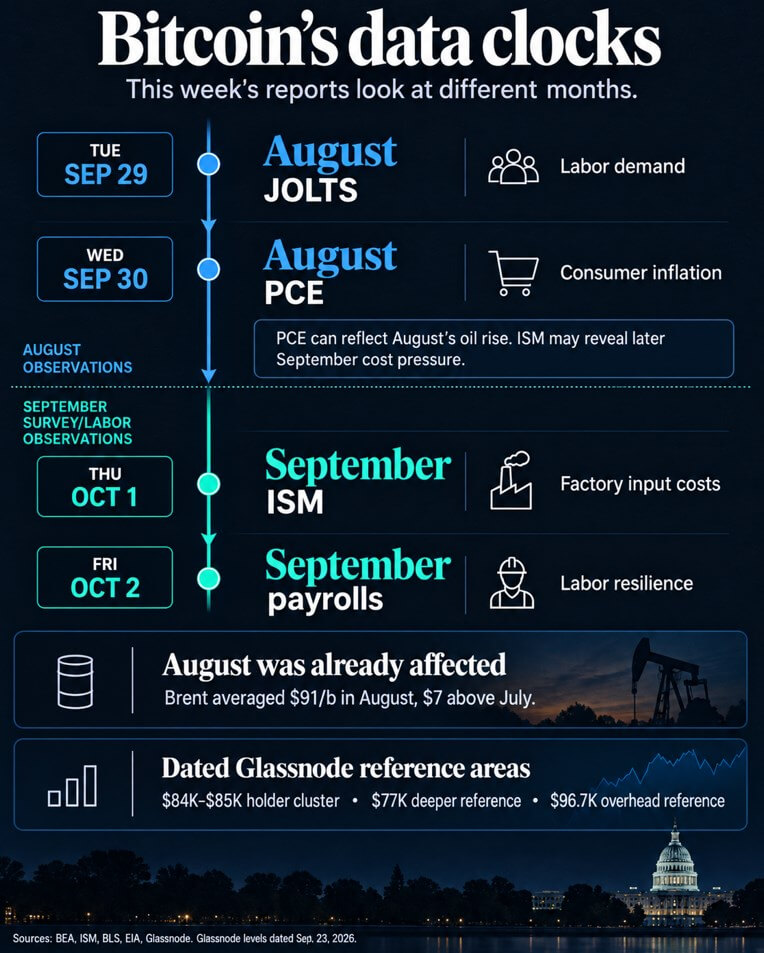
If investors expect higher business costs to keep inflation elevated, Treasury yields and the expected Fed path could rise before a later consumer inflation report registers any pass-through. A soft August PCE print could ease that pressure initially without settling what happened next.
ISM's August report put the Prices Index at 71.1 and Supplier Deliveries at 59.3, consistent with slower deliveries. Diesel fuel and freight appeared on its list of commodities rising in price, while respondents separately discussed energy and the Hormuz conflict.
A higher September Prices reading alongside slower deliveries or cost comments would signal fresh pressure on manufacturers. New orders and employment will help show whether demand is holding up as costs rise.
The Sept. 29 August JOLTS release provides an early labor check, while the Oct. 2 September payrolls will more directly test the growth side of the policy question.
The Fed raised its target range to 3.75% to 4% on Sept. 16, saying inflation remained elevated while job gains had kept pace with the workforce. Moderate job cooling could ease rate pressure, while a much sharper miss could instead raise worries about growth.
The most revealing path this week would be soft August PCE followed by a higher September ISM Prices reading. An initial Bitcoin relief move could reverse if yields and rate expectations turn back up.
Three other outcomes would test the same framework:
- Easing without a growth scare: Softer PCE, no further ISM cost acceleration and moderate job cooling could ease yields. A reclaim of Glassnode's $84,000 to $85,000 area would carry more weight if spot demand joins it.
- Persistent inflation: Firmer price signals with resilient hiring could keep rate pressure elevated. Failure to reclaim that holder cluster would bring Glassnode's lower $77,000 reference into view, without making it a fixed destination.
- Jobs break: A severe payrolls disappointment might lower yields but still hurt Bitcoin if investors respond to a growth shock by cutting risk.
The test for Bitcoin is whether each new reading changes yields and Fed expectations, and whether spot buyers support the resulting move through Glassnode's dated holder-cost area.

Bitcoin is +1.98% over the past 24 hours and currently sits at rank #1 by market cap.
Mentioned in this article

Editorial credits