Which Senate Swing States will Republicans win? (Build Your Map)
Current Odds
Odds Summary
Listed deadline passed
None had a 99% reported probability in the latest synced Polymarket data.
Polymarket · Last synced
Market Analysis
Senate swing-state market prices exact Republican winning maps
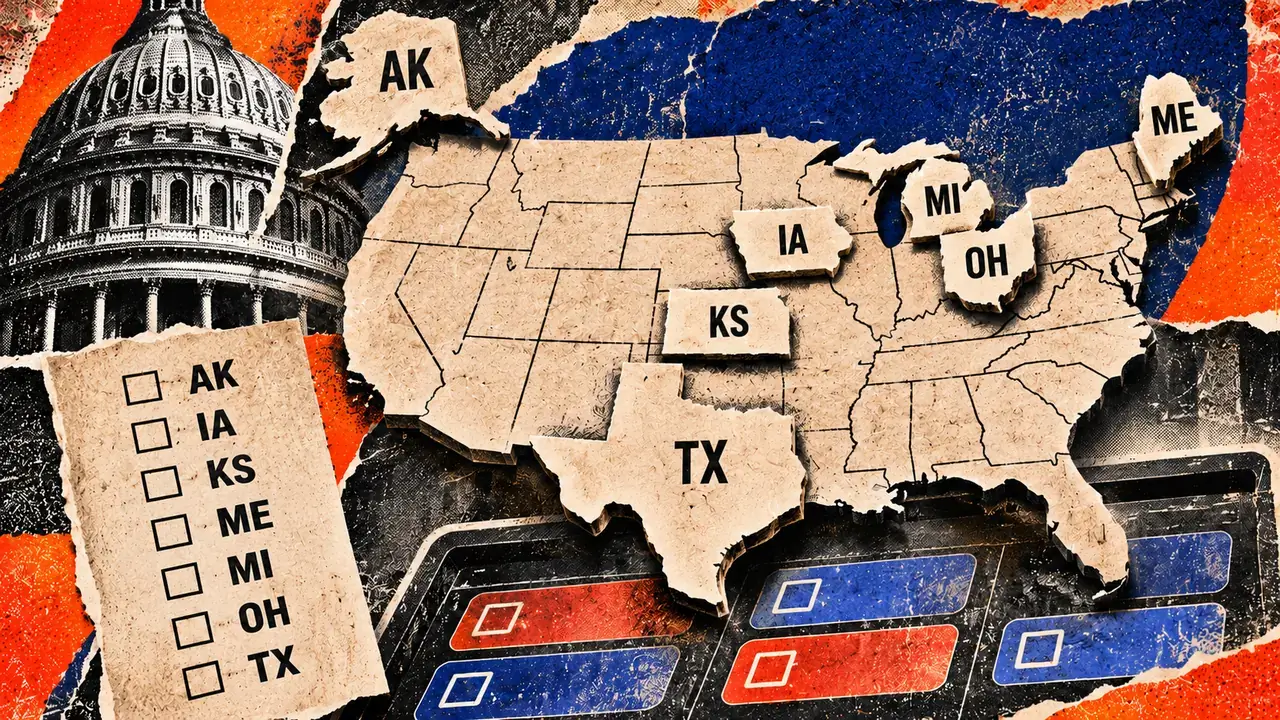
The seven-state event requires an exact match across Alaska, Iowa, Kansas, Maine, Michigan, Ohio’s special election and Texas, including any runoffs.

Polymarket’s “Which Senate Swing States will Republicans win? (Build Your Map)” event asks for the exact Republican winning map across seven 2026 Senate contests. In the imported snapshot reviewed on November 3, None led at 33.5%, followed by IA at 9.9%, IA, KS at 5.5%, and All 7 at 4.2%. These are prices for complete combinations of results, not individual state win probabilities or declared election outcomes.
Seven contests define the map
The covered states are Alaska (AK), Iowa (IA), Kansas (KS), Maine (ME), Michigan (MI), Ohio (OH) and Texas (TX). Ohio refers specifically to the special Senate election. The source rules cover the elections scheduled for November 3, 2026, including any potential runoffs.
Seven states produce 128 possible winning sets. None means the Republican candidate wins none of these seven contests. All 7 means a Republican win in every covered state. The labels should be interpreted within this group; None does not mean that Republicans win no Senate races anywhere in the country.
Each combination must match exactly
A listed outcome resolves Yes only when Republicans win every state named in that outcome and do not win any other state covered by the event. For example, IA, KS requires Republican victories in Iowa and Kansas and non-Republican results in the other five states. An additional Republican victory in Texas would make that particular combination incorrect.
The IA-only quote likewise describes an Iowa win paired with Republican losses in all six other covered contests. It cannot be read as the overall probability of a Republican victory in Iowa. That broader question includes every combination containing IA. The same distinction applies to each state and prevents a single map quote from being mistaken for a standalone race forecast.
Party affiliation and unresolved results matter
The rules treat a candidate as Republican based on ballot-listed affiliation or nomination by the Republican Party. An independent candidate does not count as Republican regardless of any other association with the party.
A state counts as not won by Republicans if a Democratic, independent or third-party candidate wins. The same treatment applies if its result cannot be determined by March 31, 2027. That provision and the inclusion of runoffs mean that the event’s November 3 date should not be interpreted as a promise that every race will be settled on election night.
Resolution follows calls or certification
The named resolution sources are the Associated Press, Fox News and NBC. The market resolves once all three have conclusively called the relevant elections. If they do not reach consensus, the rules use official certification.
Partial returns, an individual projection or an apparent lead therefore should not be substituted for the source’s resolution process. The imported scheduled deadline is November 3, 2026, at 23:59 UTC; the election-result rules, including runoffs and the March 2027 provision, separately govern final settlement.
What the leading quote establishes
None is the largest individual quoted combination in the reviewed snapshot, but its 33.5% price remains below 50%. A leading outcome is not a certainty or a majority forecast. The distribution across many alternatives also means that a low price for one specific map does not alone establish a low probability of Republican wins in the states it includes.
The import displayed approximately $62.01 million in volume, $40.04 million in liquidity and $3.76 million in open interest. Those figures and the odds can change. They describe trading activity, without establishing turnout, polling movement or the cause of traders’ views. The final assessment depends on the exact seven-state results and the settlement rules.
Source
What Could Move the Odds?
Market-Implied Thesis
The 98.3% None price implies Republicans will win none of the listed Senate races, with Alaska the remaining material exception.
This is an aggregate claim: AP-reported Democratic wins in Kansas, Ohio, Michigan and Maine, plus CBS News’s Texas projection, leave no confirmed GOP win in the basket.
What Could Reprice It
A final Alaska result is the key repricing event because a Republican win there would directly invalidate the market’s None outcome.
AP reported the Sullivan-Peltola contest remained uncalled and noted Alaska’s ranked-choice tabulation can apply when no candidate receives a majority.
Where the Market May Be Weak
The event remains open despite its November 3 close date, creating uncertainty over how its displayed price maps to unresolved post-election settlement.
The rules cover elections scheduled for November 3 and possible runoffs, but do not clarify in the supplied text how an uncalled Alaska result affects an event still shown as open after that date.
Counter-Signal
Republican Dan Sullivan can still win Alaska: AP described the race against Mary Peltola as unsettled, preserving a path against None.
Because the market resolves on whether Republicans win any listed election, one Alaska GOP victory outweighs the otherwise broad set of reported Democratic results.
Market Details
- Resolution criteria
- This market will resolve according to which of the United States Senate general elections in Alaska, Iowa, Kansas, Maine, Michigan, Ohio (special election), and Texas, currently scheduled for November 3, 2026, are won by the Republican candidate, inclusive of any potential runoffs.
- Platform
-


- Category
- Politics › US Election
- Scheduled deadline
- November 3, 2026, 11:59 PM UTC
- Market rules summary
- Multi-outcome Polymarket event. Each listed option is represented by its Yes price on the underlying market. View full rules
Frequently Asked Questions
What are the current Which Senate Swing States will Republicans win? (Build Your Map) odds?
Polymarket reports Which Senate Swing States will Republicans win? (Build Your Map) odds with None at 99% and AK at 0.8%. These probabilities are market-implied and can change as liquidity and trading activity update. The latest market snapshot includes $78.84M volume, $184.86K liquidity, and $5.07M open interest. CryptoSlate last synced this market data at Nov 11, 2026, 18:32 UTC.
What could move the Which Senate Swing States will Republicans win? (Build Your Map) prediction market odds?
The 98.3% None price implies Republicans will win none of the listed Senate races, with Alaska the remaining material exception. This is an aggregate claim: AP-reported Democratic wins in Kansas, Ohio, Michigan and Maine, plus CBS News’s Texas projection, leave no confirmed GOP win in the basket. Catalysts to watch include Alaska’s eventual Senate result, Alaska ranked-choice outcome, and Settlement handling of Alaska.
How does the Which Senate Swing States will Republicans win? (Build Your Map) prediction market resolve?
This market will resolve according to which of the United States Senate general elections in Alaska, Iowa, Kansas, Maine, Michigan, Ohio (special election), and Texas, currently scheduled for November 3, 2026, are won by the Republican candidate, inclusive of any potential runoffs. Multi-outcome Polymarket event. Each listed option is represented by its Yes price on the underlying market.
Related US Election Markets
 Which party will win Vermont’s 2026 governor election?


 Which party will win Kansas’s 2026 governor election?