
Quick Take
- An Oct. 28 Kalshi snapshot priced four Senate contracts at $3.02 before fees, exceeding their conditional $3 gross payout.
- Control can resolve early on media calls, while seat contracts use February composition, exposing the hedge to different settlement outcomes.
- Displayed depth, fees and collateral-return settings affect execution and the cash committed to the four positions.


Prediction exchange Kalshi’s Senate markets showed different Democratic odds on Oct. 28, but buying a four-contract hedge at the quoted prices cost $3.02 before fees for a $3 gross payout only if the control and seat-count outcomes aligned.
The Senate-control market had a 64.5% midpoint at 22:11:45 UTC, while a normalized estimate from the Democratic seat-count markets put the chance of 51 or more seats at about 62.1%. That 2.4-percentage-point gap was a comparison between prices. The four purchase quotes already exceeded the conditional payout by two cents, and the contracts’ different settlement provisions left a separate risk.
The quote test comes alongside Talos’s Oct. 28 research into pricing differences across Senate markets. Its historical nine-leg model found occasional positive results under stated execution assumptions. The four-leg calculation here examines a separate package using purchase quotes captured on Oct. 28.
What the $3.02 package buys
The package combines one YES on Democratic Senate control with one NO on each of three disjoint seat outcomes: exactly 51, exactly 52 and above 52. Those seat buckets cover every Democratic total of 51 or more without overlapping.
At the Oct. 28 snapshot, the purchase prices were:
| Position | Quoted purchase price |
|---|---|
| Democratic Senate control: YES | $0.65 |
| Exactly 51 Democratic seats: NO | $0.9 |
| Exactly 52 Democratic seats: NO | $0.84 |
| Above 52 Democratic seats: NO | $0.63 |
| Total for one of each | $3.02 before fees |
If Democratic control resolves YES and Democrats finish in one of those seat buckets, the control contract pays $1. Two of the three seat-NO contracts pay $1 each, while the third pays nothing. The total is $3.
If control resolves NO and Democrats finish below 51 seats, all three seat-NO contracts pay and the control YES pays nothing. That also totals $3. Both aligned cases leave a two-cent loss before fees at the quoted purchase prices. No orders were executed.
The midpoint comparison answers a different question. A midpoint is halfway between the price offered by a buyer and the price requested by a seller. The three 51-plus bucket midpoints themselves summed to 64.5%, matching the control midpoint. All seat buckets together summed to 103.8%; rescaling that full ladder to 100% produced the 62.1% estimate. Buying the hedge still requires paying each seller’s quoted ask.
Even a purchase below $3 would need another test: whether the four legs actually offset.
Kalshi’s CONTROL terms permit accelerated resolution when at least four of eight designated media sources declare a winner and none issues a contradictory declaration. Kalshi retains discretion over accelerated resolution. The current market rules otherwise use the party of the Senate’s president pro tempore on Feb. 1, 2027.
The seat-count terms use Senate composition on Feb. 1, with a fallback to the next date data becomes available, and count independents with the party they caucus with. The seat outcome therefore rests on composition at a later observation date than a possible early control call.
A vacancy, caucus change or altered race outcome between a control determination and the composition date could separate the results.
The cash consequences run both ways. If control YES wins but Democrats fall outside the 51-plus buckets, all four contracts pay, totaling $4. If control YES loses but Democrats end up in a 51-plus bucket, only two seat-NO contracts pay, totaling $2.
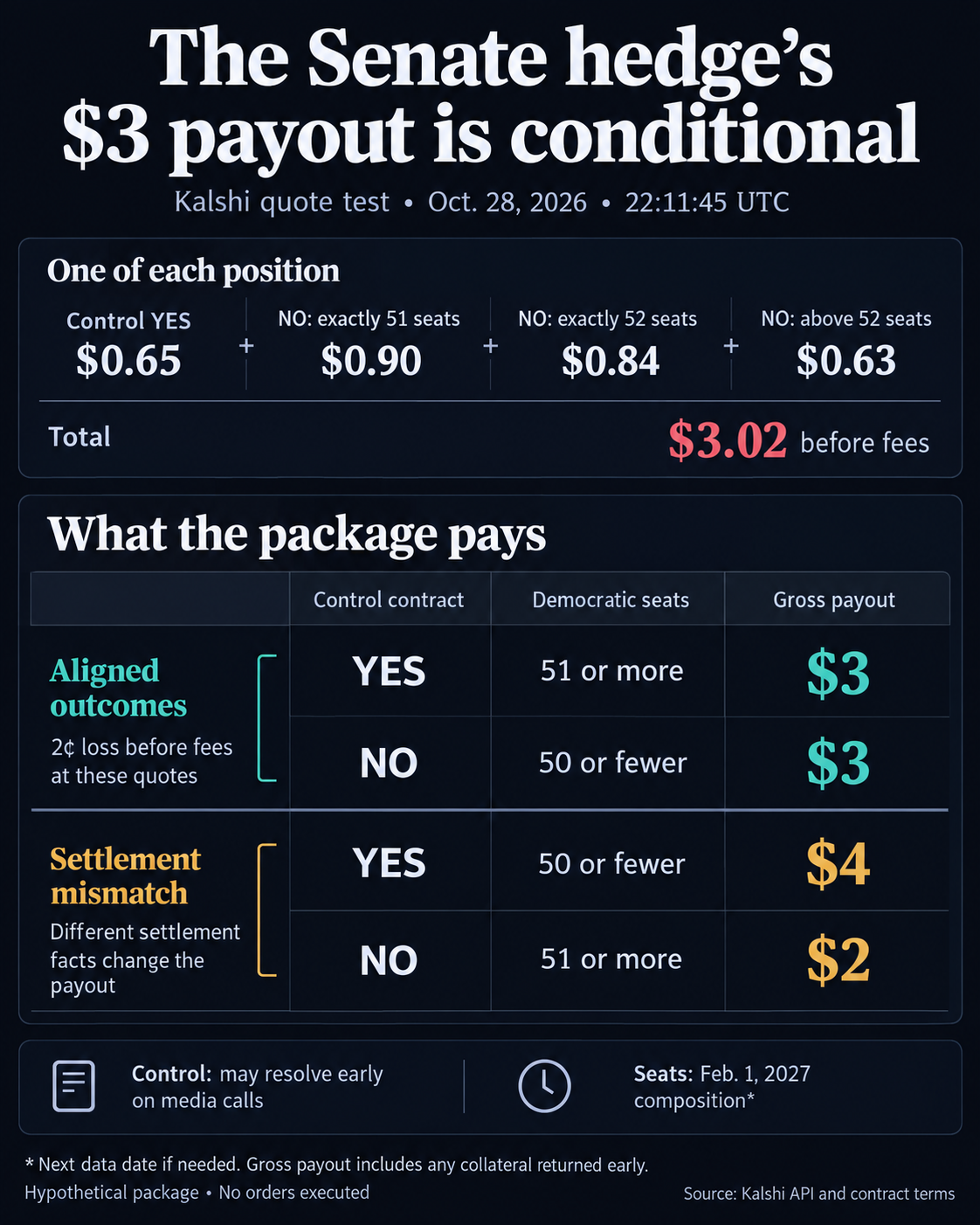
A trader retains exposure to the difference between an early control determination and later chamber composition, even after completing all four positions.
Displayed depth, fees and tied-up capital
A later set of orderbook snapshots, retrieved sequentially at 22:16:13 UTC, still implied the same four purchase prices. The displayed quantities were uneven: 363.87 contracts for control YES, compared with 75,698.05 for NO on 51, 21,942.19 for NO on 52 and 17,253.28 for NO above 52.
The control leg limited the size visible at those best prices. Buying 1,000 equal packages would require reaching deeper into that book, even though the three seat legs displayed much more quantity. The requests captured separate books in sequence, and displayed orders could change before all four legs filled.
Kalshi’s orderbook documentation explains the price relationship: the books list YES and NO bid quotes, with an ask derived from one dollar minus the opposite bid.
Fees require similar care. Kalshi says some markets have maker fees, so leaving a resting order cannot universally be treated as free execution. The $3.02 purchase total excludes fees. Actual charges depend on the applicable market and order sequence, and any trading charge would add to the loss in the aligned payout cases.
Its rounding documentation also distinguishes direct-member balances, aligned to $0.0001, from non-direct-member balances, aligned to $0.01. Model fees round upward to six decimal dollars, while an order-level accumulator can rebate rounding overpayments across fills. The account’s balance precision and accumulated rebates determine the final rounding effect.
The order-size documents also differ. A CONTROL filing dated Oct. 11, 2024 says Kalshi reduced the minimum from 5,000 contracts to one, while the presently linked terms PDF still prints the older provision. The one-of-each comparison is an arithmetic unit; live order acceptance was untested.
Capital usage also differs from gross payout. Kalshi’s collateral-return feature is event-specific and opt-in, and returned collateral may restrict subsequent sales. The three seat-NO positions imply at least $2 of gross payoff within their mutually exclusive event. Any amount returned early reduces the payment left for settlement, leaving the total gross payoff unchanged.
Cross-event offsetting against the control position is unconfirmed here, so the cash committed depends on account settings, execution and settlement timing.
Talos’s historical model is a separate trade
Talos’s Oct. 28 research examined a different nine-leg package using the higher seat-count ladder, with NO positions from 51 through 57 and above 57. Its $8 gross payout likewise depended on both contract families resolving on the same basis.
Using Aug. 1 through Oct. 25 quotes, Talos found a positive modeled edge after estimated fees on two of 51 quoted days when every leg crossed the spread. That rose to seven days when the control leg was assumed to fill passively. Its unrounded fee calculation and fee-free passive-control assumption were modeling choices; no orders were executed.
Talos reported an average 3.3-percentage-point range across four Senate probability representations, reaching 9.7 points at the widest. October’s average gap was 2.5 points. Trading volume grew over the same period.
Mentioned in this article

Editorial credits