Which party will win Vermont’s 2026 governor election?
Current Odds


Market Analysis
Vermont’s 2026 governor race tests whether Scott’s coalition belongs to Republicans
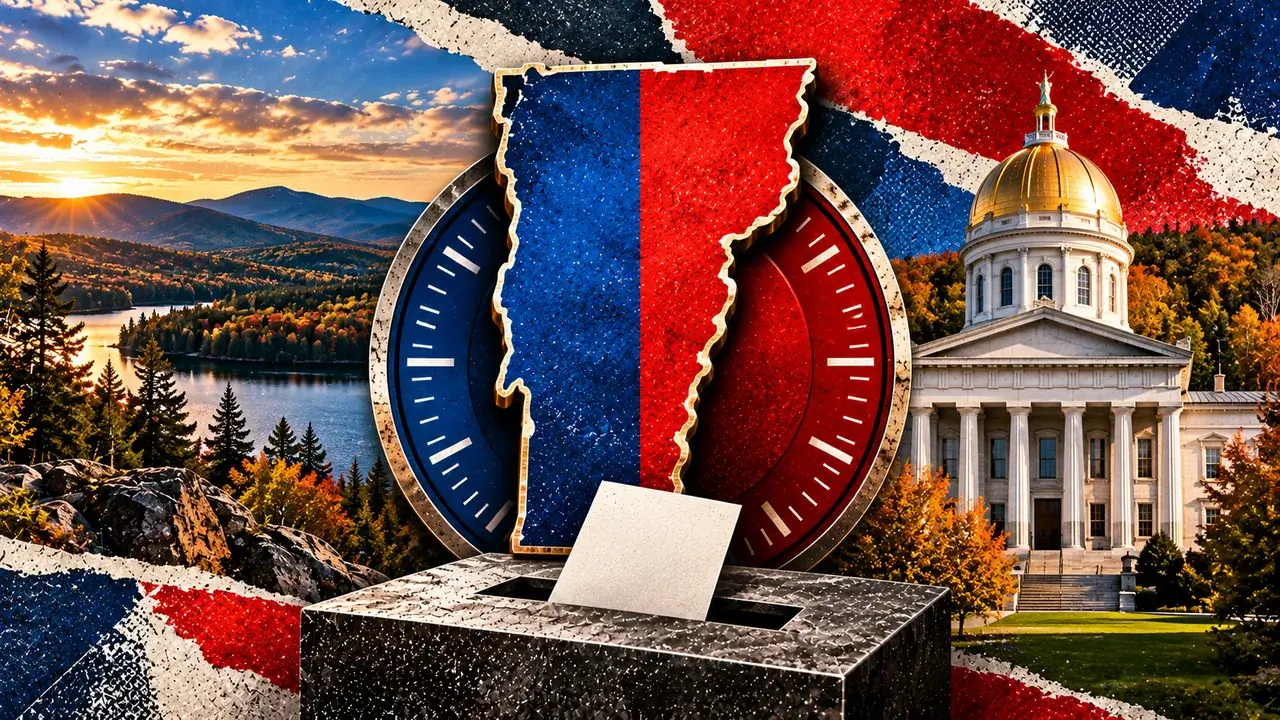
Phil Scott’s last victory gives Republicans a powerful electoral baseline in a state that backed Kamala Harris. The central question is how much of that support survives a competitive challenge, and which evidence would show his personal coalition beginning to fracture.

The strongest case for a Republican victory in Vermont’s 2026 governor election rests on Phil Scott’s ability to separate his candidacy from national party identity. His last result establishes an unusually demanding starting point for a challenger. The hidden assumption is that the coalition belongs to Scott personally and remains available in 2026. A party-level forecast depends heavily on that candidate-level judgment.
The supplied market context contains no outcome prices, so it cannot establish a quoted hierarchy or its strength. The evidence does support examining why Republicans could lead expectations despite Vermont’s Democratic presidential preference, and what would weaken that case.
Scott’s 2024 margin sets the Republican baseline
Vermont’s official 2024 canvass records 266,439 votes for Scott, or 71.45%, against 79,217 votes, or 21.24%, for Esther Charlestin. That 50.21-percentage-point gap makes an ordinary improvement by the opposition insufficient to reproduce a close contest. A challenger needs a substantial change in voter behavior.
The causal inference is that Scott has persuaded a large electorate to evaluate the governorship separately from national partisan competition. AP describes him as one of only two Republican governors in states Kamala Harris carried in 2024. Those facts together explain why Vermont’s presidential preference offers a weak standalone guide to this race.
The qualification is that a past margin measures a completed contest, including its particular opponent and campaign. It does not establish a permanent Republican voting bloc. Evidence that voters still approve of Scott while preferring Democrats elsewhere would reinforce the incumbent-centered explanation. Evidence of declining support specifically for his governorship would challenge it directly.
Vermont’s two-year terms keep the comparison recent
The Vermont Constitution gives governors two-year terms. Consequently, the 2024 result is a relatively recent electoral test for the 2026 contest. That strengthens its usefulness as a baseline: the challenger must explain why voters should reverse a choice made just one gubernatorial cycle earlier.
The same timetable creates a vulnerability. A two-year term gives voters another opportunity to respond quickly to dissatisfaction. If a consequential dispute develops during the term, Scott’s previous margin cannot establish how voters will weigh it. The relevant question becomes whether dissatisfaction reaches people who previously supported him.
This also creates different campaign incentives. Scott has reason to preserve the state-specific judgment that produced his last victory. His opponent has reason to connect identifiable governing decisions to consequences for Vermont residents. A campaign that merely reproduces national partisan divisions would have to overcome the demonstrated willingness of voters to cross those divisions.
Amanda Janoo’s challenge needs evidence of coalition change
The supplied research identifies Amanda Janoo as a challenger. Her candidacy gives the opposition argument a concrete test, although the record supplied here does not establish the strength of her campaign. Candidate-specific evidence matters because Scott’s previous result cannot tell us how voters would assess a different opponent.
AP’s primary preview describes Democrats’ effort to find a nominee capable of defeating Scott. The electoral problem implied by his margin is substantial: a challenger must consolidate opposition while persuading some voters who previously chose the incumbent. Greater enthusiasm among existing opponents alone would leave the central obstacle intact.
Hypothetical catalysts include credible polling showing former Scott supporters moving away from him, or a documented policy dispute that changes their assessment of his performance. Fundraising and endorsements could demonstrate campaign capacity. Their electoral significance would become clearer if they accompanied measurable movement among voters, particularly those willing to split their tickets.
The Republican case depends on Scott remaining its anchor
The strongest counterargument is the gap between Vermont’s presidential preference and Scott’s success. Harris’s statewide victory establishes that Republican gubernatorial strength coexists with a different national partisan choice. It leaves open how readily Scott’s support would transfer to another Republican.
A hypothetical withdrawal or nominee change would therefore require a fresh assessment. Applying his 71.45% share to a replacement would assume the very transferability the evidence has not established. With Scott in the race, the decisive next evidence would be credible head-to-head polling that tests whether his 2024 supporters remain with him against the actual challenger.
Sources
What Could Move the Odds?
Market-Implied Thesis
The 77.5% price implies a Republican win is the base case: Phil Scott is expected to defeat Amanda Janoo in Vermont’s general election.
That reading treats the candidate Yes price as a party-level judgment. The official primary canvass confirms both nominees were selected, removing nomination uncertainty.
What Could Reprice It
Vermont’s November 3 general election is the decisive remaining event, because the market resolves on the gubernatorial winner rather than campaign signals.
The Secretary of State calendar places governor on the November 3 ballot. The November 4, 4:59 AM UTC close follows election day, concentrating repricing around returns and the winner determination.
Where the Market May Be Weak
The price has meaningful displayed liquidity, but the absent trader count makes it hard to tell whether the signal reflects broad participation or concentrated positions.
The $294.45K volume is cumulative turnover, not independent conviction; $136.37K liquidity and $70.46K open interest do not identify how many participants set the 77.5% price.
Counter-Signal
Janoo’s 39,614 primary votes exceeded Scott’s 21,466, leaving open a turnout-based path for the Democrat that the Republican-leaning price may underweight.
This is only a limited counter-signal: the votes came from separate party primaries, and Janoo won with 44.56% while Scott won with 93.06%, so raw totals are not a general-election forecast.
Market Details
- Resolution criteria
- This market will resolve according to the winner of the 2026 Vermont gubernatorial election.
- Platform
-


- Category
- Politics › US Election
- Scheduled deadline
- November 4, 2026, 4:59 AM UTC
- Market rules summary
- Multi-outcome Polymarket event. Each listed option is represented by its Yes price on the underlying market. View full rules
Frequently Asked Questions
What are the current Which party will win Vermont’s 2026 governor election odds?
Polymarket reports Which party will win Vermont’s 2026 governor election odds with Phil Scott (R) at 77.5% and Amanda Janoo (D) at 22.3%. These probabilities are market-implied and can change as liquidity and trading activity update. The latest market snapshot includes $294.45K volume, $136.37K liquidity, and $70.46K open interest. CryptoSlate last synced this market data at Oct 29, 2026, 01:37 UTC.
What could move the Which party will win Vermont’s 2026 governor election prediction market odds?
The 77.5% price implies a Republican win is the base case: Phil Scott is expected to defeat Amanda Janoo in Vermont’s general election. That reading treats the candidate Yes price as a party-level judgment. The official primary canvass confirms both nominees were selected, removing nomination uncertainty. Catalysts to watch include November 3 general-election result, November 3, 2026 general election, and Late order flow or election returns.
How does the Which party will win Vermont’s 2026 governor election prediction market resolve?
This market will resolve according to the winner of the 2026 Vermont gubernatorial election. Multi-outcome Polymarket event. Each listed option is represented by its Yes price on the underlying market.
Related US Election Markets
 Which party will win Kansas’s 2026 governor election?


 Which party will win New Mexico’s 2026 governor election?


 Which party will win Georgia’s 2026 US Senate election?