
Quick Take
- The Fed held rates at 3.75%–4%; both dissenters wanted a quarter-point increase.
- Bitcoin fell below $77,000 as Binance reported a $6 billion security incident and liquidations surged.
- Restrictive credit and suspended withdrawals affect leveraged traders through different channels.


he Federal Reserve asked for more information before changing interest rates. Eighteen and a half hours later, the economy supplied it: growth was strong, inflation remained elevated, and households were spending more without buying much more. But before investors could settle what that combination meant for Bitcoin, a Binance security breach raised a more immediate concern about their ability to move money.
The Binance hack complicates any attempt to treat Friday's crypto selloff as a verdict on Wednesday's policy decision. Expensive borrowing and uncertainty over an exchange can both discourage risk-taking, but they work through different channels and demand different responses.
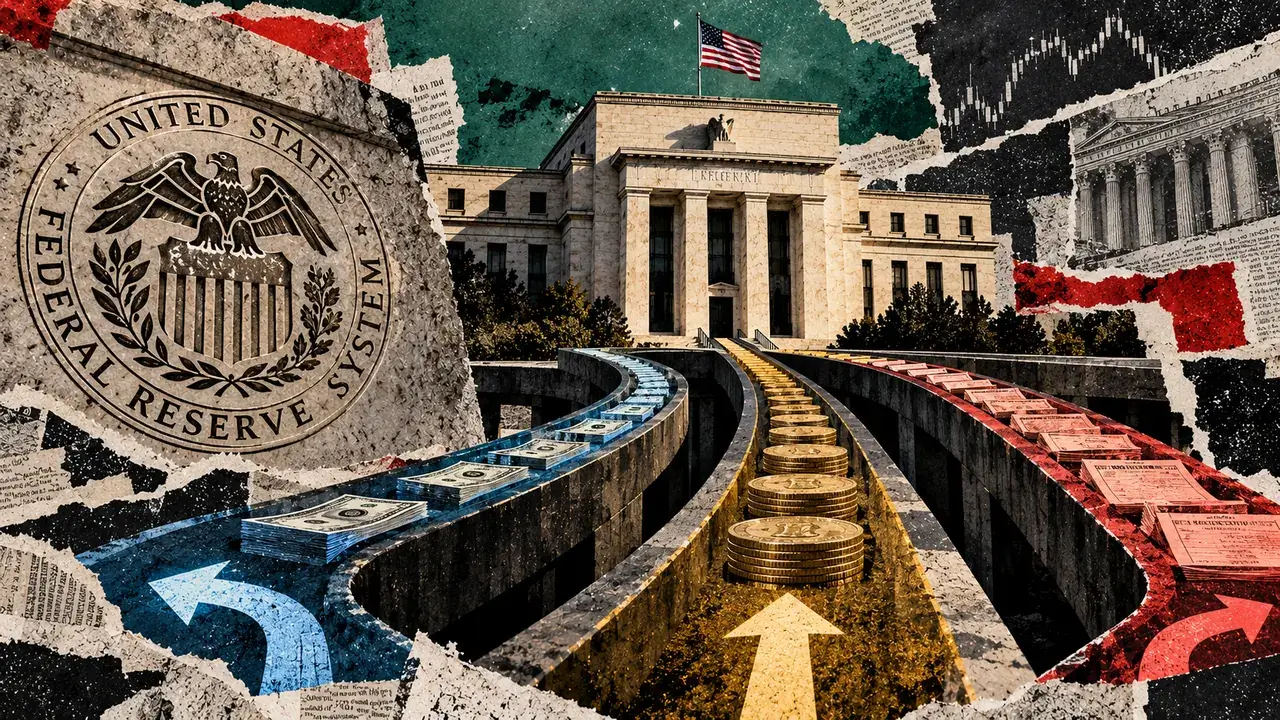
The Fed's 10–2 vote left its benchmark range at 3.75%–4%. Both dissenters, Lisa Cook and Beth Hammack, wanted a quarter-point increase. The disagreement concerned whether to raise borrowing costs immediately or wait for more evidence, leaving the prospect of another increase in December unresolved. An unchanged rate offered little basis to assume cheaper financing was coming.
Selected FOMC meetings, October 2025–October 2026. Policy bars show the midpoint of the target range announced at each meeting. Projection bars show the median target midpoint for end-2026, calculated from published participant dots. Blank projection bars mean no new quarterly projections were issued, not a zero rate. Dates identify meetings, not forecast endpoints. Projections are individual policy assessments, not commitments or market odds.
 CryptoSlate
Thursday's growth report also offered little reason for immediate relief. Gross domestic product expanded at a 3.4% annualized rate, up from 2.2% in the second quarter and slightly above the 3.2% economists expected in a Reuters survey. Annualizing expresses the quarter's growth as though that pace continued for a year; it does not mean output increased 3.4% in three months.
Consumer spending and private fixed investment together grew at a 4.9% annualized pace. Because that measure excludes inventories, government spending, and trade, it suggested demand was robust beyond the components that can distort headline GDP.
The economy offered little evidence that it needed lower rates, while the inflation report supplied reasons to remain cautious about declaring progress secure. Yet the household data revealed the strain against which further tightening would have to be judged: an expanding economy could still leave consumers with less purchasing power.
The Fed's rate pause offered households little relief
Consumer outlays rose 0.5% in dollar terms, while the increase after inflation was less than 0.1%. Disposable income, measured after taxes and adjusted for inflation, fell 0.3%. Households collectively paid a larger bill for almost no increase in the goods and services they bought.
These figures explain how strong GDP can coexist with financial strain. Spending can support the economy even as prices absorb more of consumers' income, leaving them with less room to sustain purchases or absorb higher debt payments.
The inflation figures were similarly mixed. September's personal consumption expenditures price index was 3.6% above its year-earlier level: the core measure, excluding food and energy, rose 3.1%. Both annual readings matched Reuters' reported expectations, offering less basis for treating the release as a fresh inflation shock, even as price pressure remained uncomfortable for policymakers.
Over the third quarter, however, PCE inflation slowed to a 2.1% annualized pace, with core inflation at 2.5%, both below their second-quarter rates. Quarterly annualized changes and September's year-over-year comparisons cover different periods. Together, they showed progress alongside persistent price pressure, leaving policymakers to judge whether further tightening would secure that progress or place unnecessary pressure on households.
The immediate market response was also less decisive than the later decline suggested. Reuters reported that US stock-index futures pared existing losses after Thursday's releases. Remaining negative for the session while improving after the data is compatible with investors finding the news reassuring. By Friday morning, concerns about the returns on enormous AI investments were encouraging purchases of Treasuries, pushing yields and the dollar lower. Falling stocks therefore reflected a wider reassessment of risk, with several developments competing to explain the movement in prices.
Binance made access to money an immediate concern
The Binance breach added a problem that monetary policy could neither explain nor resolve. Interest rates influence the cost of financing a position, but an exchange's security and operating status influence whether customers can move the assets supporting it. Traders now have to assess both going into the weekend.
In its preliminary update, Binance estimated the incident's impact at approximately $6 billion and said roughly $3 billion had been frozen on-chain. It temporarily suspended withdrawals during security checks and pledged to cover losses through its SAFU protection fund and company funds. An Oct. 30 clarification said deposits remained unaffected and continued to operate normally. Freezing blocks transfers without automatically returning the money.
The reimbursement promise addressed who would bear losses, but it didn't say when normal operations would resume or what the investigation might reveal. Nonetheless, customers don't have to expect an exchange to fail before deciding that uncertainty over access makes a leveraged position too uncomfortable to maintain.
Bitcoin keeps working throughout incidents like this while the businesses used to trade it experience disruption. Investors still rely on exchanges to hold collateral and execute transactions. Difficulty moving funds can therefore affect their willingness or ability to maintain positions, without any change to Bitcoin's underlying protocol.
In a report published at 2:22 a.m. EDT Friday, CoinDesk said Bitcoin had touched approximately $76,460 before recovering toward $78,500. It cited CoinGlass data showing $1,530 million in rolling 24-hour liquidations, including about $1,290 million in bets on rising prices. When falling prices leave insufficient collateral, platforms can close those positions automatically, adding selling pressure to an already-falling market.
The totals measured that pressure across an overlapping series of events. CryptoSlate's initial account of the selloff also documented weakness before the first highlighted transfers, showing how a new shock can intensify losses already underway without accounting for every trade that preceded its public emergence.
The price decline leaves two problems unresolved
By Friday morning, Bitcoin investors faced two unresolved risks: the future cost of financing and the reliability of the exchanges holding their assets. Restrictive rates could leave leveraged positions vulnerable before an exchange breach supplied another reason to reduce exposure. Separating those pressures would require examining trading around each announcement, although simultaneous releases and unrelated market developments would still limit any claim about causation.
Japan added another influence on global funding conditions before the reporting cutoff. Its central bank held rates at 1.25%, raised next fiscal year's inflation forecast, and reiterated its readiness to tighten further. Currency and bond investors were assessing more than the Fed, while the competing signals from technology shares and Treasuries complicated any simple account of crypto's losses.
Those risks can compound each other without requiring a single explanation for the selloff. The Fed influences the financial conditions in which investors take risks, while exchanges help determine whether they can manage those risks when prices move against them. Bitcoin's independence from central banks does not remove either dependency from its market, and neither a rate pause nor a reimbursement promise resolves both.
Mentioned in this article


Editorial credits