

Quick Take
- Bitwise says AI abundance, recession or modest growth can all push Bitcoin higher.
- BIS models a fourth path: automation boosts output while weakening consumption and long-run growth.
- Bitcoin’s upside hinges on whether AI wealth reaches investors faster than wages and liquidity erode.


Bitwise CIO Matt Hougan argued in an Oct. 14 memo that nearly every macroeconomic path ends with Bitcoin higher, including an extraordinary AI productivity boom that makes scarce assets more valuable.
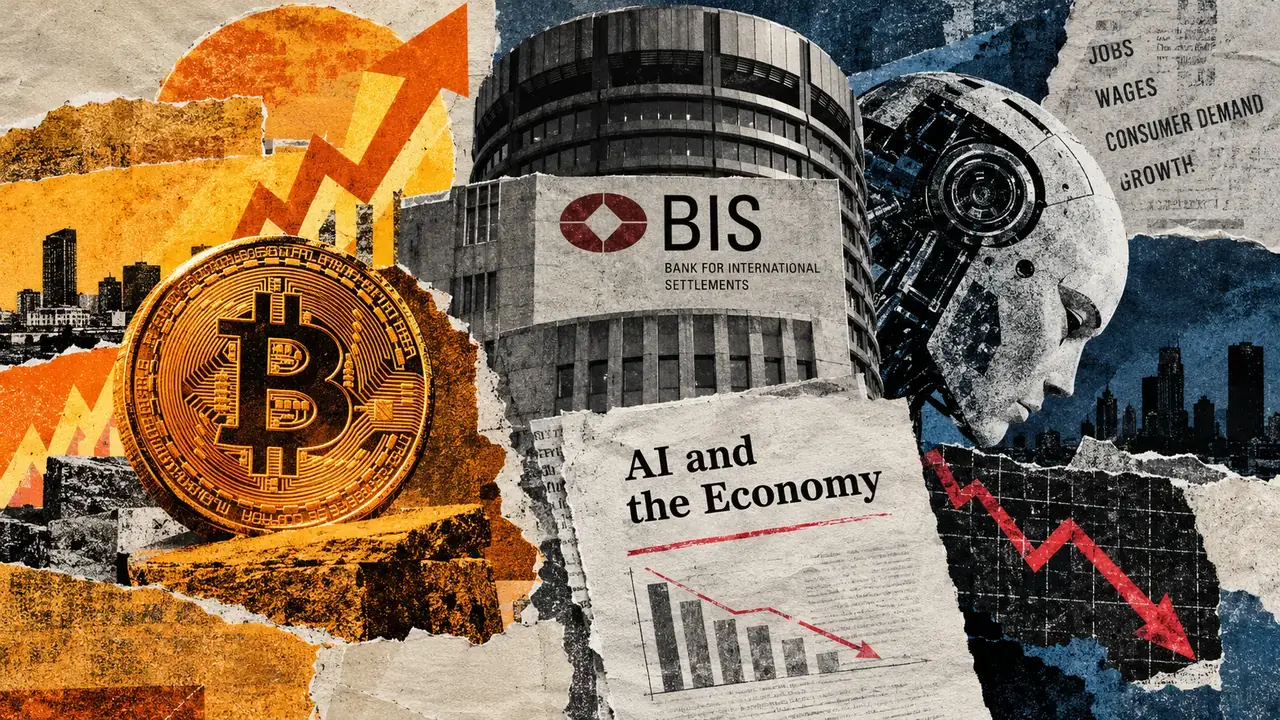
Two days earlier, the Bank for International Settlements published a working paper that models a fourth path. In it, AI automates work and lifts output, and consumer demand that funds further innovation thins out until growth fades.
Hougan's three paths for macro and Bitcoin
Hougan's memo lays out three outcomes, starting with AI abundance that makes intelligence-based services cheaper and shifts value toward scarce assets.
A bursting AI investment bubble triggers a recession, policy intervention, and monetary expansion that eventually boost demand for Bitcoin. Modest productivity gains support gradual adoption, continued ETF demand, and higher institutional allocations.
He acknowledges interim drawdowns and risks outside the macro environment, and each path assumes that abundance, instability, or monetary expansion ends up as additional demand for Bitcoin.
BIS Working Paper No. 1381, “Transformative AI and demand bottlenecks” by Phurichai Rungcharoenkitkul, noted that AI productivity gains automate more tasks, and investment absorbs a larger share of output.
Consumption shrinks as a share of GDP, the consumer market that pays for innovation thins, and further AI innovation becomes less profitable.
In the calibrated scenario, consumption's share of output falls from about 69% to 62.1% when further innovation stops being profitable. Long-run sustainable growth drops from the 2% pre-AI baseline to about 1.6%.
Actual output growth peaks just under 2.4% about 15 years into the AI era and stays above 2% for about 35 years, as businesses keep accumulating machinery and computing capacity while the innovation engine weakens.
The paper also models a high-growth case where output expands about 5.5% a year 20 years in and keeps accelerating.
The mechanism centers on consumption's share, with total consumption free to keep expanding. If output rises 10% and consumption's share falls from 69% to 62.1%, the consumer market index moves from 69 to 68.31.
That is a 1% contraction inside an economy that produced 10% more. An investment boom can look like strength while the base beneath it narrows.
Wages and the natural rate
The model estimates that labor's share of tasks falls from 60% to 15%-50% over three decades. In the demand-bottleneck calibration, real wages settle about 15% below the path they would have followed absent that level of automation.
That result assumes fixed labor supply, a static set of tasks for workers, and wages tied to marginal productivity, so different assumptions could move it materially.
The natural rate of interest can rise during the investment boom as capital demand strengthens and fall once the bottleneck emerges. The paper's pre-AI reference is 1.65%, its median 20 years out is 1.2%, and a 90% model band spans -0.6% to 4.4%.
Falling rates from a healthy productivity transition can support asset demand, including Bitcoin, and falling rates from weak consumption, financial stress, and contracting credit can coincide with deleveraging.
Early evidence is mixed
The Fed's Oct. 14 Beige Book noted that businesses in 5 of 12 districts reported reducing headcount through attrition, delaying hiring or expecting fewer jobs once AI-related productivity gains arrived.
Consumer spending was broadly flat, and more than half of districts said higher-income households drove it. Employment was broadly stable, with three districts reporting modest increases, five slight increases, and four flat readings.
The Beige Book is a qualitative survey that gathers observations through Oct. 5 and describes uneven gains and unequal purchasing power, while leaving the BIS feedback loop unconfirmed.
The US trade deficit widened to $105.6 billion in August, driven by strong imports of AI hardware. Economist Dean Maki estimates that about 70% of AI-related capital spending went to imports.
Suppliers abroad capture a large share of equipment demand and manufacturing revenue, and American household income captures a portion of the boom.
AI-linked equities sold off on the hot CPI print on Oct. 14, with CoreWeave down about 16%, Nebius and Dell about 11% each, and Oracle about 9%, alongside elevated borrowing yields for AI infrastructure debt.
That move reflects expensive capital, a nearer-term risk than a demand bottleneck, and Bitcoin can feel both through different channels.
What it means for Bitcoin
Bitcoin's supply is fixed, and its price depends on investor demand, purchasing power, and market liquidity. Weaker wage growth gives households less discretionary capacity to save and accumulate.
Concentrated gains make demand more dependent on a narrower group of wealthy investors and institutions. Weaker broad consumption can eventually reach corporate earnings and financial-market liquidity.
These are economic transmission hypotheses built on the BIS findings, and the paper itself covers growth and rates.
AI wealth that concentrates among investors with a high propensity to hold Bitcoin could keep demand resilient while household consumption stagnates. The net effect depends on whether new capital reaching Bitcoin outweighs reduced purchasing power elsewhere.
If productivity and real wages improve together, consumption holds its share and ETF subscriptions continue across conditions, Hougan's scarcity thesis rests on its strongest foundation.
Higher real yields from strong productivity would compete with Bitcoin, and a broad prosperity base would support it.
If productivity improves while hiring and worker income weaken, consumption's share keeps falling as investment's share climbs, and AI credit spreads widen, an investment boom could mask a thinning demand base.
ETF flows that stall while AI spending continues would be the earliest market evidence, and the Oct. 27-28 Fed meeting can shape the near-term rate path while the multi-decade growth mechanism remains unsettled.
Bitcoin's supply remains fixed amid AI-driven abundance, and its demand depends on how AI distributes wealth, reshapes consumption, and shapes financial conditions.

Bitcoin is -3.32% over the past 24 hours and currently sits at rank #1 by market cap.
Mentioned in this article



Editorial credits