

Overview
Introduction
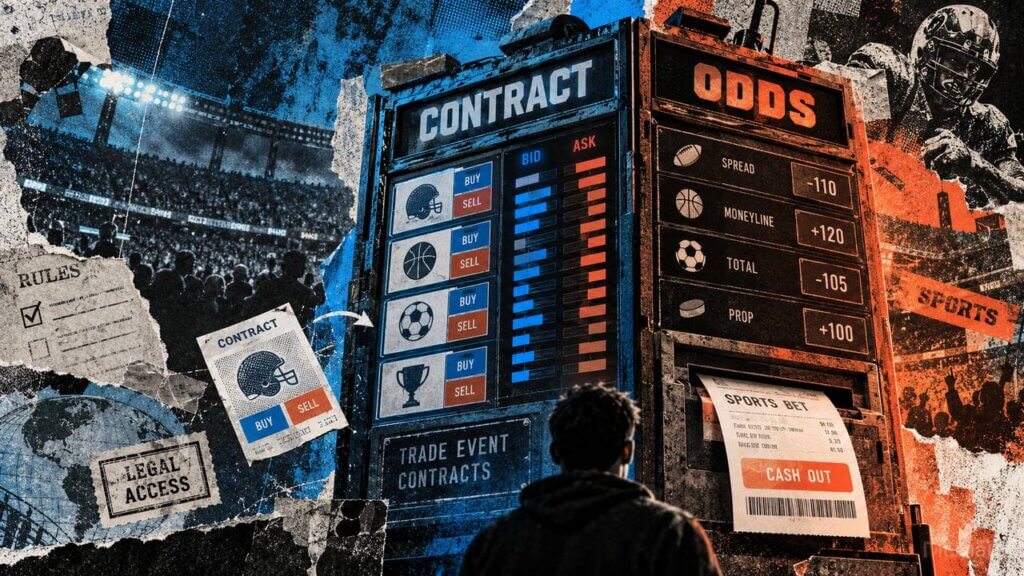
The central difference between prediction markets and sports betting is structural, although their typical subject coverage also differs. A prediction market typically lets participants trade event contracts with prices formed through an exchange or market system. A sportsbook usually posts odds and accepts a bet as the counterparty under its house rules.
Both products can offer a position on the same game and produce a similar economic result. Neither the contract label nor the headline odds answers every question. The label does not determine legal status, and the odds do not reveal total cost. Compare who supplies the price, whether and how the user can exit the position, how costs are charged, which rules determine the outcome and where the product is available.
Key takeaways
Prediction Markets vs. Sportsbooks at a Glance
| Dimension | Prediction market | Sportsbook |
|---|---|---|
| Basic instrument | Event contract or outcome share | Wager under book rules |
| Typical counterparty | Another participant or liquidity provider through a platform | Sportsbook or its risk operation |
| Price formation | Bids, asks, market makers or an automated pool | Posted and adjusted by the sportsbook |
| Common format | Contract price from $0 to $1 | Decimal, American or fractional odds |
| Early exit | Sell if resale is permitted and liquidity allows. An opposing position may hedge rather than close the original contract | Cash-out only if the book offers it |
| Cost | Spread, trading fee, slippage and related charges | Embedded margin and any stated fees |
| Size limits | Contract or position limits may apply | The sportsbook may limit the accepted stake |
| Rule source | Contract terms, market rule, resolution source, platform rulebook | Sportsbook house rules and event grading policy |
| Availability | Depends on platform, product, contract and location | Depends on company licensing, market and location |
The table describes common structures, not universal rules. Some event products use a broker interface and partner exchange. Some sportsbooks offer exchanges or cash-out features. Read the exact product instead of relying on the category name.
Who Sets the Price?
In an order-book prediction market, participants place bids and offers. A trade occurs when prices match. Market makers may quote both sides, but the platform does not need to take a directional position in every contract. The current quote reflects available orders and can move as information or order flow changes.
A sportsbook posts odds that incorporate its probability estimate, risk exposure, competition and desired margin. It can move those odds after news or betting flow. The book is usually the bettor's contractual counterparty, even if the company manages risk elsewhere.
Counterparty structure often influences which pricing details appear before an order, but the product's interface and rules determine what the user can see. A prediction-market order book can reveal a spread and some depth. It does not show every participant's information or guarantee a fill. A sportsbook quote gives a clear offered price for the permitted stake, but the internal pricing and liability process is not an open order book.
The prediction-market platform comparisons cover platform-level differences.
Crypto-first readers can compare crypto prediction-market providers with ranked crypto sportsbooks.
Contract Prices and Sportsbook Odds
If $0.60 is the executable purchase price, a winning contract has a gross payout multiple of about 1.67, comparable to decimal odds of 1.67 or American odds of roughly -150. This compares gross payouts and excludes separately charged fees. It does not remove costs already reflected in executable prices.
Assume a $60 outlay:
- Buying 100 event contracts at $0.60 costs $60. If they settle at $1, they produce a $100 gross payout and $40 gross profit.
- If it wins, a $60 sportsbook bet at decimal odds of 1.67 produces about $100.20 gross payout and $40.20 gross profit.
The similar top-line result does not make the trades identical. The contract buyer may pay a transaction fee and cross a spread. The bettor's quoted odds can contain the book's margin. Minimum increments and rounding can also differ.
The contract-price payout mathematics explains how bid, ask, fees as well as break-even probability alter the comparison.
Fees, Vig, Spread and Slippage
For a market whose listed outcomes are mutually exclusive and exhaustive, convert each outcome's odds into an implied probability and add them. The amount by which the total exceeds 100% is the overround. It indicates embedded pricing rather than guaranteed realized profit.
A prediction market can expose cost differently:
- The bid-ask spread creates an immediate round-trip gap.
- Trading fees can depend on price, quantity, order type or series.
- Slippage appears when an order consumes multiple price levels.
- Funding, withdrawal, network or conversion fees can sit outside the trade ticket.
A platform with no posted trading fee is not necessarily cheaper. A five-cent spread can cost more than a stated fee on an active market with a one-cent spread. Compare total entry and exit cost for the intended size.
CryptoSlate's analysis of Kalshi's event-contract model and Polymarket's contract mechanics keeps current product claims separate because the platforms do not share one structure.
Liquidity and Early Exits
A participant may exit before the event ends by selling the contracts if resale is permitted and sufficient liquidity for early exits exists. Selling existing contracts can reduce or close the position. Buying an opposing position can offset the economic exposure, but whether the platform nets the positions depends on its rules. A trader may face a wider spread, partial fill or no practical buyer at the intended size.
A traditional sportsbook bet remains open until grading unless the book offers cash-out at its chosen price. Some books offer cash-out, but the book determines availability and price. The feature can disappear during volatile play and its price does not need to mirror an exchange order book.
Neither path guarantees a favorable exit. In a thin market, a market order can fill across several progressively worse price levels. A sportsbook cash-out can embed a substantial discount. A participant who needs flexibility should compare actual exit controls before opening the position.
Market Range and Position Types
Sportsbooks concentrate on sporting events through dedicated odds and grading rules. They commonly offer moneylines, spreads, totals, props, futures as well as combined bets. Their house rules handle overtime, abandoned games, player participation, event-location changes plus statistical corrections.
Prediction markets can cover sports as well as politics, economics, weather, culture, crypto and corporate events. The sports prediction-market providers focus on that overlap. Contract formats can include binary outcomes, ranges as well as mutually exclusive choices.
More breadth does not guarantee better trading. A niche contract may have thin depth, while a major sportsbook market may accept more stake. The same platform can be liquid for a headline election and weak for a local match.
Resolution and Bet Grading
Both products need rules that convert a real event into a financial result.
A prediction contract should name the resolution source, cutoff, timezone, treatment of corrections, dispute path plus final authority. A sportsbook should state its grading source and policies for postponements, cancellations, ties, dead heats and player participation.
Similar questions can resolve differently. One market may use the result at the end of regulation, while another includes overtime. One political contract may follow a named certification, while another uses a media call. Compare definitions before comparing prices.
The event-contract settlement process separates resolution, settlement as well as withdrawal. Marketing often compresses those separate stages into a single “payout time” claim.
Regulation and Legal Access
In the United States, a regulated event-contract exchange can operate under the federal derivatives framework. Sportsbooks commonly operate through state gaming licensing. Litigation and rulemaking can test where those frameworks overlap, especially for sports event contracts.
These are broad regulatory frameworks, not universal legal answers. A platform's registration does not automatically authorize every contract or every user location. A sportsbook license in one state does not authorize access elsewhere. Geofencing, age, identity, sanctions, account plus contract restrictions can all apply.
The five-part legality assessment keeps five separate tests. Readers should not infer legality from an app-store listing or marketing phrase.
Gambling, Trading and Economic Similarity
Asking whether prediction markets are gambling can mean several things. A person may be asking about risk, legal classification, tax treatment or product design.
Economically, paying money for an uncertain event outcome can resemble a wager. Market trading features can add limit orders, price discovery, early exits and hedging. Legal classification still depends on governing law and the instrument, not on one economic analogy.
Tax classification is another question. The event-contract reporting process starts with the instrument and transaction history rather than assuming that a platform's marketing label determines how a transaction must be reported for tax purposes.
Which Structure Fits a User's Task?
The better fit depends on the user's task and priorities. Neither structure is universally superior.
| User priority | Questions to ask |
|---|---|
| Transparent live quotes | Is the order book visible and deep at the intended size? |
| Simple fixed ticket | Is the sportsbook price firm for the permitted stake? |
| Early exit | Can the contract be sold and how reliable is cash-out? |
| Broad non-sports events | Does the platform list clear, liquid contracts with defined sources? |
| Sports-specific markets | Does the product cover the desired bet type and grading rules? |
| Crypto custody | Who holds the funds backing the position, who controls any wallet or smart contract and how can funds be converted and withdrawn? |
| Legal certainty | Which regulator, license, platform, contract and location apply? |
For onchain products, examine the onchain market infrastructure. Compared with an offchain sportsbook or exchange, an onchain product can add risks involving custody, the oracle that supplies the event result and the blockchain network.
Risk Controls and Fair Comparisons
Both products can limit stakes, suspend markets, reject orders or investigate account activity. The reason and process differ. An exchange may impose position limits and volatility controls across a contract series. A sportsbook can cap an accepted stake, change the quoted odds or close a market under its house rules. Neither action proves that the underlying event became more or less likely.
Responsible use starts with a loss limit that does not depend on a forecast being correct. A contract settling at zero can lose the full amount paid. A sportsbook ticket can lose the full stake. CryptoSlate's compulsive gambling support resources provide contacts for anyone whose event-based activity is becoming difficult to control.
Comparison also needs consistent timing. Record executable quotes from both products at the same moment, calculate net profit for the same outlay and outcome, and include every applicable fee, spread and slippage assumption. A stale sportsbook line compared with a live contract book does not establish a pricing advantage. The principles that separate thesis from execution explain why those assumptions matter.
Promotions should be removed from the base comparison. A temporary credit, odds boost or fee rebate can change one transaction without changing the underlying product structure. Calculate the ordinary price first, then show the promotion as a separate, dated adjustment with its eligibility and withdrawal conditions.
Limits also deserve separate rows. A displayed quote may accept only part of the desired sportsbook stake, while an exchange book can fill size across several worse prices. Compare the final accepted ticket with the completed trade, not the headline quote.
Frequently Asked Questions
Are prediction markets the same as sportsbooks?
No. They can create similar exposure, but prediction markets commonly use tradable event contracts and market-driven quotes. Sportsbooks generally accept bets at posted house odds.
Are prediction markets better than sports betting?
Neither structure is universally better. Compare total cost, market availability, rule clarity, liquidity, exit options, legal access and user protections for the exact product.
Why can the same game have different prices?
Prices can differ because the products have different participants, margins, fees, risk exposures, rules, deadlines and available information. Contract wording may also make the outcomes unequal.
Can you cash out early on a prediction market?
A participant may sell some or all existing contracts before resolution if resale is allowed and sufficient liquidity exists. Buying an opposing position may hedge the exposure, but it does not necessarily close the original position. That differs from a sportsbook cash-out offer controlled by the book.
Are sports prediction markets legal everywhere in the US?
No universal nationwide answer applies to every platform, contract plus location. Check current platform status, contract eligibility, jurisdiction and account rules before participating.