


Overview
Introduction
Prediction market profits can be taxable, but one universal US tax category does not cover every event contract and platform. The treatment may depend on whether the instrument is a regulated contract, another derivative, a wager or a crypto-linked transaction. The taxpayer's status and activity can matter too.
Preserve contract-level records before choosing a form or classification. Record entries, exits, settlement, fees, voids, transfers as well as statements. Crypto-funded markets need a second trail for the collateral because acquiring, spending, bridging plus receiving digital assets can create separate questions about tax basis, the amount used to calculate gain or loss, and whether a transaction is treated as disposing of the asset.
Key takeaways
This guide provides general educational information, not tax advice. Tax law depends on facts and jurisdiction. Consult a qualified professional for a specific return.
Why Prediction Market Tax Treatment Can Vary
Prediction markets use several product and entity structures. A platform can list event contracts on a regulated derivatives exchange. An app can route through a broker or futures commission merchant. Another platform can issue crypto outcome tokens through smart contracts. A play-money forecasting site may have no cash redemption at all.
Those differences matter because tax classification can depend on the legal instrument, transaction path, platform entity, jurisdiction and taxpayer's status and activity. Calling a product “prediction trading,” “event contracts,” or “betting” does not establish its tax result.
Start with four identifiers:
| Identifier | Evidence to preserve |
|---|---|
| Taxpayer and activity | Individual or business status, purpose, frequency and professional advice |
| Legal instrument | Contract specification, platform agreement and exchange or protocol role |
| Transaction path | Buy, sell, expire, settle, void, transfer, claim or redeem |
| Property and currency | Cash, stablecoin, token, foreign currency or other collateral used and received |
The separate legal-status analysis addresses platform and contract status. Legal availability and tax classification are related but separate questions.
Which Events Need Records?
A durable ledger captures more than the final withdrawal.
Opening a Position
Record the date and time, market identifier, outcome, quantity, execution price, gross cost, fee, currency, platform and complete contract rule. Retain each individual fill. If the platform provides only a reported average, preserve the supporting statement and flag the missing fill-level details.
Selling Before Resolution
Record the quantity closed, sale proceeds, fee as well as remaining position. The cash leaving the platform later does not replace the trade date and proceeds record.
Holding to Settlement
Save the final outcome, settlement date, settlement value plus any adjustment or fee. Keep the resolution notice and rule version if the market involved a dispute or clarification.
Voids, Ties and Corrections
Refunds, $0.50 tie settlements, cancellations and corrected outcomes can produce cash flows different from a normal $1-or-$0 settlement. Preserve the company explanation and ledger entry.
Deposits and Withdrawals
Cash transfers help reconcile the account but may not be taxable events by themselves. Crypto transfers need asset, quantity, wallet, transaction hash, fair market value, fees and ownership context.
The resolution and settlement sequence separates those steps from cash availability. Tax records should preserve the dates instead of compressing them into one payout.
A Cash-Funded Contract Example
Assume a user buys 100 Yes contracts at $0.42 and pays a $2 fee. The cash outlay is $44. If the contracts settle at $1, the platform credits $100.
| Record | Amount |
|---|---|
| Contract purchase | $42 |
| Entry fee | $2 |
| Total cash outlay | $44 |
| Settlement proceeds | $100 |
| Economic gain before classification | $56 |
The $56 is an economic reconciliation, not a declaration that every taxpayer reports the amount on the same form or under the same Code section. Fee treatment and contract classification require the applicable rules.
If the user sells the position at $0.70 before resolution and the platform charges another $2 fee, gross proceeds are $70 and the economic gain is $24 after $4 of total fees. A platform may label or report an early sale differently from an expiration or settlement, so retain the underlying fill record.
Use contract payout calculations to interpret displayed contract prices and potential payouts. Tax work begins with the actual fills and statements.
Gains, Losses and Fees
A complete ledger should reconcile cash and contract quantities separately:
ending cash = starting cash + deposits - withdrawals + gross sale and settlement proceeds - purchase payments - separately charged fees + cash adjustments
ending contract quantity = starting quantity + units bought - units sold - units settled, redeemed or voided + unit adjustments
If an export reports net proceeds, do not subtract the same fee again. These reconciliations find missing records. They do not determine how any resulting gain or loss is classified for tax purposes.
Track gains and losses separately by instrument. Do not report only net withdrawals. A user can reinvest proceeds without moving cash to a bank. A platform can also withhold or report an amount that does not equal the final tax liability.
Fees deserve their own fields. Trading fees may increase cost, reduce proceeds or receive other treatment depending on the transaction. Funding, withdrawal, network, data plus subscription costs can follow different rules. Retain the invoice or schedule and ask an adviser how each applies.
Cross-platform multi-platform arbitrage positions produce multiple legs. A combined economic strategy does not erase each platform's trade, fee and settlement record.
Crypto Collateral Creates a Second Record Trail
A decentralized market can use a stablecoin or other digital asset for collateral. The event-contract result and crypto movement should be tracked separately.
Assume a user buys 500 stablecoin units for $500, pays a network fee to move them, spends 200 units on outcome tokens, and later redeems winning outcome tokens for 320 stablecoin units. Records may need to show:
- Acquisition date and basis of the 500 stablecoin units.
- Transfer transaction hash and network fee.
- Fair market value and units used to acquire the position.
- Outcome-token quantity, price and trading fee.
- Resolution and redemption of 320 collateral units.
- Later sale or use of those units.
Where basis reporting applies, a stablecoin's dollar target does not by itself eliminate the need for basis records. Small value differences and network fees can matter. Bridging may change the token or custody path. Wallet-to-wallet transfers need ownership evidence so they are not mistaken for disposals.
The onchain collateral record trail may span wallets and blockchain bridges, the result delivered to the smart contract by an external data system called an oracle, and the resulting token redemption or settlement. CryptoSlate's digital-asset tax developments track broader policy changes but cannot replace personal advice.
Information Forms and Platform Statements
A US platform may issue an information return or annual statement. The form can depend on the entity, product, year and reporting rules.
For transactions after 2025, US digital-asset broker reporting may include gross-proceeds and basis reporting for assets covered by Form 1099-DA. Applicability depends on the entity, product, asset and year. The IRS Form 1099-DA instructions explain the reporting rules. A crypto-collateral user should reconcile the form against wallet and platform records.
Do not assume a form named in a company FAQ applies to all customers or fully settles the return. The IRS digital-asset reporting guide says reportable income, gains as well as losses still need to appear on a return even when no Form 1099-DA arrives. Save every form as delivered, note any discrepancy plus follow the correction process promptly.
The consumer-facing platform can differ from the exchange or intermediary. CryptoSlate's analysis of Coinbase's contract-market structure and Robinhood's event-contract structure describes those stacks. Tax documents should be matched to the issuing legal entity.
Records to Keep
Keep an exportable transaction ledger with these fields:
| Field group | Minimum detail |
|---|---|
| Identity | Account name, legal entity, account ID and jurisdiction |
| Contract | Market ID, complete wording, outcome, source, cutoff and rule version |
| Execution | Timestamp, side, quantity, price, order type, fill ID and fee |
| Settlement | Resolution, date, unit value, adjustment, void or dispute |
| Money flow | Deposit, withdrawal, currency, amount, transfer method and charge |
| Crypto | Asset, units, wallet, hash, network, fair market value and basis source |
| Documents | Monthly statements, annual forms, confirmations and support corrections |
Download records regularly. Platforms can change export formats, product entities or access. Screenshots help with rule context but should not replace machine-readable fills and statements.
Use a consistent timezone and retain the original timestamp. Tax years and holding periods can depend on exact dates. Record foreign-currency conversion sources and times.
Account security supports record quality. Keep original exports read-only, store a second copy as well as document any manual correction. Hashing an export or preserving the platform's file name and download date can help show which version was used. Wallet custody and records affect access to transaction history, while centralized exchange statements may sit beside wallet records.
Tax rules can change by year. Keep the software version, exchange rate source plus assumptions used for each return. Later guidance may require a correction without changing the historical transaction facts. Follow current developments, then verify filing decisions with official instructions or a qualified professional.
A Year-End Reconciliation Workflow
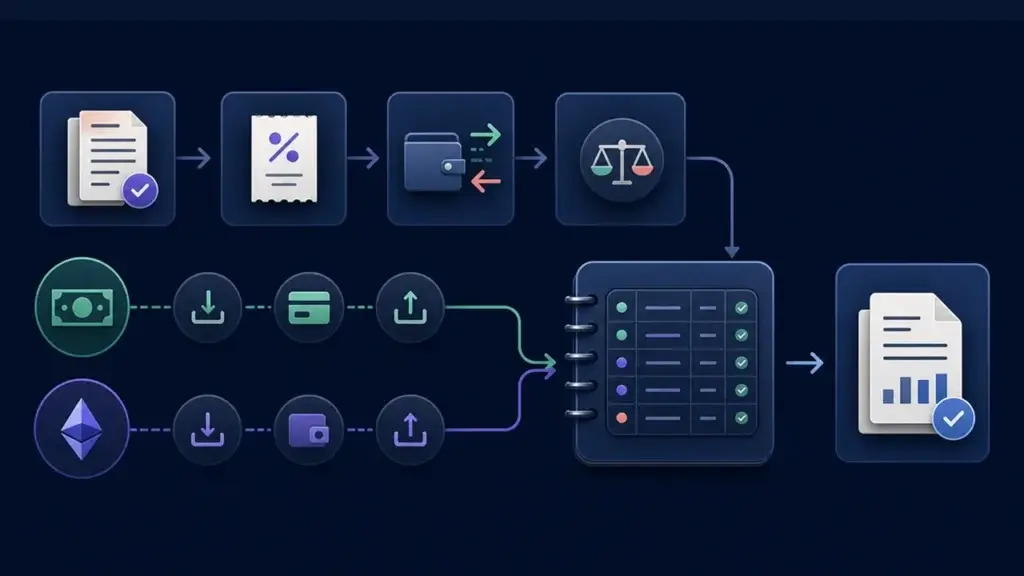
- Export every account and wallet record before access changes.
- Normalize timestamps, currencies, quantities, fees and identifiers.
- Match deposits and withdrawals between owned accounts.
- Reconcile purchases, sales, settlements, voids and open positions.
- Separate event-contract activity from crypto collateral transactions.
- Compare statements and information returns with the transaction ledger.
- Investigate missing basis, duplicate proceeds and unmatched transfers.
- Preserve the source files and an audit trail for edits.
- Give the ledger, agreements and open questions to a qualified preparer.
Open positions need a year-end snapshot even when they have not settled. Record quantity, cost, current statement value, contract status and expected resolution date. The snapshot helps reconcile the next year and gives an adviser the facts needed to determine whether any year-end rule applies.
Keep tax work separate from performance dashboards. A platform's displayed profit may reflect bonuses or estimated values for open positions, while account performance may also be measured against deposits and withdrawals. Platforms may calculate an estimated open-position value using a mark price. Neither that reference price nor the resulting position value necessarily equals tax proceeds or basis. Rebuild the ledger from transactions, then use the dashboard only as a reasonableness check. Document every difference instead of forcing the records to match an unexplained summary.
Anyone comparing a sportsbook transaction with an event contract should first distinguish contracts from sportsbooks. Do not assume similar economic exposure produces identical reporting.
When Professional Advice Is Especially Important
Seek advice when activity is large, frequent, business-related, cross-border, crypto-funded or spread across entity types. Advice is also important when a platform issues an unexpected form, an account changes legal entity, a contract is voided after a prior-year statement or records are incomplete.
Other triggers include foreign accounts, sanctions or residency changes, borrowed funds, partnerships, entities, trusts, retirement accounts, professional trading status and amended returns.
An adviser needs transaction-level documents, not just a total profit estimate. Those records provide the facts needed to analyze the applicable tax classification.
Frequently Asked Questions
Do you pay taxes on prediction market winnings?
Profits can be taxable, but treatment depends on the instrument, platform, jurisdiction as well as taxpayer. Reportable activity can exist even when no cash is withdrawn.
Does a prediction market send a tax form?
Some entities may issue statements or information returns based on the product and year. Users still need to reconcile those documents with their own records.
Are prediction market losses deductible?
The answer depends on classification and taxpayer facts. Do not assume every loss offsets every type of income. Obtain qualified advice.
What tax records should Polymarket users keep?
There is no universal treatment. The answer can depend on whether the user is on the international or US product, the instrument, collateral, jurisdiction plus transaction path. Keep separate records for the event position and every digital-asset movement.
Do stablecoin prediction markets create crypto tax records?
They can. Acquiring, transferring, spending, receiving and disposing of stablecoins may require basis and fair-market-value records in addition to the event-contract result.