


Mt. Gox moved more than $700 million worth of Bitcoin while the market was already under stress, giving traders a familiar reason to ask whether old bankruptcy coins are moving closer to new supply.
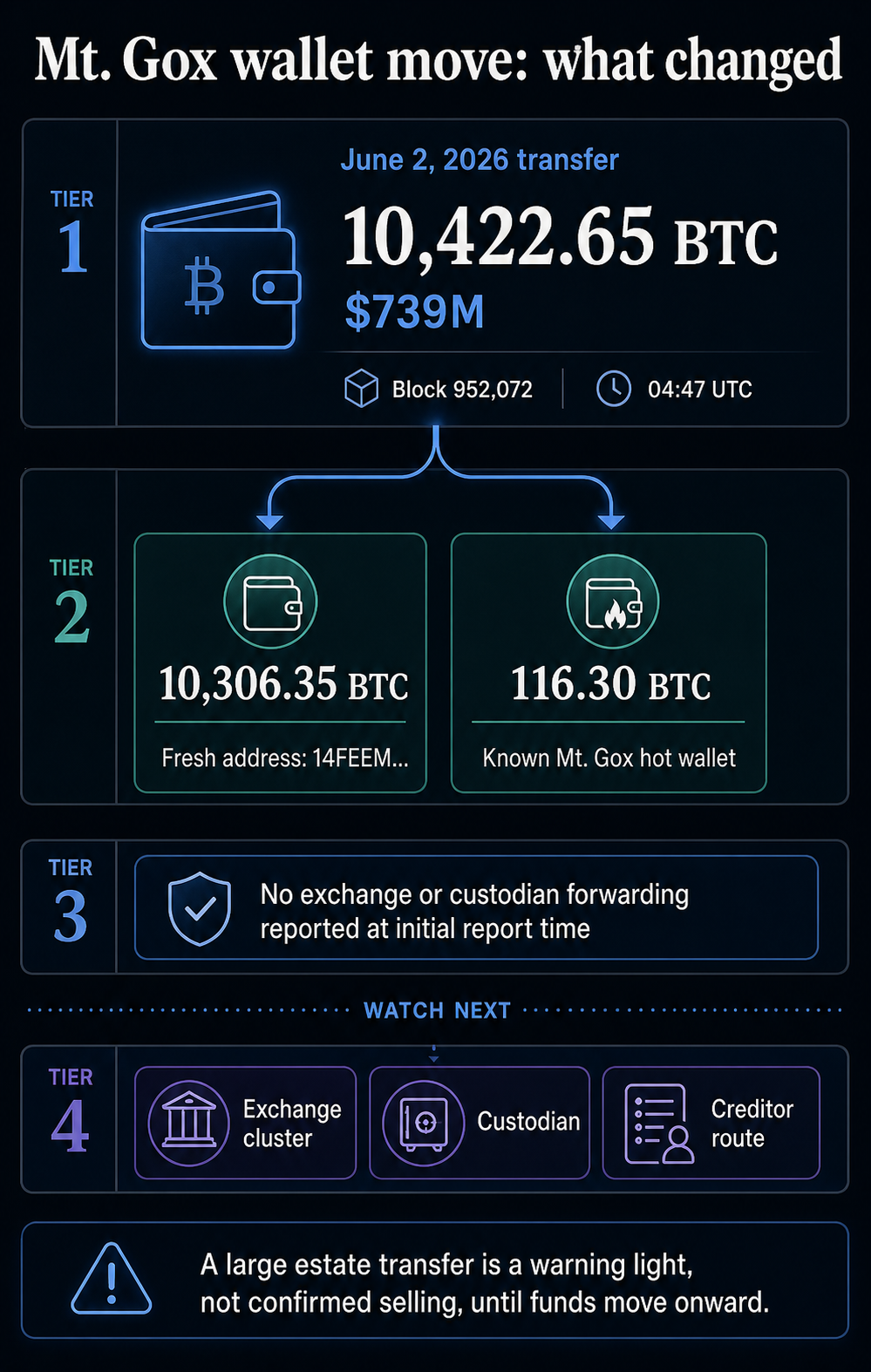
The estate-linked wallets moved 10,422 BTC on June 2, worth roughly $739 million at the time of the transfer. Most of the stack, 10,306 BTC, went to a fresh address beginning with 14FEEM, while 116 BTC moved to a known Mt. Gox hot wallet.
The transfer occurred in Bitcoin block 952,072 at around 04:47 UTC, months before the current repayment deadline of Oct. 31, 2026.
So, it seems that Mt. Gox is active again, while immediate sell pressure remains unconfirmed, as no onward movement to a custodian, exchange, liquidity provider, or creditor distribution venue was reported at the time of the initial report.
The transfer revived an old supply problem
Mt. Gox remains one of Bitcoin‘s longest-running market overhangs because the estate still controls a large BTC balance more than a decade after the exchange collapsed. The June 2 transfer carried weight because it reminded the market that a known pool of old coins can still move with little warning.
The remaining estate balance was reported at roughly 34,504 BTC after the move. The visible activity is split across multiple transfers rather than a single visible sell order, and direct exchange-bound flow remains unconfirmed.
Still, a balance of that size is enough to keep traders watching every large estate-linked movement for signs of distribution.
The official trustee process gives that concern a concrete calendar. In an Oct. 27, 2025 notice, the Mt. Gox Rehabilitation Trustee extended the deadline for several repayment categories from Oct. 31, 2025 to Oct. 31, 2026 with court permission.
The notice said many creditors still had not received repayments because some had not completed required procedures or because processing issues remained.
That language points to a drawn-out process rather than a single clean market event. It also explains why wallet movement can be meaningful before immediate selling is visible.
Coins may move for internal wallet management, repayment preparation, custody setup, or liquidity routing before any creditor receives BTC or any exchange sees flow.
| Signal | What it shows | What remains unconfirmed |
|---|---|---|
| 10,422.65 BTC moved on June 2 | Mt. Gox-linked wallets became active again with a large transfer | A confirmed market sale |
| 10,306.35 BTC went to a fresh 14FEEM address | Most coins shifted to a new destination | Whether the destination is an exchange, custodian, or creditor endpoint |
| 116.30 BTC went to a known hot wallet | A smaller slice moved through familiar estate infrastructure | Whether the larger stack is being sold immediately |
| Repayment deadline sits at Oct. 31, 2026 | The bankruptcy process remains active | Whether remaining BTC will be distributed in one batch or staggered flows |
The next signal is onward routing
The practical threshold is simple: the transfer becomes stronger evidence of sell pressure when the coins move from estate-linked wallets toward venues that can distribute, custody, or sell them.
That is why Arkham's Mt. Gox entity page carries more weight than the headline dollar value alone. On-chain labels, destination clustering, and counterparties can indicate whether the fresh address remains part of the estate's wallet structure or begins interacting with exchange and repayment infrastructure.
The distinction is practical. A large internal transfer can still shake sentiment because it changes market expectations for the timeline. But a wallet reorganization is different from coins arriving at a venue where they can be sold or handed to creditors.
The former is a warning light. The latter is closer to actual supply.
The June 2 routing, as reported at the initial deadline, sat on the warning-light side of that line. The coins had moved, the process was live, and the repayment deadline was visible.
Yet the key downstream signal was still absent: no confirmed move into a custodian or exchange had been shown in the initial reporting.
The market may care about the transfer even without proof of sale, especially during a weak trading window. It still needs proof of onward routing before treating the move as immediate supply hitting Bitcoin order books.
The timing made the movement feel larger. On June 2, Bitcoin fell more than 5% below $68,000, and nearly $400 million in leveraged positions were liquidated within an hour.
That backdrop carries weight because leveraged markets can turn a wallet alert into a sentiment catalyst.
The evidence supports timing, not causation. The Mt. Gox transfer occurred around 04:47 UTC, while the liquidation story describes same-day market pressure.
The cleaner conclusion is that Bitcoin was already vulnerable, and the Mt. Gox movement added another reason for traders to think about supply.
CryptoSlate market data on June 3 showed BTC trading at $66,737, down 3.76% over 24 hours, with $57.34 billion in 24-hour volume.
The broader CryptoSlate coin rankings showed a $2.3 trillion crypto market, $137 billion in 24-hour volume, and 57.9% Bitcoin dominance.
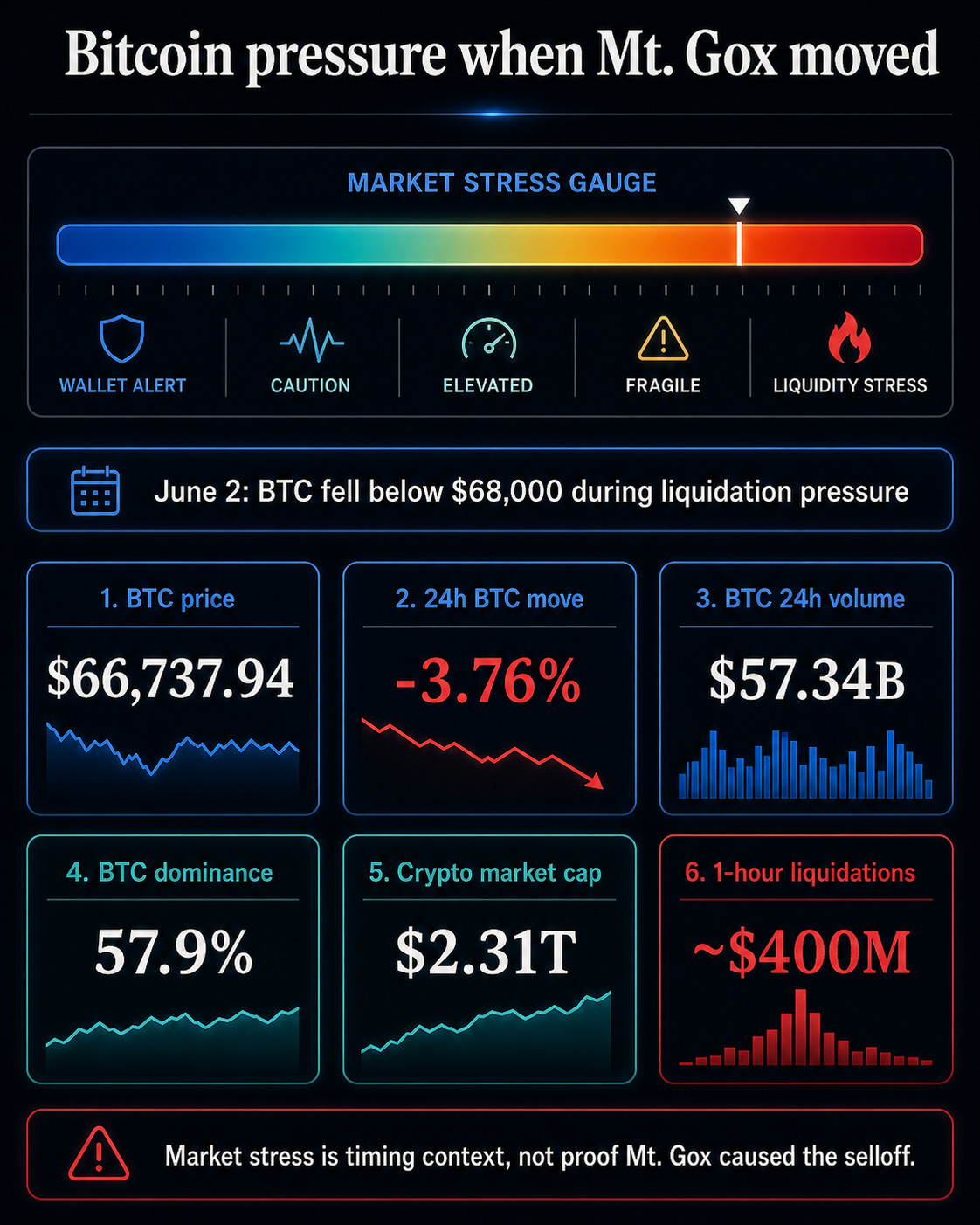
Those numbers cut in both directions. Bitcoin is deep enough that a staggered repayment process does not automatically overwhelm the market.
At the same time, a high-leverage selloff can make any large potential supply source feel more urgent than it would during calmer trading.
That puts the focus on whether a measurable path has opened from the estate to liquid supply. As of the initial reports, that path had not been shown.

Mt. Gox is now a process overhang
CryptoSlate's prior Mt. Gox coverage framed the 2026 repayment extension as a shift from a single-date shock to a recurring process overhang. That remains the best way to read the June 2 movement.
The deadline tells traders when the estate process is supposed to finish. The wallets tell traders whether that process is moving. The exchange, custodian, liquidity provider, or creditor endpoints indicate to traders whether the movement is shifting toward market supply.
Until those later signals appear, the most defensible answer is restrained. The June 2 transfer showed that a bankruptcy estate still holding tens of thousands of BTC is active again, even as Bitcoin is under pressure.
It also left the most important question about sell pressure unanswered.
That distinction is what keeps the move from becoming either complacency or panic. Mt. Gox has enough BTC left to remain a meaningful watch item, and the repayment process has a live deadline.
But the market signal to watch is not the first move into a fresh wallet. It is whether funds move from that wallet toward an exchange, custodian, liquidity provider, or repayment route.

Bitcoin is +1.94% over the past 24 hours and currently sits at rank #1 by market cap.
Mentioned in this article

Editorial credits