
Quick Take
- Crypto corporations contributed $206 million to 2026 midterm spending as the industry seeks durable federal rules.
- The Senate’s Sept. 15 CLARITY vote will test whether market-structure legislation advances.
- Beyond CLARITY, founders want banking access, workable tax rules, and protections for noncustodial software.


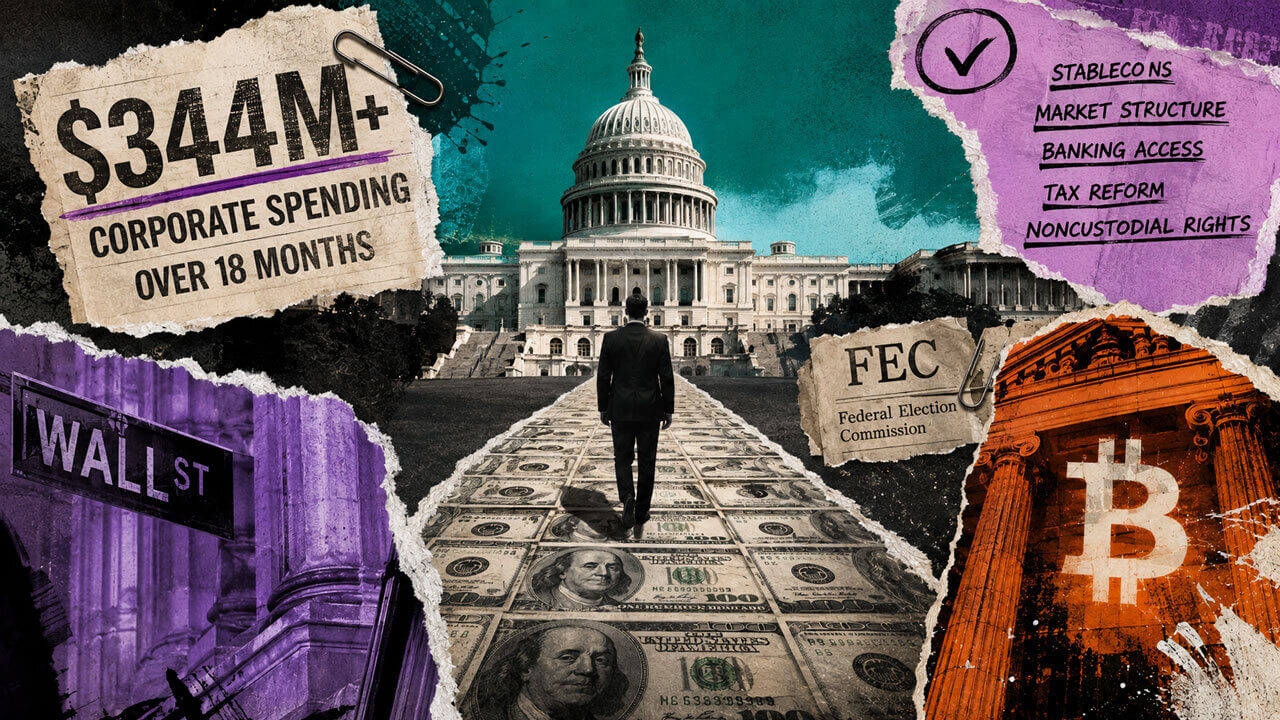
Corporate political donations hit a record $646 million over the 18 months through June, according to Public Citizen's analysis of FEC filings. Crypto political spending led every other corporate sector at $206 million, while crypto, AI, and online betting together accounted for $344 million, more than half the total.
The GENIUS Act already created a federal regulatory framework for payment stablecoins, the SEC is rewriting crypto rules under Chair Paul Atkins, and the CFTC is pushing to bring more digital asset trading onshore. The Senate also faces a Sept. 15 cloture vote on the motion to proceed to the CLARITY Act, a procedural step requiring 60 votes to limit debate.
Three years ago, the industry's Washington agenda was simple: stop regulating through enforcement and say what rules apply. Founders interviewed for this piece describe a different ask now, one that treats today's wins as a starting point Congress needs to make permanent.
Crypto political spending seeks durable rules
Utkarsh Ahuja, founder of Moon Pursuit Capital, said the industry has moved past asking for rules.
He told CryptoSlate:
“Founders are building companies on five- and ten-year timelines, and investors are deploying capital on similar horizons.”
A regulatory framework that can swing with each new administration gets priced directly into where that capital goes. Serious long-term bets are hard to make when asset classification, agency jurisdiction, and compliance requirements could all move again in four years.
Ahuja framed the goal in terms of credibility:
“The US doesn't need to be the easiest jurisdiction for crypto, but it should aim to be the most credible and predictable.”
SEC Chair Paul Atkins said on Aug. 18 that legislation remains indispensable to creating rules “future-proofed” enough that a future regulator cannot simply undo the current SEC's work.
That an administration official and an industry investor are converging on the same point independently gives the durability argument real weight beyond standard lobbying language.
| Earlier crypto agenda | New congressional agenda |
|---|---|
| Stop regulation by enforcement | Make today’s rules durable through statute |
| Define whether tokens are securities or commodities | Lock in SEC/CFTC jurisdiction before administrations change |
| Get a federal stablecoin framework | Keep stablecoin rules open to new entrants |
| Win permission to operate | Gain access to banking, charters and payment rails |
| Protect exchanges and issuers | Protect noncustodial software and settlement infrastructure |
| Make crypto payments usable | Update tax rules for microtransactions and machine payments |
The Sept. 15 vote shapes what comes next
The House passed the CLARITY Act 294-134 in July 2025. The bill would create a system letting the SEC and CFTC jointly regulate the offer and sale of digital commodities, resolving the jurisdictional fight that has defined crypto lobbying for years.
Ahuja, Ryan Kirkley of Global Settlement Network, and Parth Kapadia of OpenVPP all named finishing market structure as their priority, independently of each other.
Whether the Senate clears cloture on Sept. 15 will shape which fight the next Congress inherits.
If cloture clears and the bill later becomes law, market structure could stop being the answer to every question about crypto's agenda, freeing attention for banking access, tax rules, and noncustodial protections.
Fail it, and finishing market structure remains the industry's dominant fight straight through the midterms, with committee control and chamber leadership suddenly carrying much higher stakes for crypto than they did a year ago.
| Scenario | What happens politically | What crypto focuses on next |
|---|---|---|
| CLARITY clears cloture and advances | Market structure looks more likely to be settled before the midterms | Banking access, payment rails, tax treatment, noncustodial protections and implementation |
| CLARITY clears cloture but stalls later | The industry gains momentum but not permanence | Keeping pressure on Senate leadership and preventing the bill from being rewritten |
| CLARITY fails cloture | Market structure remains unresolved heading into the election | SEC/CFTC jurisdiction, asset classification and committee-control fights |
| CLARITY fails after control of Congress shifts | Negotiations may reset under new leadership | Rebuilding the coalition and defending earlier policy gains |
Crypto wants infrastructure access
Kirkley wants federal regulatory sandboxes that let startups test settlement infrastructure under supervision “without needing a megabank's compliance budget on day one,” modernized bank charters, and direct access to payment rails.
He added that “ambiguity taxes every founder building here.”
That means crypto companies want the same infrastructure access banks already have, well beyond a regulator's acknowledgment that they can operate legally.
Kirkley also warned that stablecoin rules need to stay workable for new entrants, since GENIUS implementation could otherwise harden into an incumbent moat and close off the open market it was supposed to create.
Total stablecoin market capitalization sits near $303.7 billion, and 21 financial institutions, including Goldman Sachs, Bank of America, Citi and Deutsche Bank, announced on Sept. 1 plans to launch a jointly owned dollar-pegged stablecoin by early 2027.
BIS chief Pablo Hernández de Cos has separately argued that stablecoins do not yet credibly function as a means of payment at scale, while presenting tokenized deposits as a more promising path. That view reminds us that Washington's stablecoin enthusiasm is not universally shared.
Congress still writes crypto tax law for people
Kapadia's example involves a homeowner's battery enrolled in a virtual power plant, automatically earning thousands of tiny crypto-denominated payments for exporting electricity or responding to grid conditions.
Cynthia Lummis's pending digital asset tax proposal includes a $300 de minimis exemption meant to spare consumers from tracking every small crypto transaction, but it excludes property held for income production.
Kapadia argued that the carve-out excludes households earning automated crypto income from physical infrastructure, since the enrolled battery counts as income-producing property.
His proposed fix is an aggregation rule treating a year of micro-settlements as a single basis event, though how any enrolled battery gets classified in practice still needs confirmation from tax counsel.
Kapadia also wants a federal path for noncustodial settlement platforms, arguing a system that orchestrates payments without ever holding customer funds should not need money-transmitter licenses in fifty states. Congress has already begun addressing this.
The Blockchain Regulatory Certainty Act, introduced by Lummis and Wyden, would exempt developers and infrastructure providers without control over user funds from money-transmitter status.
CLARITY's Senate materials describe similar protections for software developers who never control customer assets. Kapadia's request builds on that foundation, aiming to make those protections durable enough to survive state-by-state licensing fights that recreate the same problem elsewhere.
His final ask involves tokenized assets tied to physical performance, like renewable energy certificates and verified megawatt-hour receipts, which he wants classified on the commodity side of the line.
Tokenized real-world assets have already more than tripled since the start of 2025, reaching nearly $39 billion as of Sept. 1.
Market structure, in other words, also touches receipts for electricity, grid capacity and other machine-measured outputs.
| Policy area | Industry ask | Why it matters |
|---|---|---|
| Banking and payment rails | Modernized charters and direct access to payment infrastructure | Prevents crypto firms from depending entirely on incumbent banks |
| Stablecoins | Rules workable for startups, not only large banks and issuers | Keeps GENIUS from becoming an incumbent moat |
| Federal sandboxes | Supervised testing for settlement and tokenized products | Lets startups experiment without megabank-scale compliance costs |
| Crypto taxes | Aggregation or de minimis treatment for machine-scale payments | Makes thousands of tiny automated transactions economically usable |
| Noncustodial settlement | Federal protection for platforms that never control user funds | Avoids 50-state money-transmitter fights for software-based systems |
| Tokenized physical assets | Commodity-side treatment for verified energy and performance receipts | Extends market structure beyond tokens, stocks and Treasuries |
Whether crypto political spending delivers durable rules
One path has cloture clearing Sept. 15 and the bill later becoming law, giving the next Congress room to work through banking access, tax treatment and noncustodial protections beyond relitigating basic jurisdiction.
Under that path, institutional capital gains the predictability Ahuja describes, and the industry's political spending starts converting into legislation a future administration cannot casually unwind.
Another path has cloture failing, or CLARITY stalling short of full passage, leaving market structure as the industry's dominant fight into a midterm election that could hand committee gavels to different hands entirely.
In that scenario, Ahuja's durability problem stays unresolved, capital keeps discounting US crypto policy for its volatility, and the industry's record political spending buys attention without buying the permanence founders say they need.
Crypto's next fight is over how much of the financial system it gets permitted to help rebuild.
Mentioned in this article


Editorial credits