Quick Take
- Circle’s USDC migration spans 37 mainnet networks, each with its own upgrade authority.
- An 813-logical-qubit circuit record signals urgency, not a reliable Q-day countdown.
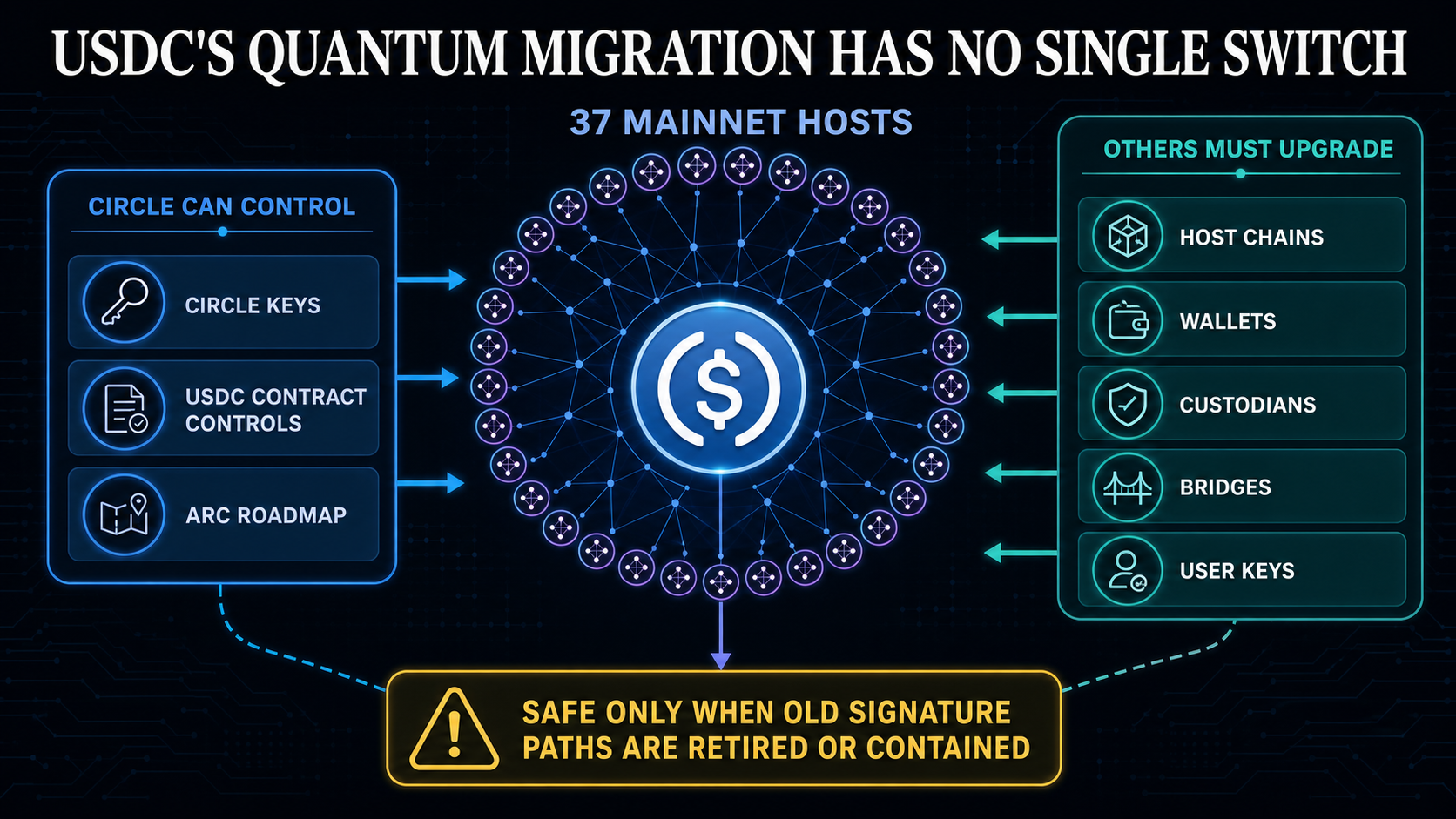
- Circle can harden its own keys and Arc, but wallets, custodians, bridges and host chains must also move.


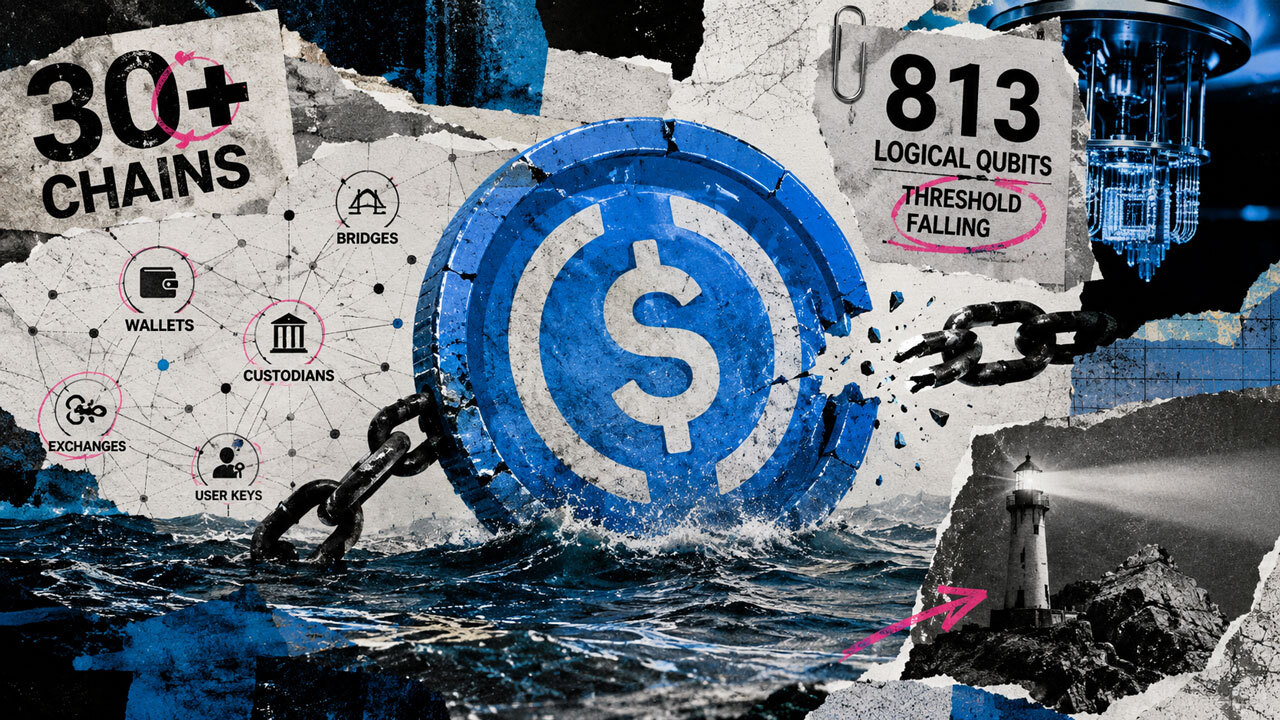
Circle issued a warning that the quantum circuits needed to attack widely used blockchain signatures are becoming leaner, citing a low-width record of 813 logical qubits.
For the USDC quantum migration, the immediate consequence is a dependency problem across every host chain, wallet, custodian, bridge and user account that must eventually accept a safer way to authorize transactions.
Circle's current contract documentation contains 37 mainnet USDC rows. The company can protect infrastructure it controls and exercise token-contract powers on supported networks, but it cannot rotate a customer's private key, rewrite a custodian's signing stack or unilaterally change the signature rules of Ethereum, Solana, XRPL or any other host.
In its Aug. 31 disclosure, Circle told developers to inventory their cryptography, identify vendor dependencies and prepare key rotation. USDC was worth about $73.6 billion on Sept. 2, giving that coordination problem financial scale. A migration that secures Circle's own keys while leaving an old wallet, bridge or base-layer path exposed would not secure the whole footprint.
The 813-qubit figure is one coordinate, not a countdown
Circle describes 813 logical qubits as the August 2026 low-width record on ECDSA.fail. That is evidence that quantum circuit designs are becoming more resource-efficient, but the number is easy to misread.
The public challenge specification optimizes a reversible point-addition circuit for secp256k1, the curve used by Bitcoin and Ethereum. It scores submissions by multiplying peak logical-qubit width by average Toffoli-gate count. A design can reduce width by spending more gates, or reduce gates by using more width. The 813 figure therefore does not describe, by itself, a complete Shor attack, its circuit depth, its error-correction overhead or how long it would run on physical hardware.
A March 2026 paper makes the tradeoff explicit. The researchers estimated that a 256-bit elliptic-curve discrete-log attack could use fewer than 1,200 logical qubits and fewer than 90 million Toffoli gates, or fewer than 1,450 logical qubits and fewer than 70 million Toffoli gates. Their minutes-scale scenario also assumed a fast-clock superconducting architecture, physical error rates of 10^-3, planar connectivity and fewer than 500,000 physical qubits.
Those estimates are a stronger resource model than a width figure alone, but they still do not provide a delivery date for such a machine.
Circle's hardware comparison also needs correction. Its post says Google achieved 105 logical qubits with Willow. Google describes Willow as a 105-qubit processor, while the associated Nature paper describes 105 physical qubits used in a distance-7 surface-code logical-memory experiment involving 101 qubits. That is not the same as 105 attack-ready logical qubits.
The migration case does not need an invented deadline. NIST standardized SLH-DSA in FIPS 205 and says organizations should begin replacing quantum-vulnerable cryptography now. Its 2035 horizon concerns deprecation and removal from standards, not a prediction of Q-day.
The practical trigger is readiness. Networks need enough time to add verification rules, wallets and custodians need tested key-rotation paths, and users need a period in which classical and post-quantum authorization can coexist without splitting liquidity or trapping balances.
Arc is one controllable layer inside a 37-network system
Arc gives Circle a place to design post-quantum support more directly, but its present documentation separates several layers that Circle's disclosure compresses into the phrase “supports SLH-DSA.”
Arc's execution-layer documentation describes a precompile that can verify SLH-DSA-SHA2-128s signatures. A verification precompile lets contracts check that signature type. It does not automatically replace the signature that authorizes an ordinary network transaction.
Arc's custody guide still specifies standard secp256k1 ECDSA transaction signing. Its post-quantum roadmap places opt-in beta post-quantum wallet signatures at mainnet launch and post-quantum validator signatures later. Circle also says Arc has not chosen its final post-quantum transaction-signature scheme and expects hybrid ECDSA support during migration.
Arc can become a proving ground for a hybrid design. It cannot make USDC quantum-safe on Ethereum, Solana or 35 other mainnet rows simply by adopting that design.
USDC quantum migration spans 37 different network paths
Circle's public count is itself moving. Its USDC page says 35 networks as of June 29, 2026 while enumerating 37 names. The current contract-address table is the mainnet anchor used here and contains 37 rows. A separate Circle Mint table reaches 38 only when Arc testnet is included, so Arc testnet is not counted in the inventory below.
The table distinguishes verified signing classes from hosts that need their own cryptographic audit. “EVM path” means an Ethereum-style externally owned account normally uses secp256k1 ECDSA, with its public key recoverable after signing, while a smart-contract account may use contract-defined verification. “Chain-specific” avoids assigning an exact scheme where the cited primary chain documentation does not establish one. The status column records whether the cited material establishes a host-wide post-quantum switch; it does not rule out exploratory work elsewhere.
| Host network | Signing and exposed-key path | Protocol upgrader | Circle-controlled layer | Host-wide migration status |
|---|---|---|---|---|
| Algorand | Chain-specific | On-chain supermajority | Native asset controls vary | No host-wide plan established |
| Aptos | Chain-specific or multi-scheme | Host governance, wallets, custodians | Native asset controls vary | No host-wide plan established |
| Arbitrum | EVM path | Chain governance plus wallet stack | EVM token admin roles | No host-wide plan established |
| Avalanche C-Chain | EVM path | Chain governance plus wallet stack | EVM token admin roles | No host-wide plan established |
| Base | EVM path | Chain governance plus wallet stack | EVM token admin roles | No host-wide plan established |
| Celo | EVM path | Chain governance plus wallet stack | EVM token admin roles | No host-wide plan established |
| Codex | EVM path | Chain governance plus wallet stack | EVM token admin roles | No host-wide plan established |
| Cronos | EVM path | Chain governance plus wallet stack | EVM token admin roles | No host-wide plan established |
| EDGE | EVM path | Chain governance plus wallet stack | EVM token admin roles | No host-wide plan established |
| Ethereum | secp256k1 EOA or smart-account path | Ethereum protocol and wallet ecosystem | EVM token admin roles | Migration research, no completed host-wide switch |
| Hedera | Chain-specific or multi-scheme | Host governance, wallets, custodians | Native asset controls vary | No host-wide plan established |
| HyperEVM | EVM path | Chain governance plus wallet stack | EVM token admin roles | No host-wide plan established |
| Injective EVM | EVM path | Chain governance plus wallet stack | EVM token admin roles | No host-wide plan established |
| Ink | EVM path | Chain governance plus wallet stack | EVM token admin roles | No host-wide plan established |
| Linea | EVM path | Chain governance plus wallet stack | EVM token admin roles | No host-wide plan established |
| Monad | EVM path | Chain governance plus wallet stack | EVM token admin roles | No host-wide plan established |
| Morph | EVM path | Chain governance plus wallet stack | EVM token admin roles | No host-wide plan established |
| NEAR | Chain-specific or multi-scheme | Host governance, wallets, custodians | Native asset controls vary | No host-wide plan established |
| Noble | Chain-specific | Host governance, wallets, custodians | Native issuance module | No host-wide plan established |
| OP Mainnet | EVM path | Chain governance plus wallet stack | EVM token admin roles | No host-wide plan established |
| Pharos | EVM path | Chain governance plus wallet stack | EVM token admin roles | No host-wide plan established |
| Plasma | EVM path | Chain governance plus wallet stack | EVM token admin roles | No host-wide plan established |
| Plume | EVM path | Chain governance plus wallet stack | EVM token admin roles | No host-wide plan established |
| Polkadot Asset Hub | sr25519, Ed25519 or ECDSA accounts | Polkadot governance plus wallets | Asset Hub controls vary | No host-wide plan established |
| Polygon PoS | EVM path | Chain governance plus wallet stack | EVM token admin roles | No host-wide plan established |
| Sei | EVM contract path | Chain governance plus wallet stack | EVM token admin roles | No host-wide plan established |
| Solana | Ed25519 transaction signatures | Solana feature and validator process plus wallets | Token-program authority varies | No host-wide plan established |
| Sonic | EVM path | Chain governance plus wallet stack | EVM token admin roles | No host-wide plan established |
| Starknet | Chain-specific account-contract path | Host governance plus wallet contracts | Native asset controls vary | No host-wide plan established |
| Stellar | Chain-specific | Validator consensus plus wallets | Native asset controls vary | No host-wide plan established |
| Sui | Chain-specific or multi-scheme | Host governance, wallets, custodians | Native asset controls vary | No host-wide plan established |
| Unichain | EVM path | Chain governance plus wallet stack | EVM token admin roles | No host-wide plan established |
| World Chain | EVM path | Chain governance plus wallet stack | EVM token admin roles | No host-wide plan established |
| X Layer | EVM path | Chain governance plus wallet stack | EVM token admin roles | No host-wide plan established |
| XDC | EVM path | Chain governance plus wallet stack | EVM token admin roles | No host-wide plan established |
| XRP Ledger | Chain-specific or multi-scheme | Sustained trusted-validator amendment support | Issuer controls vary | No host-wide plan established |
| ZKsync Era | EVM path | Chain governance plus wallet stack | EVM token admin roles | No host-wide plan established |
The documented examples show why one deadline cannot describe the whole footprint. Solana transactions use Ed25519 signatures. Polkadot supports sr25519, Ed25519 and ECDSA accounts. Ethereum-style externally owned accounts and smart-contract wallets have different migration options even before comparing them with a non-EVM host.
Upgrade authority also differs. An XRPL amendment needs more than 80% trusted-validator support for two weeks. Algorand protocol changes require an on-chain supermajority. Stellar network upgrades depend on validator consensus. None of those decisions belongs to Circle.
Freeze and reissue powers do not rotate a user's key
Circle has important controls at the token layer. Its EVM FiatToken design includes roles that can mint, burn, pause, blacklist and upgrade the contract. Its USDC terms also reserve blocking and service-suspension powers in defined circumstances.
Those controls could help contain an identified incident on a supported contract. Circle might freeze an address where the implementation permits it, stop minting or transfers, and arrange redemption or reissuance under its legal and operational rules. But a freeze does not make a stolen private key safe. It also cannot change the host chain's signature verifier.
The responsible actor changes with the vulnerable key:
- Circle must rotate issuer and contract-administration credentials it controls.
- A user or custodian must move funds from an exposed account using a wallet and host chain that accept the destination signature.
- A bridge operator must protect its own signing and contract controls while coordinating liquidity across both sides.
- A base-layer community must approve and deploy protocol changes.
- Wallet makers, hardware vendors and exchanges must support both old and new signatures during a transition.
The weakest link is therefore not necessarily the chain with the slowest technical proposal. The custodian that cannot rotate thousands of accounts quickly, the bridge whose emergency controls still rely on an exposed key, or the user cohort that never moves before an old signature path is retired are all targets.
A workable rollout would need more than an activation height. Each operator would need an inventory of exposed and unexposed keys, a tested destination account type, hardware and software support for the new signature, and a recovery policy for balances that do not move. Hybrid acceptance would need a defined end state so that classical authorization does not remain an indefinite bypass. Circle could coordinate those milestones for its contracts and services, but each host ecosystem would still decide how and when its own classical path closes.
Migration urgency can be real without a Q-day date
Circle's disclosure is useful because it moves post-quantum preparation into present-tense operational planning. The 813 record shows that attack circuits can improve while hardware teams work on error correction. NIST's standards give implementers concrete alternatives to test.
The disclosure overreaches when it compares 813 logical attack qubits with Willow's 105 physical device qubits as if the two values occupied one scale. It also understates the practical gap between verifying an SLH-DSA signature inside Arc and authorizing, settling and recovering USDC across dozens of independent production networks.
Circle can make its slice of the system more adaptable. It cannot declare USDC quantum-safe across its footprint until host chains, wallets, custodians, bridges and users can all move, and until every remaining classical route is either retired or deliberately contained. That is a migration program with many veto points, not a cryptographic switch.

USDC is 0.00% over the past 24 hours and currently sits at rank #6 by market cap.
Mentioned in this article


Editorial credits