

Quick Take
- Starknet says it is actively considering an independent Layer 1 and targets quantum resistance in 2027.
- StarkWare’s roadmap separates changes within Starknet’s control from bridge and data dependencies inherited from Ethereum.
- An October 11 CoinGlass snapshot showed STRK up 116.7% in seven days, ahead of an October 15 unlock allowing up to 127 million tokens.


Starknet's STRK token more than doubled over seven days while developers considered leaving Ethereum to build an independent Layer 1 blockchain.
A CoinGlass snapshot checked at 20:28 UTC on Oct. 11 showed STRK at $0.1190, up 17.7% over 24 hours and 116.7% over seven days.
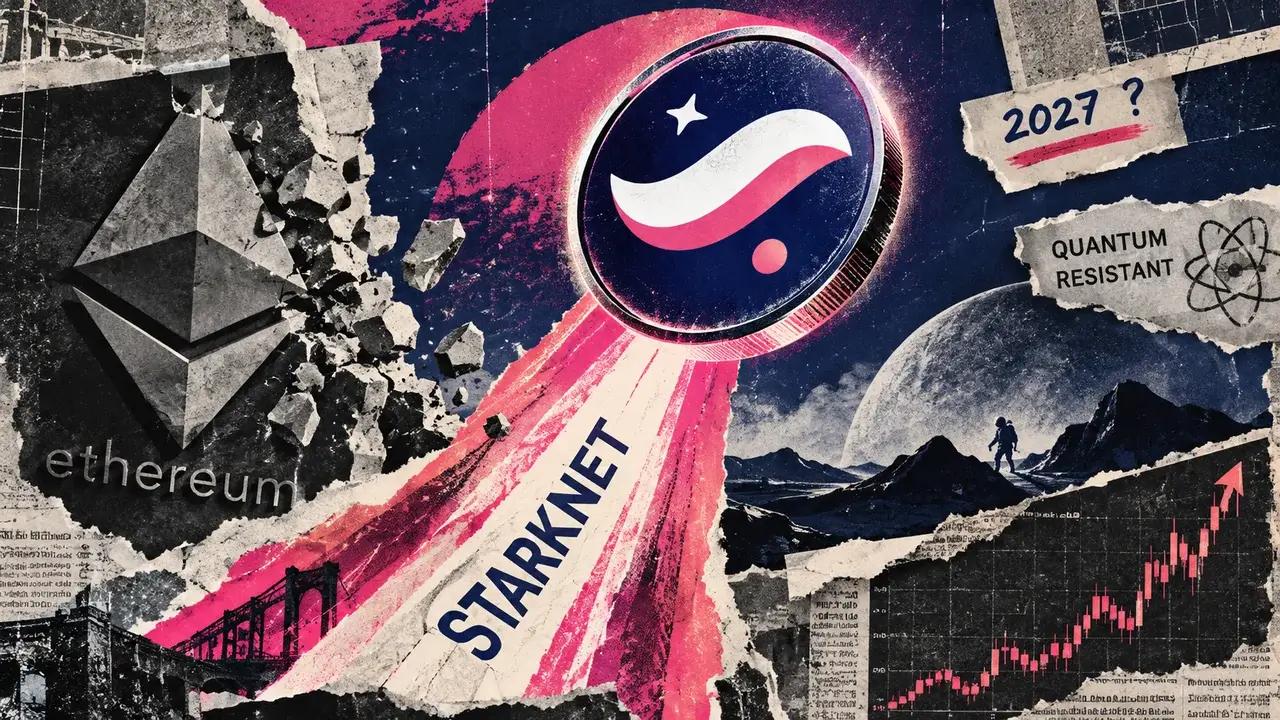
On Oct. 8, Starknet said it was actively considering becoming an L1, with 2027 as its target for what it described as the first fully quantum-resistant network. The proposed move would replace its dependence on Ethereum's underlying security infrastructure.
Starknet considers Ethereum independence to accelerate quantum protection
StarkWare CEO Eli Ben-Sasson has framed the potential transition as a response to growing concerns that advances in quantum computing and artificial intelligence could undermine existing blockchain cryptography.
In an X post, Ben-Sasson argued that the quantum threat could arrive sooner than expected and that increasingly powerful AI added urgency to preparations. The debate follows recent AI-assisted advances in mathematical research.
His argument concerns preparing for a cryptographically relevant quantum computer; it does not demonstrate that AI can already break deployed blockchain signatures.
Starknet's ZK-STARK proof system relies on hash-based cryptographic assumptions rather than the elliptic-curve mechanisms vulnerable to sufficiently powerful quantum computers.
The network also supports programmable accounts, letting users adopt alternative signature schemes without a network-wide upgrade.
In June, StarkWare published a three-phase roadmap covering vulnerable hashing mechanisms, legacy smart contracts and dependencies inherited from Ethereum. The first two phases are within Starknet's control; the third depends on Ethereum's migration.
Starknet currently operates as an Ethereum Layer 2, processing transactions separately while relying on Ethereum for settlement and data availability. Its bridge infrastructure and Ethereum-based data commitments therefore remain exposed to cryptographic dependencies outside Starknet's direct control.
In September, the Ethereum Foundation's Protocol cluster set a December 2029 target for quantum resistance across Ethereum's execution, consensus and data layers.
An independent Starknet would need its own security and settlement model to replace the protections Ethereum provides. The Oct. 8 announcement expresses consideration and a quantum-resistance target, rather than an approved migration timetable.
STRK futures turnover reaches $3.5 billion in 24 hours
In the same Oct. 11 snapshot, CoinGlass data showed approximately $258.5 million in futures open interest and $3.5 billion in 24-hour futures volume. It also reported about $14.8 million in total futures liquidations over 24 hours.
CoinMarketCap data checked on Oct. 11 showed approximately $720 million in 24-hour trading volume against a market capitalization of about $892 million.
The rally comes ahead of an Oct. 15 token unlock. Tokenomist data lists the date, while Starknet's published vesting schedule allows up to 127 million STRK to unlock each month for early contributors and investors through March 2027.
At the Oct. 11 CoinGlass price, the maximum tranche would be worth about $15.1 million and equal 1.27% of Starknet's original 10 billion-token supply. The unlock makes previously restricted tokens transferable; it does not establish how many recipients will sell.

StarkNet Token is +13.58% over the past 24 hours and currently sits at rank #72 by market cap.
Mentioned in this article


Editorial credits