

OpenAI Product Announcement in 2026
Current Odds
5 more outcomes Listed by current odds, highest first
Odds Summary
Earbuds/Headphones leads at 12.5% reported probability on Polymarket.
Polymarket · Last synced
Market Analysis
OpenAI’s Hardware Odds Favor Ambient Access as Taxonomy Drives the Spread
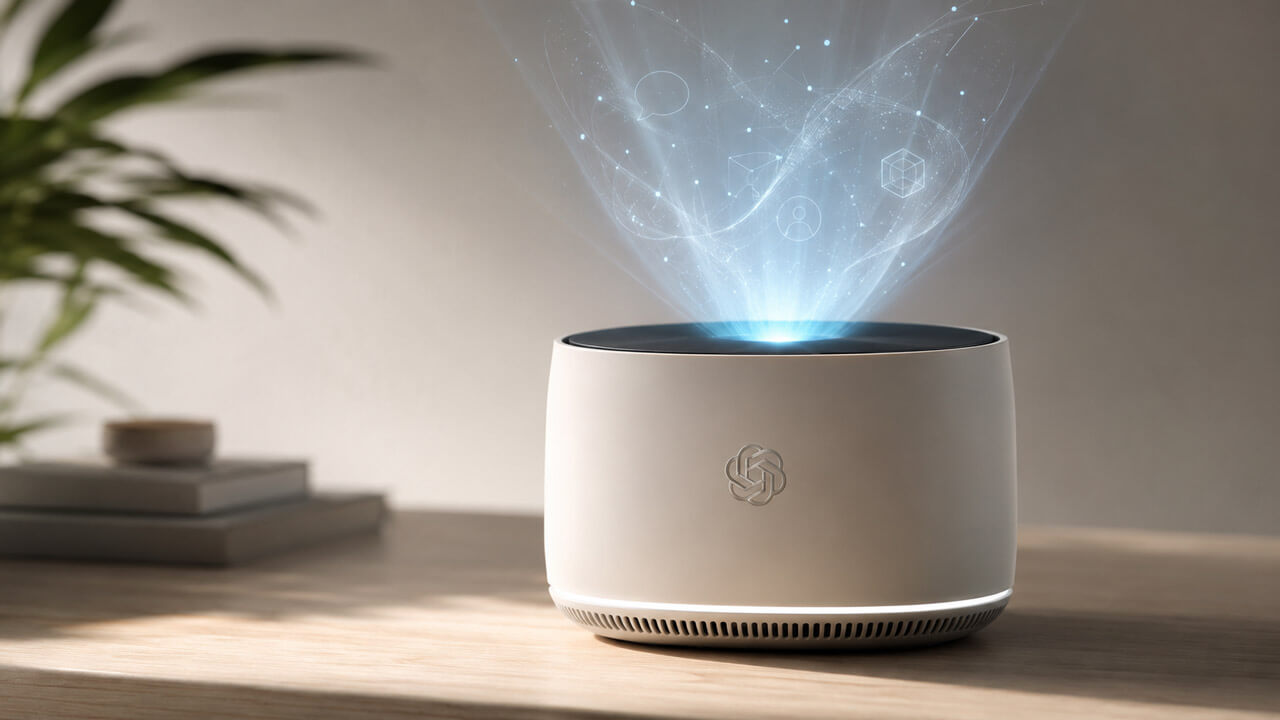
The ranking treats OpenAI’s first device as an ambient AI interface, while the rules leave room for overlapping categories. The decisive evidence will be OpenAI’s own product vocabulary, because current partnerships establish hardware intent and production capacity without identifying the consumer form factor.

The leaders share an ambient-interface thesis
The hierarchy favors hardware that can keep an AI assistant continuously accessible without reproducing a conventional computer. Earbuds or headphones lead at 23%, followed by a clothing clip at 18.5% and a necklace at 16%. Phone sits at 2.9%, while computer and tablet remain below 10%. The market inference is that OpenAI’s design effort will emphasize voice, audio or hands-free interaction and avoid competing directly with mature phone and PC ecosystems.
That inference has intuitive support, yet no sourced specification confirms it. OpenAI’s public materials had provided no consumer form factor as of July 29, 2026. The ranking therefore expresses assumptions about how generative AI should be carried and accessed, not evidence of microphones, cameras, displays or cellular connectivity. Glasses at 12.5% show some allowance for a visual interface, while the 4.2% head-mounted-display price suggests limited conviction in a larger immersive product.
Independent contracts make product vocabulary price-sensitive
The category prices total 114.1%, an important clue because these are separate binary outcomes rather than an exclusive list. The rules ask whether each listed type of consumer hardware is publicly announced by the deadline. A single device described as both a necklace and a clip-on, or several devices announced during 2026, could satisfy multiple categories. The hierarchy consequently contains expectations about naming and classification alongside expectations about industrial design.
This creates a hidden assumption behind the wearable leaders: OpenAI must use recognizable category language. A pendant-like product marketed only as an “AI companion” could create resolution ambiguity unless official images or documentation establish that it is a necklace or clothing clip. Conversely, an audio device with a wearable controller could affect several contracts. The roughly $393,030 in cumulative volume shows sustained engagement with these distinctions, while $23,230 in liquidity and $36,520 in open interest leave the hierarchy exposed to a definitive disclosure.
Ive strengthens the device thesis while leaving form open
OpenAI’s May 2025 acquisition of Jony Ive’s io is the strongest sourced evidence for a consumer-device program. Reuters reported that OpenAI bought the AI-hardware startup, and OpenAI said Ive and LoveFrom would take deep design and creative responsibilities after io joined the company. This supports the assumption that the project has senior industrial-design ownership and may seek a distinctive physical identity.
The evidence gives little basis for choosing among earbuds, a clip, a necklace or glasses. Ive’s involvement can support expectations for a coherent new object, but it does not establish that the object will be wearable, screenless or audio-first. The strongest counterargument to the current ordering is therefore category novelty: OpenAI could present a form that maps awkwardly onto the listed choices, weakening every contract even if the broader hardware program proceeds.
Infrastructure progress confirms capability without identifying the consumer device
OpenAI’s hardware announcements also run through infrastructure. The company and Broadcom announced an LLM-optimized inference chip with deployment beginning in 2026. Its Foxconn collaboration covers design and U.S. manufacturing readiness for next-generation AI infrastructure hardware. These projects show engineering, supply-chain and manufacturing ambition, but the market’s resolution criteria require one of the listed consumer products.
This split matters because “OpenAI hardware” can generate headlines without settling any contract. Infrastructure execution could consume organizational attention or become the company’s main 2026 hardware narrative. A consumer delay past the December 31, 2026, 11:59 p.m. ET deadline would weaken all categories. The opposite interpretation is also plausible: infrastructure investment could support a vertically integrated consumer service, although the supplied evidence does not establish that connection.
A second-half reveal creates a concentrated catalyst window
Chris Lehane told Axios in January 2026 that OpenAI was on track to unveil its first hardware device in the second half of 2026. That statement aligns closely with the market deadline because the rules require a public announcement, not commercial shipment. An official Newsroom post containing a product name, render and category description would provide the clearest repricing event.
Specific hypothetical disclosures would separate the outcomes quickly: an audio-first description would strengthen earbuds; attachment language would favor the clip; pendant or neck-worn language would support necklace; lenses, optics or a visual overlay would support glasses; and a touch display, operating system or cellular positioning would strengthen phone or tablet. A revised timeline extending into 2027, or an announcement confined to chips and data-center systems, would weaken the entire consumer set. Until OpenAI supplies that vocabulary, the current order rests mainly on an ambient-AI design thesis rather than disclosed product architecture.
Sources
What Could Move the Odds?
Market-Implied Thesis
The leading pricing assigns only a modest chance that OpenAI publicly announces earbuds or headphones by the year-end cutoff.
Earbuds/headphones lead the listed form factors, but 15.5% implies the market sees a reveal as possible rather than its base case.
What Could Reprice It
A public OpenAI consumer-device announcement before the December 31 deadline is the clearest repricing event, as it directly determines eligibility.
OpenAI has described AI-native devices as part of its strategy, while prior guidance reported by Axios pointed to a 2026 first-device unveiling.
Where the Market May Be Weak
Reported volume is much larger than available liquidity, so past turnover may overstate the depth supporting current form-factor probabilities.
With $456.27K in volume against $23.86K liquidity, prices can reflect prior trading activity more than current capacity to absorb new information.
Counter-Signal
OpenAI’s September 29 DevDay recap highlighted platform and product updates without a confirmed consumer-hardware reveal, weakening a near-term wearable thesis.
DevDay had been a major announcement venue; its published recap’s lack of an obvious device unveiling leaves less direct evidence for any listed category.
Market Details
- Resolution criteria
- This market will resolve according to "Yes" if the listed type of consumer hardware product is publicly announced by OpenAI by December 31, 2026, 11:59 PM ET. Otherwise, this market will resolve to "No".
- Platform
-


- Category
- Tech › AI
- Scheduled deadline
- January 1, 2027, 4:59 AM UTC
- Market rules summary
- Multi-timeframe Polymarket event. Each listed timeframe is represented by its Yes price on the underlying binary market. View full rules
Frequently Asked Questions
What are the current OpenAI Product Announcement in 2026 odds?
Polymarket reports OpenAI Product Announcement in 2026 odds with Earbuds/Headphones at 12.5%, Clip-on device for clothing at 12.5%, Glasses at 11.5%, and Tablet at 8.1%. These probabilities are market-implied and can change as liquidity and trading activity update. The latest market snapshot includes $456.3K volume, $25.72K liquidity, and $40.12K open interest. CryptoSlate last synced this market data at Oct 21, 2026, 22:17 UTC.
What could move the OpenAI Product Announcement in 2026 prediction market odds?
The leading pricing assigns only a modest chance that OpenAI publicly announces earbuds or headphones by the year-end cutoff. Earbuds/headphones lead the listed form factors, but 15.5% implies the market sees a reveal as possible rather than its base case. Catalysts to watch include Official OpenAI hardware announcement before December 31, Public device announcement by OpenAI, and New information attracting fresh orders.
How does the OpenAI Product Announcement in 2026 prediction market resolve?
This market will resolve according to "Yes" if the listed type of consumer hardware product is publicly announced by OpenAI by December 31, 2026, 11:59 PM ET. Otherwise, this market will resolve to "No". Multi-timeframe Polymarket event. Each listed timeframe is represented by its Yes price on the underlying binary market.
Related AI Markets
 Which AI model will lead Arena on October 19, 2026?
  Which company will lead Agent Arena in October 2026?


 When will OpenAI announce its paused training has resumed?