
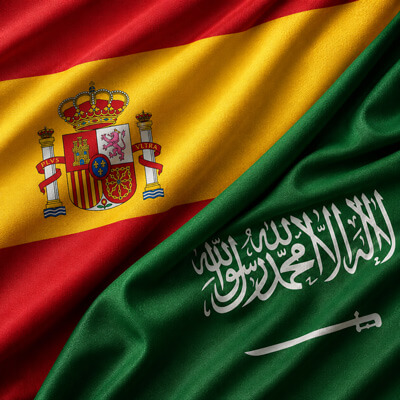
Spain vs. Saudi Arabia
Ended Jun 21, 2026, 16:00 UTC

Market resolution
Polymarket reports Spain as the winning outcome for the Spain vs. Saudi Arabia prediction market with a final probability of 100%. The market closed on Jun 21, 2026, 16:00 UTC. Final reported trading volume was $14.38M.
Final probabilities, volume, and open interest are sourced from Polymarket and were last synced at Jun 21, 2026 7:37 pm.
Spain’s Heavy Favorite Tag Faces the World Cup Draw Trap
The market is leaning on a familiar hierarchy: Spain controls the match often enough that Saudi Arabia needs disruption, fatigue, or a tournament-incentive twist to matter. The analytical tension sits in the draw, which can behave like a separate outcome or a pathway toward a late Spain win.


Spain’s 88.5% Yes price says the market is treating this World Cup fixture as a matchup where baseline team hierarchy dominates most scenario trees. The useful read sits in the structure around that favorite status: the draw at 8.5% acknowledges football’s low-scoring variance, and Saudi Arabia’s 3.8% implies that many disruptive scripts still fail to carry all the way to an outright upset.
Spain’s price requires dominance to survive match friction
As an inference from the listed odds, the market-implied story gives Spain several ways to avoid the two non-win outcomes: territorial control, chance volume, late-match depth, and defensive stability after turnovers. That matters because an 88.5% win price asks the favorite scenario to cover ordinary World Cup frictions, including nerves, officiating events, and a single goal changing incentives.
The structure of a multi-outcome market sharpens that point. The draw is a separate listed option at $0.085, giving a level result a direct claim on the distribution. That matters in football because control and conversion are separate variables. A match can tilt toward one team and still settle level if finishing, goalkeeping, or game-state decisions fail to align.
The draw carries Saudi Arabia’s most credible disruption script
At 8.5%, the draw sits well above the Saudi win price. That gap implies the market expects Saudi Arabia’s better path to be containment instead of sustained superiority. This matters because a low-event match can create pressure on the favorite outcome through clock management, defensive shape, and limited shot quality. A 0-0 or 1-1 style script would validate the part of the distribution that treats time as Saudi Arabia’s main lever.
Saudi Arabia’s 3.8% price places a higher threshold on the outright upset. The path requires several things at once: Spain creates little or wastes chances, Saudi Arabia converts a scarce opportunity, and then the match state holds under pressure. That stack explains why the win outcome sits below the draw; the market seems to respect disruption while assigning limited probability to disruption plus scoreboard control.
| Outcome | Yes price | Market-implied path |
|---|---|---|
| Spain | $0.885 | Control turns into a decisive result |
| Draw | $0.085 | Saudi containment or Spain conversion issues |
| Saudi Arabia | $0.038 | Disruption, finishing, and game-state protection align |
Deep liquidity anchors the hierarchy before team sheets arrive
The market has $628.41K in volume, $1.43M in liquidity, and $351.35K in open interest. Those figures matter because the distribution has enough participation to carry inertia while the match is still far from the June 21, 2026 close at 4:00 PM UTC. In that window, broad priors about relative team quality can dominate because roster health, lineups, and tournament incentives remain unresolved.
The FIFA-linked settlement source and single scheduled fixture also narrow rule ambiguity. That matters because the main sources of movement should come from sporting information instead of contract interpretation: availability, starting XI strength, tactical choices, and the incentive profile created by results around the match.
Tournament incentives can bend a simple favorite script
A hypothetical scenario in which Spain enters the fixture with a favorable tournament position could shift attention toward rotation, tempo management, and tolerance for a lower-risk match. A hypothetical scenario in which Saudi Arabia needs a result could push the market to consider whether defensive restraint gives way to earlier attacking risk. Those cases matter because the same team hierarchy can produce different prices when the reward for a draw changes.
Confirmed squads and lineups are the cleanest catalysts before the close. Any report indicating a lighter Spain XI would test the assumption that quality advantages survive rotation. Any report pointing to a full-strength Spain setup would reinforce the control-and-conversion story embedded in the 88.5% price. Saudi lineup choices also matter because a defense-first setup channels more probability toward the draw, while an aggressive setup increases volatility around both tails.
A compressed match state is the main counter-signal
The strongest failure mode for the Spain-heavy distribution would be credible evidence that Saudi Arabia can keep the match compressed. Slow tempo, limited shot quality, set-piece emphasis, or a red-card or penalty event would attack the assumption that Spain’s superiority translates into multiple scoring paths. That matters because compression reallocates probability first toward the draw and only then toward the outright upset.
For now, the odds tell a coherent causal story: Spain is priced as the side whose ordinary game is enough in most paths, the draw is the channel for football variance, and Saudi Arabia needs both disruption and execution to claim the smallest outcome. Any information that weakens the conversion assumption, changes risk incentives, or compresses expected shot quality would be the clearest reason for the distribution to move.
Sources
Market details
- Resolution criteria
- This event is for the upcoming FIFA World Cup game, scheduled for Sunday, June 21, 2026 between Spain and Saudi Arabia.
- Platform
-


- Category
- Sports › World Cup
- Close date
- June 21, 2026, 4:00 PM UTC
- Settlement source
- fifa.com
- Market rules summary
- Multi-outcome Polymarket event. Each listed option is represented by its Yes price on the underlying market. View full rules
Frequently asked questions
What was the final result of the Spain vs. Saudi Arabia prediction market?
Polymarket reports Spain as the winning outcome for the Spain vs. Saudi Arabia prediction market with a final probability of 100%. The final market snapshot includes $14.38M volume and $4.25M open interest. CryptoSlate last synced the final market data at Jun 21, 2026, 18:37 UTC.
How does the Spain vs. Saudi Arabia prediction market resolve?
This event is for the upcoming FIFA World Cup game, scheduled for Sunday, June 21, 2026 between Spain and Saudi Arabia. Multi-outcome Polymarket event. Each listed option is represented by its Yes price on the underlying market. The settlement source listed for this market is fifa.com.
Related World Cup markets
 Spain vs. Argentina
 France vs. England
 England vs. Argentina