



- Coinbase custody on a negligence standard
- Invesco and Galaxy ether fund
- Creations in cash or ether
Invesco Galaxy Ethereum ETF Overview
- Fund Name
- Invesco Galaxy Ethereum ETF
- Ticker
- QETH
- Listing Exchange
- Cboe BZX
- Fund Family / Issuer
- Invesco / Galaxy
- Underlying Asset
- Ethereum
Additional details
- Exposure
- Spot ether held by the trust.
- Fund Structure
- Delaware statutory trust, not registered as an investment company under the Investment Company Act of 1940.
- Annual sponsor fee
- 0.25%
- Fee Assessment Base
- Daily total net assets, as defined for the sponsor fee.
- Effective Annual Charge
- 0.25%
- Fee Terms Checked
- Sep 24, 2026
- Benchmark
- Lukka Prime Ethereum Reference Rate
- Custody Appointments
- Coinbase Custody Trust Company; Primary ether custodian; Holds the ether as the trust’s property and is liable for losses caused by its negligence, with a duty to replace lost ether.
- Retail Asset Redemption
- Individual shareholders cannot redeem shares for ether sent to a wallet. Authorized participants create and redeem blocks of shares with the trust.
- 30-day Median Bid/Ask Spread
- 0.08%As of Sep 23, 2026Invesco; 30-day median bid/ask spread; Latest published 30-day median; the issuer gives no sampling definition.; Retrieved Sep 24, 2026
- Fund Assets
- USD 24,310,000As of Sep 23, 2026
Market value of holdings
- Staking
- No
- Trust formed
- Sep. 27, 2023
- First exchange trading
- July 23, 2024
- Quarterly report reviewed
- Quarter ended June 30, 2026
- Rating reviewed
- Sep. 25, 2026, ETH methodology version eth-1.1, data cutoff Sep. 24
- Other investor costs
- Bid-ask spread and any broker charges are separate
- Official website
- Invesco QETH fund page
- Research checked
- Sep. 24, 2026
Invesco Galaxy Ethereum ETF Screenshots
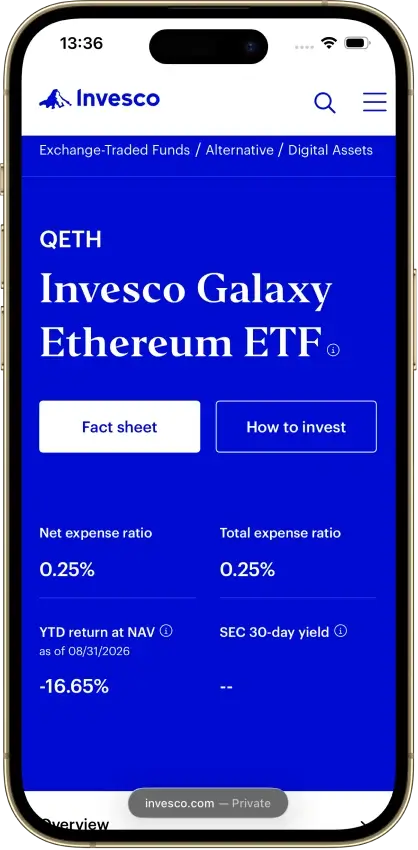
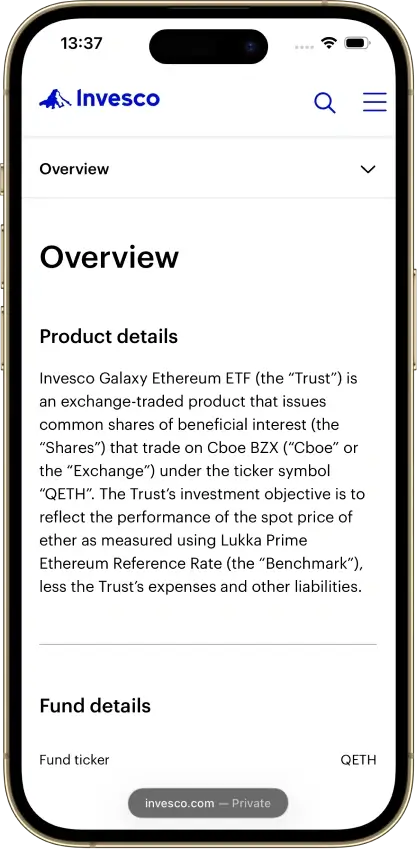
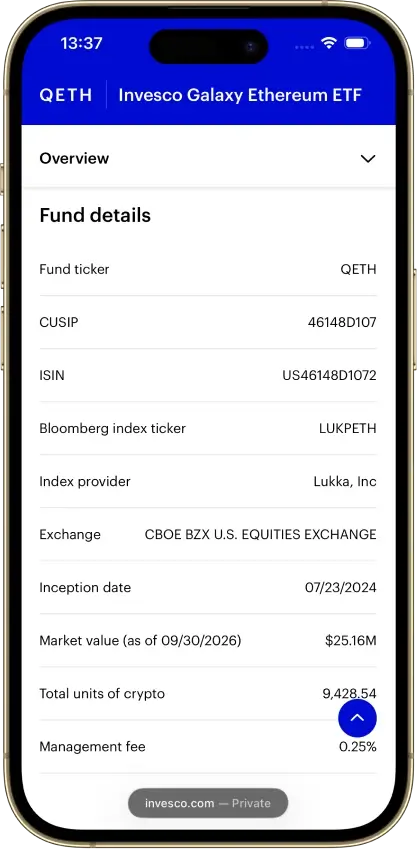
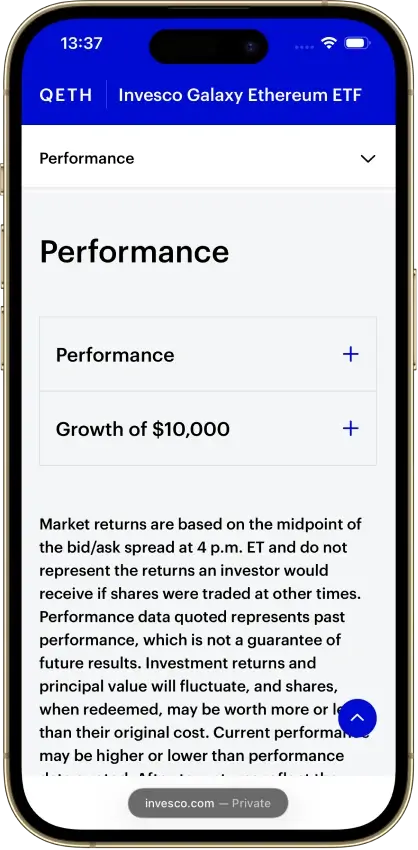
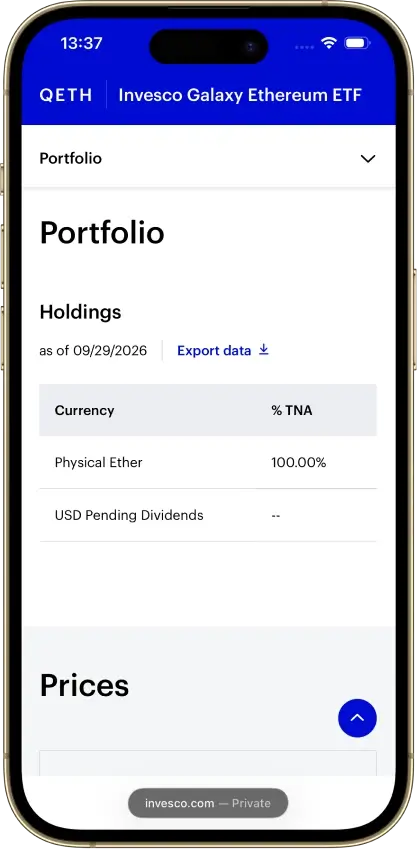
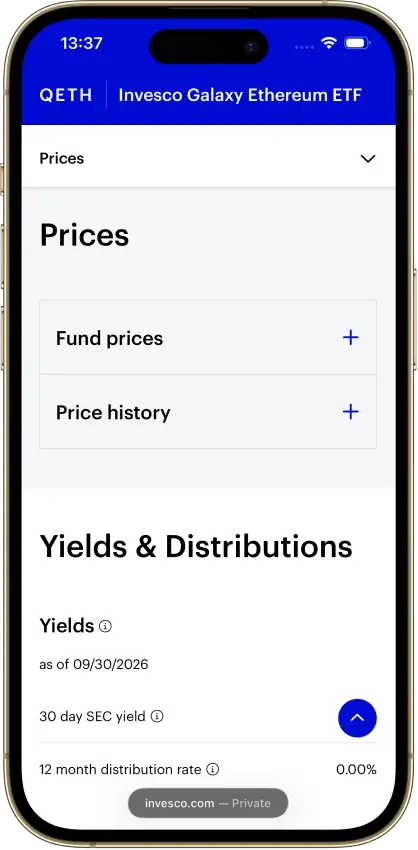
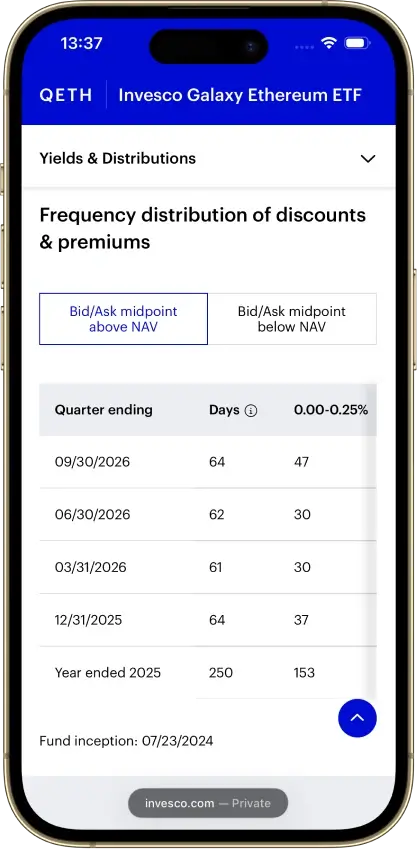
Screenshot 1 of 8
Invesco Galaxy Ethereum ETF Pros and Cons
Pros
- Custodian answers for ordinary negligence
- Reports and disclosures up to date
- No personal wallet or keys to manage
Cons
- No staking rewards
- No ether withdrawals to your wallet
- Smallest fund we rate, at $24 million
Who QETH Is For
QETH fits investors who want ether exposure as a security and are content to leave storage to the fund’s service providers.
| What You Want | How QETH Fits |
|---|---|
| Ether exposure in a brokerage account | Fits, provided your broker offers the US-listed QETH in your account type |
| Exposure without managing ether keys | Custody is handled through the trust instead of a personal wallet |
| Staking rewards on your ether | Does not fit. QETH does not stake |
| Ether to send, spend or stake yourself | Does not fit. QETH shares cannot be transferred to an ether wallet |
CryptoSlate Rating
QETH scores 6.5/10 under CryptoSlate’s Ethereum ETF methodology, version eth-1.1. The assessment uses public fund terms and reported market indicators, with a September 24, 2026 data cutoff.
| Pillar | Weight | Score | Assessment |
|---|---|---|---|
| Costs | 24% | 7.9/10 | Ongoing charge 0.25%, with no waiver in effect. |
| Published spread indicator | 20% | 8.4/10 | Published 30-day median: 0.08%, dated Sep. 23, 2026. |
| Fund scale | 8% | 2.0/10 | $24.31 million in reported holdings, dated Sep. 23, 2026. Funds of $10 million to $50 million score 2. |
| Custody terms | 16% | 10.0/10 | Fund ownership is recorded separately, and Coinbase answers for negligence or bad faith in safekeeping. |
| Reporting | 12% | 10.0/10 | Its SEC reports are up to date and product disclosures are available. Management reported effective disclosure controls at June 30, 2026. |
| Staking | 20% | 0.0/10 | QETH does not stake, so it scores zero here. |
QETH earns full marks for custody and reporting. Size and the missing staking pillar hold it back: at about $24 million it sits in the $10 million to $50 million band, and it scores zero on staking.
QETH’s rating is sensitive to the spread. At 0.07%, one unit below Invesco’s 0.08%, the overall would be 6.6/10. At Fidelity’s published 0.12% on September 22, 2026, it would be 6.4/10.
Staking is worth 20% of our Ethereum score because it changes what a shareholder earns from the same ether. A fund that does not stake scores zero on it and cannot score above 8.0 overall.
What QETH Is and How It Works
QETH holds ether so that its shares follow ether’s price, less expenses. It holds the ether itself and uses no futures contracts.
Shareholders own an interest in the trust. They can hold and trade that security but do not control the private keys to its ether.
Benchmark and How to Check Tracking
QETH values its ether using the Lukka Prime Ethereum Reference Rate, which sets the daily price used to calculate net asset value.
Net asset value, or NAV, is the value of the trust’s assets after liabilities, divided by the number of shares. To check tracking, compare the fund’s NAV return with the benchmark over matching dates. Comparing a closing value with an ether quote from another hour introduces a timing difference that has nothing to do with fees.
Is QETH Safe? Custody and Investment Risks
A fall in ether’s market price can substantially reduce your QETH holding. The exchange listing and the Invesco name offer no protection against that decline.
Who Holds QETH’s Ether?
Coinbase Custody Trust Company holds all of QETH’s ether. The agreement identifies the trust’s custody account and keeps its ether separate from Coinbase’s own assets.
Coinbase is liable where a loss results from its negligence, bad faith, fraud or willful misconduct. That earns QETH full custody marks.
Fund Structure and Regulatory Status
QETH is a Delaware statutory trust and is not registered under the Investment Company Act of 1940. Calling it an ETF does not give it the same regulatory framework as a fund registered under that act.
QETH Fees and Trading Costs
The sponsor fee is one part of what QETH costs. Buying and selling the shares adds costs of their own.
| Cost | What Applies to QETH | What It Means for You |
|---|---|---|
| Annual sponsor fee | 0.25% | Ongoing fund charge, accrued daily and paid monthly in arrears in US dollars |
| Broker charges | Depend on the broker and account | A commission or account charge may apply, separate from QETH’s fee |
| Bid-ask spread | Depends on the current share quote | A wider spread raises the cost of entering or leaving a position |
Applying 0.25% to a hypothetical $10,000 held at a constant value for a full year gives $25. Your costs move with the value of the holding, and trading costs come on top.
No fee waiver applies now.
Buying and Selling QETH
QETH trades on Cboe BZX. Brokerage access varies by account and location. Confirm the fund’s full name and ticker in your account, and check whether fractional shares and your account type are supported.
Share Price and NAV
The share price can sit above NAV, called a premium, or below it, called a discount. When authorized participants create or redeem shares with the trust, the market price tends to move back toward NAV. Check the current bid and ask prices and any broker commission before you trade.
Ether Withdrawals and Retail Shares
Buying a share does not put ether into a wallet you control. Retail investors buy and sell shares on the market. Authorized participants create and redeem blocks of 5,000 shares with the trust. That process gives an ordinary shareholder no way to withdraw ether personally.
Where to buy QETH
Explore broker options for Invesco Galaxy Ethereum ETF.


Robinhood
Trade QETH shares through Robinhood’s U.S. securities brokerage.
U.S. accounts, subject to account eligibility and trading permissions.
Listing: Primary listing (QETH — Cboe BZX). Verified markets: United States. Eligible accounts: U.S. self-directed securities brokerage through Robinhood Financial LLC; check IRA and fractional-share eligibility in your account.

Webull
Trade QETH shares through Webull’s U.S. securities brokerage.
U.S. accounts, subject to account eligibility and trading permissions.
Listing: Primary listing (QETH — Cboe BZX). Verified markets: United States. Eligible accounts: U.S. self-directed securities brokerage through Webull Financial LLC; check IRA and fractional-share eligibility in your account.
Availability depends on country and account.
QETH Alternatives
Holding ether in a personal wallet is one alternative for investors who need to make transfers or control the keys. Investors who want rewards on their ether can look at funds that stake it. Those funds add slashing risk, and part of the rewards goes to the sponsor and staking providers.
QETH vs ETHA
BlackRock’s iShares Ethereum Trust ETF (ETHA) charges the same fee and also earns full custody marks.
| Comparison | QETH | ETHA |
|---|---|---|
| Annual sponsor fee | 0.25% | 0.25% |
| Custody score | 10.0/10 | 10.0/10 |
| Fund assets | $24 million | $9.69 billion |
| Published 30-day spread | 0.08% | 0.05% |
| CryptoSlate rating | 6.5/10, or 6.4 at Fidelity’s 0.12% spread | 7.3/10 |
The two differ on size and trading cost. ETHA is about 400 times larger and has a tighter published spread, which accounts for its higher rating.
References
The rating and supporting fund terms were reviewed on September 25, 2026, using ETH methodology version eth-1.1 and a September 24 data cutoff. Market figures carry their own dates in the rating. The reporting review covers the quarter ended June 30, 2026.
We reviewed Invesco’s fund page, the trust’s SEC filings, including its annual and quarterly reports, prospectus and filed custody agreements, and third-party fund data, checked on September 24, 2026. The assessment covers fund structure, costs and custody terms. It does not include an executed trade or an inspection of private custody systems.
To report an error in this review, contact CryptoSlate.
Ethereum ETF Pillar Scores
- Fund fees 24% weight Ongoing sponsor charge before temporary waivers, fee basis, covered expenses, extra fund costs, and waiver terms.Not disclosed
- Trading spread 20% weight Published 30-day median bid-ask spread, with its source, observation date, and calculation definition recorded.Not disclosed
- Fund size 8% weight Assets attributable to the fund, using a dated figure and a clearly identified asset-value basis.2.0 / 10
- Staking & reward sharing 20% weight Share of fund ETH staked and the share of gross staking rewards retained for shareholders after all reward deductions.0.0 / 10
- Custody & asset rights 16% weight Fund ownership, asset records, custody-loss liability, withdrawal rights, and recourse for provider-caused slashing.10.0 / 10
- Reporting & transparency 12% weight Required reports, public ETH and staking holdings, benchmark, NAV, and management's disclosure-control conclusions.10.0 / 10
Final Verdict
QETH offers ether exposure with full-mark custody and reporting terms from Invesco and Galaxy, at a 0.25% sponsor fee. It is the smallest rated fund in this comparison and has one of the wider published spreads, so trading it can cost more. ETHA charges the same fee with the same custody marks and far more assets. QETH does not stake.
Best For
Investors who want an Invesco-sponsored ether fund in a brokerage account and accept its small size.
Avoid If
- You want staking rewards, the lowest fee, or a large, heavily traded fund.
Disclaimer: CryptoSlate may receive a commission when you click links on our site and make a purchase or complete an action with a third party. This does not influence our editorial independence, reviews, or ratings, and we always aim to provide accurate, transparent information to our readers.