

Quick Take
- Ethereum Foundation is shifting future L1 design toward SHA or BLAKE instead of Poseidon.
- New binary-field proof systems make SHA and BLAKE practical, reversing the old proving advantage Poseidon had.
- Drake said Poseidon is not broken, and Ethereum has issued no migration order or deployed fork.


Ethereum researcher Justin Drake said on Aug. 13 that the Ethereum Foundation is abandoning Poseidon for future layer-1 (L1) designs and pivoting toward SHA or BLAKE hashes after eight years of work on specialized, proof-friendly cryptography.
Drake reported no break in Poseidon and issued no migration order, noting that recent gains in proof systems changed the performance tradeoff that had favored the hash.
SNARKs produce compact proofs that a computation was performed correctly. Many use arithmetic over large prime fields, where the bitwise operations behind conventional hashes such as SHA-256 and Keccak historically imposed a high proving cost. Poseidon was designed to lower that cost by fitting the proof system's preferred math.
Binary-field proofs raise hash throughput
Binius research binary-field construction works naturally with 0s and 1s, closely matching Keccak's bitwise operations. The Flock paper, posted July 29, applies newer techniques to large batches of standard hash computations.
Flock's authors report that one M4 Max core can prove about 82,000 BLAKE3 compression evaluations, 42,000 SHA-256 compressions, and 30,000 Keccak permutations per second. Ten cores exceeded 660,000 BLAKE3 compressions per second, and SHA-256 proving ran more than nine times faster than Binius64 in the paper's comparison.
The proof-of-concept benchmark counts internal hash operations, while Ethereum transaction capacity and production throughput use different measurements.
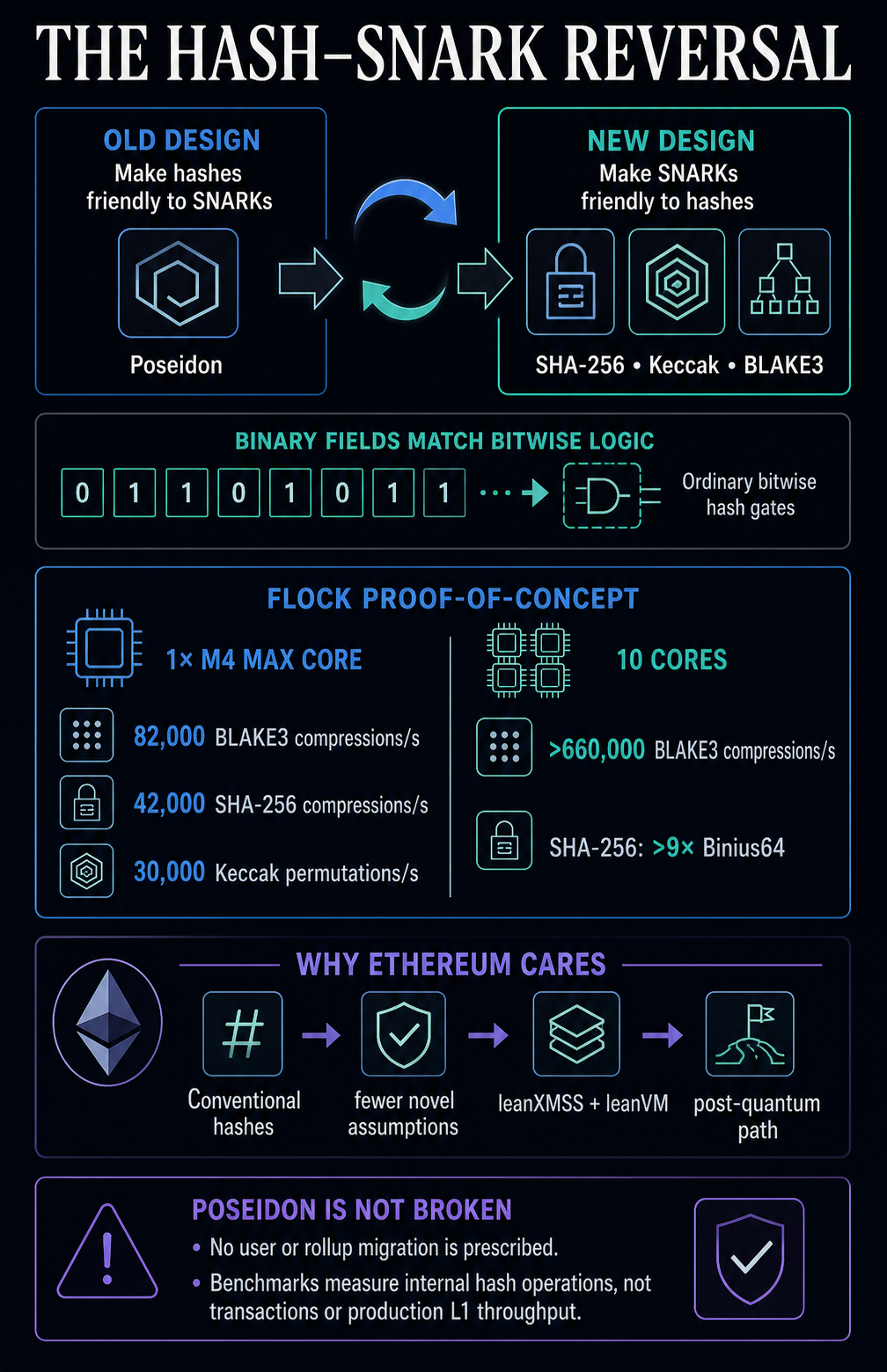
Drake described the advance as a reversal in cryptographic design: researchers have built hash-friendly SNARKs, reducing the need for SNARK-friendly hashes. Conventional hashes can enter Ethereum's design process without carrying their former proving penalty.
SHA-256 is part of NIST's Secure Hash Standard. BLAKE2 has had a public informational specification since 2015, separating it from the newer BLAKE3 implementation benchmarked by Flock.
Years of public analysis give cryptanalysts more time to test its design, and faster proofs now let Ethereum weigh that history without choosing a younger primitive mainly for proving speed.
Ethereum's security roadmap separately identifies protocol simplification as a way to shrink the network's attack surface.
Ethereum plans to replace validator BLS signatures with hash-based leanXMSS signatures, then use leanVM to aggregate their much larger data into compact proofs. Cheap proofs of conventional hashes would remove one obstacle from that architecture.
Drake's personal strawmap places production-grade leanVM around 2027 and deployments across the consensus, data and execution layers in 2028. Ethereum's official post-quantum roadmap gives a nonbinding target of about 2029 for core infrastructure and extends full execution-layer migration beyond that point.
Ethereum's roadmap tells users to leave their wallets unchanged for now, while Drake's announcement calls for no changes to existing rollups or zkVMs and describes no deployed fork. The decision concerns which hash foundations Ethereum may use in a future proof-driven L1.

Ethereum is +2.52% over the past 24 hours and currently sits at rank #2 by market cap.
Mentioned in this article

Editorial credits