
Quick Take
- XRPL’s draft AMM V2 proposes alternative pricing curves that could improve usable trading depth per unit of deposited capital.
- Direct stablecoin pools need no XRP pair inventory, so better execution alone would not establish additional XRP holding demand.
- Review, audit, adoption and actual routed trading would test the proposal, while LP returns still depend on fees and inventory risk.


The XRP Ledger’s proposed AMM V2 overhaul would let creators of automated trading pools choose how those pools price trades, potentially giving traders more usable liquidity for the same deposit. For XRP holders, the potential benefits are better execution and new ways to provide liquidity; additional demand to hold the token would depend on which assets and routes attract capital.
The distinction is visible in today’s pools. XRPSCAN responses retrieved at 13:15 UTC on Nov. 15 showed roughly 25,065 of Ripple’s dollar stablecoin RLUSD and 25,068 of Circle’s USDC in the RLUSD/USDC pool, about $50,133 if both stablecoins are valued at $1. The XRP/RLUSD pool held about 1.94 million XRP and 1.88 million RLUSD.
Those are reserve snapshots, not amounts a trader could exchange at an unchanged price. They also illustrate two different inventory needs: the first pair holds two stablecoins, while the second holds XRP.
CryptoSlate’s XRP page displayed $0.97 when retrieved at 13:15 UTC on Nov. 15, with market data marked as updated eight minutes earlier.
More depth, different inventory needs
An automated market maker, or AMM, lets users trade against a pool whose prices follow a formula. XRPL’s current design uses a constant-product-style curve. Liquidity supports trading across a broad price range, even when the assets usually trade close to one another.
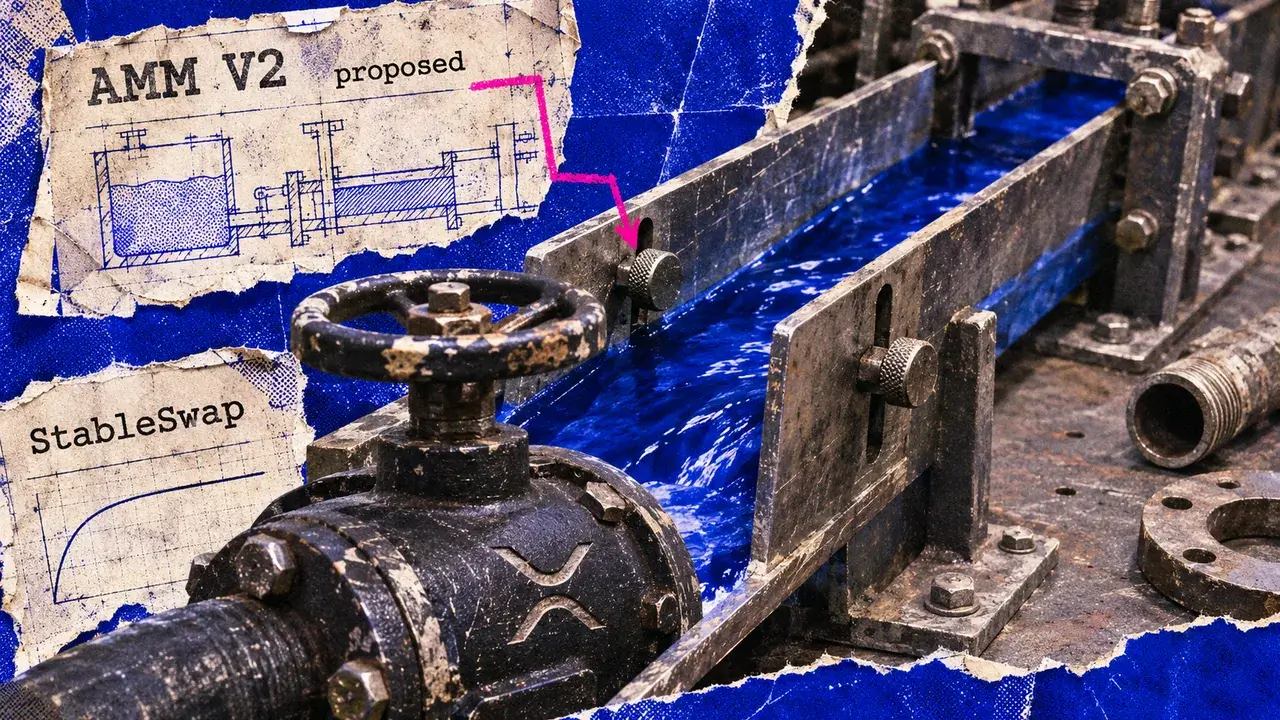
The AMM Swappable Curves draft proposes alternatives. StableSwap would concentrate effective depth near the expected relationship between correlated assets, such as two dollar stablecoins. Concentrated liquidity would let providers allocate capital within chosen price ranges. Binned liquidity would place assets at discrete fixed prices, with execution moving to another price when a funded bin is exhausted.
The economic aim is more executable depth per unit of capital. A stablecoin pool could serve trades near parity with less money spread across distant prices. A provider choosing a narrower range could make the same deposit more useful while that range remains active.
The size of any trading improvement would depend on funding, price ranges, fees, trade size and whether correlated assets remain close in value.
Routing matters as much as the curve. XRPL already combines AMMs and order books. The draft would compare curve offers at each routing step using their actual output after fees at the offer’s size, rather than choosing solely by the displayed marginal price. Any execution comparison must therefore include order-book liquidity and alternative routes, not just these two pools.
A more efficient direct RLUSD/USDC pool could improve stablecoin execution without holding XRP as either trading asset. Users still face XRP transaction costs and applicable account or trust-line reserve requirements. Those requirements are separate from funding XRP inventory in a trading pair; current AMM ledger entries themselves have reserve exemptions, which do not automatically extend to new position entries proposed for AMM V2.
An XRP pair creates a different opportunity because its inventory includes XRP. Even there, capital efficiency cuts both ways. Less XRP could support a given amount of executable depth, while a larger, more active market could attract enough providers to raise aggregate deposits.
Better pool pricing. Conditional XRP demand.
Proposed curves can change how efficiently liquidity works. The assets in each pair determine whether XRP is trading inventory.
Where does XRP enter the trading inventory?
A direct stablecoin pair can provide execution liquidity without XRP as a trading asset.
An XRP pair includes XRP trading inventory. Larger pool balances alone do not establish additional market-wide holding demand.
Better execution can arrive without additional XRP holdings; adoption and persistent funding must be measured.
AMM V2 is proposed. No efficiency multiple, executable quote, adoption forecast or new XRP buying is established. XRP fees and applicable user reserves are separate from trading inventory.
Sources and evidence
Sources
Supporting facts
- Current XRPL AMMs use a constant-product-style formula, while the draft AMM Swappable Curves specification adds concentrated-liquidity ranges, StableSwap amplification for correlated assets, and fixed-price bins alongside existing pools. [1] [2]
- The proposed curves could increase usable depth near an intended trading price for a given deposit, but gains depend on pool funding, price ranges, asset correlation, fees and actual trade sizes. [3] [2] [4]
- A direct RLUSD/USDC pool holds the two issued tokens as trading assets, while an XRP/RLUSD pool holds XRP as one trading asset; the stablecoin pair can therefore improve execution without requiring XRP pair inventory. [5] [6] [1]
- Stablecoin trading still involves XRP transaction costs and user account or trust-line reserve requirements, which are separate from XRP trading inventory; current AMM ledger entries themselves have reserve exemptions. [1] [7]
- The present XRPL payment engine already combines AMMs and order books; the draft chooses curve offers by realized output after fees at the offer's actual size, so reserves alone cannot establish best execution or ledger-wide slippage. [1] [2]
- Greater capital efficiency can reduce inventory needed for a fixed level of depth, while participation could increase total deposits; additional lasting XRP demand would require evidence of more XRP inventory in funded pools or routes, beyond recycled trading volume. [3] [2] [1]
- Execution benefits would be demonstrated by comparable-size routed quotes and fills after fees across AMMs and order books, sustained routed volume and usable depth; LP benefits need realized fees net of inventory losses and costs, while XRP-demand evidence needs persistent aggregate XRP inventory and deposit-flow attribution. [1] [2] [4]
Method
Qualitative mechanism diagram from the draft specification and current AMM mechanics. Lines and circle sizes are schematic, not quoted prices, measured depth or proportional reserves. Pair choices show asset roles, not tested routes.
Scope
AMM V2 is proposed. No efficiency multiple, executable quote, adoption forecast or new XRP buying is established. XRP fees and applicable user reserves are separate from trading inventory.
 CryptoSlate
Higher turnover alone would not distinguish those outcomes. The same inventory can support repeated trades. A stronger holding-demand case would require persistent additional XRP balances across relevant pools and routes, with deposits, withdrawals and swaps separated so reserve changes are not mistaken for fresh buying.
Fee income also belongs to liquidity providers rather than all XRP holders. XRPL’s documentation describes relative-price and arbitrage risks. Concentrated liquidity adds range management: Uniswap’s explanation shows how a position can become entirely one asset and stop earning fees outside its range. More efficient capital is not automatically more profitable capital.
The tests before a demand claim
AMM V2 remains proposed work. The discussion opened in May, and the Foundation’s feasibility page was updated Nov. 4. Its roadmap lists rebasing and reopening the implementation pull request, then review and audit, as next steps. Activation requires validator approval. The current specification gives binned pools a separate amendment gate from concentrated liquidity and StableSwap.
The Foundation’s Nov. 4 assessment said no issuer, wallet, exchange or DEX front end had publicly committed to using the pools.
For XRP holders, persistent inventory tied to additional funded use would strengthen the demand case, but larger pool balances alone could reflect capital moved from elsewhere. Better execution could arrive before any additional holding demand is demonstrated.
Mentioned in this article



Editorial credits