
Quick Take
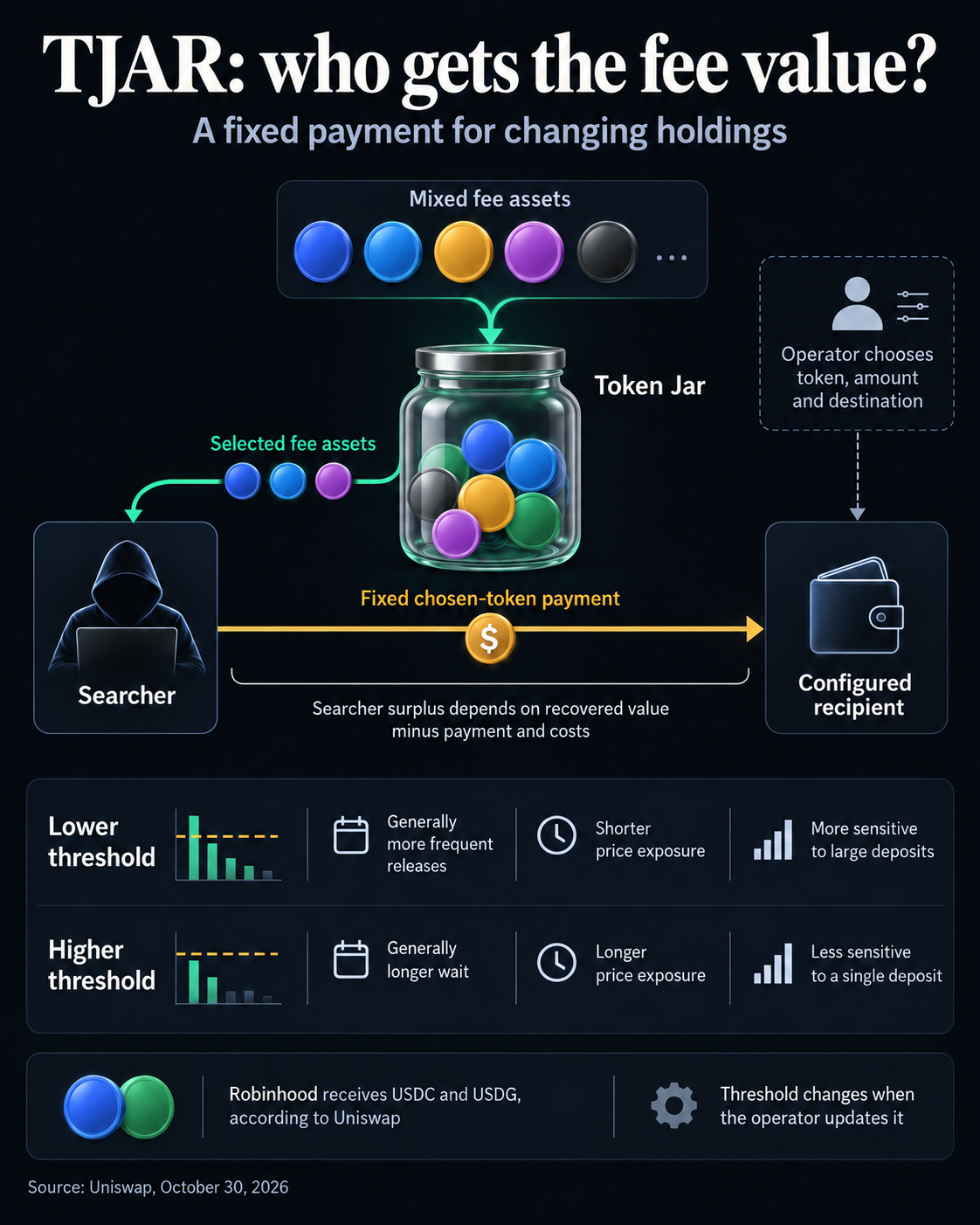
- Uniswap says Robinhood already receives Uniswap API fees in USDC and USDG through its TJAR converter.
- Outside searchers pay a fixed token amount for selected fee assets, seeking surplus after execution costs.
- Lower release thresholds can accelerate receipts but leave more value for searchers when large fee deposits arrive.


Uniswap outlined on Oct. 30 how its Token Jar (TJAR) fee converter lets outside traders buy accumulated fee tokens for a fixed payment.
Uniswap opened TJAR to other apps on Oct. 29, saying Robinhood already uses the system for fees collected through the Uniswap API across its supported chains and receives USDC and USDG.
Those stablecoin receipts come from traders known as searchers, who exchange the required payment for fee assets held in an on-chain Token Jar. The arrangement sends the chosen token to a configured destination while leaving searchers to assess whether the assets are worth taking.
A Token Jar holds incoming assets, while a Releaser contract specifies the payment token, amount, and destination. The app’s operator chooses those terms.
The developer documentation says a searcher pays the full release amount even when selecting only some assets, and receives the entire balance of each asset it names. Anything unselected remains in the jar, and the payment goes to the operator’s configured recipient.
The jar does not value its holdings, and no price oracle automatically adjusts the payment, so asset balances and market prices can change while that amount stays fixed.
Searchers have an incentive to act when the recoverable value exceeds the payment and execution costs. Competition can narrow that margin, but the mechanism does not guarantee a profit.
Robinhood’s stablecoin setup differs from Uniswap’s protocol-fee deployment, which uses UNI sent to a burn address. TJAR lets other operators choose their destination.
The documentation currently says TJAR’s optional protocol fee is unset, although the Uniswap DAO controls that parameter.
Uniswap's faster receipts have a trade-off
Uniswap’s Oct. 30 pricing explanation says a lower release threshold generally lets jars clear more frequently, shortening exposure to token-price movements. However, a large deposit can suddenly push the holdings well above the fixed payment.
Its hypothetical example starts with a jar holding $950 of assets and a release price of 1,000 USDC. A $500 fee deposit takes the holdings to $1,450 without changing that price, so the resulting gap can reward the searcher at the operator’s expense.
A higher threshold makes individual deposits less significant relative to the payment, but generally leaves assets waiting longer before conversion. The operator balances frequent receipts against price exposure and the surplus available to searchers.
Mentioned in this article



Editorial credits