
Quick Take
- PGPZ’s Oct. 20 letter asks the SEC to accept targeted evidence without exposing issuers’ unrelated financial activity.
- The SEC proposal already includes limited exhibit redactions, but broader privacy instructions remain a request for the final rule.
- Transaction-validity proofs do not establish spending, and PGPZ says material holdings, preferential terms and conflicts must remain disclosed.


A Zcash policy group is asking the SEC to let token issuers substantiate their fundraising claims without exposing unrelated wallet activity, giving Chairman Paul Atkins’s earlier financial-privacy arguments a concrete test in the agency’s proposed disclosure regime.
Pretty Good Policy for Zcash (PGPZ) argues in its Oct. 20 submission that evidence should answer the claim investors need checked.
It says proving that a transaction obeyed a network’s rules does not establish how an issuer spent investor money. Accounting records or other financial evidence may still be needed.
Atkins discussed the policy ambition behind this approach in remarks on Dec. 15. He described zero-knowledge proofs, selective disclosure and wallet designs as tools for demonstrating compliance without surrendering an entire financial history.
He also expressly said his views were his own and not necessarily those of the SEC or other commissioners.
PGPZ wants a public account of material holdings and conflicts alongside supporting evidence that does not expose unrelated financial activity, and it asks the SEC to make that approach explicit.
As of Oct. 26, the SEC docket still labels Regulation Crypto Assets a proposed rule, with its October 20 comment deadline now past. The letter’s suggested protections are requests for the final text, rather than an adopted compliance route.
What founders would have to disclose
The proposal, issued Aug. 18, would create a startup exemption for offerings of up to $5 million over four years and a fundraising exemption for up to $75 million over 12 months.
Eligible issuers would receive a tailored route around securities registration requirements, with disclosures and federal antifraud and antimanipulation provisions still applying.
Rule 103 would supply narrative disclosure requirements for issuers using those exemptions. Paragraph (b)(7) covers material token economics and allocations: supply, pricing, lockups, distribution methods, related-person holdings and release schedules.
It also covers mechanisms for generating and destroying tokens and methods to verify their transaction history.
Other provisions address the intended use of offering proceeds, management, related-person transactions, and conflicts. Related persons’ transfer or resale restrictions would also have to be described.
Rule 103(a) would also allow disclosures tailored to the issuer’s circumstances. It says disclosure need not be provided where a requirement is inapplicable or responsive information is unknown or not reasonably available.
A description of token supply says little about the investment bargain if it leaves out material insider allocations or conflicting interests.
PGPZ’s submission isolates a narrower issue inside it: how much underlying financial activity must become visible to make an issuer’s account meaningful.
PGPZ asks for an instruction that expressly allows accounting records, cryptographic proofs, and selective disclosure of relevant records. Issuers would explain what the chosen method verifies and its limitations.
A transaction can satisfy the network’s rules while leaving unanswered the issuer-accounting question of how investor funds were used.
PGPZ says accounting records or other financial evidence may be necessary for that claim, so privacy technology would sit alongside conventional records, with the evidence chosen to fit the assertion.
The group wants the SEC to distinguish what investors need in public disclosures from supporting records that an auditor or regulator may need to examine. Its request expressly preserves applicable audit standards.
That would make the audience for the evidence part of the design, alongside what the evidence proves.
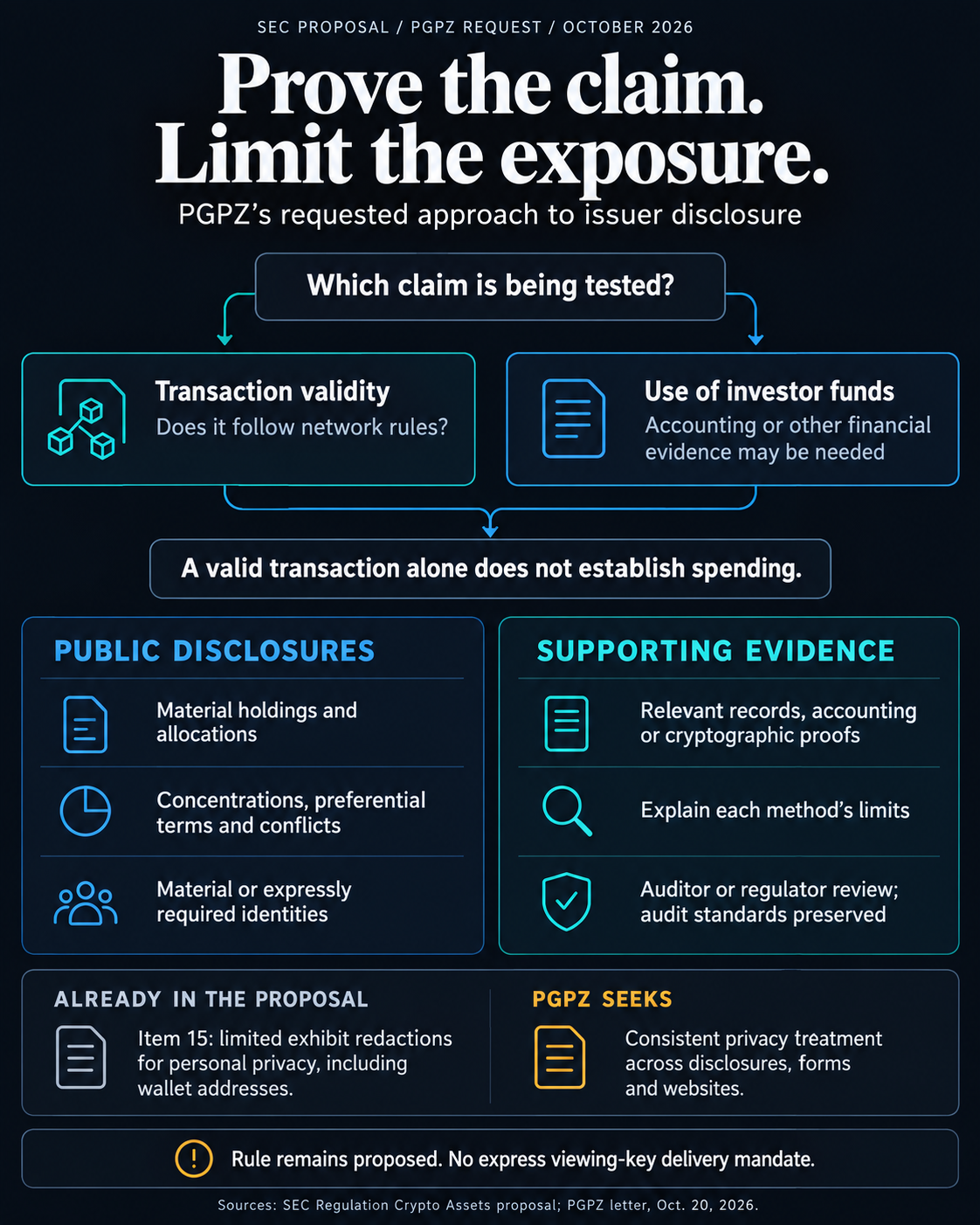
PGPZ warns that a key can expose extensive financial activity even though it cannot spend funds. It asks for narrower evidence instead of making key access the default, and for clarification against requiring complete public histories or viewing and spending keys.
Rule 103(b)(7) contains no express viewing-key delivery requirement, and the letter seeks clarity about how the proposed verification language would be satisfied.
Zcash group notes where privacy protection meets public disclosure
The instruction to Form 1-CRYPTO Item 15 would permit redaction of required exhibits where disclosure would constitute a clearly unwarranted invasion of personal privacy. Crypto wallet addresses are expressly among its examples.
PGPZ asks the SEC to apply it consistently to Rule 103 disclosures, related forms and websites.
Item 15 includes a separate route for redacting specific terms in paragraph 6 or 7 exhibits when the issuer customarily and actually treats the information as private or confidential and the omitted information is immaterial.
The instruction requires identifying the omission and using brackets to show where information has been removed. Commission staff could request an unredacted copy and the issuer’s supporting analyses, then require inadequately supported redactions to be restored.
The protection would therefore limit public exposure without placing the underlying records beyond regulatory scrutiny. It also would not establish a general right to remove material narrative disclosures elsewhere in the framework.
The final instructions would need to address the consistency of PGPZ requests.
PGPZ accepts aggregate amounts and narrative descriptions where they adequately explain holdings, relationships and transactions. Its condition is that they must not conceal material concentrations, preferential terms, or conflicts.
Where a person’s identity is material or expressly required, the letter says to disclose identity while omitting unnecessary financial identifiers.
Leaving out an unnecessary wallet address could protect unrelated activity. The letter’s condition is that investors must still learn about material relationships, concentrations and conflicts.
Rule 103 would attach to issuers relying on the proposed exemptions. PGPZ maintains that Zcash is not a security and expressly does not assume that a Zcash ecosystem organization would need those exemptions or the safe harbor.
If the SEC adopts the regime, its treatment of verification methods and privacy across disclosures will show how far the Commission carries that ambition into issuer requirements.
The test is whether founders can protect unrelated financial activity while still giving investors a credible account of their holdings, conflicts and use of funds.
Mentioned in this article


Editorial credits